⌕
··
It's hand now. Hey, we are, we are live. Hey, welcome to, uh, to beta episode one. We did beta episode zero double o last week. This is beta here with the church digital podcast. I am Jeff Reed and of course once again joined by Ray D'Armis. I'm guessing Ray you want to say hi to somebody?
··
Uh, hello to everybody out there that is sending their kids back to school today, specifically in South Florida. We are with you. Oh my goodness, man, good luck to all of you. Yeah, traffic was interesting. Um, needless to say that I was kind of enjoying having like peace and quiet in my morning drive and all that is now gone. Thank you very much for that. But we, we don't need to talk about like Miami traffic or wherever you are traffic. We want to, we want to talk about your question. So beta, this is a new thing for us here with the church digital and of course we have got the podcast. We've done uh almost 100 episodes with coming up on our 100th here in a couple weeks. But we wanted to move away from heady theoretical philosophical conversations and try to get more practical in the midst of COVID season. Try to find some sort of practical application even in the midst of all of this chaos. So to this end, we're doing this live stream here. Beta. Here's what we want to do. We're going to get to the topic here in a second, but moving forward, if you've got questions on church online, on digital church, on online discipleship, on physical church, on digital church planting, any of this sort of thing involving ministry in digital space, uh, avatar space, even talk some virtual reality stuff. Hey, we want to hear those questions. As my dog barks, I love Ray. I love you too, Ray. And the other way. Uh, text your questions to for the church. Just make this 484-324-8724. 484-324-8724. Even weirder. That's why I love live because stuff like this is gonna happen. So hey, Ray, why don't you just kick off here a little bit and just talk a little bit about what we're gonna hit on this episode?
··
Yeah, you know, we had some great questions, uh, specifically from down in the Keys. And I thought it was pretty awesome to see some of this. Uh, I know Jeff, you and I both had some time ministering to some of the folks down there. Uh, and for those who don't know, there's a lot of churches down there that are smaller churches that are trying to experiment and do church online. Uh, what was pretty awesome was we got a series of questions as they're looking to reopen, as we're looking to get things started as far as how they want to continue to do church online in that space. And so as we kind of carry this forward, we're going to go through some of the questions that were offered to us, uh, right?
··
And so that is awesome. Yeah, and so yeah, we wanted that. We wanted to hit into this in hats off for our friends in Isla Morada. Basically opening up in this series of questions kind of encapsulating this idea: how do we do a creative digital church service and a physical church service at the same time? And so we hit end that a little bit. Oh my gosh, that's even last week's. This is a train wreck and this is live. I love it. Hey, let's get to the first question. Hey, Ray, like we need to check the slides in advance so we can delete them so like the inner spheres don't see me screw up in a massive way. That probably would have been good, but that's on me.
··
Hey, is it more effective to create a church service exclusive for online or to live stream a physical service? Is it more effective to create a church service exclusive for online or live stream that physical service, right? You want to take the first shot?
··
Yeah, I'm a bigger fan for exclusive for online, um, for so many reasons. Number one, you're talking to a specific audience and you're creating a unique experience. It's just for them. It's catered for them. Also, just keeping in mind something as basic but as important as the length of a service. We're much more forgiving in person than we are walking through screens. That's just the reality of the situation. Many of you will watch, uh, you know, even an hour message live and in person and jog along with your pastor. But when you are either listening to the podcast or whether you're watching it through a YouTube channel or something else later on, especially the smaller the screen gets, the less length of time that you're willing to forgive. So I'm a bigger fan of catering the specific experience for the online audience.
··
Yeah, I, I would agree with that. Try to create that that online experience, even if it's things like a host talking, a campus pastor, one of the pastors talking direct to the to the online audience. Maybe it's a sermon where the pastor is looking direct at that lens and engaging with it at a way that maybe that pastor is not able to do when he's trying to preach to to an entire room. There's an opportunity to really dig in to that online environment. Now keep in mind, and this is where the COVID season really just gets messy for us, because pre-COVID you had physical audience and you had digital audience and and sometimes they overlapped, but for the most part it was kind of kind of separated. Now here, COVID, mid-COVID, post-COVID, coming out of it, wherever we are in the season, we're seeing people try to go back to the building, but a lot of our physical audience pre-COVID is still watching online. So just keep in mind that you're going to have these mixed, these hybrid, uh, kind of services towards that. And in our ones, our people who are called to Christ, they're not looking for that 60, 70 minutes service, that 40-minute sermon. If if you're really true trying to dig into evangelism, you're that's not the presentation that the online people are looking for that are called to Christ. So create that that shorter, that more succinct environment, which is actually going to lead us here into question number two.
··
Question number two: is it easier to get better engagement in five to 15 minute segments rather than a full 40 to minute service? So we're talking engagement, two-way conversations, chat, uh, likes, comments. Uh, Ray, what are you thinking off of that, man?
··
I got a hot take here. Uh, so good content is good content no matter what the length. That's that's my hot take. So and and I think that's gonna require a lot of honest feedback, especially to you content creators, pastors specifically that are writing your messages. So you might might want to make sure and kind of pitch a few people to make sure that all 40 to 60 minutes of that content is truly engaging because if it's not, guess what? It can be chopped up into those five to 15-minute bits and redistribute it on social media or even in your online service. Shorten it up. It's okay to trim it down to the best of the best of it. That's totally fine. Uh, in the same way that when you go to a high-end restaurant, you know, you're not getting like six sides with your main course. No, you have to order every piece that you truly want. Why? Because it's gonna be the best of the best. That steak is gonna be the best version of it. They don't need to dress it up with extra sides because they know they're serving you something that's quality and A1 directly off the bat. And so it's gonna take a lot of hardcore feedback, but if your content is truly engaging, just like, hey, Avengers: Endgame. Yeah, we sat there for three hours. For three hours. Why? It was great. And because we knew what we were going to and we would have sat there for four because we believed it was going to be that good. But you know, for our messages, we got to reconsider. Yeah, pastor, that is not an excuse to preach a three-hour sermon. Don't don't write that down. Those guys on that crazy thing where they screwed up the first slide, they said we should preach a four-hour sermon. That is not. That's not where we're at. Uh, but but definitely have that good content and and really really beat that down. If it's if it's 15 minutes, if it's 10 minutes, if it's five minutes, if it's if it's 30, it has to be engaging, captivating. And as a communicator, let me say, even the talks that I do, I don't judge whether it's it's effective in that. It's for me, it's a it's a much better conversation to allow others to speak into it. We actually did a podcast just recently with uh with Patrick up at Nuvo Church where he was talking about that, where he was letting others speak into the sermon and getting some of that, some of that feedback. So pastor, be open-handed with some of this stuff towards it. The end game for us, uh, if we're really interested in doing online in context of reaching people with evangelism, comes down to shareable content. What can you do that is going to make that bit of of media, a sermon, a worship clip, a testimony video? What does it look like to make it shareable? Best practices would be shorter the better. Or if you're doing a larger service, pastor, wrap up your service by physical service by saying, "This was yours. Was this service impactful free to you? Do you know somebody in your life that needs this message? Our sermon is completely on Facebook right now. Why don't you take a moment just as you're walking out to the car, share this service on Facebook with people that need to hear it?" Ask your 99. That's the people engaged to your church to share and start to create assets and resources. It's true. 60 seconds can be more impactful in somebody's life digitally than 60 minutes can. And the ability for us to generate this content, to make it shareable, to get people even within the service and with the service, get them connected into an engagement pathway. This is a phenomenal opportunity that we have with the church today.
··
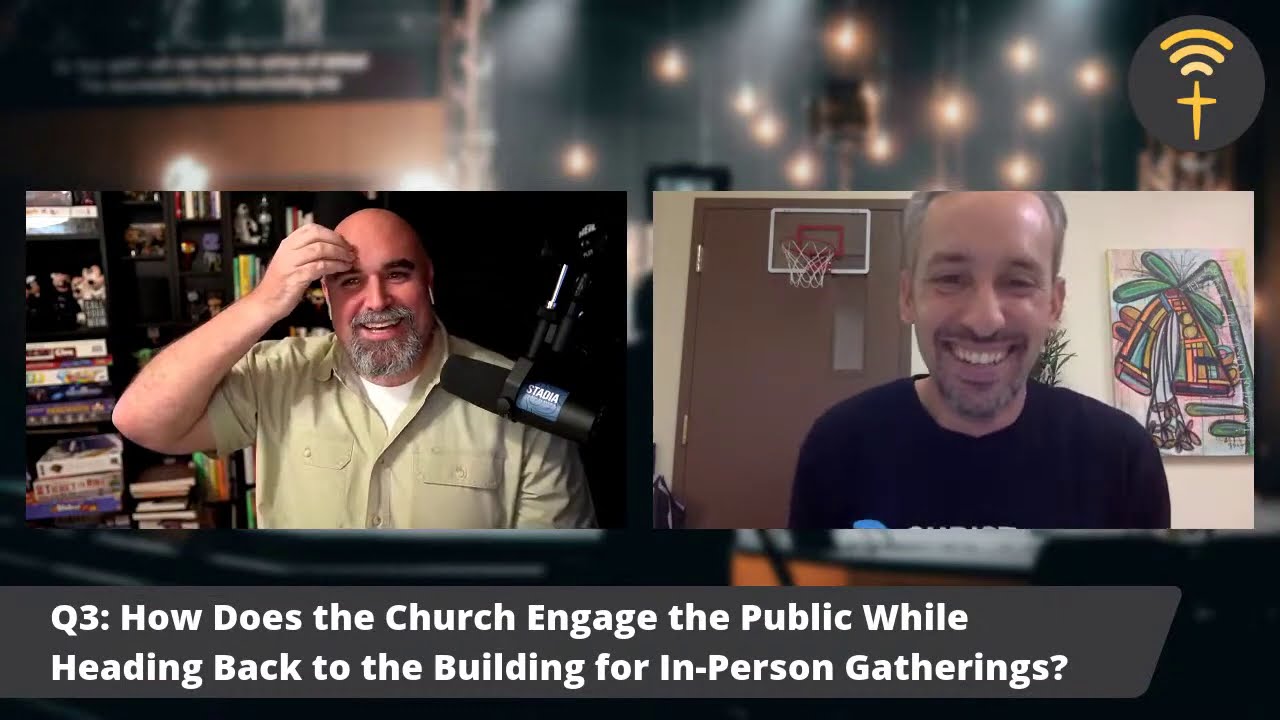
Hey, so let's roll into question three here, kind of stream rolling. How does the church engage? This is a hard one. Like, this is, let's kind of back up here a little bit. I don't know that anybody's got the answer. How does the church engage the public while heading back to the building for in-person gatherings? How does the church engage the public while heading back to the building for for in-person gatherings, right? What are you thinking off of this?
··
Well, I mean, the first thing I would say is that's something that's kind of just, it can't just be your services. It's got to go beyond your services. You got to serve your community. And mind you, um, if you missed out on that opportunity during COVID, you missed that on a big opportunity. But it's not too late today. You can still get involved in some way in your community. Find the needs that are going on and find ways to engage them. But the reality of it is is that people don't care what you know until they know what you care, right? They know that you care. That's the thing that's important. And your community needs to know that you, church, that you care about them, that they matter to you. And then there's the age-old question that many churches have asked: if your church disappeared from your community, if you had to shut those doors, would they care? What is it that you provide for them? That's what matters. And so in the same way, don't just dream of the big online space. I love what Carrie Neuhoff says. He says nobody should out-local the local church. And that should be true of your church and true of mine.
··
Yeah, Carrie is so good, man. And he talks about this idea of the church online, the digital church, and he talks about it actually being hyper-local instead of glocal and global and going over. He says church, we've got an opportunity with our degree to be hyper-localized into certain areas. And I would challenge it in this season for us as church, as much as we're interested in reaching the world, let's understand that through digital, through church online, we've got an opportunity to be hyper-sensitive to the to the communities around us. This is, we we know this, and you talk to any online pastor, they'll tell you this: people connect to community before they connect to Christ. And so even at least in online circles, and and I would suggest
··
Coming out of this COVID season, I think culture is shifting more and more that way where we're not necessarily embracing this idea of the organization of the church as much as church. We need to allow individuals an opportunity to speak into that, and so having that happen, giving individuals an opportunity to speak, that is the true engagement point where it's not a nameless organization trying to tell people how to live their life, but it's individuals telling the story of what Jesus has done for them through the Holy Spirit in their own individual lives.
··
Yeah, you know, and touching base on that, you know, social media outlets now, Facebook, YouTube, and others are really trying to figure out how to build those communities locally too. And so, you know, everything from, hey, in your online broadcast, it's okay to throw in a few local jokes, things that only your community would get, things that are unique to your niche area. You know, like Miami, we have a lot of these things. Last week we celebrated reopening, and so we took out pots and pans and we banged them together. Why? Because in Miami, that's a hilarious way that we celebrate all of our sports teams. Folks show up at the local Cuban restaurant on 40th Street and 87th Avenue called La Careta, and they show up with pots and pans and they bang them around. That's how we celebrate championships and all sorts of other ridiculousness. And so those are like small little details that you can throw into your service that, guess what, yeah, only your local audience is gonna get that. Nobody else is gonna get that. But that helps bring that community even more together. Why? Because, guess what, my people on Facebook are connected to people on Facebook in Miami more often than not. Yes, they will touch the person in California or the person in Spain, but most of the time when they smash that share button, people in my Miami check it. That's awesome. And let's be honest, we're in Miami. We really don't celebrate our sports teams that often. So in the grand scheme of the number of times you would expect to see the pans and pots, yeah, like the Heat down three to one, it's over. So, you know, we celebrate more than Cleveland, and that matters. So Cleveland, passing shots to that. Ouch to the people in Cleveland that are watching this right now. I'm sorry. I'm actually going to be up in the Ohio area here in a couple weeks.
··
So Phil Underwood, the pastor who asked these questions, you know, these are great questions by the way, Phil. You're doing ministry in the Florida Keys, so hats off to you. You are the true winner, whether or not your question got selected, sitting alongside the beach doing the work of God. Phil, I'm envious of you in this season. So thanks very much for this.
··
Remember, people out there, if you've got questions, we want to answer them through shows like this that will be better structured, and my dog Ray Skywalker hopefully won't be barking as much. So text those questions in: 484-324-8724. It's literally alphabet on the keyboard for the church. Check that out. Hey, we've got Beta as well as other free resources, of course, over at thechurch.digital. And this show, Beta, will be seen on, I think it's on Facebook and YouTube right now. We'll get it on all the social media networks on the website, and of course on the podcast. If you're not listening to the podcast, check this out. It's got our Church Digital podcast, which is far more theoretical, future-driven, and then of course Beta here, which gets more practical.
··
So, hey, Ray, we're landing the plane quickly. Any closing thoughts?
··
No, just keep those questions coming. I love the thought of now that many churches are considering reopening. Don't forget online matters. The majority of people are going to join you outside of the room. Yeah, online matters. Church culture is shifting. Away for us as much as we want to go back to the way that it was February 2020, we go back there, there's nobody there. And so learn lessons, keep fighting for this direction of it, not even embracing this idea of digital being the end game, combining the two together. But ultimately comes down to creating that disciple maker and letting that person be the focus of our ministry moving forward post-COVID into the next normal.
··
So, hey, thanks very much for jumping on this. For Ray, I'm Jeff with the Church Digital. Thanks for being here, and we'll see you next time here on Beta. Y'all have a good one.
Auto-generated from audio, lightly cleaned for reading. · Watch the full episode →
