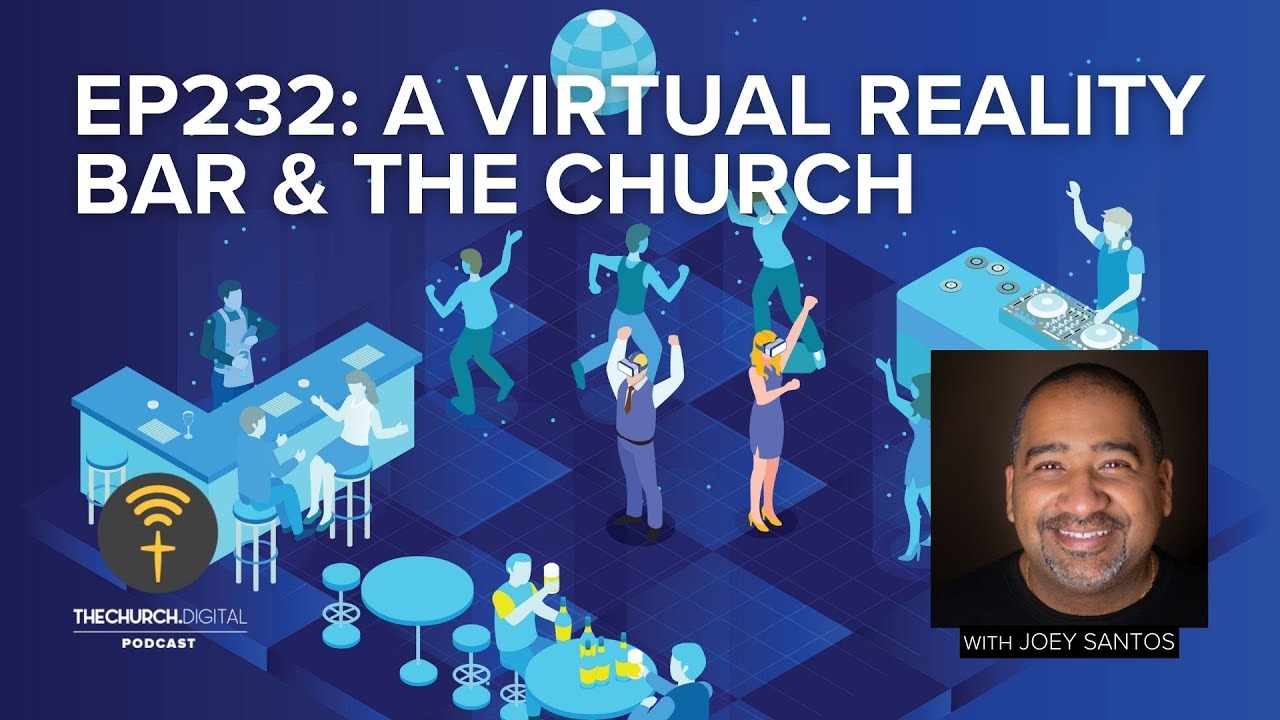
GET MORE INFORMATION ON CHURCH IN A VR BAR - http://churchinavrbar.com A SELF-PROCLAIMED "PASTOR AT THE BAR" Joey Santos has been on The Church Digital Podcast in the past, talking about his experiences doing church at a physical bar in Ohio. A self-proclaimed “Pastor at…
But the question that I would ask every pastor is what are we losing by not going there? What is the kingdom losing by not taking up, by not looking at this opportunity to meet people where they are? Because they're by the millions.
Welcome to the Church Digital podcast. Through this podcast we'll talk about the technological innovations within the church, but more than tech for tech itself, we'll address deeper questions. Is disciple making possible digitally? How should we approach the digital mission field? Can a biblically grounded church operate in digital space? Oh, and where does the metaverse fit into all this? Whether you're a big or small church, an established church or a startup church, the Church Digital's goal is to help churches like yours learn to be a multiplying church digitally and physically. Our heart is that churches like yours would discover a newfound focus on disciple making that will revolutionize your church. And now here's your host, Jeff Reed.
All right, hey everybody, happy Labor Day. It's Jeff with the Church Digital podcast. Looking forward to this conversation. Digital church network, leadership network, so much other fun stuff. And we've got a really interesting conversation centered around today. You know, it's funny. I'm the guy that always got like a lot of side hustles and hey, that's a great idea, let's really move towards that. And the guest today in this conversation, man, I just kind of walked into this incredible opportunity, incredible vision. It's like yeah, I really, I really just want to be a part of this thing and actually see how it rolls out.
So before the conversation, we're bringing in Joey Santos. Hey Joey, how you doing?
Hey Jeff, how you doing, man? Good to see you again.
Good to see you as well. And so Joey is, man, I feel like I've known this guy for decades, but it's really just been like, I know, right before COVID. Like it's just one of those like very, it was very accidental actually. Like we all of a sudden we're in the same room. It was like kind of guys got thrust together in unique situations. So it's good. You know, it's totally off topic, but you know, it's like in the action movies where the guy and the girl who have nothing to do with each other go through the traumatic experience of whatever the action is, and all of a sudden they're like dating afterwards. Joey, you're my action hero. Like we just got kind of put together in this unique situation and, oh man, this is all sorts of weird.
Exactly. Don't take this too far. That's not where I'm going. But oh my gosh, that's so good.
So Joey's my global innovations—no, global innovations pastor, right? Is that the right title?
No, that's integration, man. You gotta, you're the only one. You gotta mix me up with J-Mo. That's what happens.
Listen, if you're gonna get it confused with anybody, it's a good thing to get confused with you guys. Got it. That's a good place to go. But it's global integration pastor with Christ Church. You know, Joey's been blessed with a great church that has vision and understanding of how digital operates and really has been quietly kind of setting the standard and really running, doing some creative things in digital space. So you can check out what's the website? Our christchurch.com. Christchurch.com. And so check that out. But that's not even really the thing that we want to talk about in this conversation. That was just a commercial for Joey up at the front.
Now Joey, one of the things that I love about Joey, actually Joey's been on the podcast maybe pre-COVID. It's been quite some time. We had him on long ago talking about unique expressions of church. We've talked a lot about some unique expressions lately, but Joey historically was running church in a bar and so was really utilizing the online broadcast to run a micro location that was located at a physical bar up there in Ohio. And so maybe Joey, just even to start to kick off the conversation, why don't you tell us a little bit about that bar? Is that still going? Maybe over the past couple years, how things shifted, and maybe what lessons have you learned through it?
I know I think it was so interesting when we first talked about this, like almost three years ago, right? We're talking about the online and how the online church was impacting every church dynamics and routines. And we were talking about that house campuses and people meeting in houses. And this bar owner started conversations like, man, what would it look like to have a church in my bar? And I was like, you know what, that sounds interesting. Let's do it. So we jumped right into it and we were trying to figure it out.
I'll tell you this: I think the lesson that we learned right off the bat, because we had a very good first year, and then COVID came around and forced us to take a break, and that was one of the best things that happened to us. The first time we launched the church in the bar, we did it in a way of pretty much replicating the experience that you have in a streaming service, right? So we're literally broadcasting live from the auditorium. So we had all the gear. We set up in a way that we took over the entire bar sound system and TV so we could broadcast in every TV and broadcast the sound to the entire bar. But we're just streaming the services. And you know what we learned was there was a big rotation of first-timers. People come for the first time, they will never come back. They'll come for the first time and never come back. And the thing that we learned from it is that they were like, well, to do this here, I can do this at home. And I can just sit in my house and watch it. Because when you watch the service, you're not talking. When you're watching the service, you just pay attention to what's going on on the screen. And you know, people don't go to the bar to just watch something. Even if you go to watch live music, which this bar offers live music, you're pretty much talking the entire time you have live music.
Well, that's what we learned. Going to the next, you know, post-COVID, back in the bar, we're like, let's just change this whole thing and we completely flipped how we do services in terms of meeting the audience needs. And that's all we did. So we changed from one, like three songs like we do on the stage, to one song pre-recorded on location, something that can control the environment, control the sound. We pre-record the sermon and the message is recorded. The same message that we preach in the main campus, but the difference is we stop every five to seven minutes, make a point, ask a question, and put five minutes on the clock to have the discussion live. So now you have this opportunity. You're not just listening, but you're participating in the conversation about the message.
And that's when we start experiencing like results, right? That's when people are like, I want to come here and stay. And that's now we're experiencing that. We're experiencing that. I like this. It's community-based. It's about the conversations. Doesn't matter who's preaching. I just want to talk. And I, and I, and then you have the results. And right by the bar, there's a river, Miami Little Miami River, that's where we have the baptisms now. Now we're getting people getting baptized because the experience they're having, the conversations that they're having, how they're growing spiritually.
So I think in a short answer, that's what's going on with the church in the bar. It's been an incredible experience for sure. And extended out to a Wednesday night meeting. So we're not only meeting on Sunday mornings, but we're having Wednesday nights in the basement, come very informal. We're gonna dig deeper into what we learned on Sunday. Let's do the same thing. Let's sit around and have conversations. There's no video recording. There's nothing. It's just community. Let's see. Now let's talk. What's going on in your life? And we go from there. So that's what's going on at church in the bar right now.
That's beautiful. Now with the church in a bar, like are you seeing people from Christ Church? Are they just coming to the different microsite location? Are you seeing people from other churches come in? Like what type of person are you really starting to connect with when you're doing church in a bar now?
Yeah, that is interesting. The first round, before COVID, the majority of people was from our church because we promoted that way. Like we approached it as a church planting, saying hey, we need a group of people to go there and start volunteering and be part of it. And gradually those numbers are going down, but like people are like, I don't want to do this thing anymore. I don't feel like I'm getting it because they are there expecting to have the big church experience. And what changed post-COVID is like, I became the pastor in a location. So I'm there every Sunday, right? So they didn't have that before. They didn't. They just had volunteers running it. Now I'm the pastor and I'm setting it up. I'm doing this whole dynamic that when you're doing church planting.
But around the bar, we, you know, we have beer metal signs around. Well, we made metal signs, but "Church in the Bar, Sundays, 10:20 a.m." That's the majority of the people they're attending the church right now. That's people that come Saturday night, Friday nights, come to party, to drink, see the sign, and like, you know what, I can check this out. And it's kind of interesting because right now they're the core people at the bar, the church in the bar. They're my volunteers. My core volunteers. They are. They're the most faithful ones. They are. So I would say right now the vast majority of people are people that came straight out of the bar and it's coming to Sunday morning service.
That's beautiful. What we're seeing, I mean, once again, this is just another one of these examples, right? Where if you do something different, you reach a different person. And you know, Joey, you're seeing that as you're doing church in a bar, not a branded micro location or like a multi-site location just trying to copy and paste what a typical church service is, but you're reimagining it. You're making it contextually fit more within the bar locale. And as a result of that, you're reaching people that the buildings aren't going to reach.
Well, listen, we can talk about church in a bar all day long, but I want to add another wrinkle to this. You know, Joey and I were having a conversation, I don't know, maybe somewhere June, July, and you know, I challenge Joey like I challenge a lot of pastors: hey man, start thinking about what you can do in virtual reality, start thinking about what the metaverse could look like. And so I was jumping on a call with Joey. Joey simply said one of these words that was life-giving to me. Hey Jeff, what do you think about starting a bar in the metaverse?
This was intriguing to me. Well, Joey, why don't you talk a little bit about this? Like, I mean, you told me, hey, why don't we start a bar? What's going through your head? How did you get to this place of even starting a bar in virtual reality?
I think, you know, you got that train going because you've been talking about metaverse for a while now, and you've been exposing the potential. So you know, like most people that got interested in this, I went and got my VR set and I was like, let me check out what Jeff's talking about and start looking at some of the churches going online, going on a virtual reality and other locations, other activities. And the thing that impressed me the most by visiting other churches in a VR space in other locations, other activities, is actually to see what we
See at the bar, that's people. They're completely lost. They're looking for answers and they're trying to meet people to have those conversations. And I, it hit me because that's the experience that I have in person at the bar every week, and not only on the weekends. Like, I'm not ashamed to say I hang out at the bar a lot because that became our location. So I'm at the bar outside Sunday, Wednesday nights. I'm at the bar. I was there Saturday nights meeting people. And you know, because I'm there, the owners introduced me to all his friends as, "Here's the pastor at the bar." That's how they know. The staff introduced me to people. "Here's the pastor at the bar." So I'm known there as the pastor at the bar. And because of that, people actually say, "Hey, talk to..." They ask questions. People in the middle of a busy bar asked me before, "Can you pray for me right now? I'm going through this." And I got to pray for people in the middle of a bar.
So looking at that experience and seeing what I saw in the VR, I was like, you know what? We already know the environment in an in-person experience. Let's just build the same thing in the VR because it's going to be familiar for me, for other volunteers that went involved. Should go in and like, let's see, in the bar, people going to come in the bar to talk, to fellowship, to have conversations. We can have those conversations. They're not strange for us. So we're like, let's try something new that's not the regular church format and let's go simply in a way that's familiar to us. But I see the potential because people go to have those conversations, and I want to have those conversations with them right there.
So the idea here then would be to have these types of conversations, to build a bar and environment to foster those types of conversations in virtual reality. You know, and more specifically, if you're aware of virtual reality, like the world that we're considering going into is VR Chat, which, if you know the podcast, I commonly call that the red light district. DJ calls it the wild wild west. Like, this is the world where it's estimated that forty to fifty percent of its inhabitants are having virtual sex and private rooms. Hey, so let's open up a bar so that we can talk with people.
Yeah, you know, it's interesting. Like, I actually have talked with Christ-centered recovery organizational leaders. I've pitched this idea because I'm like, "Hey, I want you to, I want to know what your feedback is like. What's your thought? What's your thinking?" I'm about to get like yelled at. And surprisingly, I wasn't. So I'm curious, you know, as you've thought of this, Joey, like, how much positive feedback? How much negative feedback? What have been some of the conversations that you've received when you've started thinking and talking about the idea of doing this bar in virtual reality?
I think it's kind of like, in like everything else, whatever is new right now, I'm having a hard time getting across to people just the virtual reality alone, right? Because again, for a lot of people, they cannot even grasp those things are real. And I tell people, the fact that it's virtual doesn't change the fact that it's real. It's real for the people in there. They're trying to look for answers and conversations.
So just like for us, when we launched the church at the bar, our church family, it was like, "It makes sense because they already know all the crazy stuff you're already doing online, right?" So it's very ancient for a church family. They're like, "Yeah, that sounds great," which was great to have the feedback. But churches around us, they were very vocal about how crazy we were by putting a church at the bar. And I think that's the reactions that we get. We got this very mixed reactions. The first reaction is really about this virtual reality thing. We should not get in there because it's not real. And I'll tell people, I said, "I'll tell you this. Get your set. I'll hold your hand and we're gonna walk together and you're gonna see how real it actually is."
But I think what people get confused is like, if you're going to set up a bar in a virtual reality, people are not going to be able to drink. People are not... Like I said, it's about the conversations. It's about the connections. So I think it's just like you and I had a conversation years ago about some concepts for online church and how that's so new to some churches in the church concept. I think we're back in the same territory right now of VR being like, "Oh man, here we go again, something new," and people don't understand. People don't see it.
I was in Chicago just a few weeks ago and I was with a friend of mine, a pastor friend of mine, and he literally set up a meeting with his staff and said, "Joey, come here and talk about this. I've seen you post on social media all this thing about virtual reality, metaverse, and all that. Tell us all about it." And I thought it was very interesting because we just had this like two-hour conversation with his staff and they're blown away. So this thing is real. Yeah. And this pastor actually has a headset, but he has no clue about those places you can go and meet people, have conversations. And I said, "Hey, let's set up a time one Sunday. Go with me. We're gonna walk together through those places."
So yes, Jeff, I think the reception is gonna be different from place to place. Our church family completely embraces the technology. You know, the leadership adds components to the budget so we can support our starting this approach to virtual reality. But I think outside the church is still pretty hard for people to embrace the VR alone, much less having a church there that represents that, have a bar that represents the church.
Now, one of the things that I think makes this idea unique is, at least in the conversations that I've had with you, and what something shifted. I mean, you're not broadcasting church services into a VR bar. Is that yes? Is that true? Like, what? Yeah, so like, you're, how does leadership view that? Like, what? Because so much of the physical church experience and the church online experience is centered around the sharing of, or the watching, the viewing, the consuming of a church service. But you're not doing that, or at least that's not the aim and the goal of this. So talk to me now.
Is that? And I think what helped is that when you go to the church at the bar in the physical location, it's a way to decentralize form. I mean, on a physical church at the bar, we're not replicating anything that we do in a big church setting. So it's completely separate. It's completely different already. So you know, it's not weird for church leadership to look at like, "We got to do this differently."
I just left the meeting, you know, our church is still battling with the impact of COVID in terms of in-person attendance. And I had a conversation with my staff and I just talked with the leadership today and I said, "We got to figure out a way to show our staff how not to let the structure dictate the programming. We're in a big building. We have a gigantic building that's not being filled every weekend, but we still behave like the building is full. And by doing that, sometimes we don't meet the people's needs when they come in the building."
So I think it's the same thing going to a different place. If I go to the bar and I try to replicate the church service, because even like to the point, Jeff, that when pastors, you know, pastor that's preaching and formulated questions, I tell them, "Don't ask questions like the person is going to church for ten years," because my audience, it's not going to respond their way at the bar. Like, don't tell them, "So when you pray to God, how do you pray about blood?" No, they don't pray. So the question is to be formatted knowing that the audience wants to learn from the Bible, but how, more than ever, how does that actually apply to my personal life? And ask me questions that made me connect the dots between the Bible teaching and my real life. And we make sure the questions are like that.
So I mean, we're already practicing what it looked like for us to go out of our comfort zone in our own buildings and build something outside that's completely different, your completely different audience in a physical space. And now we're taking that to the virtual space because we got some practice there now doing this at the bar. And now we're gonna have to change that again. We're gonna have to tweak that again. We're gonna have to teach people how to have conversations they're not used to. And they're gonna replicate a church service. You're gonna be a church service, but not the format that we are used to. Meaning the model is gonna have to change because if you're going to reach people where they are, we got to change the model. We cannot just stick with the one and believe it's going to do it all.
That was beautiful. I love that. Yeah, I mean, you started off talking about decentralization and, "Hey, what we're doing here at the bar is different than what we're doing at the building," which is recognizing contextualization. If you're going to really reach a physical person at a bar, that is going to look different than the physical person that's going to attend a church building to get their spiritual questions addressed. And even building on top of that contextualization, if we're really going to engage with people in virtual reality, yes, there are churches that are being successful broadcasting their services online, and many of those pastors are my friends, and far be it for me to disparage that or even the people who are preaching church services in virtual reality. But what I love about this idea, Joey, is its shared experience and it's relational. You're inviting people into a shared space for the purpose of building a relationship, building trust. And so much of that in a safe space in where you're not, you know, you're not prophesying, you're not preaching, you're literally not getting behind a pulpit and going off. Like, that's a that's going, I predict, and it's we're building it. It's an experiment, right? But the heart of this is I see that being immensely successful way to build relationships.
Yes, that's, and that's the focus. I mean, that's our call, right? It's a call to love people where they are, to have a relationship with people. And I probably gonna quote a lot of a mix between J-Mo and Dave Adamson here, and a lot of stuff that we have conversations. Guys, that again, we have been very attached for too long to a specific model, what we call church. So you know, it's kind of interesting because we don't even call our small groups that meet at homes church. We don't. We make sure that's a very distinct, right? We say, "Hey, on Sunday I go to church. During the week on Tuesday nights I go to my small group," which is the reality. What's happening in that small group is the church. And I think being able to restore the idea that wherever I am, I am the church. And we actually have that.
So when we first started our house campuses, every time somebody started house camps, they got a t-shirt from us that says, "I am the church," really big in the front. And because we want to be able to understand that like, no matter where you are at, you are the church. You are called to do those things the church is supposed to do, to love people and to meet people where they are and to lead them into a life of discipleship. And the things that do all that is relationships. The relationships is what's going to drive all those things.
To happen and we want to make sure that happen in the contextualization of a virtual reality because we see how that works in real life for all of us right. So I, we go to the golf course, they pair you up with somebody you never met and you start having a conversation and they dropped the F-bomb a couple times in conversation. Well by hole number three they're like, "So what do you do for a living?" and I'm like, "I'm a pastor," and they'll be like, "Oh man, I'm so sorry," and I'm like, "You know what, don't apologize. Just be who you are. Go ahead and be who you are. That's totally fine." And just by saying things like that, man, I'm telling you, it's one of those things that let people just relax.
I don't know Jeff, your audience for this podcast totally, but I was just going to take a, I was just going to be very authentic with people here. Is when people see me at the bar, um, I may have a glass of bourbon in front of me and that when people like hears the pastor at the bar and they see that on my table, it brings the walls down because they absolutely associate that into like, "Oh, you're normal," and I'm not, I'm not here advocating for all the pastors who start going to bars are drinking so they can connect with people. I'm saying that contextualization matters to me because I'm doing a ministry inside that environment. So because I'm present in that environment every week for them to, I'm not the pastor that just shows up Sunday morning to say, "Hey, let me tell you about your spiritual life." I'm the pastor to actually do life with them during the week so they can see a real connection.
So I think when, like for us, like how we translate all that into the virtual reality, how we be, how is how we stay authentic by going to virtual reality and doing church, doing church in terms of how we be, how would be relational to people that leads them to Christ without losing our, or our character in Christ, without losing our values in Christ. We don't have to lose any of those things and we still can be authentic and meet people where they are. And I think that's the challenge for every church, like how we stay authentic to who we are in Christ but still relational to people outside the church building.
Yeah, it's so good. I mean, Jesus is the same yesterday, today, and forever. I know, right? Church in a bar, the conversations, the bourbon on the table, like I, I don't, I mean I don't know the legalism that's centered around that, but I gotta believe that that doesn't change who Jesus is. Um, but the contextualization that maybe we have to do something different to reach a different type of person, uh, takes to get them to see Jesus, uh, to get them to trust us enough to get to the place of that conversation of Jesus. Uh, that's truly what I'm excited about, you know?
It's interesting. Um, you know, I'm actually trying to remember. I don't know that we've had Dave Ferg... Yeah, no, no, we did. I did a training uh with Dave Ferguson centered around his blessed practices and we're actually in the process of writing a book uh with um, uh, with Dr. John Harris from, from um, Hearts Like His, it's a Facebook church, on the idea of digital and metaverse evangelist and it's centered around Dave Ferguson's book on blessed practices where it's, uh, you know, BLESS. It's the acronym. Begin with prayer. I'm motioning to this on YouTube if you're watching me in real time. If you're listening, sorry, you're not getting the, but it's begin with prayer, uh, it's listening. And you know, it's funny, like E, uh, for Dave when he was doing this physically was eat. And so was begin with prayer, listen, eat, eat with someone, share a meal. Um, and then it was serve. That person was the first S, and then I would share Jesus's story as their your story as the second S. And uh, and so the challenge came down, "Hey, can you adapt BLESS in the digital metaverse?" And I was really excited, but that whole eat thing, I was like, "I don't, I don't know that I really want to limit this to eating." Um, and so it was funny, we got a bunch of like digital metaphors passed around and started, you know, thinking and dreaming and talking, and the idea of shared experiences quickly rose to the top where, "Hey, you know what, we're gonna in VR we're gonna jump into Pop One together. We're gonna play a game or we're gonna walk around a world together. We're gonna sit around a campfire and just start to talk with people, or even something as crazy as we're going to create a bar and just start to like talk, engage, dialogue with people in these virtual spaces."
All of a sudden we're starting to see where that's the first but crucial step in really trying to engage with a different type of person in these metaverse where yes, you can throw the seeds, you can scatter it, and you know some of it's going to hit thorny soil. You can walk up to people and it's going to get on the rocky path. But man, if you could, if you could like work the soil in advance, if you could create an environment where you're building that trust, that relationship, you're pre-tilling the soil, you're getting it stirred up a little bit so when that seed is cast, it falls into the moisture there. Uh, I mean, I'm really like digging this analogy, but the truth is though that man, you can do a lot. We can reach and connect with a different type of person, yeah, through doing something unique like this.
It is, and I think it goes back, you just hit a great point of the trust. I, we try to really, you know, get people to understand the gospel. We want people to accept the gospel, but there's a trust issue because they don't trust us, right? They don't trust the church as it is. It just don't. So now we have to go in and build that relationship first, and after we build the relationship, we got the door open to have those conversations. That's what has been so clear to me by having this opportunity to be at the bar and meeting people every Sunday.
This just, this, you know, this past Sunday, um, we had this lady come in and here's what she said: "I'm coming to church for the very first time." That's her first time ever walking in the church, and her first experience is in a bar. That's so, and then to me is like, "Okay, I just want to talk to you, right? Like, what caused you to come and walk in here?" And then we have this great conversation uh in the, in the, in the, again, I'm trying to just listen. I'm asking questions and she's talking and she's talking and she's expressing and I just asking questions. I just want her to tell me your story. Tell me how you got in here. And in an interesting way, throughout that, you start to build, just in one meeting, start to build. It's not totally built, it starts to build that trust because I'm really interested in her life. Uh, and then she started, you know, she asked for questions about, I'm talking about my family, I'm talking about the things I do in life, and they so we are having a conversation that has very little to do, you know, in a moment with the theory of the Bible or the scripture at the moment. We're not talking about those things, but what we were doing, exactly what Jesus did, that was just go in and contextualize people's lives into what he's teaching and he's talking. Uh, and I think, man, we got so much there to offer as a church if you can just learn to have those conversations and allow people to just stress to you.
Like, a lot of the time you gotta give time. I like, uh, you know, Jason Morris is so strong at that. He talked a lot about time. Like, that's their currency in this environment. It's just time. It's not, you know, we don't need to build a five, six, seven, twenty million dollar building to reach people here. We're talking about a three hundred dollar headset and the ability to just go in and start having these conversations. I mean, whatever way you want to build this thing, uh, the investment that you do financially is not as much as you're gonna be making time in your time, dedicating into connecting and meeting and talking to people.
Yeah, that's crucial. The time aspects, and you know, it's funny. I just, I talk with people all the time that are interested in this metaverse stuff and that it's like, "Put the headset on, go up to somebody and start a conversation." Yeah, okay, you can play Pop One with some people. You can, uh, you know, jump in and Beat Saber with somebody you don't know. Like, yeah, yeah, definitely, you explore those spaces. It's fun, it's new, but until you sit down at that campfire, until you walk into a rec room, dorm room with somebody, um, you know, until you walk into the bar and have a conversation, like you're not, you're not going to really understand culturally what it is and the what community looks like in these spaces. And uh, you know, for many pastors that are out there, it's funny. I was just writing uh on this maybe earlier this morning, but for many pastors out there, like they need to embrace the idea. They need to look at that community. They need to walk around um and then find their person or peace. They need to prayer walk the metaverse as as crazy as it sounds, but start to really look at the potential of what's here.
Well, I just, and I look at, you know, we're in Kansas City. Just, you know, months ago having this first conversation, and I first of all, pastors out there is going to say, "I don't have time for this," and I understand that, right? I'm in a physical church building here. I'm in charge of our online ministry. I'm in charge of communications. I'm in charge of family ministries. I'm in charge of IT. Uh, I'm in charge of a weekend experience like production and worship. I got a great staff degree, but I manage all the staff doing all that. I got a beautiful family, got wife, two boys, 16 and 13 years old, very busy. They keep me very busy. They do all this, the right, you know, you say, "How do you find time to?" You find time to it like trust me, you find time to it because it's worth it. Because it's worth it when you walk in there and you see people in need. In America today, the last time I look at it, there are millions of Americans. I'm not even talking about the whole globe. I'm talking millions of Americans daily on those devices. So we can argue all day long, "Yeah, I don't need to get involved in this. I don't need to get in there. This is just a fever is gonna go away." We can make all the arguments should not go in there, or we can actually, like, you know, let me go check this out because there's an opportunity here. And I think, you know, the church, I wish the churches would look at this way. I wish pastors would start looking at there's an opportunity.
The thing that really hit me, Jeff, I'm already like a first early adopter from the moment we talked, but going back to Kansas City meeting when we talking to these churches, it was the first week of vacation Bible school. So I told my oldest, "So hey, just get in the car. Let's just do a road trip together. Let's go with me in this meeting," and he's sitting there. He's just listening. He's on his own iPhone doing his thing, and he's listening, and it's amazing the conversations we had later. He listened to everything. He bet he's multitasking. He's doing, but he captured everything. That's the generation. He actually this week he's like, "Um, are you going to Houston? Can I, I mean, he knew he knows I'm going to heal someone, so he's like, "Can I go with you?" And because I like the conversation, again, that's another to me was a sign like that's the generation that's coming that we can prepare them to be disciple makers through this technology because that's going to be.
Part of their lives. It's there's no way to escape that. It's going to happen. So it's already happening. It's already part of their life. So when I look at all those things, I'm thinking, yeah, we can let that go. We can. We don't have to embrace this opportunity. But the question that I would ask every pastor is, what are we losing by not going there? What is the kingdom losing by not taking up, by not looking at this opportunity to meet people where they are? Because they're by the millions, their daily. So that's to me, that's the challenge. That's what hit me. It's like I don't think it's worth letting go the opportunity to be in the environment that I can meet millions of people and have the conversations. And then the other day, it's the millions of people just tell us the potential. This is still a one-on-one ministry, just like with my next door neighbor in my house. Virtual, online, it comes down to one-on-one ministry. We're going to meet people one at a time. We're going to minister to them one at a time. We're going to impact their lives one at a time. But they're by the millions. So we need an army of pastors to come and say, let's do this thing. And then that's really the heart of, like, multiplying this idea, training, you know, on best practices or other systems, and really starting to, like, equip. Because you're right, it's not one to millions. It's one to a few. And if we, if the church will really understand the potential of the metaverse, are lots of small conversations and not mega conversations. It's not a microphone. It's a whisper. You know, that's really a lot of what I think the tension of today's church is. Because they're not, they're looking at the metaverse either discrediting it or seeing it as another way to megaphone something in front of a whole lot of people and missing the opportunities to build that trust on an individual level. That's so good.
Well, hey, listen, we are championing this idea of the metaverse. We want to open a bar. We want to be a church in a virtual reality bar. And so here's what we're doing. I actually built a slide deck and then I bought a domain name and then I put the two together. And so you can go right now to churchinavrbar.com. And so that exists. There's more information there on what we're trying to do. The reality is that we're trying to partner with churches to build the minuscule amount of funds necessary to put this thing together. And we're hoping to partner with churches that are comfortable, that are familiar, that want to be conversational in this space. Once again, we're not launching a sports virtual reality bar that's going to have forty-seven different TVs scattered around for you to broadcast church services. That's not what we're trying to do. Nor do we want to see sermons happen with one man or woman preaching on stage. We want the DJ to play some music. We want the bartender to be relational. And we're looking for people to be part of shared experiences, building relationships with others in the space. And so that's our hope for the church in the VR bar. And we're looking to partner with churches and with individuals that want to be part of this. So check out churchinavrbar.com for more information on this and other initiatives.
And what's, you know, before I shift gears on things, man, Joey, just any thoughts on that? Church in a VR bar?
Yeah, that's fantastic. And I think I again would encourage people. We are not trying to do this. This doesn't have to be my thing. First of all, what I like about this opportunity is that we can actually work together with many different churches in participating in this. Because again, this thing is twenty-four seven, right? I mean, we got people from everywhere to participate, to join in. And I love the idea of us doing this together. So I really will appreciate all the effort and time you've put into this, Jeff, and open up doors for people to go and understand and explore. And I even make myself available. Feel like I want to talk more about this. I don't understand the whole bar dynamic. I absolutely, how we can set up a time, we can talk. But let's do something crazy here. Like, are we, and they know, let's do something crazy. Let's just build a barn of your environment in the metaverse and let's just go for it. Let's go meet people and see what happens. I'm telling you, in an in-person experience has been amazing, fantastic. It's totally worth it. And I don't think it's going to be that much different when we jump into the metaverse environment.
Yeah, and just even transparently, let me put some numbers on this. We've sat with my world building team here through the Church Digital. And I mean quotes on this thing are like twelve thousand dollars. And so we're trying to raise a portion of that through other churches. You know, Joey's and Christ Community Church is willing to contribute some. And but we're trying to raise other with that as well. If you want to reach out to me directly, we can talk specific numbers. So there is a financial component to this. There's also the reality that a VR bar should be open seven days a week, if not twenty-four hours a day. And what does that look like? Well, that's going to be bigger than one individual church. And so my hope is here through Digital Church Network that we can try to find some friends on mission. So maybe some other churches and individuals and organizations that may have financial vision for this, but also maybe you want to be part of a unique experiment to try to reach a different type of person through conversational approaches in virtual reality. And so that's the hope here with Church in a VR Bar is to meet these unique people, but to also find like-minded individuals that want to give it a shot, experiment, and see what it's like to maybe engage differently to reach this different type of person.
So for more information, you can check out churchinavrbar.com and that'll get you more information. Here, real quick, now it was interesting as I've talked about this with some churches. A lot of churches are excited. Some churches are excited, I should say it that way. Some churches, you know, to be honest, they're a little uncomfortable with the bar aspect. That, you know, maybe a little too edgy. Virtual reality is edgy. Bar is edgy. Put the two ideas together in VR Chat. Like there's a whole bunch of edging. You know, and that uncomfortability, that's not a bad thing for some of you. Maybe it is too aggressive. Actually, I had a metaverse pastor pull me aside and was like, "Hey, Jeff, instead of a bar, why don't you do a coffee house? Like a virtual reality coffee house in VR Chat?" And my response was, "That's actually an excellent idea." Like I could almost see creating several different shared experience environments in virtual reality designed with this conversational approach. Like I don't think a VR coffee house is that far away. And to be honest, you know, a beer with a foam top is probably not that far away from a latte. You just gotta maybe adjust some of the coloration and the glass. Like I got to thank the world builders probably maybe a step ahead to get to that coffee house as well. But I do, I'm excited about this opportunity. But I also see vision where maybe other opportunities will open up and we can start to create more of these shared experiences as we're going.
So awesome. I just like the idea of churches working together. We talked about this before, you know. We sometimes experience some kind of a sense of competition between churches in the physical space, but we don't experience that in an online environment or even a VR environment. You see more churches coming together. So I like the idea. That's why I like the idea of churches coming together. That was, we can just, you know, share this experience. And then we can, you know, it would be amazing for churches to come together and build a bar and then six months from now the same churches come together. Now let's open something else and let's just expand this thing and let's just build this ministry like for the kingdom and see how far we can go with this. Let's just embrace and see how far it goes. So I like the idea. Though we've talked about this as well, you know, it's easy to look at this. I listen, you want to have a conversation about the ecclesiology of what we're doing and whether or not it's a church or not a church, what it's going to look like over time, you know what? That's a conversation worth having. But the result of that conversation does not dictate whether or not we should be doing what we're doing. Like to lean into the ecclesiology, should we actually be calling this a church? Should we be calling it a mission field, a missional opportunity? Like we can debate that. That conversation all day long. And to be honest, I'm not dying on the field of whether or not it's a church or not. But what I would say is that while the ecclesiological conversations need to be happening, the missiological conversations, whether or not this is a mission field that is worthy of our time, there's no conversation centered around that. Yeah, the answer is yes. Leaning into the missiological implications, the missiology of what we're doing to try to reach these different people that the buildings are not reaching by utilizing virtual reality in a new way, like there, that's not questionable. The answer is go. Now, and so we would, I would love conversations with organizations that want to go that route through VR Church in a Bar, VR coffee, shopping, whatever. I don't know. I don't even know what everything rolls out. But at the heart of this, like let's figure out how to do something different with this metaverse technology to reach a different type of person. And the goal is not to just be different. It's to the end of the day, can you reach me, really reach people for God through it? That's the goal.
So the end of the day is this is really not about the how, how fun, how cool, how different this is. But it's like, you know, as much as I love technology, some of the steps I see online and in the VR is like crazy that actually is happening. But I never, it never crossed my mind in my wildest dreams that I would spend my Sunday mornings in a bar and I would be meeting people and talking about Jesus and baptizing people out of a meeting that we call church that happens inside of bars in the morning. So that's, you know, I think we just got to be a little bit open to something new. And I think we got to be this much open to the overall goal in mission. And if we can just keep the mission as a big picture, I think we're going to get there together. I think, you know, just a little bit of like, okay, I'm going to give a little bit of openness to the difference. But here's the big mission and we don't deviate from it. And that's the thing about this venture that we're in, if we can call it this way, with the church, the bar, and the VR. Is that it's, we're never going to deviate from the mission. We're never going to. We're going to. That's always going to be there. That's, we're never going to go out for that.
Well said. Don't deviate from that mission. Awesome. Well, hey, Joey, as we're landing the plane here, any closing thoughts, man?
I just want to appreciate your time, man. I think we're living some amazing times in, you know, a few years ago I thought, oh, we're going to land on this online church thing. It's going to be awesome. And that's one thing, Jeff. I final thought for pastors listening to these church leaders. This is not your next online church. This is another layer of ministry in your
Church, and I hope that does not create another sense of desperation for you, but I'm saying you got young people in your church that already has the VR. You got people—not just the young, all ages—they already got that advice waiting for an opportunity to know what to do with it besides playing games. But you're going to continue to minister to people through online church. The online church is not going to go away like the physical church is not going to go away. We just got another layer of opportunities to reach people, but it is very missional. And it's worth doing. So I really encourage pastors to just like give it a chance, to just learn more about it. Just go learn more about it. Just learn more. Just explore the possibilities. Talk to people. Talk to Jeff, Charlie, ask questions. Bring more people into the conversation and see how this can actually fit into the mission of your local church. You know, we talk about online church being an extension of the local church, being an extension of the physical church, and here's another layer to that extension—that's the VR. And I think I'm excited about it, how God's going to use this.
Yes, very, very much so. Pastor, church person, young person, lean in, ask questions. You know, it was funny just last week—we had a podcast, maybe it was two weeks ago—we did a podcast with Seacoast, which is a huge megachurch, multi-site church. And you know what Seacoast did? They listened to the crazy twenty-year-old, and they actually experimented on what the twenty-year-old stuff was. What they're reaching thousands of people as a result of it. Go back, we'll put a link in the show notes to that episode. But the reality is that you've got people with some crazy ideas, and rather than discrediting them and ignoring them because it doesn't fit within the physical paradigm, maybe, maybe we should experiment on it. Maybe you should invest in them to the point where you trust them spiritually, and then give them the little resources that are necessary to do it. Seacoast has invested zero dollars and zero cents into a twenty-year-old, into the idea, the missional imagination of a twenty-year-old, and as a result of it they're reaching thousands. What we're talking about here is you're not going to break the bank on this. I guarantee every one of your physical campuses is one hundred times more expensive than the stuff that we're talking about doing in this space. But maybe, just maybe, the opportunity to reach a different person utilizing this stuff—maybe there's a way to do this. I don't know if you're more interested in the experiment. Check out churchinavrbar.com and would love to connect with you.
Hey, Joey, man, it's been great to hang out with you. Looking forward to—I know I'm looking forward to Houston coming up in a little bit, and for wherever the Lord leads. So thanks for jumping on here, man. I'm excited about it.
Thank you, Jeff. Appreciate your time.
Awesome. For Joey, this is Jeff with the Church Digital, Digital Troops Network, Leadership Network, New Thing Network, and whatever else we can attach toward Network 2.0. Thanks for jumping on the podcast, and we'll see you next time on the show. Y'all have a good day.