Communities ▾
Events ▾
Shows ▾
Blog ▾
Family Sites ▾
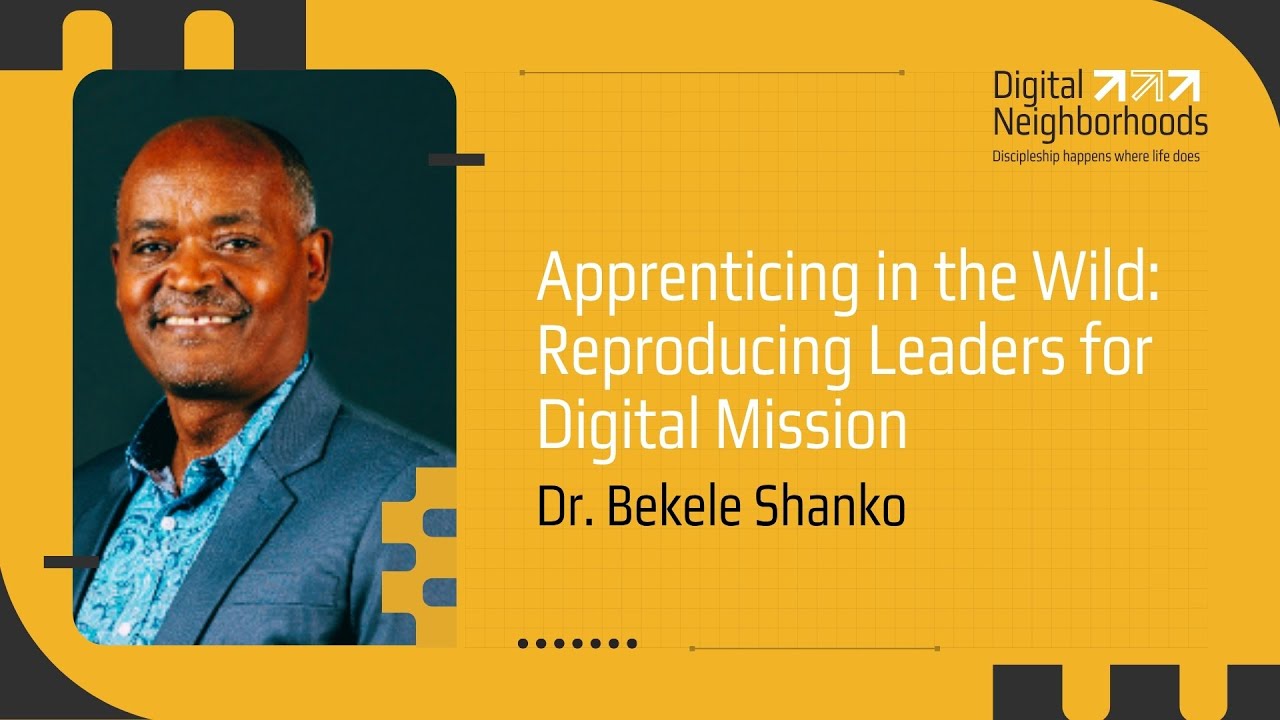
Apprenticing in the Wild: Reproducing Leaders for Digital Mission
Dr. Bekele Shanko, whose influence has contributed to the planting of 2.4 million churches, brings his hard-won wisdom on leader multiplication to the Digital Neighborhoods Summit. Drawing on biblical models from Moses to Paul, he outlines a clear framework for identifying potential leaders and apprenticing them intentionally in digital spaces. This session is a must-watch for anyone serious about accelerating the Great Commission through reproducible discipleship.
All right. Hey, we are coming back from the last round of breakouts. I hope things were good and excited about, man, just all the greatness that's happening here with audience mapping, with God Tools, with next steps, with augmented reality, with fundraising, with BAM portals, with artificial intelligence, with digital discipleship, with Right Now Media. Like, oh my gosh, like I, I just, I, I understand. I feel the pain that you're going through, Jeff. There's too much.
I know. I know. I know. People love supporting digital missionaries. Like there's a lot of love in digital and virtual spaces and I hope that you're feeling it.
Hey, listen. Oh, we've got Beckly Shenko, Dr. Beckly Shenko coming on in a little bit. Just a little tease, dudes. Like, direct, forgive me, I shouldn't call him dude. Like I just have so much respect for this man, but I mean like 2.4 million churches have been planted because of the influence of Dr. Beckly Shenko. That's two with a dot and a four and a whole bunch of zeros behind. I think it's one, two, three, four, five, five zeros. 2.4 million with an M. Hey, and we're talking about apprenticing. We're talking about multiplying selves. What is, okay, I'm the guy that's planted 2.4 million churches. I'm pretty sure has a strategy, an effective strategy on how to multiply ourselves. Maybe we should listen to him on that. So we're excited. Dr. Beckly Shenko coming. He's backstage right now getting his tech set up. But I, there's a couple things I want to throw at you right now before we get going into this with Beckly.
Hey, you know what? Conferences like this with the Church Digital, this is, we're free. Like we do the Digital Missionary Conference for free and this is not the only conference that we're doing. We've got a lot more conferences coming up soon and even in 26 and beyond. And it's our intent. It's our intent to always do this for free. You know, first off, you know, our sponsors like what we've seen so far with Right Now Media and BAM portals and God Tools and Next Steps and all of these are investing and sponsoring this conference. Stadia, Starurch, like so many, I could rattle off, look at the website, there's like 25 or 30. There's a lot of people that are investing resources into this and helping the Church Digital do this conference. And so so excited, so thankful for the sponsors that we have out there. But I want to challenge some of you right now to maybe step up and help us.
Why can I not click on this show on stream? Am I not streaming right now? That's interesting. I have no idea why I can't do that. Hold on one second. Show on stream. There you go. Error message, platform was buggy on me. Talk about losing momentum. Hey, we want to keep these conferences free. Here's what I'm asking. Those of you that are watching the stream right now, pay it forward. If you've benefited from the conversations that we've had here, if you've benefited from the breakouts and the sessions that are happening, I want to invite you right now, click the link on the screen and pay it forward. Sponsors like, um, you know, Right Now and the many opportunities through Crew, BAM portals, Reliant, all of these are helping the Church Digital continue to do this part of this. I'm going to ask you as an individual, maybe it's your time to do that as well. There's other conferences that we're doing. I'm going to have the same conversation with them in the coming weeks, but help pay it forward to allow these conferences to continue on the Church Digital in the US 501c nonprofit. All gifts. Listen, if it's 50 cents, if it's five bucks, if it's 50 bucks, whatever. If you receive value from this, maybe figure out how much value it is and give that back to the Church Digital so that we can continue to do the ministry that we're doing.
I, um, that's interesting. Hey, everybody. Yeah, thank you. That was good. We're trying to figure out some tech on Beckly. So I'm kind of doing a soft shoe routine here. How am I doing? Hope it's good. Hey, so we're excited about that. Um, I want to talk a little bit. So this has been the Digital Neighborhoods Conference brought to you by Global Church Movements. We've got Beckly Shenko coming on here in a little bit who's going to represent and talk a little bit about that, about what he is seeing and what he's a part of doing globally. But there is some really exciting things happening with Global Church Movements globally, digitally. And so I'm going to, I want to take a moment right here. I want to introduce my friend Cadis Bakoli. Cadis lives in Albania. And if you've ever met the Albanian version of Jeff Reed, you're about to see him on the screen. And so so excited to play this video of Cadis Bakoli for you. So, hey everybody, take a look at this.
Hello friends. My name is Kadis Bakali and I come from the country of Albania. I serve with Crew Global Church Movements and help lead a growing network of digital missionaries across many nations. It is such a joy for me to be with you virtually and share a little bit about what I'm seeing God doing in the digital world. The internet today, as you know, and the social media are filled with noise, opinions, debates, and very often hate. But beneath it all, we see the deeper reality. Our world is broken and love is growing cold and people are searching for hope in the wrong places. Social media show us both its dangerous side and its powerful potential. It can spread hatred, division and lies. But it can also become a channel of truth, hope and life. When it carries the message of Jesus, Jesus warned us in the parable of the good seed and the weeds that the enemy works in the dark sewing confusion and destruction. We see this every day online and this is exactly why our calling as digital missionaries matters much. We are here to sow truth to plant the gospel in digital spaces where the enemy has scattered lies. God has given us a voice in this generation. A voice that can reach young people scrolling late at night, influencers shaping culture and ordinary people longing for peace. You may feel small when you post a video, share a verse, or send a private message. But remember that God delights to use what is small to bring great change. A simple clip can awaken faith. A short chat can open the door to discipleship. A kind comment can lead someone to Jesus. So take heart. Do not grow weary. Every post, every message, every prayer online is part of God's mission. You are not just filling the internet with content. You are filling it with light. Together across nations and languages, we are a digital army of hope. And today I want to introduce you to one of those digital missionaries. His name is Shabban from Tanzania serving in Zanzibar, a place with a strong Muslim community. You may not see him much in the video, but he and his team have been using digital tools to share Jesus and to start new faith communities. Their story. It's a powerful reminder of what God can do when we say yes to him in the digital spaces. Let's hear his story.
Today is my very first time to join with the team to do a digital outreach and it's been a great experience. It's very fascinating and I've been enjoying my time here sharing the gospel. So as for the team, today is the third time we are doing this digital outreach and yesterday we published an ad on Facebook, Instagram and all our social medias. So today the team are here gathering and just trying to respond and connect with everyone. So as a team we are looking forward and we are trusting God to just reach out to more people and to build a strong digital community.
Amen. On my side, this is among the biggest spiritual experiences I've ever had. Yeah. I never knew that there are people out there who you can reach out online through social medias, Facebook, WhatsApp and they can truly accept God. I never knew such a thing but I've experienced it and I've seen there are people with problems out there for sure. It's my first time sharing gospel. Yeah. And I've come across a lot of people but among them I got four people. Four people got saved by Christ led by me. So I feel like I've done something great, you know.
I had so much fun and I learned a lot in this digital outreach. I've been doing this for three days and I just realized that people need to hear the good news. People just need a word of encouragement. People need to hear a word of hope. And in this world, there's only one hope and that is Jesus Christ. And that what we have been trying to do for three days. I am looking forward to meet these people in physical. I just want to meet them. Give them a big hug. Gladly today we're going to see one of our disciples. Her name is Lightness. We were able to reach Lightness through digital outreach that was done like three months ago. Yes. And during this digital outreach, we were able to reach almost 100,000 people and 54 people received Christ. And we had also one discipleship group. And today we're all prepared. I have Oliva with me. I have Shabbani with me. And we are here ready to see Lightness. And I know she's going to be excited. We have carried some gifts for her. We can wait. Yeah. So here she is. Here's Sister Lightness.
It's so good, right? I hope you're encouraged. You're seeing a digital ministry that exists in Africa that's reaching Africans. Now, you heard some phenomenal stats, right? You 100,000 people reached with the message and 54 received Jesus. Like, you know, the 100,000, the vanity metric, like that's something. Oh my gosh, we connected with 100,000 people and yes, that's 100,000 people that are in the process of moving closer to God. But recognize also that there's a lot of work in taking all those people down the squiggly line of whatever it is to get to that 54 number of people that have accepted Christ and what they say, what you say, the one discipleship group that came out of. You know what I love of Global Church Movements, of Global Church Ministries, is that they are doing this globally. They are connecting and reaching people at a global level and they're not afraid of digital. They're leaning into this space. They're training Africans on how to utilize digital. They're working in WhatsApp. There's, you know, other stories and testimonies that I've seen of how they are utilizing digital to reach in and connect with people around the world. And so, you know, you can check out the booth. If you click on the sponsor section up at the top, you can download some of the assets there from Global Church Ministries or Global Church Movements. But but let me do this. If you're interested in finding a global movement digitally, go ahead and click that button. It'll take you over to GCM's website. And that is a great, great, great, great, great, great, great, great, great. I'm stalling. It's a great place for you to connect and get more information on what a global movement can look like.
Okay. Tubba Kelly, I said hello. His wife Rudina is beautiful. It's wonderful. Two of the most passionate people I've ever met on digital ministry globally. I remember the first time I met him, like I'm kind of going off on a tangent here, but I remember the first time I met him.
I was working for Stadia and it was pre-COVID. And like he started talking and it was just like pre-COVID, so like there wasn't a lot of digital people around. And so like I'm listening to him talk and I'm listening to this Albanian like very eloquently describe an effective digital missionary strategy. And once again, 2019, a lot of that didn't exist, or at least people weren't talking about it. And it was fascinating to see that. And it's been a lot of fun at a personal level building that relationship, swapping back and forth, having conversations, and watching each of the ministries grow and expand. And so we, the Church Digital, are very excited to be partnering with global church movements and in supporting each other in this effect, in this process of getting the gospel on a global level.
So let me tell you, I'm going to tell you right here. Um, this may be the best talk of the day. I'm very excited walking into this one. I have been waiting for Jeff Vanderel Steel talked about that previously. I've been waiting for Jeff Vanderelt to do this for months.
Um, I've been waiting for Becklly Shenko, Dr. Becklly Shenko, to do this for years. I met Beckle through finishing the task back in the Stadia days. This is probably 21 or so, 22. If you don't know, finishing the task, it's Rick Warren's deal to complete the great commission by 2033, which I guess is the 2,000-year anniversary of the great commission.
And so within 2,000 years, the goal is to complete the great commission where everyone can hear the gospel. And so I met this gentleman Belle, who I come to find out through global church ministries and whatever process, like his goal was to put one church for every thousand people on the planet globally via whatever method possible. One church for every thousand people on the planet globally, and that was his goal.
And so like that's fascinating. That's mind-blowing. That's like, you know, this, that's an incredible, incredible, incredible goal. And so I, the finishing task, I meet him, was in some level of leadership with the organization. It's complicated, but at the end of this, one of the questions that came up in our conversations as we're trying to figure out how to complete the great commission digitally was, hey, how do you get one church for every hundred people on the planet globally utilizing digital tools? And you know, Beckle and the team were the ones that facilitated that question. And it was funny that first night, this is honest to God, true story.
Um, that first night that was said, we were staying out at Saddleback Ranch out in the West Coast in California, here in America. And I did not sleep because the idea of one church for every hundred people on the planet globally utilizing digital tools, that stuck with me. It was like it was in my crawl. I would close my eyes and I would literally see one colon 100 and trying to figure out what it was. And my roommate, I was staying with some guy I don't know from some other missions organization, he hated it because I got up, I sat down in the chair, I grabbed my iPad and the keyboard. And to this day, I created the plans for what is now the Church Digital because of Becklli Shenko and him challenging me at a personal level to think more multiplication, to think smaller, to think more agile. We created the plan for the Church Digital, and it's been beautiful to see that plan come to fruition.
Now, one church for every 100 planet globally utilizing digital tools, in God's timing, and this is not that timing. We're just merely getting started. But the man who inspired me to do the Church Digital is I want to introduce and bring on the screen. Belell Shenko is, I cannot even tell you the number of organizations that he's involved with, the number of the amount of influence that he has on the global sphere of church and mission work. This may be the highest honor through the digital missionary conference, easy, but through the Church Digital in general. I am so excited to bring into this conference Belell Shenko. And so sir, let me go ahead and bring you on. Thank you for joining us.
Um, I'm looking forward to your conversation centered around apprenticing in the wild and what it's going to look like to multiply ourselves to be more effective in multiplying in digital mission work. So I'm going to take myself off the screen and then I'll bring on your presentation. Thank you.
Yeah, Jeff, thanks so much first of all for inviting me to be part of this exciting conference and thank you for that warm introduction as well. And I'm already excited about the vision that the Lord has placed in your heart to see a digital church for every 100 people. That is very, very exciting. And my role at this moment is to talk about multiplying leaders for a digital mission.
Those of you who have attended the previous sessions today have realized what God is already doing and how he is positioning us and the body of Christ to take advantage of the growing global connection of digital means for us to proclaim Christ and to multiply disciples and the leaders and the churches. So I'm talking about multiplying leaders for digital mission, and I will be covering why we multiply, how we multiply, and then I will look at few examples of multiplication from biblical as well as personal.
So why do we multiply? Multiplication is very, very important. We multiply because Jesus, when he gave us the great commission, he commanded us to go and make disciples of all nations. It's all nations and disciples who obey. So we cannot go to all nations making disciples unless we have that DNA of multiplication: multiplying disciples, making disciples who make disciples who make disciples.
We multiply because we want to see the continuity of God's work and the expansion of God's work. That is only possible through multiplying leaders. We want the work to continue, not only to continue but to expand, to grow so that we are reaching scope. And you also multiply yourself because you want to make your best contribution today. You want to be the best of you and you want to do the best for the glory of God. And multiplication is key to do that.
Why do we multiply? I want you to think about these three days called yesterday, today, and tomorrow. So yesterday is past and tomorrow is not yet here. Tomorrow is the future and yesterday is the past. But you and me, we live in today. You know what our role is as we live today? It's to connect yesterday with tomorrow.
So what was the church like yesterday and what is the church going to be like tomorrow? We are, we have been ushered into the digital world. The world has changed in front of our own eyes. So we connect yesterday's practices, yesterday's life, yesterday's history with what God is going to do tomorrow. So by learning from yesterday and effectively utilizing the opportunities that we have today, we shape tomorrow. We shape the future. So that is why we multiply. And also, when you are developing leaders who are multiplying, you are also developing yourself.
You know, one of the reasons that we develop others is that in the process we are growing ourselves as leaders. So these are some of the whys of multiplication, and what motivates me. I really love multiplying myself and developing leaders.
Um, what motivates me every day to commit myself to multiply myself, to mentor many leaders near and far, one is I want to see the fulfillment of the great commission accelerated. You know how many people are still unreached, unchurched, unengaged, or un-Christian in the world? About 5.5 billion people. They don't call themselves Christians. And these people are waiting for us. They don't identify themselves with Christian faith. From about 8.2 billion people that we have alive today, the entire 5.5 billion people identify themselves as unreached or un-Christian or unchurched or undecided.
And we have the commission. We have the responsibility to take the gospel of our Lord Jesus Christ to these people. So that motivates me. And we cannot do that unless we are multiplying leaders.
Another motivation that I have is we have this clear mission as well in the book of Acts chapter 18, taking the gospel from Jerusalem to Judea to Samaria to the ends of the earth. And that, by the way, it's a geographical emphasis of the great commission, from Jerusalem to the ends of the earth. But the digital mission, if you add that digital mission to Acts 18, you will create completely a different ends of the world, ends of the earth.
So Acts 18 plus global digital nation, you know, the world has become one nation. Matthew 28 speaks about every tribe, tongue, people, and nation, but the digital world is completely different. People speak the same language. They browse the same links and so on. You will find people speaking the same language all over the world because of the power of media today.
That motivates me to multiply myself because we have great opportunities to engage people anywhere in the world through digital means. And what also motivates me is that in the church, I talked about 5.5 billion un-Christian population. That means we also have about 2.7 billion people who identify themselves as Christians, and they need to be equipped. They need to be empowered. They need to be mobilized as an army of Jesus Christ fulfilling the great commission. And that motivates me to develop leaders because there are so many people in the church that are not engaged in fulfilling the mission of our Lord Jesus Christ.
And you and I need to passionately mobilize those people and help them, train them, give them the necessary tools, and help them how they can share Christ, how can they disciple people, how can they multiply themselves?
Another motivation is I want to see increase the impact by the church, by you, and by me. And the best way to multiply the impact of the kingdom is by multiplying leaders. So those are some of the motivations that I have.
And looking at the mobilization, I talked about the 2.7 billion people who live on this planet calling themselves Christians, regardless of how strong, how shallow their walk with God is. But 2.7 billion people, those people must be discipled because that is the workforce that we have in the body of Christ. They need to be discipled.
And you and I can give the necessary tools and training for them because every Christian is also sent. But for them to be sent, they need to be disciples of Jesus because they are going to represent Christ and present Christ.
And then when we talk about mobilization, we are also helping Christians to transition from being consuming Christians to contributing Christians toward the fulfillment of the great commission. We want Christians to transition from being idle, not doing anything for the Lord, to being engaged in the mission of God. Every person who calls Jesus his or her Lord and Savior, they need to be passionately equipped, empowered, and sent to be part of Christ's mission.
And you and I have the ability to do that by the power of the Holy Spirit. And also, one of the reasons we mobilize people, Christians, is we want to give them, we want to help them have that sense of purpose and meaning in life.
Jesus said when you carry my burden you will find rest to your soul. That means you will find meaning and purpose in your life when you obey me.
So we are helping Christians to obey the Lord and to carry Christ's burden. That is the power of mobilization. When you also look at multiplication, we are talking about multiplying leaders.
Why do we multiply? It's amazing for us to recognize that multiplication is the very, very first blessing that God gave to humanity. After he has created us in his own image, he blessed us. So what does that blessing contain? He said be fruitful and multiply and fill the earth.
And you know, the digital network is the best way for us to fill the earth. And why do we fill the earth? Because God has given us that stewardship responsibility of his creation. Whatever he has created, God's presence, the presence of God's kingdom must go through disciples who follow Jesus and the disciples who are multiplying themselves.
So we have been given that stewardship responsibility of God's creation and we want to fill the earth through people who love and follow and proclaim Jesus.
The other reason for multiplication is Jesus taught us about multiplication. When he gave us the parable of the sower, the seed that fell on good soil, what happened? It grew. It multiplied how many times? Thirty times, sixty times, one hundred times. Imagine yourself as a digital missionary, as a person who is equipping and empowering people, multiplying yourself thirty times.
That means you are working with thirty passionate leaders who are making us, who are developing as leaders who are making us disciples and you can have sixty times, you can have one hundred times. That is the nature of the good soil. That is the power of multiplication.
When you look at Jesus's strategy, Jesus didn't only teach us but he also lived it out. Jesus's strategy when we look at his disciples, he had three leaders at the core of his leadership, he had twelve and unfortunately he lost one, so there is no guarantee that every leader that you develop will become the right leader. And Jesus had then seventy or seventy-two, he had one hundred twenty when the Holy Spirit came in the book of Acts chapter two, and then five hundred, and then three thousand and five thousand, and today about two point seven billion people. That's the power of multiplication.
I want you to see this picture. There is one seed of corn. When you sow one seed on good soil in many places you don't even just get one cob, you get two or three sometimes depending on the fertility of the soil. So one seed doesn't only grow to one seed. One day I sat down to count how many seeds are on that cob. You know how many I found? It took me time to count but I found nine hundred sixty-one seeds. So just one seed multiplied into nine hundred sixty-one.
And if you don't eat the nine hundred sixty-one seeds and if you sow all of them, now you have the entire field of corn harvest. And if you harvest that and sow again, you can take the whole state. So that is the power of multiplication.
You know, when God designed his creation, he has this built-in strategy of multiplication and this is how God sustains his creation. This is how God feeds us. This is how we get our food through multiplication.
So my encouragement to you, you may be alone today. You may have few people that you are working with today but trust God and ask God and develop strategies of multiplication. Ask God to lead you to the people that he has already prepared to work with you and have this vision. Have this DNA of multiplication. Take yourself as one seed of corn and how many times can you multiply yourself? That is how we can quickly impact the world for Jesus. That's how quickly we can engage so many people with the gospel. It's not just me. It's not just you. But we are working with so many committed, passionate people who are impacting their communities, their relationships. Every person now has digital relationships, their network. But what are they doing through their network?
So God's strategy of multiplication to sustain his creation is powerful. You know, when we study the Bible, we have some good examples of people who multiply themselves and developed other leaders and ensured the continuity of the work that they were doing.
So when you think about Moses, you have Joshua with Moses. There was Ruth with Naomi. There was Elisha with Elijah. And there were Peter, John, James and other disciples with Jesus and Timothy, Titus, Epaphroditus, Silas and Seneca and many others with Paul. These were some of the leaders who ensured the continuity of their life and their mission and God's mission in and through them.
Now the question I have is, so Moses had Joshua. Elijah had Elisha. Who do you have? Who is the person that you are investing your life on? And I encourage you not just to even have one. Have multiple people that you are investing your life. That's how we can accelerate the fulfillment of the great commission.
So who are some of the people that you can invest your life on? One is the digital natives, people who are spending hours and hours on digital media, people who are living in that geography. So geography now has changed. So it's not your physical community. There is that digital neighborhood and I like the topic of this conference, the digital neighborhood. You have people who are active in your digital neighborhood and they need to be engaged. God will guide you to the right people that you can invest your life on for multiplication.
Disciples who are already obeying, when you ask somebody to do something they are faithfully doing that. Those are potential people for us to start mentoring. Those who are willing to learn and willing to grow, faithful and available. We see that from Second Timothy two two. And people with potential. How do you identify people with potential? They initiate something. They are not waiting for you. They initiate. They take responsibility. But then they make mistakes because they are learning and they are taking responsibility and they are learners. They ask you questions. They come to you. Those are people with potential that as Jesus selected his disciples, these are some of the qualities that we see in potential people that we select to develop as leaders.
So how do we do that? Few things. One is by modeling. You know, Jesus called his disciples, come and see. Come and see where I live. Come and see what I do. And we also do that. But for us to invite others to come and see, the assumption is that we are already doing something that is attractive. That is a good example. And when people come to us, they not only see what we do, they also see who we are.
So we model that lifestyle of faithfulness and committed relationship with the Lord and obedience to him. Paul wrote to Timothy, set an example in your speech. That is what people see when they come to us. In your conduct, in your love, in your faith, in your purity. People see those things from us and they are attracted to us. So we create an attractive environment by the way we live our lives, by the things we do, and people want to be with us and that is one of the ways to multiply leaders.
Another one is you give opportunities for people to practice, to experience and be intentional about developing leaders. Give them responsibility with authority. Release people to take action. And as they go and start obeying and they start doing, observe how they are doing and then based on your observations give them developmental feedback, not destructive feedback.
You know, sometimes it's easy for us to tell the things that people did not do right but let us tell people the things that they have done right because that is how they grow. That is how they learn.
We learned lots of lessons from Jesus. How he developed leaders, how he multiplied leaders. Jesus had forty-two months here on earth. And if you analyze the amount of time he spent in public places in relation to in comparison to the time that he spent with his twelve disciples, it's amazing. Maybe I can simply say maybe eighty percent of his forty-two months here on earth Jesus spent with twelve people. It's very, very important.
And what did Jesus do? Jesus loved them. He lived with them. He ate with them. He prayed for them. He revealed the kingdom. So he helped them to set their mindset, their priority on eternal perspective.
You know, I'm so amazed to see in the four gospels that the word church is mentioned only three times, just three times in the book of Matthew, only in Matthew sixteen and Matthew eighteen. But in the same book of Matthew, Jesus mentioned the kingdom forty-six times. And Jesus's priority and focus was building the kingdom. So he revealed the kingdom to them. He said the kingdom of God is with you, around you, over you, inside of you. The kingdom has come. The kingdom is here. And he helped them to understand the kingdom.
Even after his resurrection in Acts chapter one, Jesus was still showing the kingdom of God to his followers and he had patience with them. You know, there were so many times I'm sure Jesus were disappointed by some of the responses of his disciples like Peter. But he had patience even after his resurrection. We read Peter inviting his friends to go back to fishing and Jesus went back to them at the sea and said, Peter, do you love me? Restoring, bringing them back. He had patience with them.
Jesus taught them. He asked them questions. He listened to them. He sent them with authority to preach the good news, to cast out demons, to heal diseases, the sick people. He gave them authority and they were sent. When they came back, he asked them, he received report and he gave them feedback. Again, his feedback was to help them to focus on God and his kingdom.
And we also see some lessons from Apostle Paul. You know, when you dig deep into the epistles as well as the book of Acts, you will be amazed to discover that Apostle Paul had a powerful network of leaders around him. Even when you read some of his epistles like the first verses, verses one and two of many of his epistles, he writes, Silas and Paul write this. Timothy and Paul write this. Titus and Seneca write this with me. So he even includes people in the epistles that he writes. He was surrounded by leaders.
So there are spheres of leadership network around Paul, the inner circle, the middle circle, the outer circle. That is what you see when you read Second Timothy two two, those who are reliable people, faithful people qualified to teach other people. He was surrounded. He was not alone to take the gospel to the entire Asia Minor up to Rome during his time. That is how you and I can influence the world by building a network of leaders around us.
And through digital means you are not limited to geography. You can have leaders from anywhere in the world. That is the power of digital neighborhood.
So we can learn from Paul. And finally, I want to share with you one example from my own life. When I was invited to help start church planting division for Campus Crusade for Christ, Cru, about fifteen years ago in two thousand ten, God put in my heart the vision that Jeff explained when he was introducing me, to see a healthy church planted for every one thousand people. And at that time in two thousand ten, the global population was seven billion and two billion people identified themselves as Christians and five billion did not.
So when we had that vision of planting a healthy church for every 1,000 people equally distributed, fairly distributed around the world, including some of the most difficult places, the goal was to see additional 5 million churches planted. 5 billion people. We needed a healthy church for every 1,000 people. And the statistics that you need additional 5 million churches.
So my family and I moved to the US to our head office in Orlando, Florida. And one day I was on my knees and I was asking God, "God, how can Campus Crusade crew plant 5 million additional churches, a church for every 1,000 people? The world is so big and wide." And I heard the whisper of the Holy Spirit in my heart saying, "You are not my only child. And Campus Crusade is not the only organization that's fulfilling my purpose. I have many children. I have many organizations. Go and look for them and work with them."
That started this journey of collaboration. And we took few months with my team to build relationships with a number of church planting organizations. And on September 30th, 2011, these five organizations that you see on the screen came together and we agreed to form what we call GACX, a global alliance for church multiplication. Five organizations and we agreed to humble ourselves to focus on the kingdom of God and to learn from each other and to share resources generously and to focus on the kingdom of God.
And we also agreed to make the kingdom of God bigger and more important than our own individual organizations. Our individual organizations are platforms for us to serve the kingdom of God.
So we agreed and we also agreed to report the work that we were doing, the lessons we were learning, the challenges we were experiencing, and we agreed to meet every six months.
And then we started collaborating with one another. We started sharing resources so generously. I wish I had time to tell you so many stories.
And we also agreed to invite other like-minded leaders to be part of this network. And this is where we are today. By the grace of God, we have grown today and many organizations are part of the global alliance for church multiplication where the kingdom of God is the highest priority for all of us and we don't come with selfish ambition to build out our own organizations but to do everything possible to please God and to be answers to Jesus's prayers that Jesus prayed in John 17. "May they be one as you and I are one." And that prayer of Jesus is still being answered and it's not fully answered yet.
And it takes our willingness and our commitment to focus on the kingdom of God. So we have more than 120 organizations and every year now we meet annually and our next forum is in fact within two weeks at the end of this month in Asheville, North Carolina. We will be meeting about maybe around 400 leaders are coming together to collaborate. Two organizations, three, four, five organizations. They form partnership and they develop a project around the world and then go and work.
Right now we have more than 350 collaborative projects around the world. So this is just one example to inspire you to multiply yourself to go and work with others.
There are so many people God has already prepared for his mission and it will take your commitment, your vision, your faith, your prayer and your intentionality to connect with those people and to strengthen the work of the kingdom of God so that people will have opportunities to know Jesus, to follow him and to become his disciples. So as these organizations report, we have already seen a total of around 3 million churches reported by these organizations.
And some of these churches of course are house churches and missional communities and so on. And I can't say we have the entire 3 million churches. We are not sure. I can't guarantee you. But what I guarantee you is that some churches multiply and some churches die. So this is what I have for you now.
And I want you to take maybe a minute or two just personally reflect on what I have shared. And I'm sure the Holy Spirit has been speaking to you even the things that I have not said because the Holy Spirit has a message for you.
So as you think about what I have shared, think about this question: Why multiplying leaders is critical to engage digital neighborhoods with the gospel. Why multiplying leaders is critical to engage digital neighborhoods with the gospel. You may want to write one, two, three short phrases because as you answer this "why" question your conviction is growing that yes, I need to see multiplication of leaders, committed followers and disciple makers for Jesus. I want to see around me near and far. God has given me all these connections and he wants God who can use those connections to raise up more leaders for the mission.
And then the next question is practical action, practical step. What will you do to develop more leaders? Because that is one of the best ways to increase the impact of the kingdom of God and to use the opportunities of the digital, the digital communities, the digital networks, the relationships that we already have to impact those communities with the gospel of our Lord Jesus Christ. So what will you do? Take few minutes and Jeff you can take over from me.
Yeah, that that's beautiful. Um wrestle with that. What multiplying leaders is critical to engage digital neighborhoods with the gospel? Why multiplying leaders is critical and what will you do to develop more leaders?
Um before we let you go, Dr. Shenko, I do want to ask you one question and I want to hear a little bit from your story.
Let's imagine young Belel, uh maybe not doctor at this point. You've obviously influenced many along the way in your life. What was early Shenko like? What did you do wrong in multiplication? What did you do right in multiplication? And maybe what was the thing that helped you understand what this looked like and turned the corner?
Can you give me some history here, a little bit what that was like for you personally when you were young?
Uh yes, thank you. Thank you, Jeff. I'm naturally a problem solver. Whenever I see a problem, I tend to assume responsibility.
For example, when I was very, very little, when I was 13 years old in a rural village in Ethiopia, we didn't have a school in our village, in our community.
And my father was taking me two hours on foot to a school every day. He would carry me on his shoulder two hours. He walks with me and he carries me most of the time because I was very, very little. And he waits for me until the school is over. He visits some families and friends where the school was located and then he brings me back home. So we were spending four hours a day for me to go to school and many kids in my neighborhood, in my community, they didn't have opportunity to be educated.
So at the age 13, I was in ninth grade because I was a very good student and I did grades two, three, four in one year because they used to promote us during those days when if you were a very good student.
So I was very young and I decided to start a school for the kids in my village. So I gathered all the children who were unable to go to school that far and I started teaching them how to read, write and do maths and do spelling and words and so on. And after teaching them for a year I promoted them to first grade and then I called their parents. I said, "I have been teaching your children. Now you need to pay me salary."
So it was like a job creation for me and I charged them for the services that I was providing and I was poor. My family was poor. I didn't have shoes for my feet. So I used my first salary to buy a pair of shoes for myself.
So since then I have been involved in solving so many problems. But by the way, that school is still there. We have about 500 kids in my village, in the village that I was born, and many students, many people have gone through universities and are professionals and so on.
Um but when I was leading Campus Crusade for Christ in southern and eastern Africa region, my family and I were living in Harare, Zimbabwe, and I brought the best five national directors of Campus Crusade ministries in southern and eastern Africa and we spent three days together.
I asked them one question: Why are we not experiencing explosive movements of multiplication and church planting?
And we spent three days and we identified three reasons and they said number one, we don't have the right leaders and we don't have enough leaders. Number two, we have not experienced model movements that you are talking about. We have not seen it. Number three, we don't have financial resources. We lack financial resources. So I said, "Wonderful, now you have identified the critical barriers for us to experience movements. Now you know them, go and solve them."
So they went back home. Four years later I brought the same group of five leaders. I asked them the same question. You know what they gave me? The same three answers. We don't have enough leaders and good leaders. We don't have financial resources, enough adequate financial resources, and we have not seen the movements that you are teaching us about.
So then it dawned on me that unless you take practical intentional step to develop leaders, you're not going to solve that problem. So I took the responsibility to design a leadership development curriculum and then enrolled younger leaders with potential between the age of 25 and 35 years in a two-year program and we called it Emerging Leaders Initiative for Africa.
And we graduated the first batch and we took another batch and we started seeing progress in solving those problems.
So that was 2008 that we launched that program. Today that program is a global program. It's called Global Institute for Transformational Leadership, GITL, and it's all over the world.
We offer accredited master's degree in transformational leadership because church planting is taking place all over the world. But what kinds of leaders are leading those churches?
You want to see that those churches have quality leaders who are leading, growing, multiplying, sustainable movements. And my vision is to see at least 10,000 leaders from around the world who have gone through this program and effectively leading the church and particularly the church planting movements and the leadership development initiatives around the world. So we have classes all over the world, from Asia to Africa to Europe to Middle East, everywhere. So that is my personal passion to see quality leaders raised up and those leaders are multiplying themselves and raising up more leaders.
That is how we can ensure that the mission is accelerated and good leaders are leading the church of our Lord Jesus Christ.
Amen. I love the fact that you're walking into this as a problem solver acknowledging that. I love the fact that you're inviting other leaders and other speakers to speak into it.
I was speaking off air with Andy, our producer, when you brought up the first slide. When you brought up the first slide, there was like the five organizations like it was you and it was Timothy Initiative and a couple others that started GACX early and then
Slide two was like 150 and everybody and their mothers on there and, you know, I—you know, it's funny. I said to Andy, I was like, "I think we're doing it wrong just even internally with the church digital about investing more and partnering more with other organizations and trying to be the salt, maybe working along with others." Some things for us to kind of think through, but your vision here in this and what you've shared is beautiful.
Thank you for that. I got Beckel's link on the book "Never Alone." It's interesting—texting me in the background. I know it was in chat.
And so check that out. Grab it. I'll grab it on Amazon. His story of how this grows and the inspiration centered around that.
You know, I would say maybe digitally some of us, we need to start to ask those questions. Why are we not seeing that? What does it look like for us too? And start to ask these questions and intentionally hammer it out—like, come up with solutions towards that—and ask for the Holy Spirit to work through us and along us as we're reaching towards creating movements in digital and virtual spaces. And so, Beckel, sir, thank you for the time and joining us today. I greatly appreciate it.
Can I make one short comment?
You can, sir. Thank you.
Yeah, yeah. As you saw, the growing network of GSX, I think in the digital sphere. As I said, the world has become a digital village. I think you and many others who are engaged in the digital mission—I think there are so many people in the body of Christ who are trying to do something in that regard. If you could develop that network, similar network in the digital world where you are helping people to learn from each other—so it's a learning community to equip and empower the body of Christ to effectively use the digital platform to accelerate the fulfillment of the Great Commission. I think this is an amazing opportunity that we have. So I just encourage you and many others who are involved in the digital area to network selflessly, network for the glory of God, and just accelerate the mission.
Yeah, no, thank you for that. That was very well said. And that's our heart. Sometimes we get distracted. I'll own some of that. But the heart to be that—it's funny, and this is going to be really ironic in this moment. I keep a Ronald Reagan Funko Pop here by my desk. Ronald Reagan says that there's no limit to the amount of good one can do as long as he doesn't care who gets credit. And so that's actually the reason why I keep said Funko Pop within arm's reach at my desk every day. And so, Beckel, Dr. Shenko, thank you for the time here. Ladies and gentlemen, give it up for Beckel as he's walking, leaving the room. Thank you for that, sir. Appreciate your words and your wisdom here. Incredible.
Um, ladies and gentlemen, what do you think? I would love to hear in chat. Go ahead and throw at me feedback, comments across the board. Beckel in general, or J Mo, or Jeff Anderson, um, Cheryl Boyd, and like, we've had some incredible sessions. I hope—hey, Demarcus, good to see you, man. Um, I hope that you have been challenged like I wanted you to be challenged. I listen, challenging me, and I knew what he was going to say. Like, I'm listening to this and literally I'm like, I'm looking at this slide. It's going from like five to 150, and I'm like, "Dude, we're not, we're not, we're not doing this. Like, we've got to, we've got to work better. We've got to work better. We got to partner with others." And, um, you know, that's that's coming soon. 2026, man. It's there's always change, man. And for us to be an agile digital organization, to really see God move in digital, in virtual spaces.
It was interesting talking about Rick Warren. Um, Rick Warren, he did a lot of studies on why movements were not historical movements, why historical movements were not effective. I learned this, I think at Lisbon—Lisbon we was talking about this—and like, there were multiple reasons why global movements were not effective historically. This is Rick Warren. This isn't Jeff Reid. Rick Warren did a lot of studies on this. This is what he found. Number one, um, it was too centered on self. Too many people wanted their own credit instead of being willing to let others take the credit. And so we, the church digital, we want to figure out how to get beyond that. My heart is to do that. We are doing that in many ways, but we just need to continue to fine-tune better to do that. There's no limit to the amount of good as long as he doesn't care who gets credit. Jesus across the board preaches the idea of humility. Hang out around the Beatitudes. Let me know how you feel about that.
Secondly, this is funny. I don't want to be controversial. Send hate mail to Andy at the church digital. Go ahead and do it. You, he'll love it. Be, uh, Rick Warren found that there were too many white men that were involved in a lot of the failed global movements. It was not involving enough global voices, and it was not involving enough female voices. And that is another challenge for us with the church digital. We're looking forward into things. How do we platform more women? How do we bring more women in leadership? Um, you know, yes, we work with complementarians. We're fine with complementarians, but we probably lean more towards an egalitarian, so to speak. If I can say that without getting myself in trouble. My board's probably like, "Jeff, why'd you say that?" But it's okay. Okay, it's late. Um, and but the other part of that is let's get beyond people that look like, um, well, Andy Mage, Jason Morrison, myself. It's funny, we're all bald. I don't know what it is about bald Americans that are doing digital ministry, but, uh, just kind of set that aside with that. How is that for the closing thought of the conference? Bald white men doing digital mission work.
All right, listen. There's a lot that I still need to share and talk about. Seriously, we are trying to figure out, um, how to—oh, no. That's not the right one. Um, remove from stream. Yeah, proceed. Uh, let me—I meant to click on this one. We are wanting to pay this forward. Let me throw this link up here again as we're closing up. Hey, before you leave, don't leave on me. I'm going to announce the next digital missionary conference and when it's going to be in '26. Don't go. Don't go. I'm seeing that number shrink. Nobody more. Y'all stick around.
Uh, digital missionary conference. Pay it forward. If you found value in this thing, click on that link. Consider giving a little bit to the church digital so we can continue to do these digital missionary conferences and pay it forward.
Hey, uh, so we've got more summits that are coming up. Let me pull up Andy if you can put my screen share on. Can you do that? Can you do that from where you are, or do I need to do that? I may need to do that where I am. No, thank you, Andy. Andy can do anything, man. Andy's like the ninja backstage. Hey, give it up for Andy. We'll give Andy more applause later.
Hey, listen. We've got three more digital missionary conferences coming up in the next three weeks. Today, we are wrapping up right now the Digital Neighborhoods Conference. And so we're so thankful for that. September 24th, next Wednesday, we are hitting on the Control Alter Recover Conference. This is literally a conference centered around Christ-centered recovery and what that looks like. We've got sponsors like Project Exodus in South Africa, Regeneration based out of Watermark in Dallas, and many other organizations that are passionate about recovery.
Now listen, if you're part of Stacy's breakout, recovery is not—is like, we're talking recovery. I honestly believe this. Like, I have a recovery process in my life that I've gone through. And so if you know me, I can—if you want to pull me aside, I'm happy to tell you that story later. But the fact is that recovery is not just for addicts. And the larger part of this, the more that we shine the light as digital missionaries, the more that we shine the light in the darkness, we need to be prepared to shine the light on ourselves. Like, let's be honest and truthful about who we are and even the struggles that we have as we're doing ministry in digital spaces. That makes us more endearing to the people that are also struggling in digital and virtual spaces. Like, the ability to be honest—yes, I'm struggling with something—that is not, you know, in physical church like, "Oh my gosh, no, you got to be perfect." Digital, nobody cares if you're perfect. Nobody's perfect. There's no masks in digital like there is in physical. And so why not address it, embrace it, get it out there publicly, talk about it so that God can work through your transparency? And maybe, just maybe, your transparency can help do ministry with others. We're going to talk more about digital Christ-centered recovery next week at the conference.
The European Digital Missionary Summit is next up on October 1st, and the Gaming Summit is going to be on October 8th. You can go and click on that button www.mmissionary.digital and get connected to one of the or all of the digital missionary summits. You got to register across the board. Save your spot. These are the four conferences that we've got coming up in 2025.
Now, I, pro—by the way, um, before I announce '26, let me say this. If you are wanting to get access to the videos on demand from today—like, today was great. All of the sessions, the keynotes were awesome. The breakouts were great. I've been getting great feedback about what's been going on there. Uh, we've got video that's going to be on demand for that. And if you're interested in getting the inside scoop when all of these videos get released, what you want to do is you want to join fam. We had a record—like, I don't know how many people actually joined fam today, but it was kind of like it just was funny. WhatsApp just kept exploding on my massively long screen, multiple pages of names of people that were jumping on. I'm so excited about that. And so we will announce when the VODs are available from today. We'll announce it in our fam in Discord and WhatsApp before we'll send the email. I'm just letting you know because we send a lot of email. And so if you want to know when these videos are going public, you want to subscribe and you want to hang out in our fam either on Discord or WhatsApp because that's where we're going to let it leak. And so we let our family know stuff like that first. So if you want to know, go and click on that link, jump into WhatsApp or Discord, follow the web page, WhatsApp or Discord, subscribe, and get included in what's going on there.
Um, I, you know, I think that was it for my announcements. I want to go ahead and thank oh so many people. Andy Mage, uh, for producing this thing, working in the background. Always a pleasure hanging out with him. I know there's an announcement. You see what I'm doing? Dragging everybody along. So you guys stick on. It's not my first rodeo. Um, so Andy Mage, thank you for producing this thing and making it happen in the background. Um, uh, the Word Revolution team, Barbara Canero and her team did a phenomenal job on communications and creating a lot of the graphics and visuals of what's happening with this.
And like this team's not stopping. They've got three more conferences to promote and head into with control out recover. Uh, the European on October 1st and the Digital Missionary Summit on the 8th. And so thankful for Word Revolution and the work that they've been doing.
Wordrevolution.com you can certainly check them out on that. We've had volunteers from multiple continents working in the background, managing tech support, um, praying with people, chat. Like it's just so many people, so many friends through the Church Digital doing this.
And so sincerely, thank you. I know all the work that goes into these conferences. I feel the pain of it. But I know on the flip side, the value of seeing people get challenged, eyes lighting up to some new contexts, to new concepts, and seeing it move forward from there is so cool. And so thank you everybody from top to bottom, A to Z, for making this happen.
Okay. Hey, as I'm wrapping up on the stream here, let me go ahead and do this. We, the Church Digital, are going to be doing our next Digital Missionary Conference in 2026. We're rattling the cage a little bit. We did a one-day conference back in April. 2025 was a big deal. It was like 11 hours, I've been told. Like it was pretty massive.
Um, we were doing a four kind of short mini conferences more targeted in 2025, and then now what we're looking at in 2026, we will be doing a two-day conference. Go ahead and save the date. It's going to be May 12th and 13th, 2026. It will be, um, the it'll be the Church. Uh, no, it'll be. We'll post information on missionary.digital, but it'll be a free two-day conference, May 12th and 13th, 2026.
Uh, we will do, uh, I'm just promising you right now, uh, we will do multiple tracks. But instead of doing it spread out like we did for this one, we'll combine it all. We'll probably do a major track and then a series of minor tracks. We'll do breakouts and things like that. I'm excited. I'm excited about the fact that everybody else is excited about these conferences, and we will move forward with that in the days ahead.
So you can register for that. Uh, it is going to go live at Missionary Digital at some point today. I would imagine if it's not live already, it will. You'll find this page on the Church Digital Digital Neighborhoods, and then we'll roll it out in the subsequent conferences in the time ahead.
By the way, as people are still hanging on, which is awesome, um, I am doing a stream tomorrow on YouTube with Jason Morris. Uh, we'll be celebrating the conference, unpacking what happened today. And if you missed Jeff Vanderpelt's talk on gospel fluency, um, we will be doing that on the stream publicly. All the other talks are going to be private, but we're just going to release the gospel fluency one. And I'm going to be doing that noon Eastern, UTC US 4, here on TCD's YouTube channel, YouTube.com/thechurchdigital.
I think that's it. And I don't know if there's anything else I need to say. Andy, is there anything else I need to say?
Andy's giving me the thumbs up. Ladies and gentlemen, I am done. Hey, here's what we're going to do. We've got the tables are open. Feel free to hang out in the lobby outside. Connect with people. Stop by the sponsor booth. Click on some stuff, view some videos, download some stuff, and go meet somebody you haven't met yet. Meet them, talk with them, pray together before you leave the conference. Ladies and gentlemen, I've been Jeff with the Church Digital. Thanks for hanging out with us here today with the Digital Neighborhoods Conference. See y'all later.
— departure log decoded via WhisperX, lightly cleaned for reading —
Bekele Shanko brings their voice to the Digital Neighborhoods — part of the global Digital Missionary Conference.
