⌕
··
There's a lot of digital tools in the toolbox, but I got to tell you, one of my favorite right now is a software called Altar Live. Hey everybody, it's Jeff with the Church Digital Podcast once again powered by Stadia Church Planning. We there's a lot of talk about Altar Live. You see it in the Facebook groups. There's a lot of interest, a lot of traffic on the website trying to figure out what this thing is and is it actually effective? And I want to tell you, I am super excited about what I'm seeing coming out of where they are now and where they're coming.
··
If you've never heard of Altar Live, check out the website altarlive.com. We've got a link in the show notes. A couple thumb clicks and you're good to go there. Altar Live otherwise is basically Church Online Platform. If Church Online Platform and Zoom had a baby, it would be Altar Live. And while that's incredibly exciting in context of your weekend service, it's going to revolutionize your church once you start thinking of everything beyond Sunday and you start using this platform, Altar Live, to have conversations centered around discipleship. Let Altar Live be your disciple-making communications platform. It's not just for Sunday. Honest to God, you could use this thing seven days a week. And yes, I did just say "honest to God" on a church-based podcast. We'll go and let it slide. This is an incredible conversation. It's an incredible platform.
··
So we brought in Stephanie Leath, who's the CEO of Altar Live. This literally, this company was born in this COVID season and already out of beta providing a solid product. We brought in Andy Mahone, who's got a great title: Marketing and Technology Evangelist. I want that title. Marketing and Tech Evangelist. That's, and he's doing a great job getting promotion out. We wanted a church perspective too, and so with the Stadia Futurists—we've talked about that before—one of these cohorts that we work with with Stadia that's really championing this idea of church innovation and even going multimodal, embracing digital—we brought in Rob Perry, Digital Pastor from Lifepoint Church over in the Carolinas. Because Rob's been experimenting with it for a couple months through the Stadia Futurist group, and I wanted his perspective. I wanted his insight. What are you learning here as you're going through this platform? And so with the conversation with Stephanie, with Anthony, with Rob, we're really starting to get insight to how churches can use Altar Live once again, more than the Sunday service, and start to use this to effectively make disciples digitally. Love this conversation. You're going to love it, and you need to check out that link, altarlive.com, as well.
··
So Stephanie Leath, Andy Mahone, Rob Perry from Lifepoint, Altar Live coming in for the conversation. Myself, Jeff, with the Church Digital and Stadia Church Planning in a conversation that I'm simply calling "Altar Live: Redefining Engagement Throughout the Digital Church."
··
Okay, everybody, here you go.
··
Hey Stephanie, why don't you tell us a little bit about Altar Live? Maybe where did this idea come from?
··
Well, so Altar Live was really born out of helping a local pastor friend of ours get his live stream online back in March, April last year when the pandemic had first hit. And as we started to get his broadcast up and going, we quite quickly realized that while live streaming was, you know, had its bumps and bumps on the road, really the harder challenge was how do we actually now engage people online? There's an audience of people watching, but what does it actually mean to relationally connect with them? So Altar was really born out of trying to solve that problem. Our team of software engineers, Andy and myself, have put together a platform really trying to address the need to turn one-way broadcasts really into a two-way conversation.
··
That's awesome. So you've been doing this really just since the COVID season, have you? What have you learned in a very short amount of time?
··
So like the idea was born March, April 2020. Like the software is now public. It's no longer beta. So like, what has that growth process look like for you guys?
··
Well, it has definitely been a learning experience right alongside churches through this wave of innovation. So yeah, we launched into beta officially last October and out of beta with about 700 churches on the platform this past April, which has been really exciting to grow and learn alongside churches. So what have we learned? Andy can jump into this as well. I mean, we have definitely learned, you know, I like to say that this is probably the biggest innovation wave that has come to churches since maybe the projector and to enter church buildings. Maybe the smoke machine too. But you know—
··
Whoa, whoa, that smoke machine, that's a deep cut right there. That's good stuff.
··
So the overhead projectors of the 80s, that was a challenge to overcome. Well done. Church websites were also a big thing, but less church websites had less to do with the actual, you know, core meat of what makes church church. This last innovation wave of moving things online and not just live streams online, but entire communities—what is it? You know, a lot of churches that we've worked with in the past year have started out just live streaming and realizing, alright, we have an audience online, but now we have people connecting with our church who don't even live in our state or live in a different country. Or it's my sister's mother who's connecting. What does it mean now that we're going back in person to be able to not just minister and work with the people in our building but also those online? And how do you treat them as more than just an audience but actually a thriving part of your community?
··
So things we've learned along the way: online is not just a secondary standard for how church can be done, but it's a place where real community and real church can thrive. It's more than just something that you throw up, but a place where people can be reached and community can be built in some of the same ways as physical and some ways that are actually even better or more enhanced than what you can do physically. So it's been a fun ride. Andy can probably jump in and share some of the lessons along the way there too.
··
Yeah, well, one thing that we have heard early on was that leadership and pastors, pastoral staff really concentrating on content. "We got to create more engaging content. The content itself will be engaging." But what we, with almost every single church, the engaging part is people talking to each other, right? It's not necessarily responding to the content. So you can have great, really great reflection questions, and that's a useful thing during a sermon or something, but it's people having side conversations, maybe during the church service itself, and certainly like in that coffee hour afterwards. But not just in some big group. I like, I don't want to get a pretty bunch view of 50 people. Um, actually I'm a good talker, so I'd probably be one of the three or four people who talks a lot, and all the others would be like, "Oh my gosh, he's still talking. I want to talk to my friend." Um, so allowing people to congregate and just live with that one-on-one or in a small group of people, not necessarily a formal small group, but just as you see them, you know, organically at church and connect with friends, meet with your community, just feel that there's a sense of belonging. Like, this is my tribe. These are the people that reunified in by our faith. That kind of engagement, that kind of interaction, is really missing in the basic live stream where it's mostly just looking at content and then really trying to get people to talk and chat. But even the talking in chat is sort of talking to them, the leaders, as opposed to talking with each other.
··
You know, Andy, I've heard you say in the past, even like comparing Altar Live to maybe, I don't know if even competitors is the right word, but like Church Online Platform, CHOP, the platform that comes out, you know, out of Life Church. You've talked about how Altar Live is really more of a deeper relationship type of platform as opposed to like what Life Church is doing with CHOP, where it's a much broader reach. And so, man, like what problems were you trying to solve with this software? You've got CHOP that's doing something. There's things that does great. There's things that maybe are some challenges. So like, when you're creating this software, this platform for church online services and other things, like what are the things that you guys set out to kind of solve?
··
Yeah, oh so many. And yes, I agree. Church Online has gone broad. Certainly Altar is really trying to go deep, not just be a platform for your Sunday services, but seven days a week. Because what happens in the online environment too, when you're thinking about building online communities and discipleship, it's not just about those two hours on a Sunday morning. It really is about what happens on the other six days of the week too.
··
So two things that we set out to solve: the first was the common thing we've seen a lot of churches do, which is "Join us online here on Church Online Platform, Facebook, or YouTube, and then join us afterwards for a time of fellowship on Zoom." We said, "What if we could build a platform that combines those two experiences together?" Where people don't have to jump between software, they don't have to jump between links, but you actually can facilitate everyone on the same platform and deepen their experience of that hour or two hours they might have on a Sunday morning. And then on top of that, also be able to use the same platform to host Bible studies, to host midweek events, church movie nights, small group sign-up fairs, church budget meetings, staff meetings. Really the life of the church could happen instead of split between multiple platforms on the same platform.
··
So that was one of the first things we were trying to address. The second was, as Andy mentioned earlier, really trying to, like he said, the chat. Really, most platforms right now do a few things: they live stream, they have a chat box, they might have some individualized chat, you might have some moments or announcements that you can send out, but that's really the extent of which engagement happens. On top of that, then from the staff side, how you measure engagement becomes likes, shares, comments, which in and of themselves, you know, and attendance, you know, views, how many people viewed, which in and of themselves are not bad metrics, but it doesn't give you the full picture of how engaged are people actually with your service? Are they making meaningful connections with other people? Have they found other people that they connect with, not just with the content but with each other, on a peer-to-peer connection?
··
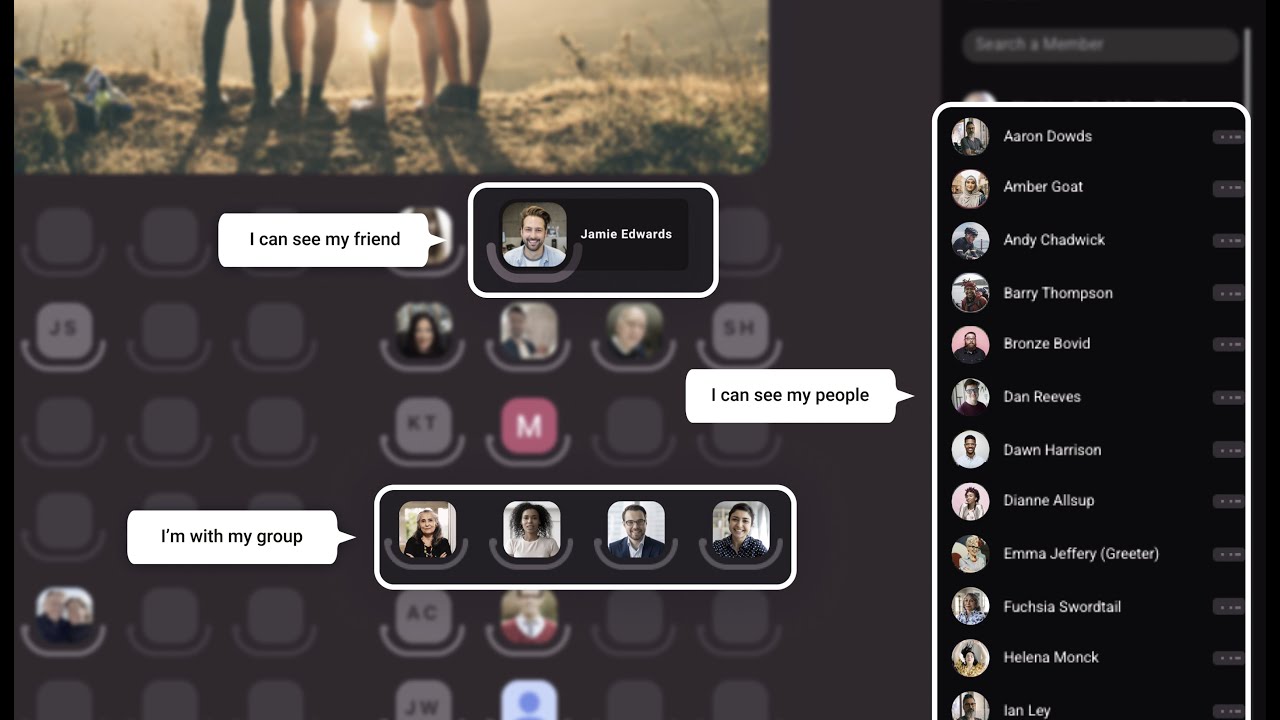
So what we try to do in Altar is really build a platform that allows that peer-to-peer connection to happen. So on Altar, you can do things like sit in a row with somebody else and be on video conference together while you're watching the live stream, and you can jump between rows or between tables to be able to go see other people and say hi to them. You can also watch at a distance if you don't want to be participating in video conference, but for those, you know, first-time video visitors or anonymous people who are joining your event, instead of just either jumping into a just a straight on-demand live stream or a room full of Zoom people that you don't know, you now have the ability to actually slowly get to know people. I'll give an example of a church that we work with.
··
Within Canada, Elam Church they had somebody who's been following a few people. Actually, what I'll give: two. One has been following their posts for a while now. There are a PhD candidate in Brazil moving to Canada soon, looked up their church online, hopped into their altar service and was able to go meet people at the church that he's going to come see, you know, when he moves to the states. And he now actually knows what they're, they look like. He has a friendly face when he gets there because he was able to actually interact with people.
··
Another lady who filled out a connect card on their website ended up coming to a service, sat down in a row with a pastor, and again, same thing was able to actually go that one step deeper than just becoming an audience member to actually becoming a community member.
··
I love these ideas of trying to, I mean, what you're talking about is creating community in digital space. So often the weekend services, the challenge is really: who are these people that are watching these services? And you know, with Church Online Platform, and once again I don't want to disparage that, but it's really centered around that text-based chat that sometimes as little as ten percent of people are actually engaging in. And so very few people are active in chat, and it's a lot of work to kind of get to that point. Or it's the connection card, which often times people aren't wanting to give that much information, especially if they're cold to Christ or even called to the organization.
··
And so really, by kind of merging this webcam, you're helping pull people out of that isolation and starting to create better experiences. You're starting to get people connected into the community and pulling them out of that church in isolation piece. And I love that because now there's, it's you're starting to chisel away a lot of the challenges that has come around, that have been people have been working through, that church has been struggling with, looking at this digital church.
··
Now, Rob, through LifePoint, you've been experimenting with Altar Live. And Rob's part of Futures Group, Estadia, some of the churches that we do a lot of specific, real deep coaching with, trying to help digital and multimodal. A lot of the crazy stuff that we talk about here on the podcast, Rob's a guinea pig. And so really, just with this Altar Live, we wanted to see like how it worked and what were maybe some of the use cases for it.
··
So like with you specifically, what have you seen? How has Altar Live connected and helped within your church expressions? How are you using it?
··
Yeah, um, I was thinking about that as you were asking Andy and Stephanie. Like, what problems were you trying to solve? Um, and I guess around March or April, you know, experiencing the virtual world using lots of different technologies and conferencing software and all this, um, and realizing where we are like a milestone in church history. Like we're gonna get to do things and innovate like never before. It just got me thinking. Um, one, the immediate thing was get up online quickly, and we're able to do that with Chop, and you already talked about that, Jeff, and just the huge gift it is to the kingdom. Um, but then quickly realized we had lots of viewers but not engaged people. Um, and that was the driving thing for us was: how can we create more community? How can we get the folks that, yes, I think Stephanie you said like a metric will be how many viewers, you know, all right, well that's a big number, but I'm only seeing in chat like, you know, maybe a handful of those that are engaging.
··
So how can we get folks that are doing church out of isolation and engaging? And that's, you know, I think I originally saw Altar Live even before Jeff giving us the opportunity with the Futurist to be able to experiment. I believe you were running some Facebook ads at some point in the fall, and I saw those and clicked on that. And then timing-wise just saw Jeff. And so that requirement of looking to engage or people who are coming but get them to get into community was a big thing for us.
··
Yeah, and one of the cool things I think, Rob, that we've seen you guys do on the platform too is your block parties, and how you guys are trying to create again smaller, intentional groups. The way that small groups have become a really important heartbeat of a for community, the same, you know, you guys are trying to see: how can we do these online? Even going forward, what does it look like to help people not just connect with our church and its content but our church and its people?
··
Yeah, I think you're talking about like we got, I guess, two big use case buckets that we have. A church we call our church on the block environment. These are expressions of the church throughout the community. Austin Abney's leading that up here for us. And so there are a few of them meeting now. They're going to be a whole lot more. And it's leveraging so there's that physical. They're meeting physically, and we've got digital content. And how do we leverage this?
··
And so yeah, Altar Live, that's a big thing for us is how we've got gatherings of people. How can we facilitate, yes, show the content, but how can we get the community getting around tables or rows? Um, and that's definitely an area. The other big use case for us is we have our women's and men's ministries that have been meeting online. So everybody's online. And then slowly, late fall, early beginning of the year, they're starting to meet. Some of them are feeling comfortable meeting in a home, but then others are staying where they are. So we've got physical and digital. How are we gonna combine that?
··
And so again, I'm thinking, okay, if we can get a camera in one of them with a live stream going to Altar Live, and we can make this multimodal experience where they're created like they're in community and the technology, like they don't have to worry about technology. So that's the experiment side of this. And when I think that's probably about when Jeff said, "Hey, how about if we allow you the experiment? We'll take care of the first two months." And that I was like, "Oh, these two big use cases for us, um, really, really helpful beyond looking at it for our worship experience as well."
··
Yeah, I love that, Rob. I do think small groups is, going forward, when we think about online ministry and online engagement, there is always going to be room for thinking about content, algorithms, SEO, all those things that are a part of the world of online. But beyond that, the small groups, how do you then turn those engaged or those audience members into people who engage in some of the other activities or opportunities that they have to connect relationally?
··
I think one of the other cool things, use cases that I don't think we actually ended up using Altar for this, but we've had a few other churches do this. Um, you can think of so many things that our world has now learned to do online. One of them, a few that just come to mind: memorial services. So we actually just had a church do a memorial service on the platform the other day where, um, people, you know, they had it in the building, but they also had, about it was a very well-known member of their community, and about forty people also joined on the Altar Live side who actually got to see people that they knew and have a deeper interaction besides just viewing it alone in their own home on a YouTube page. Instead, they really got to feel like they could honor this person by being together and, you know, talking in her memory on this event. That was a really cool one.
··
I've seen churches do movie nights on the platform. So they might show an episode of like The Chosen and invite their church to come and watch together, and then use the lobby afterwards as a time of discussion about what they're seeing. Something that you can invite other people to, again, because it's low barriers to entry is one of the beauties of online.
··
I've seen others do youth group on the platform. Some fun things there when it comes to allowing youth to not just be on one giant Zoom call, but really also, you know, connect within each other more interpersonally. Conferences, small group fairs, things like that we've had on the platform as well, where again, really thinking about creating an intentionally meaningful time with other people.
··
I was just going to say you mentioned a memorial, and I had, you know, sadly I had to do one over Zoom mid-summer, and that, I mean, it was fine. The family was so happy to have that technology so others in other states could be viewing. But we had a case, and Andy was, I texted Andy on your chat line one night. I was like, "Hey, if the family's okay, I'm thinking about using Altar Live so that it's, it just feels better than a Google Meet or a Zoom memorial." And we didn't get to use it in that case. The family didn't decide to do it. But it was the fact that it was different because you all know, like, everybody's tired of Zoom and Google Meet. But then add to that this significant event in somebody's life, family's life, that, um, just the simple fact that it looks different is huge. Like, and I, you're not trying to be immersive, but there are elements of what you do that get to that a little bit of an immersive experience. Um, and so that was why I was like, "Oh, this is another way we could use this."
··
So yeah, I mean, that immersive part of it is definitely a big thing we tried to aim for. The, you know, and Zoom, you've probably had the experience like Andy said. If you're kind of once you have more than five people, you're mostly listening to other people talk instead of participating in the conversation yourself. So on Altar, we really and try to intentionally allow people to choose who, where they want to go, who they want to talk with, and really recreate some of those organic conversations that happen when you just happen to bump into somebody in the hallway.
··
We lost a lot of that when we went online because it became a unidirectional conversation. But really, you know, democratizing, as we like to say, or flattening the hierarchy of conversation has really helped deepen levels of engagement. And ultimately, people come back to events where they feel personally connected. That's a, you know, we know that about in-person experiences. We spend a lot of time thinking about how, you know, first impression experiences, how we make someone feel known and seen when they come to our church. The same thing has to happen in an online space. People need to be known and seen.
··
You also allow people to not be known, which is also good for, you know, what I mean? Like, um, in the, uh, in a meeting space, the digital meeting space, and those technologies, it's boom, you're there unless you, you'd, you know, shut off your camera, and then you're like, "Oh, what are people thinking?" But you allow, you know, your software just having that ability to enter in and be unknown but allow myself to be known when, or to look around the lobby and see who's there. "Oh, I see a friend. I'm gonna go up there and virtually tap them on the shoulder," you know, the equivalent of that in the digital space.
··
Yeah, exactly. The balance of anonymity, being a fly on the wall while also, you know, taking that first step to actually meet someone and be known. Ultimately, I think the more that we give people control in those situations, I think the more comfortable they are engaging in that. Like, even in some use cases that I've done, I'm attending a church plant and starting to get involved with the church plant down here in Miami. So they're not even doing physical services. They're still kind of doing pop-ups and things, but the core group has been getting together for a Zoom call. And so it's been thirty to fifty people on Zoom where...
··
There's like a master teacher format we're actually going through or we were going through, Pete's Cazeros, whatever, healthy relationships, you know, good, great material, good, great stuff. Falling like a baby, it's hilarious. Uh, just personally, like it just was really good. But coming out of that, it's, you know, you're together with like 50 people and 50 people in a Zoom call is is the worst of Zoom. Uh, because it's only, I'll say it like, there's only one person talking, maybe two, but you can't open up the mics for all 50 people because if four people try to talk out of the 50, and it's so big you can't read body language to know who's getting ready to talk and who's not. And so all of a sudden it's just your pandemonium. And so, and we were setting up for the small group. They were playing like a jam track in the background and there's like a slide they were trying to, you know, create this vibe doing the best they could with the Zoom tool. But it's funny, it's like I want to talk to that guy right there. I want to talk to square number 17. I want to see what's going on in his life. I am not in his. When we break out into the breakouts of Zoom, I'm not in square 17's group, so I don't know what's going on. I wanna, I want control. I wanna have that side conversation. And dang it, the little like, I am via text thing, that's that's not good enough. The year is 2021. I should be able to have a conversation with the guy.
··
Yeah, that's so 2020, Rob. Uh, Jeff, that's that's so 2020. Get to get that out of here. But and that's what, by giving control, you're allowing people to do that, Rob. What are you thinking?
··
One of the things I missed was in the physical space as a pastor, I would walk the lobby. Yes, I'm not like, no, and I can't be anonymous, but I missed being able to go and see a person who maybe is just hanging off to the side and I want to be able to go and talk to just them, not the whole group. And so, um, having that kind of capability is so important because it helps bridge that gap into the physical world where I was used to doing that, even in the auditorium, to be able to go and see people that are sitting on the road and go and speak to say two or three of them versus standing on stage. I don't want to do that. I'm going to be teaching in a little bit. I just want to talk to Jeff, you know, Jeff and Andy and Stephanie. So yeah, I missed that too. I wanted that control.
··
Yeah, we see that, right? Almost, I would say every church service. Um, so there's two, they're basically two parts of it. There's the live stream event, uh, where people sit in pews. Uh, if they call them pews in their church. Um, and then afterwards, and sometimes even before, uh, what we call the lobby, uh, where people sit at tables. And so there's no big lie. There's no big video screen that everyone's watching together. Instead, they're just like us here. We're, they're looking at each other, seeing each other and having a normal conversation. You can name the table something, right? Every single church service has a table called "Meet the Pastor." And so it's either one mode of the pastor sits there and then people stop by. It's like, "Hey, Pastor, good to see you," and maybe it was the one who gave the sermon or not, or just like, you, like Rob, the pastor goes around all the tables, right? And uh, they don't have names. It's just, "Oh, there's, okay, there's Stephanie sitting at that one. I haven't talked to her in a few weeks. Good to see her," you know? That so that sort of dynamic we see. Um, there's some churches who are kind of breaking the rules, or right, I should say writing some new rules. Um, my favorite one is what I call uh, "Sunday on Monday." That there's a bunch of people who don't make it to the live livestream, and so they'll watch the worship service and the sermon um on demand later. But of course, they're watching it so low they can't participate in the chat. The chat's old now. Um, so what, but the thing is, there's more than one person. There's quite a few people who go see it on demand later. Some of them are working. Some of their visiting family. Um, they already say it. Some of them uh are in their soccer league or some, not during COVID, but uh, you know, I know my church has fought little league tooth and nail. Um, but they're regularly missing Sunday service. And so what these churches are doing, it's like, "Well, we're going to have the exact same service. It's now recorded, so it might have been live at the time, now it's recorded. We're going to do it again on Monday night at 7:00 PM or whatever day or time." And now, and that's it. It's an event. It's not on demand. It's another event. And so go at that time, and all the other people who missed, they can now sit in rows together, so the tables together, and now they have community. So they didn't have to sacrifice community. They're doing more than on-demand livestream. They're they're still part of the life and rhythm of the church. Um, so that that's the one I really, really like. I call it uh, "Sunday on Monday." I wrote that down, Andy. That's beautiful.
··
Another one I've seen too is some churches do a panel discussion with the pastors or church staff about the sermon. So thinking about how to really take what's happening on a Sunday morning and stretch it farther, like it doesn't just have to sit on Sunday only. Like Andy said, Sunday could actually be a different day of the week that this happens. That's one of the beauties of online. But I've seen some churches do panel discussions on the platform. Well, they'll have a Q&A with the pastor or several people, and again move people between kind of that auditorium room and then to the lobby where they can actually, you know, talk with each other and then back into the auditorium to facilitate some of that inner dialogue between members as well.
··
I wonder if we'll ever get at a point where you can have like a flash worship where people are going on demand and all of a sudden you set a metric like there's there's 14 views going on. If we can all assemble them together and get in a worship space, I don't know. That's exciting to think about.
··
It is exciting. I mean, that's one of the beauties of digital is you can have church anywhere. You don't have to have even necessarily a highly produced event either. I think that's going to be a really cool thing that comes out of post-pandemic, you know, is is realizing what what is it that people come for to church? They sometimes come for the content, like how great your preaching is or how great your band is, but they really stay for the people. And I think that that aspect of it is what people want. They want to be able to connect and have a personal connection with somebody um in this space. So having tools that actually allow you to throw that up a lot easier and with less headache is I think where technology is catching up to now.
··
Well, I was just going to double down on what Stephanie said. Why do people go? And um, about um, about two months ago I saw a Barna study on prayer, on about online prayer, and uh, the the part that really struck me, it was that uh, 30-something, 32 percent of people of non-Christian faith, they have faith, it's just not a Christian faith, would consider going to your church online, but not for Sunday, but yes for prayer. If they were, if they went there and someone prayed with them, for them, presumably for them, right? And that 24 of people have zero faith, agnostics, atheists, or maybe uh, spiritual but not religious, would also consider going to your church. They would never go to your church building ever, probably not even for prayer, but they would go online for prayer. And so that's something that we're exploring with a number of churches of really using Altar Live and mostly in the lobby side of it uh for prayer, for like a prayer chapel. It might it might be before service, during service, after service, maybe totally different day of the week. Um, and so what they'll do is they have their service. They have a lot of people watching on Facebook where they've been watching for months and months and months. And then somebody says in the chat, "If anyone would like prayer, click here," and then bring them over to Altar Live. And then now they're in a face-to-face in a one-on-one intimate setting. It's probably someone they don't know. Um, but if that's the power of prayer, is you don't necessarily have to seek out somebody you know, but someone who's going to intercede for you. Uh, that's that's been very powerful. So I'm I'm personally I'm moved by that, that we have a platform that is helping you know uh let that take root. You can start to see here where this tool, and I want to call Altar Live a tool, it can be used in many different ways, but it's it's taking you in a deeper place and a deeper relationship with people. I mean, we're talking about doing prayer meetings and we're talking about doing using this for um for to do master teacher small groups, staff meetings, just different relational tools. That's not, these are unique use cases really in context of what church online would look like. The majority of people would look at a tool like Altar Live and be like, "Oh, it's a church online platform competitor. Let's just play our service in there. Just do it as is and people can then talk." But really, if if you're not, even when it comes down to the programming, if you're not willing to adjust and change to be more conversational, to be more relational, more open-ended questions with some of this content, you're not going to get the engagement. And and it really gets down, actually, one of the one of the first Altar Life services I attended was that it was it was a physical church that was just streaming their service, and it was basically the same type of thing you'd see on top. And and I sat next to this lady um in a in a row in Altar Live for you know 55, 65 minutes, and it was awkward because there was no interaction points. There was no dialogue. There was no opportunities for within the service programming for me to say, "Hey, I'm Jeff. Tell me your name." I would have been willing to do that. She would have been willing to do that. But because it didn't fit within the program, like because there wasn't an opportunity for us to dialogue together, for us to pray together, for us to to challenge each other spiritually, and this is what the tool can do, but it really just needs churches to be willing to maybe look at what the offering is, at least in context of the weekend service and even beyond that, and realize it's much more dialoguing.
··
Well, that I mean, that's the big thing. Like we say that, you know, there's been a big shift and of course, "Oh, we're all online now," or something like that. But what you just described, would at least any church that I've been to, would it would never happen in the pews, in the rows. It's not like the pastor doesn't say, "Okay, everybody, let's let me stop talking and now everybody talk amongst yourselves," right? And um, some people might not be comfortable with that. The pastor might not be comfortable with that. But that could be perfectly normal and better uh online. So rather than replicate, you know, what we've always had, um, trying new things, so like I'm writing some new rules. Uh, so I'm encouraged by what you say, Jeff. I haven't seen too many churches change that yet, uh, even in Altar Live. It's usually the things outside of the Sunday service where you see a little bit more uh of new formats. But I do think it's coming. I mean, I think you're spot on, Jeff. I mean, what what are you know, what do Andy and I see as challenges in transitioning churches um when they are coming to the platform? It's always a two, two-sided thing. There's one is the technology side. Anytime you introduce new technology, it's a behavior change. Even if you change your phone number, it's a behavior change, you know?
··
And then the other side is the actual strategic. What does it mean to do discipleship online? What does it mean to have a service online? What does it mean to do prayer online? The playbook of in person doesn't isn't necessarily a one-for-one correlation to how you do online events. And it does require some creative thinking. I think that area is where the church is starting to get caught up. I love what you do, Jeff, in that space. I think there's a lot of great churches that are getting creative in that space and consultants doing the same that I think is sometimes where we feel the tension of Altar being a little bit further ahead of churches and like, "This is what we could do now, we just gotta get there on the other side."
··
I mean, the very practical side that we see go really well is the behavioral change when it comes to technology. The good news about that is it's not rocket science. It's just time and you know, having a strategic vision in the right direction. So when we onboard churches to Altar, usually it takes about thirty days really to take the training wheels off because if you think about the number of members of your team that need to really get on board, we usually do a few dry runs or in parallel to a Sunday service to start getting it a little bit more acclimated. By you know, in those first thirty days is really where people are starting to dip their toes in and start running on the platform.
··
With any platform, the most important thing is social momentum. You need to have critical mass as well as people who are going to take that first step to kind of set the norms. Like you, Jeff, said on that call or on that Altar service you went to. You know, ones that I've seen Altar services that go really well are ones where there are specific online hosts that have become a little bit more familiar with the platform and they're the ones like hopping between tables or rows. They're kind of setting the behavioral standards of what you can do on this platform. Because when anybody comes, I do this in Facebook groups. When I come to a Facebook group for the first time, I'm like looking to see, "All right, how much do people share? What's too long of a post? You know, how should I act in this space?" The same thing has to happen in online environments. And so that's why it takes a little bit of time, but it is something we do with a lot of churches when we onboard them to the platform.
··
Stephanie and Andy, do you guys find that as you onboard people and they bring in other staff and maybe key volunteer leaders as they start to experience something new, do they start to come up with ideas themselves and start to go, "Oh, we could use this in this way"? Do you see much of that?
··
I'll tell you, I was just on a call with a church the other day. We were doing the demo of the platform. It was actually my second demo with them because I talked with the lead pastor and then the lead pastor brought his volunteers on. And then in the middle of the demo, one of the volunteers like, "Wait, wait, wait, let me go grab..." and I forget what her job title was. She was like, "Let me go grab this lady," and she did something on their team related to, I think it was marketing and other things. And she was like, "Quickly, could you just repeat that part?" And then they had a side dialogue in the middle of our demo. They were like, "Oh, and we could use this for this and this and this." And it just gets people's brains spinning of both a pain reliever when it comes to what you described, Rob, using all these different platforms to try to patch it together. I mean, when they describe to me how they run their Sunday services, I was like, "Oh, that sounds like a lot of work." And then the second is, "How do you actually get to do the thing that you signed up to be on church staff for, which is minister to people?" You know, that's I think one of the most rewarding parts for me is when people light up realizing, "Oh, yeah, there's some technology here, but more importantly, I actually get to connect with people. I could empower members of my community to engage with one another. I could actually feel like I'm using my skills and gifts to make people feel welcome or to go to that next level. Or I could actually pray with people if I'm somebody who is really a prayer warrior in my church." So some of those things I think are really exciting to see when people's brains start going.
··
Yeah, I actually think you're going to see a movement in the coming months. I, you know, somebody the other day asked me, a pastor friend, "Hey, Jeff, are you disappointed that you know, buildings are starting to open up and people are starting to go back physical? Like, and this is the end of digital and digital and hybrid and all this because we're all going back to the building?" And my response was, "I'm ecstatic. I love the fact that people are going back to the building, but we still got a long way to go because for months during this entire COVID season, the digital has had to play the role of physical and digital for the established church. And in trying to be everything for everyone, it challenge has been, it's really been nothing for no one because you can't do digital-specific things because, and I don't want to like overstate here, but the physical people, they don't understand, and you're trying to reach the ninety-nine instead of going after the one."
··
And I think you're going to see a renaissance of digital ministry because you've got staff. I mean, and Rob's a great example of this where he's understanding this now because he's had an eighteen-month intensive in digital ministry. Thank you very much, COVID. And coming out of this, the churches that are still leaning in and realizing, "Hey, digital is more about relationships and disciple-making than broadcasting that service," and if we can really embrace that idea now, yeah, I think you're going to see churches. Some will go back to the building and wipe their hands of it. I've already seen churches trying to sell off the video encoders they bought, you know, gun to their head in the COVID season, because they want to go to the building. And that's great, go back to the building. But those of us that want to run, let them run. And that's what I love about Altar Live is it's a tool perfectly designed in the right season to allow a church that wants to run. It's you're giving them the power to run at a depth in a relationship level that I don't know that there's many other tools out there that actually do this.
··
Yeah, well, thanks, Jeff. I mean, that is exactly why we created the platform, really to try to beat the algorithms of just comments, likes, and shares, but go deeper. That's what church is about. I mean, that for us it's no different than any other church. We're trying to make disciples. And we just say the phrase, "Help people follow Jesus, live like Jesus, and help others do the same."
··
Well, I want to look for tools that I can put in the hands of our different environments that are going to help multiply the energy, is going to multiply disciples in our area. And so love that I get to experiment with Altar Live, and we'll continue to look at that.
··
So what's next for Altar Live? Like, I'm looking, okay, yeah, I am looking for like an insider tip here, some mic drop. Something I don't want to get a dev mad at me or anything, but what's on the roadmap? What are you guys working on?
··
Oh, what is next? Well, you can imagine our product roadmap has been very long since the day we launched. There is just so much cool stuff that is coming out down the road. So I'll say, if for those who have tried the Altar platform or are looking at it, what's coming? So first and foremost, feature for feature, we are matching Church Online Platform. I think that is, there's a lot of great features on there that we have learned from and we've seen churches use. So you will be seeing things like announcements, equivalent of moments, coming to the Altar platform. Polls and Q&A, more moderation for the chat as well as for your hospitality team. You can imagine on a platform like ours where there's video conferencing too, there is a sense of wanting to create an environment, some facilitation. So hosts will be able to assign people to seats, remove people from seats. So you could imagine, I've had some churches do this actually even without this feature yet, but their online team will be in the lobby. I was sitting at a table with someone and one of the online hosts was like, "Oh, talk to a lady." She's like, "Bethany, you should really meet this other person. Let me go introduce you." And then they went and left to a different table and this person introduced them to each other and let them talk and then left and did the same. She was just like floating around the event. So imagine that kind of like being an usher and taking people to their seat, really helping take the first step so that people feel welcome. So you'll be able to do that with more and more tools on the platform.
··
Then we have some other things coming out, bigger picture. So small groups. The day after we launched Altar, the biggest requests that we've gotten on the platform is increasing row size and table size. Did Rob, was Rob one of those? I think he might have said that. Did I say that? Me? Yeah, so I we've been working on increased size since early fall. So that will be coming out over the summer as well. It'll come out in a few ways. One is going to be an ability to do small group video conferencing on the platform, so essentially replacing how you use Zoom. So you can spin up just standalone video conference events where you can share your screen, you can have videos, you can do breakout groups from there into the lobby state and back. And you can use that for your Bible study, small groups, leadership team meetings, all of that.
··
The second that will come out will be the ability to have meetings from inside an auditorium-style event. So now you can imagine you could have spin-off classrooms where you could have a before-service Sunday schools, like literally like classrooms as you would probably send people to before a service in real life. You could do the same on Altar where they enter in the event, they go to the classroom they want, and then back to the auditorium where they can watch the service together.
··
Then thirdly, you'll see increased row and table sizes. So our number one most requested feature, you know, will be, you know, it'll first go to eight and then twelve. So you'll be able to accommodate more bigger groups on the platform as you go. Obviously, there's no limit to people who can join events on the platform, but the amount that are doing video conferencing will increase.
··
Then we've got lots of other fun features. I mean, I could keep going on with coming down this roadmap, but definitely on the analytics side, there's gonna be a lot of cool things there about engagement. So not just attendance and time watched, but how many people talk to other people, how many people sat with other people, who are your most engaged members, who are your leasing, you know, we're not going to give you data on, you know, "Did Jeff talk to anybody this service? Jeff talked to Rob, yes or no?" But you will see general analytics to be able to, as a host team online, know, "Well, for those who really are engaged, who actually might be good candidates to join your host team or to find a more, you know, find a new role in the church?" And on the other side of the spectrum, "Who's somebody who's kind of a fly on the wall that needs to, somebody needs to take initiative with them to really get them more engaged into the event or into your services?" So those are some of the analytic things.
··
Yeah, those are all them come to mind. Any fun ones that I missed?
··
Oh, those are all the fun ones. Yeah, no, those sound great and definitely speak into some of the use cases I'm thinking of.
··
Provide for a much more richer community that's great. Yeah, the goal is really, I mean we are trying to be a seven day of the week platform, a one-stop shop for to ease the church's need to have to send everybody to multiple different links, but really get the most out of your online events with tools specifically designed for how churches are doing online ministry. Love it, love, love the road you're on, excited to see what's coming here in the near future and what the long term looks like. So let's do this. So somebody out there at church, out there they're wanting to experiment, they're wanting to try it, they're wanting to find out next steps. How does somebody get started? How does the church get started on Alter Life?
··
Great question. Well, you can create an account for free. So our free tier essentially matches feature for feature the Church Online Platform. So if you are just looking to make that basic switch, you can start there. All of our video conference side of the platforms, you can create an account again for free, and there's practice events to just try it out, see what it's like, invite some other people in, poke all the buttons, have fun with it, and really play around with it. Then from there, if a church is looking to get started, we do a few things. So one is schedule a demo with us. We're happy to take you through as a leadership team and talk through use cases and specific needs for your church itself. The second, again, is just to create that account, upgrade to the video conference tiers, and you can get started from there. You can literally run an event thirty minutes after you create an account. So it does not take a lot to get set up and get going. The third thing is we do something called Alter Academy as well. Alter Academy is an opportunity for churches that are really not just looking for the tool but the instructor to help them along the way. So Altar Academy is an opportunity. It's a four-week workshop series where you create a digital ministry strategy with your entire leadership team. So that is, Jeff is actually going to be doing a workshop in there as well, but it's really on models of online ministry, discipleship and engagement online, resourcing your online team as well as growth and launch. So we bring together people who have actually done digital ministry themselves, pastors who have grown their own online platforms and discipled online to share best practices, and then individually do consulting with a church to figure out their opportunities and needs and challenges to get them up and going.
··
Definitely excited about Alter Life. Is the Altar Academy? Alter Live Academy? I won't get the branding right. Academy. Alter Academy. Awesome. It's not live, it's the academy, but we're doing it live or something. I don't know. But listen, any chance I get to help churches figure out how to do this better, churches that are serious about doing this better, I love having those conversations. So it's an honor to work with you guys on that, and I'm sure there's many other things down the road as we just, you know, get some of this stuff figured out. But awesome, it's been a great conversation. Really excited about Alter Live. I want to thank you guys for jumping on, but we're going to land the plane. So this has been great. Check out, we'll put links in the show notes to Alter Live, and Rob, is any of your stuff with Alter Live? Is it not public?
··
No, I'm still still experimenting, and some of those features that are going to be coming in, I get to use. So we can just send all of the church digital audience to your inner office. Me like that would not be a problem, right?
··
Problem? No, no, yeah. Okay, well maybe next time. Well, not this month. Not this month. Do it not this month to kind of keep it quiet this round.
··
So we'll link off to Alter Live so you can get more information there, the Altar Academy, and everything else. But hey, audience out there, thanks for listening and jumping in the combo for Rob, for Andy, for Stephanie. This is Jeff with the Church Digital, and State Interest Planning. Thanks for jumping on. We'll see you next time here at the show. Y'all have a good day.
Auto-generated from audio, lightly cleaned for reading. · Watch the full episode →
