⌕
··
Content without community it leads to consumerism. Welcome to the Church Digital podcast. Through this podcast we'll talk about the technological innovations within the church, but more than tech for tech itself, we'll address deeper questions. Is disciple making possible digitally? How should we approach the digital mission field? Can a biblically grounded church operate in digital space? Oh, and where does the metaverse fit into all this? Whether you're a big or small church, an established church or a startup church plant, the Church Digital's goal is to help churches like yours learn to be a multiplying church digitally and physically. Our heart is that churches like yours will discover a newfound focus on disciple making that will revolutionize your church. And now here's your host, Jeff Reed.
··
All right, hey, welcome. Glad y'all are here. This is the State of the Digital Church Address. Yeah, that may be a little egotistical, but hey, we're having fun, right? Hey, my name is Jeff. I'm with the Church Digital and a whole bunch of other organizations, and I'm excited to be here with you today for the State of the Digital Church Address. I got to tell you, today's March 3rd, by the way. We're doing this broadcast. It'll hit the podcast at some point later on, but I'm excited to join here in this stream and to be with you today. By the way, we're kicking off season three of the Church Digital podcast, and we'll get into later on really the core components of what we're trying to cover here with season three and in the podcast. But myself, my name is Jeff Digital. Jeff Reed, that's funny. And in part of that, I work with the Church Digital. I founded an organization called George Digital. Founded an organization called Digital Church Network. I'm director of Metaverse Church for Leadership Network. I am a digital strategist for New Thing Network. And honestly, I just keep talking on and on. A friend of mine joked with me the other day, "Hey, Jeff, you have so many jobs. Like, your business card has officially become an eight and a half by eleven sheet of paper." And dude was right. And that's actually really kind of funny.
··
So here, let me boil it down, man. I am really excited about the idea of a digital church, and that's really why I wanted to join y'all, to join me, to jump on this conversation. While we're talking about the idea of digital expressions of church, now when I say digital and when I say metaverse expressions of church, I'm talking about an established church that's going into the digital or the metaverse state. I'm also talking about individuals that are planting churches in the digital and in the metaverse environments. And really, as I've got my convenient little AirPods here, this is two sides of the same coin. Yes, there are nuances when it comes towards planting a digital expression of a church, and yeah, there are nuances when you're an established church that's trying to get into the metaverse. And those contextualizations, really focusing on them, allows you to have success as you better understand your strengths and weaknesses in that space. But really, my heart in all of this is simply put to have a heart for the innovator, for the pioneer, and let's call it upfront, the humble disrupter. Yeah, listen, we are people that are championing and doing this in the digital, in the meta spaces. We are disruptors. We are disrupting what's happening within the established church organization. But even more than that, there's an opportunity for us not to be jerks about it, but to be humble in that and recognize that the established models have a purpose as well. What we are doing is we're doing this to utilize different types of people in a different type of discipleship format in a different type of environment to reach a different type of person. And so all of that comes together beautifully.
··
So here's what we're doing. We have been here at the Church Digital. We have always been good at content. It's just been a fact. We know how to do content really well. Between the blogs, between the podcasts, between the live shows, between the e-books, and everything else, we, the Church Digital, have been very, very good at creating content. But the fact is that we've really fallen short in some areas. And this is open confession hour, and we're not going to go that long, but we've fallen short when it came to the community aspect. Historically, we've never really set a good example for the community. Yeah, we've run the Facebook groups and we've done things like that in the past, but honestly, I don't think that is as successful as it could be. Facebook, you're struggling with the algorithms. People are walking away from Facebook it seems in droves at this moment. And so that's not necessarily a good experience. And then there's plenty of other issues that are surrounding the Facebook and like. But listen, and this is really the challenge for the church, the big C church in general, as it's trying to understand digital. Because the heart of this is, without content—with content, we're all good at it. Like, people create content every Sunday, but the content is not good. It doesn't have a purpose unless it leads to community. And so, you know, we're going to get into that here in a little bit.
··
So hey, today we're running an experiment on community. We are broadcasting this live into a platform called Altar Live. And if you've never heard of Altar Live, you've never seen it before, look at this. This is how I tell people: if like Church Online platform and Zoom, if they had a baby, if they got together, they dated, decided to get married, have a baby, it would be Altar Live. It is this beautiful merger in a platform to broadcast content but also to allow for face-to-face conversation, engaging, happening at the same time. So literally right now, we are broadcasting this into Altar Live, assuming all my tech works, which maybe it doesn't, and I'm getting text. I'm not sure what's happening right now. And so right now, if you were to go to thechurch.alterlive.com, you can jump into churchdigital.alterlive.com, you can jump into a community that's happening there in this space and be a part of it. Would love, would love to have you in that conversation because the part of this is that content without community, it leads to consumerism.
··
Now, we can ingest content all along, but community—we'll get into this—community is where all of this starts to get to application. It starts to get to accountability. It starts to get to encouragement where I'm not running by myself. I'm running with people that are encouraging me within the community. I'm not living a Christian life in isolation. I'm living a Christian life needing a knee digital, needing a knee meta, needing a knee with other people. And so this is really the challenge of our churches: not just to create content. We're really good at creating content. The challenge is, can we create a community, a network maybe, to gather people and to connect these people together to allow for the encouragement that needs to happen?
··
This is all based off of a premise. Jay Cranda is getting a shout out here at this moment online to offline. The gospel that we hear in our online world, it has to influence our offline relationships. If it doesn't, then we are basically creating consumers. If we are one way digitally and another way physically, if I am a Christian, I'm exuding the spiritual gifts in digital space, but in physical space I'm abusive to my wife, I'm verbally abusive to my kids, I'm stealing from my workplace, I mean, you're using words like hypocrite to describe me. And so in this online to offline philosophy, we want to see that happen. But also realize, once again, that community is where the accountability comes from.
··
But hey, maybe I'm digressing here a little bit. The state of the digital church, February—where are we? March 3rd, 2022. I got to tell you, I have never been more encouraged. I have never been more excited than where we are right now. And I want to give you the secret. I want to give you the tip right here, person out there that's listening. Digital Church Network, we launched an online community called FAM. At this moment right now, there are 300 digitally minded people. Some of them are pastors, some of them are lay people, some of them are supporters, some of them are disciple makers, some of them are network and organizational leaders. There are 300 people in a Mighty Networks, if you're familiar with it, but in an online community that we're calling through the Digital Church Network, we're calling FAM. And this is a great expression, experience of community because I have been able to encourage others. Others have been able to encourage me. I tell people it's almost like we all have the Pauls, the people that have been there and that are helping us to get to where we are called to go. But at the same time, we all have Timothys, people that we are encouraging as well in bringing up to that higher level.
··
Now, you see, through the Church Digital and all these blogs and podcasts, my gosh, we just came out with network shows and all this, a podcast network. Our traffic has gone up a huge amount in '22. It's been a great year. And so we've got this community, and part of what we're doing, I'll be honest, if we're centering the community around the content, so the Church Digital podcast and some of the other network shows that we are bringing on, we are going to start to broadcast those live weekly this month where you are going to get multiple shows live through FAM utilizing the Altar Live platform.
··
Now, the thing that I love about Altar Live is at the end of this broadcast, I'm going to stop talking, and we're going to let the people within Altar Live start to talk with each other and process and apply and learn. This, you see, like the stuff that I'm coming out with, if it doesn't help you apply and do something, then we're all just creating consumers and we're wasting our time. The purpose is to get you in motion in doing things in digital and meta spaces. So we're utilizing the content to create that community.
··
By the way, and we're just a quick shout out here, we're starting a new show: Digital Ministry Doesn't Have to Be Weird. And I got to tell you, I love this graphic. The dinosaur on his phone, who's got the trendy tattoo on his forearm, plugging away with his headphones on, oblivious to the world around him. That message in itself can speak a sermon. I could go on for an hour talking about that graphic, but we're going to move on. You're going to hear more about Digital Ministry Doesn't Have to Be Weird and a lot of our other network shows here through the Church Digital. We're going to be kicking that up here in a little bit.
··
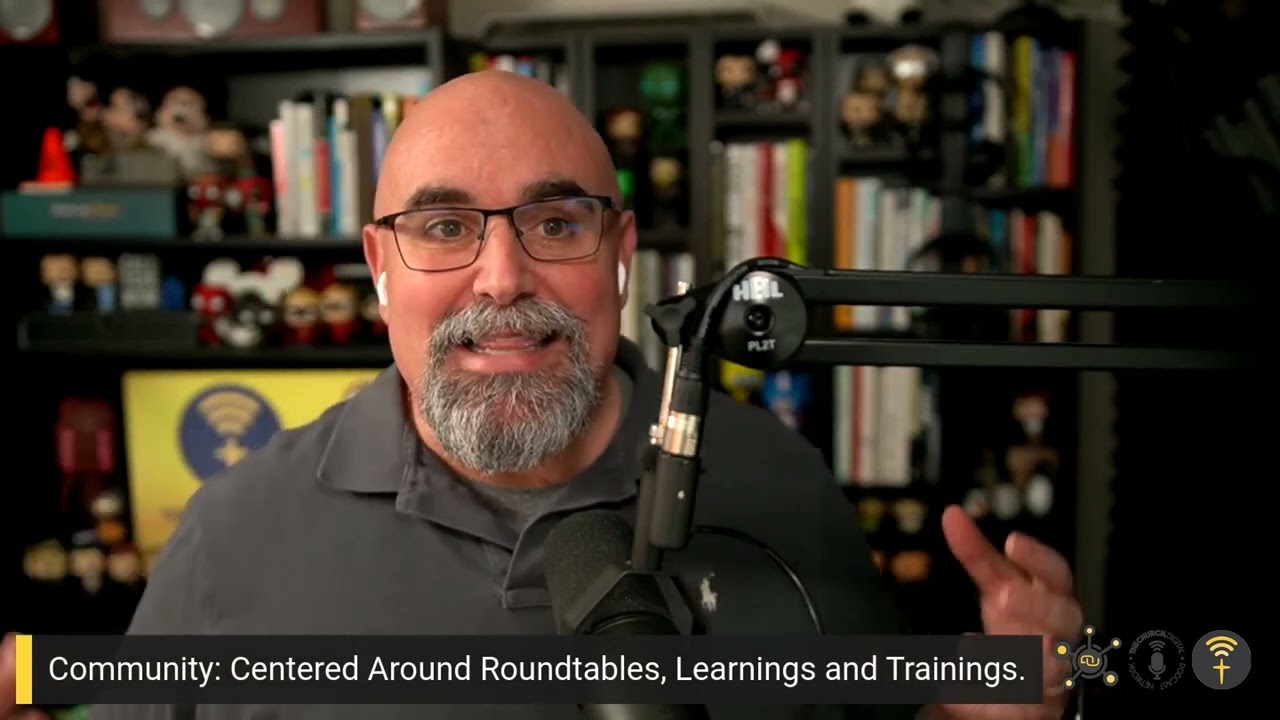
So content centered or community centered around content is one thing, but what we're also starting to pull the thread on through the Digital Church Network tied into FAM here is this idea that community centered around roundtables, learnings, essentially trainings. We're going to start creating community centered around trainings. Now, what is so much fun for me right now is talking to people that have ideas about what they want to do in digital church, but they have no idea how to get started. They don't know who they need to talk to. They don't know how to recruit the people. They don't know how to fundraise for this. They've got this beautiful idea that they are jacked up and excited about, but they just don't know how to get started.
··
And so through FAM, through the Digital Church Network, we are focusing in on creating roundtable discussions where we're bringing in ministry experts to ask questions, to learn from. We're bringing in other learnings and resources, even training centers, to allow for the network people that are part of the FAM to learn how to take the next steps they need to and within the community start to understand how to apply that to what they want to do to their ministry to their lives. Once again, it's not about the content.
··
It's not about learning this stuff. It's about helping you apply it and move forward, and that's where community comes in because community is, once again, the accountability, the encouragement, the things that we need to do to move forward. By the way, some of the recent and upcoming trainings that we've got going on here—we did a VR platform with Pastor Brock and I don't know, maybe five or six other people this week, last Monday night, a couple nights ago, and it was great. I had twenty some people showing up learning about VR platforms, and I think we're actually going to spin up a network of VR church plants that kind of help, once again, creating some community, creating a network, and applying to that. We're doing an emotionally healthy discipleship. Chris Caputo is leading that on. He's doing that early next week. Disciple making movements with Rob Wagner—how to do this disciple making, how to do this multiplication digitally. Rob's going to be speaking on this here in a couple weeks, March 14th, somewhere around there. So look, we're seeing where we're providing these training opportunities, community centered around training, which is beautiful. We want to create community around content. We want to, in addition to the content, we want to create community around the trainings. But the third thing, and I've already said it, teased it—community. We want to be part of encouragement, accountability, prayer, and basically ongoing support.
··
You see, when you create a community in digital space, you're giving an opportunity for ongoing support, for crowdsourcing that long term. I don't need to be able to handle a hundred conversations. I need to equip a community to be able to have those hundred conversations for me. Yes, there are some things that only I can do, but if there's a whole bunch of other things that others can do, and if we can figure out where community can support a movement, my gosh, the scalability and the growth and reach of this—maybe wrestle with some of that in your church. How can you equip your community to support a disciple-making movement so that your leadership doesn't have to? How can you release those people to—maybe you're starting to see a parallel even in context of your own church?
··
At the heart of all of this—all of this content, the events, the training—it all goes for not without the encouragement, without the community, the accountability of community. If we are not applying the stuff that we're talking about, that we're reading, that we're learning, if our leaders are not understanding that, then we're all wasting our time, and there are better things that you can do with your time than listen to me ramble on and on about something that is not helping you in your present expression, your present church experience. So let's figure out within the community how to take those steps, how to help leadership understand better, how to recruit the volunteers, how to fundraise, how to develop the strategy, how to develop goals and benchmarks to go to. There is so much centered around this family, and this family is what I want to invite you into.
··
We were intentional. I've said the word "fam"—this network, this community we've created, we've called fam because for many of us we were isolated, we were alone. There was nobody who was thinking like us. At least in my life I can say that's true, and the dozens of people that I've talked with just this week echo what I've just said. And so there's this huge opportunity for belonging, to connect with people who think like you, who are excited about the things that you're excited about, and who can help the ideas that you have become better through encouragement and through accountability.
··
And so for us, we've launched Digital Church Networks fam. Now, this is the core of what's encouraged me, and I'm hoping it's going to do the same thing for you. Swing over to digitalchurch.network/joinfam. You can see the spelling on the screen if you're watching on YouTube or on the stream. Podcast listeners: digitalchurch.network, j-o-i-n-f-a-m, no spaces. So this is going to get you directly to create the account to be part of it. By the way, all of this is free—the network, the accountability, the roundtables, the live shows. Oh, look, I'll be honest, I'm not sure how we're gonna make money on this, but we're not gonna charge for disciple making, training, and information. Information is free. Execution costs, which is the joy of doing it in fam because by getting some of that execution help within fam, once again, it's budget conscious and able to crowdsource it so that we don't have to charge for it.
··
We want to help scale movements, and we believe in many ways that this fam, this family, this online community, is going to be the source of it. So the state of the digital church, man—get the encouragement you're looking for at digitalchurch.network/joinfam. I have said it many times to many people already. Three hundred plus are in there. The best asset that I know of right now to help see digital churches and digital ministries expand is happening right there in digitalchurch.network/joinfam. So I would encourage you to do that, to be a part of what's happening there in the fam online community.
··
Hey, well, listen, if you want to jump in, we're going to swing over to the application part, and we're going to talk within Alter Live. So if you want to go and jump over to thechurchdigital.alterlive.com—if you're listening on podcast, dude, you're not live. Sorry, lady. It's not happening. Maybe catch the live show. Some of the stuff we'll talk about later. But what we want to do is, if you're in that area, man, let's break up into some lobbies. We're going to send you out here in a minute once I'm done talking. But essentially, the questions that we want you to ask is: How are you encouraged right now in your ministry? What is going great in twenty-two? And how are you discouraged? So you're going to go to tables. You're going to see—they're going to send you out to lobby. There's little icons you can click on to join. Sit down at a table. Others will sit down with you. But the heart of this is we want to have conversations right now. We want the content that I've done to lead to community. And so if you're in Alter Live, awesome. If you're not in Alter Live and you're watching this online, great—swing over to Alter Live, jump in, be part of the community. How are you encouraged right now in your ministry? And how are you discouraged? Second set of questions: How can community help? And how can we pray? So go ahead and take a moment right now. Jump over to thechurchdigital.alterlive.com. And hey, we're going to wrap for this broadcast. This is a lot of fun. I cannot tell you how much fun it is for me working with the New Thing Network to lead Oregon, to lead digitally, this movement, this organization, this network happening. And I'm so excited to be able to take the resources of New Thing Network, Dave Ferguson, and the tribe over there and roll it out in digital spaces for people like you to do effective digital ministry and digital multiplication in ways that have not even been seen before. Super excited. And we're gonna wrap. So hey, for Jeff, for New Thing, for all the freaking people that are on that eight and a half by eleven sheet, we're going to call it a day. Head over to Alter Live, be part of the network community over there. We'll see you next time. Actually, when we start broadcasting the Church Digital podcast live in Alter Live starting here in a couple weeks. All right, y'all have a good day.
Auto-generated from audio, lightly cleaned for reading. · Watch the full episode →
