⌕
··
One issue that the normal church model has is we listen to the pastor and we need to be listening to the Holy Spirit and find out what he has for us personally. Along with listening to the pastor and listening to somebody that's, you know, studied and spent the week really digging into the Word of God, but we need to integrate that into our own lives. And really, that's all I've been doing.
··
Welcome to the Church Digital Podcast. Through this podcast, we'll talk about the technological innovations within the church, but more than tech itself, we'll address deeper questions. Is disciple-making possible digitally? How should we approach the digital mission field? Can a biblically grounded church operate in digital space? And where does the metaverse fit into all this? Whether you're a big or small church, an established church, or a startup church plant, the Church Digital's goal is to help churches like yours learn to be a multiplying church digitally and physically. Our heart is that churches like yours will discover a newfound focus on disciple-making that will revolutionize your church. And now here's your host, Jeff Reed.
··
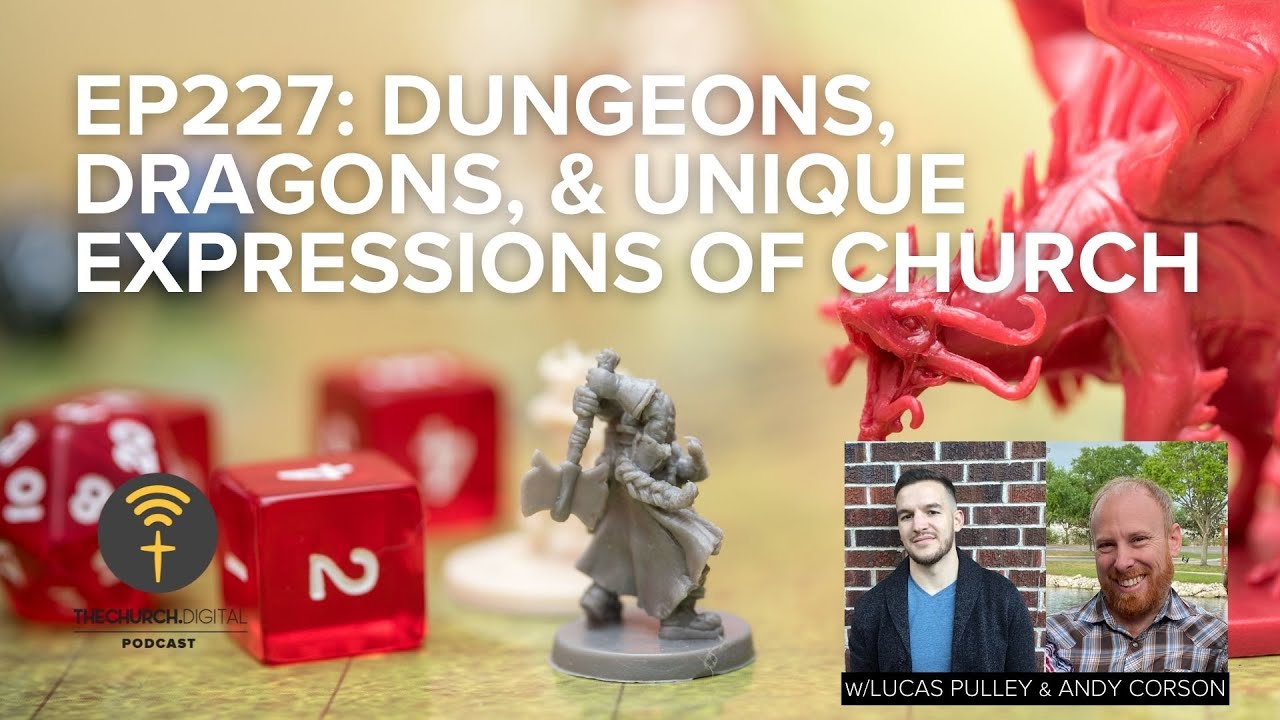
All right, hey everybody, welcome to episode 227 of the Church Digital Podcast. I have been looking forward to this conversation for a very long time. I feel like I should maybe draw it out longer, tease it, but we're just going to get right into it. So I was interviewing Lucas Pulley, executive director from Underground Network here in Florida, specifically the Tampa area and others. So I was interviewing Lucas Pulley and talking about networks and micro churches. We were talking about DAOs, yeah, we were talking about DAOs and blockchain. It was the most all-over-the-place conversation through Leadership Network, maybe three or four months ago, and he mentioned the words "Dungeons and Dragons Church," and just right then I was like, okay, I cannot have this conversation today because we don't have enough time for it, but dang it, we're going to come back because I want to explore what the idea of Dungeons and Dragons Church could look like.
··
So we were emailing kind of after the fact, and Lucas was nice enough to connect me with Andy Corson. And so Andy, welcome to the show as well. And we're going to get into Dungeons and Dragons Church, but then I discover Andy's also run a Bible at the Bar, like church at a bar, and all of a sudden I'm just, my mind is getting blown by all these different expressions of church and how church can look different in a physical building, in digital space, in a bar, in a Dungeons and Dragons game. Like, this is just once again, this is a conversation that I really, really wanted to have. So gentlemen, Lucas and Andy, thank you all for jumping on the show here. It's going to be great.
··
Our pleasure. Thanks for having us.
··
Awesome. So Lucas, why, just a big picture up front here, Underground, you know, I mean obviously we do a lot with Rob Wagner, Casey Underground. You guys were ahead of them on this, maybe the impetus a little bit for some of their mindsets. So talk to us a little bit about Underground Tampa, Underground, what you guys are about.
··
Yeah, a network of microchurches. We want to empower the priesthood of all believers, just everyday disciples to discern their calling from the Lord, their destiny to be a witness to the unreached, to the lost and the poor. And when they have some clarity about that from the Lord, to actually go and plant and develop an expression of the church in a simple way among those people that can be contextualized and meaningful and fully empowered in an intentional community among those people. So we just have a little network here in Tampa of around a hundred of those microchurches, like a decentralized network. And I have the grace of a vantage point of being able to serve a lot of those leaders and help them get off the ground or remove barriers along the way as the director of the network, and being able to see some of them plant, develop, and progress.
··
But gosh, I don't honestly remember how long it was ago, Andy, that we connected. But Andy was in the Tampa Bay area. He and his wife have been kind of missional experimenters for a long time and connected with the Underground many, many years ago. And they've been, you know, you say Bible at the Bar, and I'll let Andy talk about it, but his formal microchurch was Bible at the Bar. But they were doing all kinds of experiments, expressions of the church underneath that general label, general moniker, and reaching a lot of people in a lot of pockets of places that the church would never be reaching. We would often never see or know. But because that's not the point, you're just empowering the priesthood of all believers to be the church among the people and let them go, let them be free, and do their thing. And sadly, it was about maybe a few months ago that the Corson family moved from the Tampa area and went up to Ohio, and we've been weeping ever since. But I'm happy for him to be on the podcast to be able to tell some of their story.
··
Well, yeah, that's what I was thinking. There's this thing called digital. I don't know if you've ever heard of this before. Digital is the capacity of connecting people across long distances together. Like, you're literally talking right now to Andy. It's like we're not on the Oregon Trail anymore. We can still stay in connection. We can still be friends.
··
Oh, it's so good.
··
Andy, like, I would, so as a former Tampa Undergroundian or whatever the phrase is, and I really want to get into the heart of some of these unique expressions, let's just back up to you. Like, what's your heart? What brought you to do things like Bible at the Bar and Dungeons and Dragons Church and all these other things? What makes you want to explore some of that space?
··
Yeah, I used to be in bridge and road construction for like seventeen years. And a lot of the times when I was growing in my faith, you know, kind of wondering, was I supposed to be doing more? And God's like, no, they need Jesus in construction. So I stayed there and did my thing and just, you know, sought him and grew. And it came to a point where he told me, okay, it's time to step out of the boat. I mean, it was, we had gone on a mission trip. I led some students down there, and that was kind of the word for them. And then about a month later, he goes, that was for you too. And it was like, I had a good solid career with a good bright future, and he's like, nope, it's follow me. And he wouldn't say to what it was, just follow me. And plenty of reassurance, plenty of reassurance that it was his voice and that he was telling me that and that it was biblical. It made sense that's what he was calling me to. And so I did. I gave my notice, and he still didn't tell me what it was for. And about a month or two later, before I left, he started showing me some of the groups I'd be reaching out to.
··
And having been in construction and I've loved motorcycles my whole life, I'm a big nerd. It's a real, I'm a weird guy. I'm very strangely wired because the groups I fit into don't usually hang out together, or at least you don't realize that they do. And so the bar community, the biker community, and the gaming community were kind of where God was leading me to reach out to. And so I just started looking at ways to plug in and reach out to those people and just listening for his leading, which some days you wonder. And I ended up getting a job at the local Harley shop, which shouldn't have happened. I'm not a mechanic by any means. I'm really not a sales guy. So I ended up working there as a sales guy for a year, which again, I mean, every one of these are God's stories of, I mean, I had to put on the application and explain in the interview why I left my job, which is because God told me to. So a lot of fun. They hired me anyway. So again, total God thing. No sales experience, nothing like that.
··
You left your previous good job because God told you to. This sounds like a durable employee. Let's hire him.
··
They may have thought you had really good access to the drugs, man. Like, that's some high quality stuff you must have.
··
And so it kind of grew from working at the Harley shop. We worked every weekend, and so me and one of the other guys started doing a Bible study on Sunday mornings for work, and it just kind of grew from there. That's where Bible at the Bar, we would meet at the outside bar behind the Harley shop and do Bible study. And it just kind of started there.
··
Wait, wait, wait. You did church at the bar behind the Harley shop?
··
Behind the Harley shop. It's so awesome. I love this story. That's incredible. It started with me and one other sales guy, and when I left, we had about a dozen people there. And I was more preaching than Bible study, but yeah, it was awesome. I was able to go and talk to them. They had a writer's edge class every weekend for new riders to get their certification, and we'd show up early and give them donuts and they let me share what we were doing. And yeah, it was awesome. I'd literally sit at the bar and preach there.
··
So like, what I would imagine, being in such a public space right behind the Harley shop, lots of exposure, lots of people seeing what was going on, like walking walk-in traffic. Like, maybe tell me some of the stories of what was happening as a result of Bible at the Bar.
··
Yeah, a lot of the outreach was to that group of bikers. I got to know people in different clubs and people at the Harley shop because again, I worked there for a year. And I had one girl that was taking the class come over and use the restroom at the restaurant there because it's connected to a restaurant. As she's walking back, she just stopped and started saying, just started singing for us, just praising God, you know? Yeah, so just awesome opportunities for people to just experience Christ even just in walking by and in hearing that a fellow biker that speaks their language is following him.
··
One of the reasons I'm called to the biker community and the bar community is because you can't offend me with your language. I worked in construction for seventeen years. I've heard it. I've told the jokes before, you know, before God kind of cleaned my mouth a little bit. But you're not going to offend me. You're not going to offend me by drinking in front of me. God's, you know, cleansed me from all of that stuff to where I'm able to kind of in a non-judgmental way meet people where their walls are down. Because a lot of people won't come to church to find Christ.
··
Like, a perfect example was my sales manager at the Harley shop. He was tough, big beard, ex-Army, big truck, Harley with the big hangers, the whole, you know, the whole picture, just the cool guy. And he told me that one day he comes in. He goes, Andy, you'd be proud of me. I went to church last week for Easter. I'm like, awesome, man, that's great. Because I didn't go in. I'm like, okay. He says, yeah, I sat in the parking lot for fifteen minutes and then I went home. He could not bring himself to walk in the door.
··
But we could have a conversation on that sales floor. We could talk surrounded by motorcycles. We could talk about Christ. We could talk about the fact that I told him in an interview that I left my job because God told me to. You know, you're drawn to attention here. We talk about how doing these unique expressions of church, we reach different types of people than the types of people that are in the traditional church.
··
Buildings in your story of your friend in the parking lot, it's a prime example of that where they're not, they literally for some reason cannot go into the building. Did he actually give like this, and I don't want to get like deep into trauma or anything, but like was he just a church guy hurt? Like what was the thing that was keeping him from going in?
··
Yeah, he, uh, I don't remember anything specific. He actually, it was funny because he, um, he ended up coming to this thing called, uh, Alpha. I don't know if you've ever heard of that.
··
Yeah, okay. So we had that at our church, uh, Bay Life Church there in Brandon. And so I was telling him about it and him and his girlfriend actually came and it, we met in the student center. And so I joked that you had to go through the student center first before you go into the big church because I got him that far. It was kind of those baby steps. And then he actually, yeah, he actually attended, uh, the wedding of my wife and I, which was in the main sanctuary. So I joked that I got him into that, got him in the church. So I got him in. It took you getting married to get him into church. But we had just tons of really cool conversation, especially during the Alpha things. It was, you know, he brought stuff up again like, "What did you mean when you said God spoke to you?" And you're never gonna have that conversation until you build a little relationship and they feel comfortable to be able to ask you that. And it was awesome to be able to share and just have a conversation with him without him feeling like he's walking into somebody else's house. He's walking into a place where they're probably going to judge him and look down on him and he's uncomfortable. Like, any time you go into a new place, you don't even, from church people, when you walk into a new church, you don't know where anything is, you don't know what time things, you know, where if there's childcare, what's the process? So it can be nerve-wracking. And for somebody that doesn't attend church, they have no idea.
··
That's beautiful. Tell me, Lucas, let me ask this. Like, okay, so you've got Bible in a Bar Tampa Underground. Like, what's the percentage of, let's let's use the phrase maybe over the top, what's the percentage of unique expressions like this compared to the guy that wants to reach his gated community or his neighborhood or, you know, his workplace? Like, is there a strong percentage towards really these very creative driven ideas, or is it more, I want to use the word safe, but it's not, you know, more typical what you would see in a micro expression?
··
Yeah, I think in our, in our network, and again, um, not by design, and we have plenty of, uh, friend like a city network friends that don't look this way, but it just so happens that in ours, um, the majority of microchurches are very unique, out of the box, really experimental, and they look a little bit more, um, risky or unsafe. Like it would be over half, and it would be under half that just look like, um, very accessible, you know, like house church in a living room or, um, or something similar like that, you know? Um, so, uh, again, that's not necessarily that, that's, I don't think there's necessarily anything like good or bad, wrong or right, just descriptively, that's just how our community has come to look. And, um, I do think we sort of see ourselves as a broad community. We sort of see ourselves as experimenting on the edge of the future and trying to solicit learning to feed back into the church at large. Um, like we're just experimenting both for the sake of the kingdom in our own city but also to learn things that maybe the broader church would find a gift, you know?
··
Um, certainly true of Andy too. And, um, and I think a big part, like even him just hearing him talk a second ago about Bible at the Bar and him talking about language, like he could speak their language, and, um, you know, I think that's part of what has fueled a lot of our really unique expressions is our value for contextualization. And therefore we don't really necessarily have like a broad, we don't really have like a default or broad vision for microchurch that everybody is sort of trying to fit into at first and then maybe divert from. But the base here is nothing. Ever all the microchurches look totally different, and we've intentionally not tried to give kind of like a foundation or a starting point and given people like total, which can be paralyzing. It can be kind of paralyzing, but giving people sort of like total freedom to let the church that exists in their midst kind of be formed around their own calling and gifting and what, and their own language. And that's our value for contextualization. And it's similar to the, you know, I can't wait for Andy to mention some about the little Dungeons and Dragons ministry experiment that he was doing here. But again, I just feel like so much of that's contextualization. Like the way that he's able to reach a group of people because he knows he's wired similarly to them, he knows how to speak their language, he knows how to kind of like fit into the culture. And more than that, he actually knows how to go about ministry, like community, talking about spiritual topics, going like creating some kind of discipleship strategy that makes sense in that culture. Um, and just even hearing like, yeah, we sit at a bar and there's some preaching there. There might be people who are listening to the podcast hear him say, "For a while we stopped doing Bible study and instead like I was preaching every week," and they might think in their head, "Well, that was a bad idea. Like they should just be doing Discovery Bible or something, Discovery Bible study or something like that forever." But the thing is, for that community of people, like sitting at a bar together, like Andy's making choices, discerning with the spirit about what these people want and in what way and in what language. And probably what he's saying in a sermon would never be said in a traditional church or something, you know? Like the stories, the illustrations, like it's just stuff that's going to make sense for that group of people. And the Dungeons and Dragons thing's going to be a similar thing. It's like, even if we could convince these pockets of people to come back to a prevailing model form of the church, bikers, Harley-Davidson guys, Dungeons and Dragons crew, even if we could convince these pockets of people to come back to the prevailing model of the church, which by the way we won't, but even if we could, even if we could, we still have the problem of not being able to communicate in a way that makes sense to them and is meaningful to their story. We don't know the illustrations or the metaphors that make sense for them. And that's why like empowerment of missionaries like Andy, like he's that, he's like, "Hey, I'm wired to kind of be in the lives of these kind of three groups of people." That's exactly right. And I just love hearing Andy and missionaries like him talk about their own stories because you can kind of see how they're making decisions or like communicating about things that nobody else would because it's not intuitive to them. It's the activated indigenous missionary. So, um, I just love it. It's like Andy, you don't even like mean to be highlighting some of that stuff, but it's like stuff that I'm catching and I really appreciate it.
··
How does this, how does this multiply? Contextualization, like Andy, so you understand, uh, the, you know, the biker, you're literally working at a Harley-Davidson bike shop. Like, are you and you're pouring into individual people, the boss and whoever, some of the stories you've talked to? Um, like are you gaining insight? Are you developing leaders to take over and multiply into other areas? Are you focused on your one bar and really just developing that? Like, what's the bigger scope of where, um, Bible in a Bar is going or would go?
··
Yeah, um, funny thing is not that clever. I didn't come up with like an amazing way to go about this, and you know, four-point scheme and all this. And in fact, I think we need to be careful being too clever and just be contrite and listen to God. And that needs to be our message to the people as well, you know? One issue that the normal church model has is we listen to the pastor, and we need to be listening to the Holy Spirit and find out what he has for us personally, along with listening to the pastor and listening to somebody that's, you know, studied and spent the week really digging into the Word of God. But we need to integrate that into our own lives. And really, that's all I've been doing is, uh, just again, I was working at the Harley shop and we worked every Sunday. So, "Hey, you know, we really need Jesus before we go into this place." It was not an easy place to work, and not necessarily the culture, but just as an employee in sales doesn't jive with me. So it was frustrating, it was tense. So it was important that we spent some time in God's Word before we went into work.
··
Um, the D&D study came about because a buddy of mine went to a game shop quite a bit. We played Magic the Gathering, which is a nerdy card game. We played D&D. Again, that's just part of who I am and what I enjoy, and those are the people that we were around. And when I started getting back into Magic the Gathering, my daughter had asked me to show her how to play. She was in high school. I found a shop near work. I walked in, asked the guy to show me how to play, catch me up. And while I'm standing there, I look over and there's all these tables set up and people just come in and they hang out and play and just wait for somebody to hang out with. And God's like, "Nobody's reaching them." It's like, "Oh, okay." And from that moment, again, I was part of the, okay, these are some of the people you'll be reaching. So it wasn't like, "Okay, I need to find a way to really come up with a great ministry model." It was, "I hang out at a game shop. My buddy hangs out at a game shop. I played, taught him to play Magic. Hey, we should do a Bible study in the shop." And so number one, I asked the owner. I think that's an important part of kind of the model of Bible at the Bar at this point is talk to the owner, get permission before you start meeting somewhere for several reasons. Number one, it's respectful, and you're going to be taking up their space. Number two, they know what you're doing. Your first line of outreach is the owner and employees. And now when people ask or have questions, they'll be able to talk about it, which means they may ask you more questions and it just opens doors there.
··
But we just started doing a Bible study there, met up about once a week. And then after we finished, I think that we started with Ephesians, and after that I was like, "Okay, what do you want to do?" And he's like, "Let's do First Kings." I'm like, "Okay, sounds great." This is different. He's younger. He was like twenty, eighteen, or I think he was twenty at the time. And like, that's not your normal, "Hey, let's study this," but this book, you know? And so I was like, "Okay, because you know, encourage them. Heck yeah." So then I started thinking about, "Okay, first thing we need to do is kind of backstory, you know, set the stage," because the first verse is King David's dying. Like, "Okay, there's a lot going on here. He's only the second king of Israel and he's on his deathbed. Like, this is a transition of authority. There's a lot going on here, not just to mention that all the spiritual." But just, and in doing a backstory, it made me think of D&D and just building that world building. And so we started doing it as a D&D style Bible study. We pulled character sheets, and every character that came up, any name that came up, we're like, "Okay, we need to do a character."
··
Sheet for this person, so we need to find basically like every place in the Bible that mentions them or their family line and what decisions they're making and why. Like one of my favorites is alignment. You have basically nine different choices for people's alignment for your character, and it's largely based on why you make decisions, what's your motivation, what is your drive? And in studying the Bible this way, like I went deeper and got to know characters in a way that I never had before. Even in studying the Bible deeply, I never compiled all that and really wanted to know like why is this person doing this? What's their drive? What is their reasoning? And in doing that as well, I can talk to somebody that plays D&D and say, "Yeah, this character, I think, you know, they're probably a lawful neutral," and start talking about why. And they're going to understand that character better than most people that go to church, just because of that concept and that understanding of the D&D world. And I can't tell you how many people came up while we're sitting there with the Player's Handbook and the Bible, and they go, "That's a combination I've never seen before."
··
Yeah, what was the business owner? I mean, I'm guessing he was open to it. Was it good for business? Was it bad for business? Like, what was he concerned about? I'm just curious the business perspective of what he gained or she gained by doing this.
··
So the game shops are largely about people hanging out, so it really didn't detract from any of his business unless they hadn't been or something. We always were conscientious of where we sat and kept that in mind. But he came up to us one week and he's like, "You guys are doing a Bible study, right?" I was like, "Yeah." He goes, "You can put a flyer up on the wall if you want on their little bulletin board." So we were able to do that. And then after a couple weeks, he came back over and he's like, "Hey, somebody was in here the other day asking if we do a Bible study here. Do you have a flyer or something?" Like, who does that? Who goes into a game shop asking about a Bible study? Like, somebody heard something, and it's amazing. Again, that somebody walked into his shop and is asking his employees about a Bible study. Usually they're not going to be thinking about that in the least, and now it's kind of right there in front of them.
··
And we frequent that shop. People know us. People would walk up while we're doing the Bible study and be like, "Hey, what are you guys doing?" Or they'll just come up and start talking. We'd stop what we're doing and have conversation. But those relationships are what give us the opportunity to share in ways that we wouldn't be able to otherwise.
··
That's beautiful. How, what Lucas, what percentage? I'm curious here, because it's funny. I've done some. Let me back up maybe a little bit, and I'm gonna go all the way back to like 2006 here, because I actually, I don't know if you guys are probably familiar with like a Hot Topic or a PacSun, kind of like the head shop that was around back in the day. And so the Christian version of that was called C28. It was based out of California. And there were dozens of them in California. And actually, I bought and owned one. We ran it out of West Palm Beach, Florida. And it was literally at the mall at Wellington Green, which was a popular mall out on the west side of West Palm. And it's back when malls were a good thing, unlike maybe today. But back in the day when the economy was stable. But I, we literally saw a hundred kids, a hundred students give their life to Christ in a brick and mortar mall where we sold. And when I say Christian shirts, you're probably picturing like the Budweiser thing that was like really popular in the '90s and 2000s. These were like cool designs. Like it was more like you're more likely to see skulls and, you know, just a much more graphic image. But we trained our kids, how to like share Jesus, the employees on how to share Jesus while they're sharing, selling the shirt. And through that, I, we just, we literally, I saw over a hundred kids come to Christ in maybe the three years that that business ran.
··
Somewhere along the way, Obama said the word "recession," and the economy crashed. But it was funny. We actually had investors on the hook to open more C28s in Miami, in Tampa, in Orlando, in a number of areas scattered across the state of Florida. And just the economy, everything kind of crashed after the fact.
··
The reason I bring all this up is my story. I actually bought the property, at least the property I was the business owner. In Andy's story, which is intriguing, he doesn't have near the overhead because he is not running either of these businesses. He's working with people in that space. What's maybe describe some of the tensions, pros and cons of both. Are you working with anyone currently that's owning the business as opposed to working with others that are already owning the business? Like, what does that relationship look like in 2022?
··
Yeah, for Bible at the Bar, what we do, again, it's not a complicated model. It is something that anybody can do because I do it in like an outside bar, at the Harley shop, or my wife did it at a coffee shop. I did it at a cigar shop. The game shop, because those are places where we go. I was actually reaching out to trying to reach out to some of the guys at the Harley shop that smoked cigars and ended up at cigar shop and met some Christian guys and we started a Bible study there. But a lot of it is again just asking permission, just to make sure that you're not invading their space. Yeah, you want to come in with permission because again, so they know what's going on. It piques their interest. But you also want to respect that it's their building, it's not ours. And you know, Christians can, you know, the after-church crowd, they're the worst tippers and the worst customers. We want to change that to where everywhere that we frequent, like when we did the coffee shop one, like we're gonna buy the product, we're gonna be the best tippers, we're gonna be respectful, we're gonna be loving. And like, if you can't live it out while you're studying the Bible, go back home to your Bible study until you're ready to talk about it out in the open.
··
Which, that's a big part of Bible at the Bar is doing it out in the open because another heart of Bible at the Bar is uniting the body of Christ because we tend to get in our church and focus in our church and Sunday mornings. We had people from four or five different churches coming and we do our Bible study and then we'd all go to our home churches. So being able to have these discussions out in public so that people can hear, because we agree on like ninety percent, and we need to be able to talk about that and grow in that. And we need to be able to talk about the ten percent that we don't, and we need to be able to do all of that out in the open, not kind of behind church doors till we all agree and then we go out and we're right and we need to tell them that they're wrong. Instead, we need to have these actual discussions within earshot of people, and we need to be discussing and wrestling with things so that they can hear and go, "They don't think that they know everything. They're struggling to follow the Lord, and that's what it looks like." That's not what I thought. I thought they have it all together and they hate me because I'm wrong because I think differently.
··
Just from the Tampa Underground, like bird's eye, I know you were asking like, do we have others in the network that don't just engage a space that they don't own, but do we actually have some folks that actually own that, that stand on the other side of that relationship? And we do. Jeff, I know, I know you know John Dangler. You know, they've got well-built bikes. And so they don't own the property, but they own the business and they're leasing the property and all that kind of stuff. And then we've there's a guy named Derrick that owns a chain of coffee shops in Tampa that's a part of the Underground. And he does it very much from the motivation of being incarnationally engaged with the people who frequent the coffee shops. And so yeah, I mean, I think there are pros and cons to those doing it one way or the other. And you know, we're kind of talking about third places. It's not entirely like the t-shirt store, the C28, that's not totally a third place, but maybe some of those kids were treating it like a third place. You know, they were going and hanging out there, not just grabbing a shirt and buying it and leaving.
··
But yeah, I mean, from Andy's point of view, if you don't own it and you're just jumping in and you're trying to build a relationship with management and then you're just trying to like pop up and do ministry as a customer, as a client, it's faster. And you don't have, I do think there are sometimes there's some weird kind of power dynamics, might not be the right word, but like there's, you're not on the same tier of relationship when you're relating with somebody as a business owner or business manager and they're the customer. Sometimes there's like there's some weird power dynamics or transactional relational dynamics there. And it's easier as just like the customer with other customers kind of convening in a space in a bar, in a coffee shop, at a gym, at a CrossFit gym or something like that. So there's some pros there to like being on the same kind of tier. There's less barriers relationally and it maybe it's a little faster.
··
But on the other side, like being the, we have a lot of people who are going about it from the perspective of not of building third spaces, owning, managing, generating businesses in third places. It really comes down to calling. Like people just feel called to do different things. And but the people who are on that side, they're making trade-offs. There are there's real pros and cons to that other side. The pros are you kind of have that Proverb stuff. Like when the righteous prosper, the whole city rejoices. You know, that's Proverbs 10:10 or something like that. They, as business owners, they actually get to contribute at a city level with other civic leaders and like chamber of commerce and business. And they get to steward their resources and their network of business relationships in a way that's alternative to the way of the world. And so there's a huge benefit there. The way that they use their profits can be really prophetic. The way that they design their space and their policies for their space can be really prophetic to the watching world. So they can have a much bigger impact on a city than somebody who's just popping up in a third place for six months and trying to build some relationships.
··
But again, though, the overlap between religious affiliation and kind of evangelism stuff and also like a business place and some of the politics that can get involved there, like that'll probably get dicey, increasingly dicey over the next five or ten years. And you know, people just embracing that diceyness and complexity, it comes at a cost. You know, and it's something that people have to consider.
··
I was curious, Lucas, like what's the percentage of conversations where people are like, "No, I don't want you to do a Bible study in my business?" Like, I would imagine that's been increasingly so, but I'm just curious what your take would be.
··
We haven't heard that many examples of that. It certainly happened. It certainly happened. But there's not a lot of...
··
Examples we have many. We have much more examples of business owners being open to it and friendly to it. Um, a counterpart to Andy's um Bible at the bar, we also have a beer and Bible. Uh, and they're in there and all the bars that they've kind of uh um propped up in, the management has been very happy to have them. And um and coffee shops where stuff has happened. Schools, I mean it's a different thing. It's not for profit, but when we there, when there's little micro church discovery Bible studies or prayer groups or stuff that pop up in schools, again that's a thing where you kind of imagine there's going to be some resistance. There has been in a couple places, but a lot of openness. So I don't know if that's just a grace of the area thing, like maybe, or a geographic thing or a political thing. I don't know what that is, but that's just our experience. Maybe if you're in a, in a, a much more post-Christian city, maybe you're in somewhere up in the Northeast or something like that, um, you might have a little bit more difficulty around that. But um, we haven't seen it too much. I don't know about you, Andy, if you've had some, some experience because I know your wife was doing coffee shop stuff too. Coffee shop ministry. So I don't know if either one of you have run into any situations where an owner was like, please don't do this. I'm uncomfortable with it.
··
No, we've never had any issues. And honestly, I think, I think with you know the media and all of, even Christian media, uh, talking about the, the issues that we have and and the persecution that we experience, I think we're afraid. I think we're way more afraid than we should be. And you know, really just uh, when I was in construction at one point, I was like, you know, I should take my Bible to work and just have it on my desk. And I would go in early and read my Bible while I ate my breakfast before work. And just having it on the desk, you know, was an opportunity for discussion. And there was a point where there was a difficult discussion, but there was an opportunity for it. And you know, we were, we, I have a relationship with all those guys because we work together all the time. And again, it gave an opportunity there. And when you're going into somebody's business, again, if we can go in respectfully and we can add to their business because if I'm doing a Bible study in your business, that means me and several people are going to come and give you business. And number one thing I want to be a good tipper and be respectful and caring. I'm going to clean up my area. It's going to look better at when I leave than when I got there. We need, you know, I want to to show the love of Christ while I'm there. If if I'm not doing that while I'm studying the Bible, I'm sending an opposite message. So that that's super important. And so again, I've never had any issues. In fact, the cigar shop that we met at, and they're still meeting at, uh, the one of the managers that was working there has started coming to our group after he left. And the my last week, um, his girlfriend gave her life to Christ. Like, it's awesome. Very, very cool.
··
Listen, this has been phenomenal. I'm really intrigued, um, Andy, your goal of, of, of trying to reach what'd you say it was? It was, it was gamers, it was bikers, and what was the third group?
··
Uh, the bar community. The bar, bikers, uh, bikers, bars, and and gamers. Like, what, what uh um, what an unreached people group. Uh, and it's just an incredible opportunity there. And love, love your your heart um, going after all this. Hey, uh, I have an ulterior motive in bringing you all together for for this podcast. So let's see where this is going. I i would love some advice. And so uh, and actually, Andy, I'm gonna connect you to this person because he's in your neck of the woods. Uh, Joey Santos is um, a global integration pastor or something like that for Christ Church up, up right outside of Cincinnati, I believe. And uh, and so Joey's a friend. Uh, Joey reached out to me and he said, hey, um, you know, because evidently I do a lot of work in the metaverse or at least that's what I'm told. And so Joey asks me, he says, hey, um, I'm thinking about doing, I'm thinking about opening a metaverse, a virtual reality bar, um, in in the world called VR Chat, which is like the the red light district of virtual reality essentially. He's opening up, uh, or wants to open up a virtual reality bar in the the red light district, the wild wild west where where pretty much anything goes. There's no parental controls. Um, and for him, he's wanting to do um, not church services out of the bar, uh, but relationally connect in this virtual reality bar. Now, you know, virtual reality bar actually is a thing. It's a million dollar business um, in this space because it runs off of memberships. Uh, they have license to ship alcohol across state lines. Uh, so there's some legitimacy to this business. And they also run back rooms in virtual reality where things don't, or things happen that maybe you know shouldn't happen. Uh, things that may or may not be illegal and are legal. And so as a result of this, there's some stuff here with the the virtual reality bar, of course, we don't want to get into. Uh, but what I'm really intrigued at is his desire to create a community space that's not called church and to draw people into it. And um, long story short, we're looking for partners to to kind of come in and to be part of this as we've, it's funny, as I've talked with churches, some churches love the idea. Some churches are incredibly offended at the idea of opening a bar and instead want us to open a coffee shop, which ironically, uh, difference between a beer with a foam top and a latte is probably just a little different colorization. So I think maybe we could build both. Uh, we could get into it maybe, but but the idea is, man, what if, what would it be like to to start to create some some of these expressions, some of these experiences, some of these locations um, in the space not for church services but for relationally connecting. Um, and so I've got two out-of-the-box thinkers on this podcast. Uh, I would love some insight. Like, what are y'all thinking? Is this a good idea? Is this a bad idea? If you're virtually or not, what what advice would you give for someone like Joey and I who are interested in exploring this space?
··
I do not know a whole lot about virtual reality. I uh, fairly low tech over here. I still even use uh, paper character sheets half the time. I do like that I can still uh, play with my friends and down in Florida on D. But I think if your desire is to take Christ's places and that's where he's leading you, absolutely. I think uh, some of the difficulties are traps is to feel like you have to figure out how to fit in and be a part of them. And it that that's not what we're called to do. We're not called to um, basically sin so that we can get close to sinners. You know, Christ had no problem getting close to sinners, and he didn't water down the truth. He didn't change the message for it to be comfortable. He he just loved him. He he went where they were and and loved them there and made himself available. He went where his Father told him to go. I think that's key because uh, you know, if I was writing Jesus's mission, it would have looked way different. One of my favorite stories is the woman at the well because it says that Jesus had to go through Samaria to get to Jerusalem. But no good Jewish boy goes through Samaria to get to Jerusalem. You go around Samaria. But Jesus had to go through Samaria because his Father told him to go through Samaria. And it wasn't for an awesome huge revival where he was going to talk to tens of thousands of people. It was to meet a woman that was an outcast in her own town. That was it. It was the last place and he should not have been talking to a woman in public. It's like if everything about it was a was a screaming sign of no, don't do this. But his Father said go here and talk to this woman. And because he spoke to that woman and cared for her where she was in the mess that she was in and didn't pull any punches, like he gets, just lays it out for, but in a loving way, because he can speak in the way that she needs. And she goes and brings the whole city. Guy, so just again, following God's lead and just uh, being available and and presenting the word of God. Yeah, you know, we don't have to apologize for it. We don't have to change it or or dress it up. We just have to present it, and those that he's called will come.
··
Great reminder. Lucas, what about you?
··
Yeah, I mean, I think it's a, I think anybody who has like an incarnational missionary mind, like we, we don't invite the people where we are. We go to where people are. And when we go there, we're trying to find proximity and presence and trying to earn a hearing so that we can proclaim the gospel in in relationship with people. Anybody who has that mindset would be like, yeah, 100 percent. If there's a bunch of people living their lives majority digitally and they start deciding socially that they like to hang out in these like VR bars, then yeah, let's go there and let's connect with a hundred percent. So i, i, i like in general the the theory and the philosophy of the idea, like as a, as a missionary, missiologically, um, I think my one catch point would be like, do third places in physical space mirror third places in digital space? Like, is that like, because we wouldn't necessarily, Christians shouldn't um, we shouldn't decide how people should gather and then try to convince them how they should gather and then incarnate. We actually try to observe how they are socially already gathering and then we kind of embed because it's easier that way instead of trying to like design our own sociology to invite them into. So there's a part of me that wonders like, man, the way third places work in the and I hope your audience understands that language like just social spaces work in the in the physical world. We're always thinking like coffee shops, bars, gamer clubs, um, CrossFit gyms, like these are these are decent third place options to incarnationally engage. I don't think it will long-term be a one-to-one in the virtual world. That's an, that's just a gut thing. Like that's intuitive of me. Like I'm not sure if it's just going to overlay to like how people want to spend their social connective time in the virtual world will be coffee shops, bars, CrossFit gyms, or whatever. Like I think if we just sit back and observe how how people spend their time in virtual world, they might actually enjoy socially connecting in virtual space differently than how they connect in physical space. But it sounds like you've already said it's like a million dollar industry, so that there's already some traction there and people are starting to gather that way. So I think like, great, 100 percent. I'm just curious like long-term, the ten-year metaverse future, how do people actually connect, convene, and connect socially in digital space? I think it'll be different. Um, I wonder if it's a little bit more like, if you think um uh, my Minecraft and Roblox, like it feels like people are actually convening around missions or building things. And like, like they go to the same place to build something together or to tear something apart together. And but they're talking to each other the whole time. There's they're socially connecting. They're not sitting their characters down at a bar, but they're doing something together. So I i wonder how that'll look in the future. I i think it's mixed uh, to be honest, and it may be too soon to tell, which is one of the reasons why we're wanting to experiment with it. And yeah, get in there and let's and let's be real. It's this pennies compared to actually building an actual bar or building an activity. 100 percent. But the the truth, yeah, but you're you're not wrong. I mean, like I've I've got friends that are doing Pop One, which is like a Fortnite in virtual reality, uh, Pop Population One video game, and they're doing Bible
··
Studies in pop, one. I've got friends and so it's all around. We're going to use this term a lot: engaging in digital meta versus engaging around shared experiences. Yes, and that's a lot of what is being on mission, and some of those experiences do seem to be in a virtual reality bar. And so who's gonna win? What does it look like long term? I don't know, but it's gonna be fun figuring it out.
··
Well, gentlemen, thank you for this podcast, Andy. It's been a pleasure meeting you. I'm gonna get you connected to Joey. You'll get an email with this here in a little bit, and he will—he'll love some of the stuff that you're talking about. That's right up his alley. And Lucas, sir, it's always great to hear from you, and excited. It's funny like I, in, we're considering moving out of Miami, and Tampa and Orlando with my family have been kind of going back and forth about the future locations. And there's some areas—don't tempt me like this, Jeff. Don't. It's been talked about, summer 2023, we're relocating somewhere. I really think so. So we'll stay in touch, but definitely excited.
··
Yeah, I'm gonna start fasting. I'm gonna start fasting.
··
Well, cool. Hey, but we're gonna land the plane. So gentlemen, thank you for this. For Andy, for Lucas, this is Jeff with the Church Digital, Digital Church Network. Thanks for jumping on the podcast, and we'll see you next time, y'all. Good day.
Auto-generated from audio, lightly cleaned for reading. · Watch the full episode →
