⌕
··
You'll find that VR chat is so large in its player base that it is like a world with many continents on it and each continent has sort of a subculture to it. You'll find that in other platforms as well, but in VR chat because the player base is so big, these subcultures are, you know, are like a deeper foundation created. And so each has their needs and you can really see the hurt within the people that are in VR chat. Majority of the people are depressed, many are suicidal. It's second nature to talk a friend out of suicide in VR chat.
··
Welcome to the Church Digital podcast. Through this podcast we'll talk about the technological innovations within the church, but more than tech itself, we'll address deeper questions. Is disciple making possible digitally? How should we approach the digital mission field? Can a biblically grounded church operate in digital space? And where does the metaverse fit into all this? Whether you're a big or small church, an established church or a startup church, the Church Digital's goal is to help churches like yours learn to be a multiplying church digitally and physically. Our heart is that churches like yours will discover a newfound focus on disciple making that will revolutionize your church. And now here's your host, Jeff Reed.
··
All right, hey, you got the Church and Digital podcast, it's episode 242. Here, man, listen, I am excited about today and this conversation because really we're going to start doing a little deep dive, maybe a heartfelt check here, getting into virtual reality and what the church can and should look like and what the results can be for a church that's engaging in ministry in virtual reality.
··
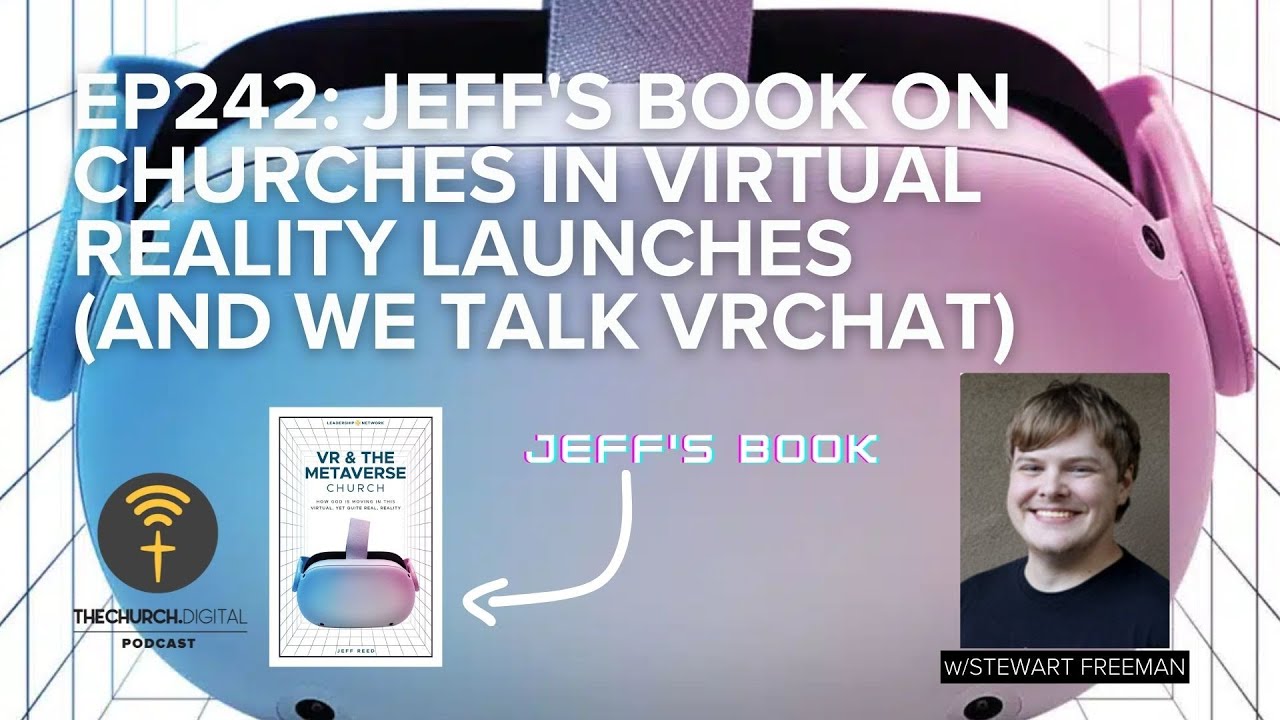
And so before we get into that, like I just want to maybe do some self-promotion. Am I allowed as a podcast host to do self-promotion? I don't do a lot of self-promotion, but I want to right here. So I wrote a book on church and virtual reality and it's published right now. Like you can download it, you can buy it from Amazon, and we, I selfishly, I Jeff Reed, would love for you to get a copy of this book. So I sat down with my Leadership Network friends, published through Exponential, and at the same time we interviewed, oh, I don't know, maybe fourteen, fifteen different people and quoted them. People that are out there exploring and doing ministry in virtual reality. As a matter of fact, today's guest is one of those that's quoted at least once if not multiple times within the book.
··
And so hey, look, if you're interested in the book, here's what I want you to do. Go to thechurch.digital slash VR book. The Church dot digital slash VR book. You can download the PDF from Exponential. The book is free. If you're like, hey, I want a hard copy, or if you're like, hey, I want Jeff to make some money on this deal, you go buy the book from Amazon. The book is free, but if you want the hard copy, then you know, Amazon, and I appreciate your support. Okay, selfish plug over, although we'll probably plug some others in along the way. But hey, for now, let's bring in today's guest.
··
So we've got Stuart Freeman coming in from Cornerstone VR. He is the VR chat director and a longtime friend here, or basically anybody from Cornerstone is a longtime friend here of the Church Digital. And so Stuart, man, thanks for jumping on the show with me.
··
Yeah, happy to be here. Thanks for having me.
··
Awesome. So Stuart, if you're watching on YouTube, is the calm, collected one in this conversation. He doesn't let things ruffle. Like, he's just always, I've never seen him worked up. Ever seen him worked up? I have a feeling maybe, maybe gamer. Maybe do you get worked up over anything, Stuart? Anything? Anything?
··
Not too much. That's pretty cool.
··
So Stuart, why don't you just, you know, a little bit, tell us about what you do for Cornerstone, of course. Cornerstone Yuba City, Jason Poling, Goose has been Jason Poling, JPO Goose as well, Michael's used the business has been on the show several times. And I, you know what, Stuart, I know I've worked with you. I can't remember in what context. No, no, you've been on this show before. We did the panel with you and Angel and Alice. Yeah, that was a good show. Um, but why don't we, we'll link, throw the links in the show notes. It's gonna go backwards, but just for a minute, talk here a little bit. What do you do? What's your role with Cornerstone VR?
··
So I am Cornerstone's director of VR chat. And so I, God led me to build a campus in VR chat and take what they were doing in Alt Space at the time, two and a half years ago, and bring it over to VR chat, the place that I was in before I was a Christian. And the people that I really blended with within that hopeless kind of space. So currently I do a lot of evangelism in VR chat. I disciple people who come to Christ through the evangelism and through the church itself. I'm the director of the church, so I oversee everything, do everything on the back end, get all the social events kind of things like that going, and shepherd the flock over there as well.
··
So for the people who don't know what VR chat is, I don't think they can truly realize and encapsulate how much of a mission field VR chat is, maybe even compared to some of the others. I don't want to discredit one ministry over another, but in VR chat, though, I call it the red light district. DJ Soto calls it the Wild Wild West. It's anything goes from an ethic or a morality level. But why don't you, Stuart, just maybe start to talk to us a little bit, start to explain to us a little bit about what VR chat is and maybe what separates it from some of the other worlds that are out there right now?
··
So VR chat is currently the most immersive of all the virtual reality platforms. And within that immersion, people really reach out to it to find an escape, to find where they could get a glimpse of hope at. And so within that immersion, there are tons of places that you can turn to. Strip clubs, all kinds of just crazy things. Um, and you'll find that VR chat is so large in its player base that it is like a world with many continents on it and each continent has sort of a subculture to it. Um, you'll find that in other platforms as well, but in VR chat because the player base is so big, these subcultures are, you know, are like a deeper foundation created. And so each has their needs and you can really see the hurt within the people that are in VR chat. Majority of the people are depressed, many are suicidal. It's second nature to talk a friend out of suicide in VR chat. Um, and so these are people that are really in our backyard. Majority of these people are United States. These are usually young adults. I would say for VR chat range, um, you've definitely got some young ones, but those are only in the public worlds that everybody tries to avoid. Um, but these are young adults, a lot of them just coming out of high school or college, and they're trying to figure out what to do in life. And a lot of them are really in a depressed stage and trying to find where hope is.
··
Yeah, so I mean, right off the bat, Stuart, you're throwing up, I would say red flags, but things that as we're doing ministry, things that we need to pay attention to. So yeah, I mean, you're describing, you know, it's no big deal to talk somebody off a suicidal run, you know, whatever. Those descriptions you said. But it, in my experience, I've run into several of those types of situations, and for me it feels like it's a higher percentage of that in VR chat compared to some of the other virtual reality worlds that are out there. Is there a reason why? Or why do you think we see more of that on VR chat?
··
I think it's the immersion, to be honest with you. I think because you can have deeper immersion, you can have deeper forms to reach out for hope. And so people are sort of magnetized to that because they can become more real there.
··
So interesting. More real, more immersion, which actually brings more to the surface. I want to ask this. Like, the mental health implications of what you're describing right here. Well, let me ask this. Like, how, what does a conversation look like for you, Stuart, as you're talking someone off the virtual ledge? There's someone that may, like, are they actively saying something? Are they subtly saying something that you're responding to? Like, describe for me maybe how one of these scenarios has gone for you.
··
Me and Goose hung out in VR chat about a week and a half ago or so. And um, he went up on the stage and did his run for the sermon that he was going to do in Rec Room. Um, and he just jumped on stage in Black Cat public world, started saying it, went and did his thing, turned down his mic like he does because it's super hectic and he can't focus if you don't. And um, and in the middle of his sermon, he mentioned that Jesus loves you. And there was a guy behind me. His name was Joe Chicken. And he was the Chicken Guy. Um, and Chicken, I want to say it was Chicken Little, the one with like the little googly thing. Um, and he's got like a really skinny neck and he's like super hillbilly looking. Um, and Goose said Jesus loves you, and he said, no one loves me. He said, I've tried to take my life four times.
··
So um, these are people that are really screaming inside. And that's why it's as hectic as it is in VR chat because people will say anything to get the attention that they're not getting.
··
Yeah, IRL.
··
Yeah. So what did you do in response? Did you pull them aside? Have a conversation? Um, what? And so this happens where this happened then it's just regular VR chat, Black Cat conversation. But I mean, Black Cat, in fairness, is a bar, right?
··
Yeah, yeah, it's a bar, but it's usually where the young kids hang out. So most people avoid it.
··
Welcome to VR chat where we're preaching on a stage in a virtual reality bar. Love it. Love it. Um, very, very interesting. Now, like, the darkness, um, the low, this is something that I really want to dig into. And it's because, like, I'm convicted, Stuart. I don't know many seminary-trained, full-time pastors that can adequately handle a suicidal person in the moment, much less, um, you know, a bivocational kid or a volunteer in virtual reality. And so setting up and making connections and finding ways to properly train people to handle situations like the suicidal situation that you're describing, like I want to make sure that we know what we're doing in that space. Um, but also I know, and you know, actually I want to ask this question, Stuart. Like, secondhand trauma. Um, I've had a number of people tell me just through the conversations that I've had in virtual reality is a serious problem because you're surrounded by the low and the dark, you're surrounded by people that are going through these hard situations. And I've had lots of conversations with digital and metaverse pastors, virtual reality pastors, who feel that weight coming on them. It's almost like secondhand smoke can hurt the non-smoker. The secondhand trauma kind of experiencing that can be a weight on you. And that's not to stop doing the ministry, but it's understanding how to feel that tension, Stuart. Have you ever, as you're doing ministry in virtual reality in the Wild Wild West, do you ever feel some of that tension or some of that weight?
··
Every day. God has made it very clear that he is my only rest. And in the midst of those moments that
··
Consistently happen in such a dark place. He's made it clear that he'll carry me through it. Well, I literally could not do without him. So what, what is that? What does this look like? Like, how, um, is there a tangible, is there a practical? Is it God is literally saying these words?
··
I don't, I don't know what's coming out of my mouth. Like, describe this for me. It's just a crying out to him. Um, and he gives you the strength. It gives you the things to say in the midst of those suicidal conversations. And um, he gives you the strength afterwards when you, uh, when you realize that that's all that's around you in in the midst of this darkness. It's everyone around you is pretty much suicidal. And so, uh, he is our hope. He's the only hope that we have, and he's the only true hope that's here.
··
So there's a little bit of your story, and I want to pry a little bit here. Um, and I don't know if it's the suicidal piece or this, but like, you were a, I mean, I, I, yeah, I'm gonna go and say it this way. You were a VR chat user before you were a VR chat pastor. And I've heard a little bit of your story where, you know, you were the guy that was in the in the low, the dark places. Um, and so could you, would you feel comfortable maybe just sharing a little bit of us, for us, my context here and audience? What I want to throw at you is is that Stewart's is actually a beautiful example, his story of somebody that found Christ um and is now multiplying and pouring back into virtual reality. Like, this is an example of somebody that um was was taken from VR and and is now doing ministry in it. So Stuart, maybe as we're talking here a little bit, set your story. Tell us a little bit about your maybe what your life look like in virtual reality before Christ.
··
So VR chat is like you're riding a high roller coaster. You're trying to figure out where the next high is to be able to find where the next glimpse of hope is. Um, so I mean, you've got you've got so many areas that you can go to in VR chat. It's it's it's so hard to even like put into words. Um, you've got clubs that are in hell. Like, um, my my time in VR chat before I was a Christian was just me trying to seek that hope. Um, and I found a good amount of friend groups from it. It's really awesome. It's a really awesome place socially. Majority of people jump into VR chat just because of its social aspect. Um, and so I, IRL, uh, just had uh finished a six-year relationship. Um, and it really brought me into my darkest time because of the decisions she made afterwards. And um, and so in the midst of my time in there where I was trying to find some sort of happiness IRL, I had a divine intervention moment that really brought me out of it. IRL, in real life.
··
Um, do you, do you feel your, your pre-Christ, pre-Christ, was your approach in virtual reality was that the same as it was physically? Like, the the low dark, were you able to separate the spheres or do you feel like virtually and physically melted into one?
··
I, I was, I would say I could separate them, okay? I would say that I, I reached out to that, um, to sort of go deep within myself. And um, on face value, I was different.
··
Do you feel like people knew you physically as well as virtually or vice versa?
··
Yeah, oh yeah. Um, VR is a place where you can actually be real. You can, you can, you know, people say it and I don't really like repeating it much, but you know, you can you can jump into a conversation and if it gets uncomfortable, you could just log off or you can go to the next world and find someone you to talk to. There's a lot of comfortability, anonymity there. But at the same time, it can become so real and raw that it gets down to the deepest things that um that you've struggled with your entire life.
··
Have you watched this, you know, I watched this documentary on HBO Max, the, the we we met in Brazil, so it's, um, they over the past couple years, my, my, I believe during the COVID season, someone actually shot a documentary, um, filmed in VR chat. And uh, I mean, it was, I think it followed you can look it up at HBO Max if you want, but I believe it followed three or four couples, um, three or four people, and the relationships that they had. And so one of one of the person ended up having like a a group of friends that they knew very well in virtual reality. Um, one actually turned into like two different couples that they that were romantically intertwined, and one of them actually got married in virtual reality. Um, and so it was really interesting to see the um the relational dynamic in this space moving even beyond the, yeah, okay, the low dark is is a thing. Um, and some of what they spoke to was was low dark and finding relationships and finding peace coming out of it. Um, but there were even like the couple that got married. Some of you are like, no, wait, did they really get married? Like, was there, I'm not really sure. Like, to be honest with you, I don't know what it means to get married in virtual reality.
··
I could speak into that. Yeah, go ahead. What does it mean to get married in virtual reality?
··
Yeah, for sure. I, I've had a, I've had a lot of relationships in VR before I was a Christian. Um, in the midst of me trying to find hope, that was one of the avenues that I took. I almost got on a plane to go meet a few of them. Um, first, like, I, I was in the, I was in the middle of that. I've been to weddings, some really awesome weddings, one with a lady, uh, it was a Star Wars wedding, and she had a wedding gown that she spent like fifteen hundred bucks on for someone else to make, and that thing was nice. Um, and to them it was real for sure. But um, you'll find that over time they realize that the reason that they reached into the space was to find that hope, and usually it's not lasting. So while it's absolutely real to them in the moment, it, it's never really works. But there are some stories.
··
Yeah, I mean, we're all looking for a new hope. Uh, no pun, oh yeah, punted. But so it's, it's, and that's what like the documentary even showed, like this, um, VR chat couple that was romantically intertwined, actually meeting together for the first time, uh, I believe in a parking garage, and it's just, it's, it's surreal. The, um, I mean, it's multinational, uh, at least the stories they pulled were multinational. It's just the the culture that's entwined here and the whether it's healthy or not healthy, whether it's short-term or whether it's long term, uh, the fact that people are finding community in that space cannot be negotiated. Uh, like that is a is a thing, and it's, and it's happening, and it's, and I love seeing churches like Cornerstone, uh, leaning into this space and and trying to do ministry, to build relationships, to connect with those relationships, and point people to Christ, you know, even in the red light district of virtual reality. So it's, it's a, it's a beautiful thing.
··
How specifically, how did you, how did you find Jesus?
··
So a long story. Good question. Long story. Um, so in that darkness, uh, when I had my divine intervention moment, um, I then realized that he was real, that he was true. Um, and I came to Jesus from a realization of him being real. Um, through Cornerstone actually. I jumped into, uh, VR, uh, a church that was in Beer Chad. I just looked it up when I got home because, you know, that's where I spent all my time. Um, didn't really work out. Um, wasn't really a gospel preaching. And um, and so they said, oh, we've got a sister church called Cornerstone. So I went over to Cornerstone in Alt Space, downloaded the app, and hung out there. And Jason Poling, the pastor of Cornerstone, led me to Christ and discipled me.
··
I mean, let's, let's, let's dig into that. I'm curious what led you to Christ in goggles in avatar form. Um, what was that like? A five minute, what, what did that actually look like in virtual reality?
··
Uh, it's just a, it's just a time of of weeping. Um, and and realizing that it's time. I, I grew up in a church home all my life. Uh, I was, uh, my my parents are very, uh, strong Christians, and I never took it seriously. I was always the in the back room, uh, where the choirs, uh, where the choir came out right before they sung, and I would hang out there, sneak in, eat donuts all day, and then, uh, church food in, and I'd go home. That was all I did. It was just, uh, I didn't understand it.
··
Yeah, I mean, did he like sit down and have a five minute conversation with you? Is he, is he quoting scripture to you? What, what does it actually look like? Were other people involved? What does it look like to to accept Christ in virtual reality?
··
It was actually, it was just a time of weeping. Um, and so he took me through the gospel. Um, they used, uh, there's there's little pins in the world that we were in in VR chat. He actually led me in VR chat. He went over to my, uh, to my home VR thing from Alt Space, uh, and took me to the gospel. And, uh, did you know the, the, um, where you got a cliff and you got man and sin and God, uh, yeah, and he took me through all of that. And um, it was just a beautiful time.
··
That's so, now I mean, so you found Christ. What are you, what are you doing? What are you doing now? So you you mentioned you direct a church. Um, where in a virtual reality worlds where strip clubs are a thing. Uh, so what, what is your church ministry? Still attached to Cornerstone? What does that look like?
··
I, I think it most compares to a, um, congregational pastor at an IRL church. Um, I shepherd the flock there. I, uh, I do all kind of tech stuff. Uh, I created the world, so I do everything in relation to that. Um, figure out the worship, all that kind of stuff. So I sort of, um, I run events throughout the week, reach out to people, all that kind of stuff.
··
So you're doing that in in virtual reality. You're doing that in Discord. Um, yes, as well. I'm just curious, this may be way too much in the weeds. Are are is your Discord the same Discord as as the Alt Space VR or are they separate Discord?
··
Yeah, we're completely connected. Um, we've found that separating it out, um, brings down engagement a good amount.
··
Awesome. Hey, I forgot to ask you a question. Let's back up. This is this is a good one. Um, you accepted Christ in virtual reality. Your parents are involved, uh, in church. Um, did you, I'm assuming you told them, like, were they like, yes, were they like, what's virtual reality? Like, what was their response when you told them about your life change in VR?
··
Yeah, they were overjoyed. I mean, you know, the parents, they've been praying. I, uh, I thought that I, I gave my life, I became saved when I was in about sixth grade, uh, at a church camp my parents forced me to go to. Um, it was the first time that I corporately felt the presence of the Holy Spirit, and uh, I didn't really know what that meant, and I didn't take any steps after that. I didn't change my life for him. Um, I, I just kept living no different whatsoever. Um, and so I think they realized in the back of their mind that I, I wasn't born again. And so, um, yeah, I, I would say they didn't learn about it deeply until God called me to plant a church in the space.
··
So let's talk about that calling. What does that mean? God's calling you to plant the church in in this space in VR chat. What does that mean to you?
··
So we have a, we have a thing called we call Dream Team. It's just a volunteer team. It meets weekly, and uh, we discuss everything that's happening. And um, and God put it on my heart that he wanted me to do that. Um, very clearly. Uh, it was just a direct call.
··
So like, what do you do then? You, so you've got this call. Um, yeah, I'm guessing you talked to Jay Poe. What was his response? How, what have you, what have been some next steps that you've done since then?
··
So that night I downloaded the things I needed to to build the world. I never build anything in my life. I was, I mean, I'm a gamer, but when it comes to that kind of stuff, you could pull Billy Bob off the side of the road, and he would be equal to what I was then. Um, and and that night I started building. Um, and he kept putting the images in my head of how he wanted me, how he wanted the world to look, what I needed to do. Um, and in a week...
··
I'd spend 120 hours and I finished, so 120 hours. How many hours are there in a week? 167, 168, something like that. So like, you spent 75 percent of time in general? Yeah, it took a week off. I mean, I don't want to be like, "All you did was just sleep," but it sounds like that's probably what you did to build out the VR world.
··
Um, how does Jason or Goose? Um, how do they help you? Like, technical aspects is beautiful. How does Jason or Goose help you towards maybe some of the pastoral aspects? Uh, the shepherding, the caring for it? Like, I'm sensing you're a very kind of abrupt, to the point person, but even through that, I'm sensing the heart that you have for the low and the dark and for the people in the space. How are they helping prepare you to do ministry in these worlds, in this kind of a space?
··
You can't really be prepared by anyone but God, to be honest with you. Um, so it's a constant running to him. But uh, it does require a support team. Um, in the midst of those times where you need to cry on someone's shoulder. And uh, Cornerstone has been a great support team for that.
··
So talk a little bit about that. How are they providing support?
··
Yeah, I mean, they're just there. Um, they have classes that I could take if I wanted to, uh, and get deeper. But ultimately, they're there for me to talk. And um, they've experienced a lot of this stuff a lot more than I have. And so um, there's someone to speak into.
··
Are there um, are there stories, anything that you can share at this point? Just straight stories. But what, what is so like, what does an average day look like? What does a weekend look like? What is a Tuesday afternoon look like in the life of uh, a Cornerstone VR Chat?
··
So um, for instance, on Thursdays we have uh, we have a worship event. And so um, we have twenty some people that come into the church campus in VR Chat, join off me, and we uh, we sing praises for about an hour, an hour straight. And then we read scripture after. And I found that for a lot of people that come and they can bring their friends and everything, found that a lot of people that come, it's the only time that they really get scripture uh, into them. And so we just straight read through like three chapters uh, in the Gospels. And uh, yeah. And then and then normally after that, I'll either go and evangelize in a space and just reach out to those that are hurting.
··
Or um, what does evangelize look like? You just walking up to avatars on the street and just sharing Jesus?
··
Uh, the direct approach doesn't really help in a space where people reach out to focus on social aspects. Um, you really need to grow relationships with the people. You really need to um, to let them know that you are someone that they could feel comfortable talking to before you get into those deep kind of conversations. Because they have so much, so much built up emotions and struggles that they're waiting for the right person to come to, to tell them to. And they need to make sure that you're that person before they get to that stage.
··
So it is straight up. I mean, you've got, you know, you've got people that are that stand in front of mirrors. It's a VR Chat thing where they just stand in front of mirrors and sit there and talk to their friends while they're looking into the mirror. And they'll do that twelve hours a day, every day of the week. Um, so it's just walking up to one of those, one of those people. Um, sort of uh, following where the spirit leads in regards to like, who to talk to, what worlds to go to. And you just stand there and you just hang out and talk. And um, and you bring that up once you realize um, what specifically they are struggling with. And you really dig into the gospel there. And you see how in such darkness, the light of the Gospel can really shine through.
··
What does it look like to build relationship? I mean, you, so you're even you're talking, you know, somewhat cold. Um, are you? Does this, you know, because I can tell, I've I've met people that have found Christ like quickly. I found people in virtual reality that have found Christ over an eight-month relationship. Um, what what do you feel like, especially in VR Chat, as liberal as that world is—liberal may not be the right word, but hopefully you understand—um, is it hard to make relationships quickly? Is it hard to get to evangelism and disciple making? Is do you find it's quick? Is it a slow burn kind of like, what's your take on that?
··
I think it's quick. I think um, when the spirit's lead into that conversation, um, you'll find in VR Chat specifically that people are ready. Um, people have been trying to seek where uh, where the bread of life is. They've they've tried everything else. This is sort of the end for them. They've already given up on real life. And now they're in this space to try and figure out more options. And when they find out that the truth really does lie in Christ, when you give them the gospel, that's where um, they really find where true hope is.
··
So do you, would you classify the average um, VR Chat user as spiritually seeking? Uh, do you think that they have an awareness of Jesus? They have no awareness of Jesus called the Christ? Like, where would you put on the, you know, the thermostat? Where would the average uh, uh, VR Chat user be?
··
The average VR Chat user in their mind sees Jesus as a meme. Um, something that uh, old senile people go to. And and people joke about. You've got, I mean, you've got VR Chat worlds where Jesus is smoking weed on a couch. Then the world's called a church. Uh, it gets it gets crazy.
··
What is what is the average person think about um, Jesus in virtual reality?
··
You'll find that Jesus is really memed in this space. Uh, all their friends, they just joke about uh, Jesus. He, you've got worlds where Jesus is smoking weed on a couch. Um, and and they also think that it's something that old senile people believe in. Uh, so in the midst of that um, joking level that Jesus is to them, they don't understand how true it can be. And so when someone comes up to them that they feel comfortable talking to, that they feel like um, really blends with them in the space, and they start talking and sharing the love of Christ, they sort of question all of that. And they um, they reach out to that and realize that no, they have been spiritually seeking this entire time. They just didn't realize it.
··
What is your volunteer team look like for this? Do you have people that serve with you through the VR Chat campus currently?
··
I don't have much of the volunteer team. Um, currently I sort of uh, man, everything. I have uh, I I found in VR Chat specifically that really the only people who have a, who God uses to move mountains are the natives that come from it. And so it is discipling and bringing people closer in their relationship with Christ from the VR Chat campus and um, bringing them back in. So we have a few people that um, that are are helping out in a few different sections. Um, and uh, one of them uh, is a friend of mine who found Christ after his mom died. Um, his name's Tyler. Um, hi Tyler. Um, and he he found Christ through Cornerstone and was discipled alongside me. And he um, he grew up and and helped volunteer in the VR Chat campus. And he is just now starting to disciple somebody. So we're just seeing the fruits of that.
··
So when you say disciple—this is even a throwback to another one, by the way. Pause. I'll come back to disciple. It doesn't surprise me that you're having a hard time recruiting volunteers for this. Um, and it's it's why I I didn't know, but I kind of I phrased the question knowing he's gonna probably say no to this because he's struggling with it. And that's that's not about you. It's that this mission field is so unique that you need to find people that understand it. And we've not, we, big sea church, have not been able to truthfully at this point paint the picture of what VR Chat is. Um, it's a lot safer to go into Alt Space. I mean, even Rec Room is is minimal compared to VR Chat. That being said, VR Chat numbers are through the roof um, compared to these other worlds. Like the the users uh, that are in the space. And the I've said low dark maybe fifty times today, but like that is very much within that that environment. Uh, and so I want to encourage you as you're as you're doing this, as you're discipling, as you're trying to multiply from within, uh, that is the organizational win for you. That's the multiplicative, that's the missional win. Um, is is raising up from within. I honestly, even like the other, as I've tried to cast vision for other churches to go into VR Chat, uh, the people that are in VR Chat want to go into VR Chat. The people that don't are new to VR entirely. Very rarely, maybe one or two exceptions, very rarely will they want to uh, because it's low, because it's dark, because it's messy, because it's complicated. Um, because um, it's not as clean as Alt Space or as uh, nothing against Meta Horizons, even, but it's just it's it's a whole different world.
··
So tell me, let's back up here a little bit. Um, discipleship. So you're trying to multiply somebody. Um, what what does that look like in virtual reality currently?
··
I go through a curriculum. Um, I go through Navigators with the majority of the people. And that's usually where we start out at. And we do have sort of discipleship funnel that we take people through um, that brings them through everything and and if they're called to preach, even brings them to the opportunity to uh, to learn how to do that. Um, if they're called to. And um, and so it's really just about being with people. Um, it's really about uh, I I disciple a handful of people. I'd take an hour and a half every week. And um, and just sit with them and talk. Um, go through any any any discipleship kind of books. But um, but you'll find that the curriculum really doesn't um, it doesn't help as much as just being with them.
··
So I'm actually uh, about to get started on creating a discipleship uh, curriculum for VR Chat as a whole that really fits with the people inside of it more.
··
Wow. I'm just curious, what's the contextualization that that fits within the VR people? What are you sensing that you would need to do different to fit in their context?
··
I I don't think that I have an answer for that. Um, it is, it's not really something that I can put into words. It just um, you know how VR is? It's a lot of trial and error. And when it comes to VR Chat, it's um, it's a different ball game.
··
I want, I I would love to help you with that, to to crack that. Um, we'll talk here. That that I was not fishing for that, but that that's that's intriguing to me. So we'll uh, we'll we'll dig into that. Um, is it hard to get people talking to, to get these conversations in uh, in VR Chat?
··
The the church as a whole should go into VR Chat and evangelize like no holding back. Um, the people in there are hurting. And everyone should go and evangelize in there. Just understand um, like you said with secondhand smoking, uh, it's it's gonna hurt you. So be prepared.
··
You know, one of the low dark stories that I've had, and I quoted this um, in the book, was I met a girl uh, who told me that she was raped. She literally used the word raped uh, in the VR Chat. And um, she was so affected. This was years ago. When did VR Chat start? I have no idea. Yeah, I mean, this this is an old story. And she told it like it was an old story. Um, but she was uh, she was raped in the space. And uh, she was so um, traumatically damaged that unknowingly, anytime I said the word VR Chat, she had a a twitch, a a physical reaction to every time that I said it. She was listening to me speak. And unfortunately, I said VR Chat maybe half a dozen times before I really realized what was happening uh, in the room. I I literally I thought like she was having a seizure, but it was just like reaction to me saying the word, which is weird. Uh, but that's a commonality that that I've seen more and more as we get into the low dark areas here in in.
··
VR chat, but it was interesting. This girl and I talk about it in the book I just published. She told me, "Jeff, the church has no business being in VR chat because of what happened to me in VR chat. The church has no business being in there. It should stay away." And unfortunately, I had to correct her and tell her, "Because of what's happening to you, what happened to you in VR chat is exactly why we need to be in there."
··
And so I would challenge a lot of you out there. This podcast is a bleeding edge podcast, okay? Look, we're not going to short sell this. If you want to learn how to do better online small groups, there's plenty of other groups, plenty of other podcasts and people that can help you in that. That's not why you're listening to me. But for many of you, this stuff—VR chat—is not clean. It's not simple. It's not pretty. It's not your typical church. And so for many of you, it's scary, and maybe it should be scary for you.
··
Maybe there's a couple of you out there that could look at this as an opportunity. It should be scary for you.
··
Oh, unpack that. Go for it, Stuart.
··
Why should this be scary? I mean, it's a scary place. You've got people running around in circles saying the worst things that you've ever heard in your life. You've got people going into a church and they're attempting to crash the service in any way possible. They come specifically to disrupt. So yeah, it should be scary for sure. But that's exactly why we need to be there, because the reason they're doing that is because of the pain that they have.
··
Well, let me ask you this. Churches that are wrestling with doing this—you know, not even like all space. Let's focus on the scary stuff. What advice would you give them? What advice would you give a church that was starting out or really starting to explore the idea of VR chat?
··
To be honest with you, Jeff, I don't think that a church should come into VR chat unless they're very specifically called to come into VR chat. I have seen damage that has happened from churches in the space that really are not preaching the gospel as it should be and have had to take people through the damage that that has caused. So yeah, if you're not called, don't come.
··
Let's unpack that. I would love to, because I don't disagree. But you know what I've seen in many ways, Stuart, and I would put you as an example of this—I think Alice, Queen of Hell, Alice in the Palace, I think is an example of this in Rec Room. But there are persons of peace in these VR spaces where I've just seen so much collaboration and opening. A person of peace, in Biblical context, is someone who would live in an area, in a town, and would help churches get started in that area or would help the missionaries or help the Jews—like, whoever they would be. The person in the town that would be sympathetic to the calling and would help towards that. Do you agree with some of my assessment? I would love you to take completely open and honest here. My assessment of you as a person of peace where you've helped others go into that space or better understand that—Alice, some of the stuff that she's doing in Rec Room—do you see that potential of helping churches get started in that space?
··
I do. It takes a very specific kind of preacher to come into the space, but apart from that, yeah, absolutely. I'm helping someone right now, actually.
··
That's beautiful. What are some of the nuances that you'd have to—you said teaching is different. How is it different?
··
You have to be such a specific person to the point where someone can walk into the room and they feel as though you are part of the culture that they just came from and the other world that they just left. So usually it requires sort of an ADHD kind of guy who is a little hectic, who's all kinds of squirrel-like. Jason Poling is an absolute amazing person for this space. And yeah, what other differences or nuances do you see, maybe between VR chat and either physical or other virtual church?
··
You mean like between the platforms?
··
Yeah, when it comes to the social aspect of VR chat, I find it to be a lot different than the other spaces. People spend more time in the space outside of just the events that they want to go to. A lot of the other platforms are very event-oriented—going in and hanging out with some friends at a specified time and doing all that kind of stuff. Over VR chat, this is all that I do. I come home from work, I get on VR chat. Like, for instance, if you know the space well, you know that tons of people get on right when they get home from work and they go to a drinking world and play drinking games until 4 AM until they pass out, and then they go to work the next day and do the same thing again.
··
As a pastor, as a director, as the church in this area, are you coming alongside them, going to the drinking games and hanging out? Like, like you mentioned, Goose was preaching in Black Cat earlier. Is that how you do ministry in the space? You engage people where they are?
··
Going back to something I said near the beginning—how VR chat is such a big space that it's like a world with continents and subcultures within those—the ultimate win for VR chat when it comes to the church going in is to find a subculture that they connect with and to spend time in that space and bring natives out of it and create a church specifically for that subculture where those people connect, more than just, you know, going to another subculture within the space.
··
So yeah, it's definitely a lot of time reaching out and spending time with those people to see what the struggles are, if anything's changed within the space, and to really connect with the individual subcultures so that you can try and tap into them and bring them to the church.
··
So then, because you've got these different subcultures, that's multiple contexts. So you could really see multiple expressions of church operating in the different continents and cultures, context, and we were saying lots of C words with needs and everything. So I mean, really you could decentralize into multiple expressions scattered across. I mean, this may be a very aggressive approach, but within VR chat, because that's the hope—you're in one context and you could easily multiply, not easily, but you could potentially multiply into others.
··
It's beautiful. What a challenge. Yeah, what's your biggest obstacle right now when it comes to the platform itself?
··
The biggest obstacle any church will find when going in is the world instance and how it's locked down. All Space has where you can broadcast instances and you can get like a ton of people—you get like 4,000 people if you wanted to in the space. For VR chat, it's single-instanced. You can't really broadcast well unless you're going to do video, which I really would not recommend in the space. It would be worse than it would be good, just because of the deep connection that the people have. You know, putting up a video is just going to sort of say that what you're doing here isn't real. Come back to the real. And it doesn't do anything.
··
Hey, Stuart, this has been great, man. Listen, I love—well, I love your heart. It's the first time I met you doing the multiple shows that we've done. Like, you are the model. You're the paradigm. You're the guy that finds ministry, that finds Christ in virtual reality, and then wants to be released to do ministry in that world so that he can multiply himself into others and bring glory to God in the midst of a dark and low world. Like, I just—it's a pleasure to hang out with you and super excited about what you're doing. You, Goose, Jason Poling—oh my gosh, there's so many people over on that team. I probably would hesitate to mention them all by name here, but definitely love the Cornerstone Family and what they're doing in Yuba City in virtual reality and everywhere in between.
··
So love it. As we're landing the plane here, Stuart, any closing thoughts?
··
Not at all. I ended up wearing my VR Family Reunion shirt, which we're having another one coming up in just a couple weeks now where we're all flying out over to California to hang out IRL from the different VR chat campuses, the Outspace campus, from our different campuses. And so when you really seek after this herding community and really bring them to Christ and disciple them, you find that they find that expression at a local church. They end up coming and hanging out with you face to face. There is no disconnect. It's just one extra step that we have to take to the people that are in our own backyard.
··
Hey, this has been a great conversation, and I guarantee that we will have Stuart on again at some point with his unique perspective here. But we're going to land the plane, kind of sorta. Before we do, remember—hey, I got a book out. So we wrote it honestly. You know, we wrote the book. Jason is in there quite a bit. Stuart's in there quite a bit. I don't think Goose made it. I wanted him to, but he got busy with some other things. But definitely wanting to bring light to the challenges and the opportunities for today's church in virtual reality. Yes, it's still an experiment. Yes, it's very new in the ecclesiological argument, yeah, theology. It may or may not improve as the technology improves. But the heart of this is that we have an immense opportunity to engage in a mission field like never before, to engage with people across the street and around the world virtually at the same time. Virtually—pun intended there.
··
So check out the book. You can follow the link at thechurch.digital slash VR book, and that'll get you connected. You can download it from Exponential PDF for free—my gift to you. But if you want to buy it from Amazon, you can get the hard copy from them there.
··
And so thanks, Stuart, for hanging out with me on the book release here. I, well, you know, I was actually going to read the quote at some point in the book, but you know, I just have to buy the book and see what Stuart said in the book that got unpublished. It was a great book about the heart for ministry in virtual reality.
··
So we're going to land the plane for Stuart. This is Jeff with the Church Digital, Digital Church Network, Leadership Network, and a whole bunch of other fun stuff. Thanks for jumping on the show here. We'll see you next time here on the Church Digital podcast.
Auto-generated from audio, lightly cleaned for reading. · Watch the full episode →
