⌕
··
Welcome to the Church Digital podcast. Through this podcast, we'll talk about the technological innovations within the church, but more than that, we'll protect itself. We'll address deeper questions. Is disciple making possible digitally? How should we approach the digital mission field? Can a biblically grounded church operate in digital space? Oh, and where does the metaverse fit into all this? Whether you're a big or small church, an established church or a startup church, plan the Church Digital's goal is to help churches like yours learn to be a multiplying church digitally and physically. Our heart is that churches like yours will discover a newfound focus on disciple making that will revolutionize your church. And now here's your host, Jeff Reed.
··
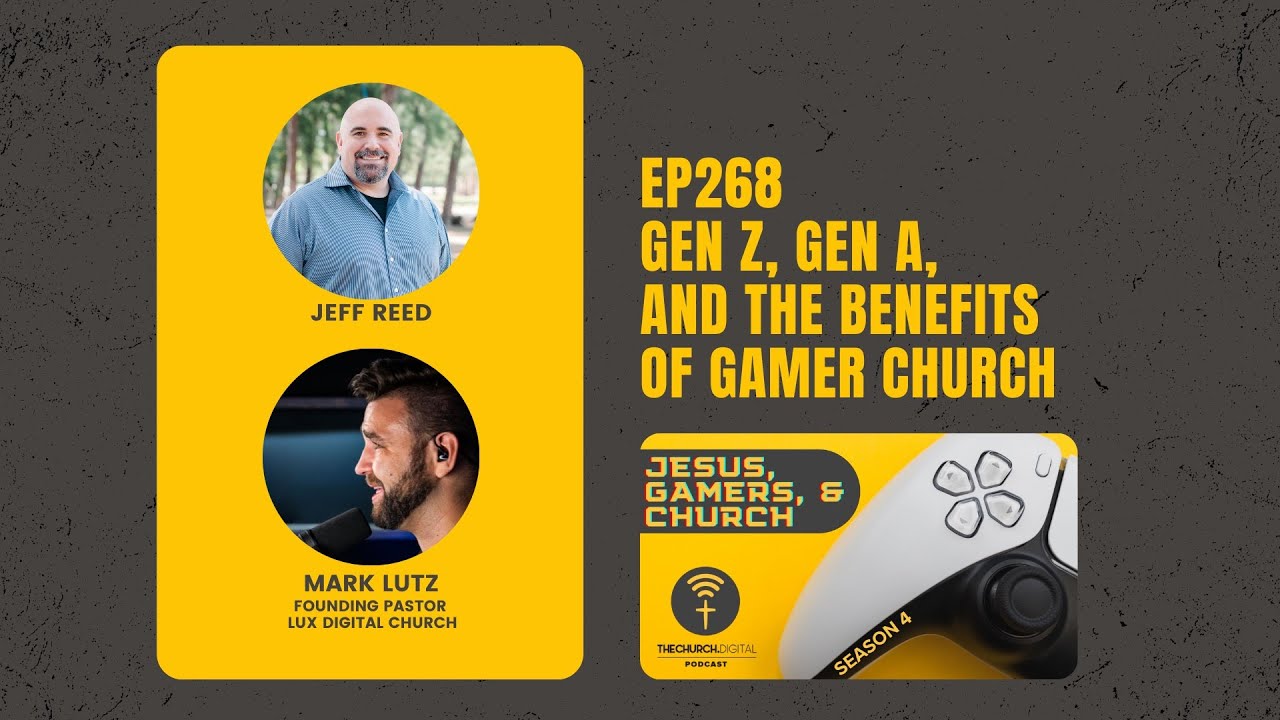
All right, hey Twitch friends, Digital Church Network. The Church Digital, Jeff here, founder of the Church Digital, Digital Church Network, so much other fun stuff. And we're doing yet another podcast episode of the Church Digital podcast here on Twitch. We've been in season four here talking about Jesus gamers in church. What does church look like in gaming culture? How can we utilize the church? How can the church reach in the gaming culture, engage in gaming culture, and really be effective to reach the 3.02 billion gamers across the planet?
··
Now I'm not in my studio. I'm kind of whispering because there's a conference happening like 30 feet that way. I'm kind of expecting the door to open and then to tell me keep it down. I'm actually in Dallas, Texas right now. I'm going to pick up my laptop. I want to show you. I'm at the practice facility for the Texas, for the Dallas Cowboys. Evidently it's a football team. Maybe some of you heard of the Dallas Cowboys. No, you know what? You're mostly watching this live. You're gamers. What do you know about football? Well, no, maybe you play Madden, so maybe you'll get something out of it. But literally, like, look at the practice facility. It's inside that building. They've got the LED screens running. There's actually like a football field that's built into like the front area, so it's just really nice. Hotel. I'm actually in Dallas, Texas, obviously with the Cowboys, but there's a conference happening right now that's aimed towards digital revival, and they're actually working with some of the top Christian influencers. And this is, these are influencers more in like, you know, not Twitch field like we've been talking about with the gamer church, but a lot of TikTokers. As a matter of fact, there's estimated that within the 40 TikTokers and like that, the people that are here, 40 of them, they have an estimated reach of 800 million people internationally. And so huge opportunities for the gospel. And it's been fun. I'm actually right after this podcast, I'm going to be sitting down with them talking about, hey, what does church look like in this space? Like, we're really good. You're really good at creating this content, but if it doesn't feed into community, it's meaningless. It's pointless. And if that community is not driving towards discipleship with purpose of multiplication in physical and digital space, oh my gosh, like you've got this huge reach, but you haven't realized how to really engage these people and disciple them in digital formats. And so that is something that I believe the gamer churches, the people that we're talking about here with season four, have realized so well.
··
So hey, we're going to wrap up season four. This is it. This is where we're going. This is the finale. Maybe stay tuned. We want to talk about that in a little bit. Let's go ahead and bring in Mark.
··
Okay, so Mark, every episode that I brought you on, there's a running joke on the show. Am I going to pronounce your name, last name, correctly? No, you're not. So we did not rehearse this. We do not practice this. And so I'm going to do it. You tell me if I'm right because I have once again no idea. Loots? Nope, that's wrong. So close. My tongue doesn't make... Yeah, it's like some people have the ability to curl their tongue, and some people biologically can't. And for you, you just biologically cannot pronounce my name. It's not your fault. You were born that way.
··
Um, it's a good excuse for everything else in the world right now, so I'm not sure if there was like a passive aggressive insult that was tied to that comment, but I'm going to assume it was the best because you're my friend, even though I feel like we've come full circle here, Jeff. I mean, we started season four with the two of us, and we're ending season four with the two of us. Somewhere along there, I got COVID and couldn't talk for like four episodes or something, but we're back in. You're in an airport or something?
··
Yeah, all good. Hey, it has been so much fun for me diving into, you know, and once again, as I said from day one, I don't get gamer culture. You know, I am 44 years old. It's been a couple decades since I really considered myself a gamer beyond playing Pokemon Go on my phone, and that's not hardcore. And so being able to better understand the culture, start to dive into, you know, even some of the nuances of video games, of board game culture, of nerd culture, and everything, I'm literally, I'll go ahead and do it. I'm wearing a love die nerd shirt as I didn't plan that. Let's go. I'm so like, um, this is where we are. And so now starting to figure out how to be the church, how to reach into these mission fields in Twitch and Discord and through these digital tools, even in video games, some of the stuff that DJ's doing through VR MMO. Like, this is for me. This has been a mind-altering conversation. I have learned so much in the past two or three months because this has just been blue ocean. It's stuff that I have never explored before at this detail. And so, man, I want to thank you right up at the top. Thank you for joining me on this journey, for maybe even challenging me to walk into the space, because I, to be honest, I didn't know what I was getting myself into, and it's been a lot of fun going on this road with you.
··
Yeah, Jeff, no, it's been a joy and a pleasure to come along and to be able to help open up more people's eyes to what God is already doing. I literally, we, I so I do another show with Andy called the Digital Church Blueprint. I think it's part of the network here. We just recorded an episode that's going to come out in the next couple weeks on digital community. And I said, you know, the church thinks that this is a frontier, right? And they're all acting like we're getting in our Conestoga wagons and we're going to head out to a couple of shanty towns and for the Gold Rush. Um, and then what you find out is you got in a Conestoga wagon and you went out west, and what was there was a cyberpunk city with millions of people that was 30 years beyond what you knew existed. And it's not a ghost town with, you know, rolling shrubs and, you know, a sheriff. It's a completely different world. And I feel like in some ways in this season, what we've been able to do is begin to tap into some of that, to realize that when you come to these environments, you aren't just coming in like, hey, there's nobody here and we're going to start something. You're walking into a culture and a language and a people group. And what's even more interesting is, like any large city, you know, Pittsburgh's known for this, right? Of having all of these little subcultures, right? You have the Polish people that lived in this area, the German people that lived in that area. And in the gaming world, you have that too. You have this massive city with the FPS players over here, the card gamers over there, and the RPG players over there, and it is really diverse and incredibly interesting and so nuanced. That has been a really fun part of the journey for me, is exploring, you know, hey, God is doing really cool things in so many different ways. And then to close that up, last week, looking at APEST and how that applies here, really brought a lot of that stuff full circle when we talked with Saint Bear. And I loved that.
··
Yeah, into the APEST conversation last week, I mean, honestly, that is still blowing my brain. You know, and I'm sitting here like talking to these TikTok influencers that are reaching, like, I'm not exaggerating, millions. And one of these guys is like, yeah, it's me by myself. And oh my gosh, can you not build a team? Like, let's talk about what your team should look like. And helping them start to recognize the ministry potential if they move beyond themselves and start to structure, you know what I mean? You're really starting with how you're building your platform. You're very passionate about your message, but you need a shepherd to come alongside you that can start to pastorally build these communities, that can work within your organization, and you can push people from the top of the funnel, the content, and drive them down into a community for discipleship for us. And so what I love is that the gamer churches, at least the ones you know, Lux, God Squad, um, they get that. Like, they're already understanding what the community is, and they've evolved. They've been around long enough to evolve from the Twitch to the Discord and having that rich complementary of a strong front door with the Twitch, the engagement, the programming, the services, the platform, but then driving that into the community aspect. And you know, Mark, to be honest, man, I quote you five times a week at least. You know where? You're talking about the only person who quotes me, so that's nice. Well, the funny thing is I butcher your last name every time I quote you. That's so, you know, maybe people may actually find you on Google or not. But when you're like, you know what, the church building is Twitch. What we do Monday through Saturday is Discord. And so we spend 85 percent of our time in Discord. It's not about the week in service. It's about the relationship. And that's the thing that so many people, that makes the idea of what we're doing with digital church, with gamer church, with influencer, virtual reality, with social media, it's moving beyond just the content. And content that goes into, you know, automatic, where we're taking the relational aspects of discipleship out. Instead, we're featuring the community aspects for discipleship, which is how we as humans in 2023, that's how we operate. This is the success of discipleship happens in relationship, happens in community. And so us engaging in gaming community and building discipleship relationships within the gaming community, like if the physical church, if the American church would understand that and start to move discipleship out of the church buildings into communities and building relationships and challenging individuals to do that, um, there's a lot of stuff to really be excited about, you know, here when we're talking gaming church.
··
Yeah, and I think, Jeff, one of the things that has been really intriguing and super fun to me personally has been, um, I think that in many ways the gaming ministry is kind of the testing grounds for what digital ministry very likely may look like in the coming years because, um, in many ways, you know, the digital natives, right, true digital hybrids are people who are pretty much like 25 and younger, right? A lot of people who grew up...
··
Up in an era where high-speed internet on their phone was just a way of life. I've talked about this a lot in various shows and in different contexts how people form their identities digitally at the same time they form them physically, how important that is, and how the next generation will likely use tech hybridly in a way that we don't see it being used right now. However, the one place where we do see that being used in a lot of ways is in the gaming community because you have this huge group of people that are digital natives and early adopters of tech out of necessity to be able to raid together, to be able to play together, to be able to stay connected with one another. And so they've already learned how to build relationships and deepen those relationships and have their life changed both positively and negatively in digital space and using digital tools. And so in many ways, what the church can learn in gaming—like if a church was to say, "Hey, we're going to get into the gaming ministry thing. We're going to launch a Discord. We're going to figure out how to connect with gamers in digital space"—what you're really doing is you're training yourself, with a group of people, on how the next generation is likely going to want to connect with the church. Not always, not exclusively, but certainly hybridly. And I think that is one of the really interesting things. The next generation, I truly believe, is going to have a hybrid approach to relationship development in which they will walk seamlessly between digital and physical. And you can actually learn as a church what that looks like by exploring and experiencing the gaming community because they are the digital natives right now. And they range in age, which is something else that we learned—they range in age from those Gen Z all the way up through, you know, Boomers and everywhere in between. And the average age is actually Millennials right now. So you have this huge grouping of millions of millennial church or tech adopters who are digital natives in the space. And we're seeing really, really cool stuff come out as a product of that, of what we're able to learn as a church from it.
··
I think there's been some really valuable lessons that may not even really come fully into light until a handful of years from now when our churches are no longer talking about reaching my generation. They won't care about reaching Millennials. They're going to be asking, "How in the heck are we supposed to be reaching Gen Alpha?"
··
Yeah, that's—I mean, that's really the question at hand. And it's interesting. My friends over at New Thing, they actually, you know, sat down and challenged me on the Gen Alpha question just even within the past couple weeks. You know, "Jeff, how can we spin out?" And to be honest, I pulled the, you know, out of my back pocket the line that I always throw whenever somebody asks me about Gen Alpha. "Hey, you know what? The terms of service of a lot of these software prevent creating accounts. Like, my son's twelve. He's not on Discord. He's not old enough for that. Discord." And you know, it's been interesting. I really respect this about my New Thing friends. New Thing tells me, "Jeff, that answer is not good enough. Like, you got to come up with something better than that. Start to work with your teams." And so, like, it's even, you know, starting the challenge, and I've already had some conversations with some of them. "Hey, we got to come up with something better than 'sorry, we can't help you.'" You know, and there's lots of things that challenge against Gen Alpha or work against that a little bit. Is it weird? Is it creepy? How do we not be that? How do we equip Gen Alpha to reach Gen Alpha? How do we equip parents to reach Gen Alpha? And so, like, there's some different angles towards that.
··
How would—let me ask that question. Do you have any Gen Alpha in, like, how is that working for you right now?
··
Yeah, yeah. Alarmingly enough, we—I mean, Gen Alpha is very young. My kids are Gen Alpha. And alarmingly enough, we actually have a lot of Gen Alpha who are in our church because we have a lot of Millennials, which means we have a lot of kids who are Gen Alpha right now who are part of our church. We just announced infinite child dedication. And if you want to get into a conversation about baptism, go have that with Jeff and not me. But we're doing infinite child dedication next month for the first time because we do have so many young kids. And my honest opinion about reaching Gen Alpha—for a lot of years now, for whatever reason, the church flipped something, and it was a really weird thing to flip, right? I remember specifically talking about how youth ministry should grow your church over time, right? Because if you reach kids, you'll reach their parents. And my honest opinion of that is like, that's backwards. Like, that should never be the way. That should—I understand why it became our goal, but it should never have become the goal, right? It should never have even been in the conversation. You want to reach Gen Alpha? Learn how to reach Millennials really well. And if you want to reach Gen Alpha when they can really be reached and it won't be creepy for you, then learn how to do digital ministry today and learn how to do that digital ministry effectively and tactfully in a way that you can actually engage in digital space powerfully and impactfully with people. I think if you can learn how to do that now, you'll be far more equipped when Gen Alpha is—I'm not saying they're unreachable now, but the best tool to reach Gen Alpha for right now is through their parents, just like the best tool to reach any child is always going to be through their parents, right? Because the parent has the most influence over their life. And they're—but there'll come a time when that's not the case, right? And we'll need to be able to reach Gen Alpha a new way. So get used to digital ministry now. Get used to gaming ministry now. It's not going anywhere, right? It's not going anywhere.
··
Yeah, yeah. So, hey, you know what? And Mark, I love what you just said. I'm going to quote it again. I'm going to misrepresent your last name, but it's just the circle of life in our relationship. But if you want to reach Gen Alpha, you got to reach—it's really reach the Millennials and empower them to reach, you know, like that's a really interesting approach. And it's definitely effective if it's the only way or the best way, I don't know. But the idea of empowering parents to disciple their kids, let me give you an understanding of how and why to do that.
··
Go for it.
··
Let me give you two examples really quick that I think can tap into that a little bit. So I'll give you two examples from two sides of the aisle. I have a really good friend, Joe, who grew up in the church with me, left the church. I don't think you'd have any problems saying that he's been on a weird faith journey. He has a son who's about the same age as my youngest daughter—Gen Alpha, right? And he actually reached out to me and he said, "Hey, as a pastor, what is the best way for me to protect my kid from the church? Like, I want to know how to protect my son from the church because I don't want a church to come into his life and mess him up. And I'm nervous about, like, letting him go to a church or letting him go to youth group."
··
And so this is—and then the flip side of that is, let me tell you the story of Bougie, which I may or may not have told on this podcast before. But Bougie's in our church, reignites his faith. His real name is Geno. His son's name is Roman. He begins reading the Bible to his son every single night. And so much so that his son is beginning to recognize scriptures because he's actually gone through pretty much every single page, every chapter, every verse of the Bible with his son. His son's heard it all now at, like, age four or five years old. And so we're seeing him change his son's life because his life has been changed.
··
But the same is true of both. There's a unique thing about both. Both Joe and Geno is that Millennials are fiercely protective of their children, fiercely protective of their children, and have learned that the world is not the place that you ride your bicycle at any time of the day. It is a ruthless, dangerous place where people take your kids and hurt your children. And so because of that, they are very defensive of their children and very protective of their children, especially when it comes to faith and church. And so the only way to reach Gen Alpha right now, I would say, in physical church or in a digital context, is going to consistently be through reaching their parents.
··
Wow, that's a powerful word right there. Definitely challenged by that. And huge opportunities in digital to disciple the parents, to disciple the millennial, to reach Gen Z and Gen Alpha with that, you know, the mobilization, the multiplication of this, the resourcing so that they can multiply it, that can be multiplied again. Definitely powerful there.
··
Hey, well, yeah, let's do this part. You know, we're coming on, on season wrapping up season four here. Let's pay homage a little bit to where we come from, you know? And you caught a lot of the shows, and I know you were sick for a stretch there, and some of the shows we're going to reschedule and do later because we just had some scheduling conflicts. But I would love to maybe hear from you, like, you're already so enriched in this culture and very little is a surprise to you at this point because you're one of the leading experts in this space. But what was some takeaways? What were some surprises? What were some of maybe your favorite moments coming off of the season here?
··
Food, Jeff. I mean, he is just puffing me up. Leading expert. I, uh, a lot of words that have never been used with me. Um, so, uh, okay. So some of the things that I feel like I've learned or taken away from it—I think that would have been a great question to be able to—every time I get a question like that, it's like the only type of question that I struggle to talk with just literally off the top of my head. Um, but I honestly think that some of the conversation with Asia and Amanda was really powerful for me to hear from their perspective as women coming into the space because, despite the fact that I am doing this with my wife, which is very unique—most guys, most people who are getting into gaming ministry are doing this with permission from their spouse but without necessarily support from their spouse, right? So a lot of guys who are running solo in this space and their wife is like, "Yeah, you can do it. That's fine." But that's what we have. I am lucky enough to have a wife who is partnering with me in it, despite the fact that she's not a gamer. And so it was interesting to hear from the female perspective—because my wife isn't a gamer—to hear how they, and just to hear the passion and the fire and the vision that came from Amanda and Asia both, was really cool. And for that show, I wasn't able to be on it, but I was in the green room listening the whole time.
··
I think some of the other stuff with Jonno, with some of the stuff that I knew about as well, but to hear the advancement of esports and really hear it from the horse's mouth of a person who's literally in that space every day working with people, learning how to shepherd in many ways, and then also not just a shepherd but also to train and equip people to be better gamers, right? And how the world is shifting. And that I had a conversation with my buddy in my kitchen today who's on the school board at the school district that I'm in. And I just said, "Listen, man, you guys—"
··
Got to start talking about spending a couple grand and getting some decent computers and starting an esports program at the school because more and more students are going to get scholarships to go to college based on their esports experience. And then Chino made said in the chat also Jade talking about Mission dollars. I think that was a really eye-opening moment for all of us as well as we just saw the need, like the very real need, and not only the need but for Jade at least how little that was. I mean my needs are greater than Jade's. I'm not going to be, not gonna lie about that. Speak as a family in situation and mortgage, but um, to see the needs and to see how easily some of those can be met to really equip, release, and remove a lot of the stress and burden off of the heart and minds of digital missionaries. I thought was really powerful and cool.
··
Yeah, yeah. I mean so much, uh, Chino's blowing up chat talking about Jay, talking about Aki as well. Um, you know, it's it's funny like the girl, uh, the girl streamers that we did a couple weeks ago, I guess, uh, here at the conference. I started talking about gamer church as a matter of fact. Mark, I literally was talking about Cambridge church. I looked at my phone and I got the Twitch notification that your service was happening and so I swiped and I'm like, this is literally what a Twitch service looks like. And and it was, um, together or maybe it, maybe it wasn't, but it definitely was was the part of the series we were on talking and um and so it's there was some several women that were asking me questions, you know, and they're they're women influencers and they feel some of the some of the stress uh that that the the twitchers with lady twitchers were talking about. Is twitcher's a thing? I never really understood if I could say it that way.
··
No, it is. It is. It is absolutely not a thing. They are a streamer, not a twitcher. Streamers, not a twitcher. Streamer, sorry. That's okay. We're still clarifying language here. So it's fun.
··
Yeah, yeah. It's it's it's it's all good. Yeah, uh, but it was it was funny just even starting to tell some of some of the stories that I've heard from from the ladies and and from you know you even talking about some of the experiences you and your wife have had uh within uh Lux and the challenges of women uh stepping into this male dominated uh society yet forty-eight percent of of women, of gamers are are women. And so it's it's really interesting how male ego and male chauvinism and whatever is so strong in that space yet percentage-wise it's not that much more than what uh than what the ladies are are present in. And so Twitter sounds like a Truckee zombie. That's that's awesome. Thank you for that, Chino.
··
Um, you know, he references Aki and uh, Aki for me that just hit close to home. Um, you know, because you know I watch. It's funny. I watch um, I watch Aki stream now um probably two nights a week, maybe maybe three nights a week uh, stop in for it for a little bit. And uh, and my kids are starting to get engaged in it. Um, my kids actually made me subscribe and I I was kind of, I guess my subscription had had not kept, but they made me subscribe to Jake's um feed uh because they wanted the cat that that you know Jade has like running around the screen, the little little like the little cat icons. Um, and I hate cats, so they thought it was really funny that I'm now paying five bucks a month to have a cat in Jake's world. So now that I want to go watch Jake because they want to, they want to check in the cat, see how the cats do. This is a conversation with with my uh, my teenage kids. And uh, but how Aki is doing the family streaming and incorporating the wife and incorporating the kids, how Aki, you know, and I see it, the family stuff where you know, see if he's talking about like the the after hours. I forget what he what the specific language he calls in that, but after dark is what it is. And uh, how he's creating that family environment um with with people on the stream like it is so good. And and I see the the people that are watching the stream engage in it so well. And and like Docky and Jake are great examples of what digital missionaries need to be. They're finding a culture, a subculture, a contextualized culture that they wanted to get into. Jay is very much into Japanese culture. Hockey is very much into reaching that, the the the the kid that does not have a family because he wants to create a healthy family environment on Twitch that those that aren't. And so creating those environments to reach those types of people as a digital missionary to to bring them to relationally to Christ and then to get them connected into to you know Lux for a church or to uh you know God Squad or something else along those lines, the discipleship community. Oh my gosh, such a good idea. Work with what you can and then what you don't want to do or what you can do, partner with someone else to do that. Stretch it. It's interesting you hear with the TikTokers. That's actually what I'm saying. It's like, hey, do what you can and in what you can't, let's get you connected to digital churches. Let's get you connected into into a discipleship community where you can feed into that. You know, we're King's Tide is is a is a new uh digital church that that's spinning up. It came off of uh of uh Seacoast Church and uh, it's another example of a discipleship community that's utilizing Discord that's taking an opportunity for influencers to feed into it and then utilizing that the community to boil the frog slowly to nurture the relationship to take it at a deeper level relationally to build the relational equity, the trust to be able to have those services. And so like, it's so interesting that the digital strategies for a gamer church, for influencer church, the content leads the community. It could be. If there's no community, if it's just content, it hollow. If the community doesn't have a purpose, then the community is pointless. And so if the purpose is discipleship, then we need to see it physically and digitally. We're discipling people digitally to the point that we are seeing the fruits of the spirit in physical and digital space. So the content has to go to community that has to be have disciple making which has to have results physically and digitally. And if that's the standard they're holding our churches to, yeah, the by the way, the biblical standard that we're holding churches to, God is going to do great things uh through his his churches in digital space. And I am, I'm excited to see more churches like yours, Mark, spin up on here. I I was encouraged, you know, I and just even as I've hung out more with the uh, the don't call it Megazord guys, the nerd culture Ministry Collective. Uh, you know, went to the summit, met some of those people, saw the collaboration, saw the friendships that developed from that, see the desire now to multiply these ideas out and to start to connect with others and create new expressions of church that are holding to that biblical standard. Like to me, that's very exciting for the future because because it's people that are wanting to do something different to reach a different type of person. And I believe that for the Great Commission to be accomplished or at least to give it a fair shake, we have to do something different. And uh, and guys and gals like you through nerd culture Ministry Collective and and all of this, it is so good to see you expanding, trying to multiply, train up that next generation to reach future generations. Um, well, let me tell you what, Mark. Since since I'm just rambling on here about nerd culture uh Ministry Collective um, I am saying the acronym right? Like that is that's the that's in the right order?
··
Yeah, nerd culture Ministry Collective is uh is the uh network and nerd culture Ministry Summit is the event. Is the event. Talk to us a couple minutes. I you know, we've I feel like we've talked about it. I don't know that we've actually like talked about it. I think we've referenced it, maybe gave it a quick nod, but are you comfortable talking a little bit here about about what it is?
··
A nerd cultural Ministry Collective? Yeah, I would actually love to talk a little bit about what both are because I think I think both are important. So first off, nerd culture Ministry Collective is a network that we're forming underneath the DCN and inside of the style of new thing. We're gathering nerd culture missionaries, digital church leaders, and org leaders together for support, connection, coaching uh, and accountability. And so what you would experience a typical network to be uh, it's that it's to encourage and strengthen new people. Uh, the the reality is the space is super, super isolating. And so it's very easy to kind of just get in your own lane and do your own thing and compete with people that you should be working together with. And so a big part of the goal of the nerd culture Ministry Collective is to help people establish and build relationships so that we can complement instead of compete. Um, and uh, and that's that's going well. We launched some of our first networks, which we of course we would have loved to launched this back in December, but um, you know, it's April and the first one met literally last night. We had the the girls uh group met. And so Amanda, that was in Asia, were on the show a couple weeks ago. Um, they met up and and they had a a great showing for one of their first ones, which is awesome. And we have a couple of more that are in the works. We'll be launching uh over the course of April and into May likely. Um, and then on top of that, we've also had NCMS, which is the nerd culture Ministry Summit. This is the event side of that network uh or that is uh that movement really. It's a collection of networks, so a movement. And it's coming up in November. So November eighth to the tenth uh this year in Marble Falls, Texas. You can find it by going to NCMSummit.com. You can register today. It's inexpensive. And if you come as a senior pastor or lead pastor or whatever, you get to bring somebody along with you. They get a free ticket to come in. There's a plus one feature so that you can bring the gamer from your church, the tech guy from your church, the youth master from your church, whomever to come and learn. And we're gathering together um ministry leaders that are in this space to help you understand really what it means to get into and minister to people in nerd culture. And which it really is, I mean, it's just like your neighbor at this point, right? It's not even like just all all of our neighbors to a certain extent are nerds in one way or another now um or all of us have nerdy neighbors. And so it's about how to reach them. So it's coming up in November, like I said. It's in Marble Falls, Texas. Uh, you can go get registered. Uh, I think, I don't know, I guess we have to like finalize the speakers, but we do have one pretty big speaker um that has agreed to come. They just has to finalize stuff. So like the announcement of who's gonna be the speaker, which is a combination of people who are in church world who you know lead churches and um and the one individual, right, has written several books um and is really has a podcast that's absolutely popped off recently. Um, he's going to be coming and speaking at it as our one of our keynotes. And this combination of that and then people are actually in this space. And so um people like uh you know Susie um from uh GSC in his own stream Susie Live and um some panels and breakout sessions from people that you've heard from on the show who are going to be there at it. We'd love to have you come out and join us for that. So you can get connected once again at NCMSummit.com um and you should really buy your tickets now and come and hang out with us in Marble Falls. I think it'll be uh, I think it'll really open your eyes to really what God is doing when you meet some of these people in person.
··
Totally. Yeah, you know, and then some Marble Falls is maybe ten minutes from where I am right now. And so deep in the heart of Texas looking.
··
Forward to spending some time and getting to meet you all. I was joking, they have not, at least my agent has not told me the way that I'm speaking. I'm getting out of an agent, but it's not not me speaking. It's somebody else that let's read a couple books and has a very successful podcast.
··
So, hey, listen, there has been so many lessons that have been learned through this podcast, and we've been able through doing the season four here, you know, we took the experiment with trying to do this on Discord. And we actually, or excuse me, on Twitch, and we actually built a decent channel just organically. We've got, I've had to look at the number, but I think it's something like 75 followers. 68 followers right now on Digital Church Networks Twitch channel. And so really excited to see that happen, you know. We were doing gamer church, but really the church digital podcast and the audience of that are really established churches. And so like, we took the posture once again of a curious learner, having these conversations and trying to expose ideas and expose people to some of these gamer podcasts.
··
Now I'm gonna let you behind the veil here a little bit, and there's some good and there's some bad here. The church digital podcast, the typical audience and the metrics that I look at the audience as we focused on gamer churches, we've actually seen the numbers drop. Like the average subscriber, the average plays that we get on the podcast here in season four has declined. Now, you know, I say that because we've actually seen the YouTube numbers skyrocket. We've actually seen the engagers and the people on Twitch increase. We've seen conversations come up in other places. We've had conversations with global mission organizations that are like, what are you doing with gamer church? We need to talk. Let's get together and start the dialogue, see how we can collaborate here.
··
So the interesting thing about gamer church is at a very high level what I would suggest is that right now in 2023, just me reading the situation at hand, the physical church is not interested as a general rule. But what I've been so impressed with is the interest within the gamer community and the passion to see that multiply. And so as a result of this, the desire, not to, well, and so I'll let Mark speak to this in a little bit, but maybe it's not so much about helping the church, the physical church, the U.S. based church, I understand this as much as it is maybe trying to create a new movement of churches that are operating in this game or space.
··
Well, I tell you what, Mark, do you want to make the announcement? You want to say this? You want me to let the cat out of the bag? Like, how should we communicate this right now?
··
Well, considering you're in an echo airport lobby right now, I will say it, and then you can comment on it. So we're really excited here at the church digital and also myself personally to announce that we're going to be launching a new podcast inside of the church digital network. And the church digital podcast network, I don't know, there's so many networks at this point it's hard to keep track all the time. But if you would go visit the church digital, you can look and see this network of podcasts, and there's going to be a new one that's going to spin off from this. In addition to that, we're working on writing a book in the background right now that goes off of this material that we're talking about that's going to give some of the ideology, the theology, and the ecclesiology for churches in digital space, specifically inside of the gaming community at the front half of that book.
··
And so it's all about deconstructing our view of digital relationship and digital space, and then reconstructing a more accurate view of what digital space really is and how the next generation is using it and how current digital natives are using it. From there, we're going to dive really heavily into some of the stories of the people that you actually heard here as we look at APEST, and we're going to be breaking that down through looking at the fivefold, the fivefold ministry of the spirit of God inside the church, and how that's being lived out inside a digital space. And wrap that up with help so you understand exactly how it is that you as a church leader can dive into that.
··
But between here and the actual launch in production and all of that of the book that's coming, we're going to be continuing this conversation that we're doing through season four on an entirely new feed that's going to come out either somewhere around the end of April or the beginning of May. In which I'm going to be taking the lead on that show. Jeff's going to continue to do the church digital podcast and move on into season five and what's next for this show. And I'm going to be spinning off a new show that's going to be directly connecting to gamers, game culture, nerd culture, what God is doing in that space.
··
So we don't know formally everything. I'm not ready to announce like who co-hosts are and exactly what the format is going to be. We're ironing out all of those details. But we're really excited to start recording and launch that new show. So stay tuned to this feed in season five because we'll let you know how you can get plugged in to the new show that's going to be dealing with gamers and how you get plugged into the Twitch and all of that stuff, following what God's already at work doing inside of the gaming and online gaming communities.
··
And so we hope that you'll come along the road, along that journey with us. And you know, follow along with what we see God is doing. And we're really excited to bring you the inside scoop, really let's give you an eye inside of it. If you don't know the culture and you don't know how to get into it, let's just give you a chance, you know, a little peek behind the curtain and a look behind the door to see what God is already doing in this space and see how you can get involved.
··
Yeah, like I said, Mark's one of the forefront leaders right now in the gaming church movement because of everything to do. Just sit, like so good, so on point. Remember, in digital church context, gamer churches is the fastest growing bottle right now. And so we are seeing so much improvement, so much gain, so much traction, probably the better word, in that space. And so we're excited to release this show. You can check out the church.digital slash podcast, and so you'll have more. We'll have more news on that. We'll be sure to get the word out via email and through all the communities once that spins up and goes public.
··
I'm so excited about the book and working with Mark on that and seeing it. You said you said three words real quick that I was like, oh, that's good. Um, what were they?
··
It was ideology, theology, ideology, theology, and ecclesiology. All of theologies.
··
So so good. And so looking forward to seeing that. Even currently, developer aiming for that to release sometime hopefully late 23 and get that out there publicly very soon. And definitely excited to see what's happening with the nerd culture ministry collective and our culture of ministry summit, um, love thy nerd, and anything else that's happening here in that space.
··
It's a little weird. I just lifted my shirt up publicly and people around are like, what's that guy doing? So I just don't worry about it. I'm not gonna do that again. I don't think I can pull that off a third time.
··
Okay, um, anyway, this is so good, right? But we're gonna land a plane like this has been a fun conversation. I'm not in an airport, but I might as well be, and this has been a great time. This has been a great season. Mark was tipping off season five with the church digital podcast. We're gonna roll that out in May. We're going to take a couple weeks. I'll tell you, next week is going to be a great podcast. We're bringing in Neil Cole. Neil is one of the forefathers of the modern micro church movement, the organic church movement. He wrote a book a decade ago, ironically for leadership network, but one of the organizations I work for now and then I write books for now. But he wrote a book called Church 3.0 that when I read it, oh, it blew my mind.
··
And as I've read this book, the micro church movement, Neil Cole was actually the guy that created in me this desire to do micro church strategies, to look at digital through a micro church lens. Contextualization, scalability, reproduction, a lot of these things that we talk about in church context, digital church context, guess what came from this guy, Neil Cole, who's one of these well-spoken leaders in the micro church movement. And honestly, he talks a lot in context about how he was the guy really before his time. He was pushing ideas as an innovator before micro church was even accepted in the United States. And so some of the challenges of being ahead of the curve that far ahead, you know, we talk about how, um, that, um, oh my gosh, what's the line where settlers get rich, pioneers get shot, you know, we talk in that in greater detail.
··
That's the line, yeah. I appreciate you having my back, my friend. That was good. I'll get your name. Yeah, it just sounds like you have a mouthful of slime right now and you're just trying to say an L is all that sounded like. But I am so excited about the conversation next week with Neil Cole. Jason Morris, Jamo, coming in for the conversation as well, because Neil Cole was hugely influential in Jamo's life and digital strategy with that. So it's going to be a podcast you are not going to want to miss. Great stuff digging into it.
··
We're going to land a plane here on season four right now. Thank you, Mark. Thank you, Andy. Thank you all the guests. I could try to rattle them off. I would probably miss him. But there have been so many that have come and have had conversations around this. We had to reschedule a couple shows. We're going to get them probably this summer. Really interesting ones centered around mental health and gamer space and how do we handle some of these difficult situations. And we can, we'll get into that in a little bit. We'll tease it later on. But so much, and definitely excited about what Mark is doing as we're extending Jesus, gamers in church into a new show and even developing this as a book to help future churches, future gamer churches get started and understand the, whatever the three words he said that was so good. But I just, I need to write them down and have him in front of me and I can't because I'm where I am. I'll do it. Mark, ideology, theology, and ecclesia.
··
Ideology, okay, they're very good. Like I said, twice the expert, and that's why I'm just the pretty face of this thing. But hey, we're gonna land a plane. So for Mark, for Andy, for everybody else who is a part of this, I'm Jeff with the church digital, digital church network. Thanks for jumping on the podcast here. Neil Cole next week. See you all then. You all have a good day.
Auto-generated from audio, lightly cleaned for reading. · Watch the full episode →
