⌕
··
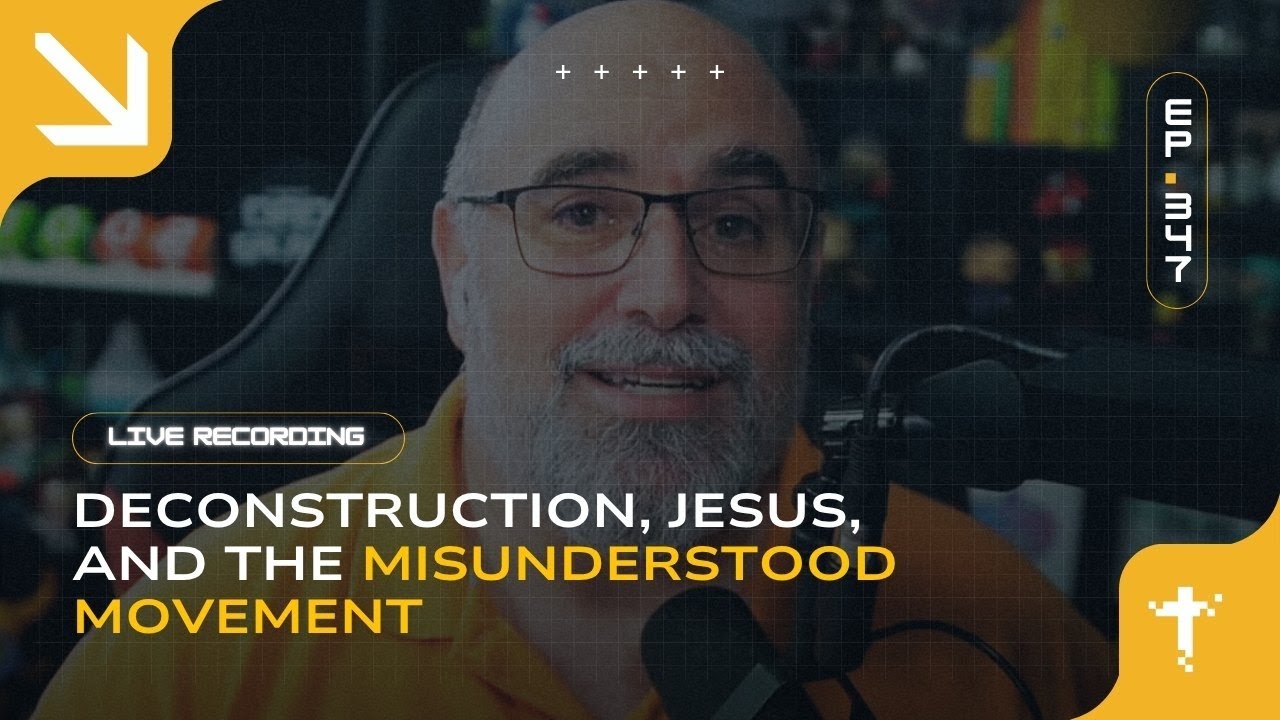
All right. Hey everybody. Uh this is Jeff here, the church uh digital episode 347 here of the podcast. Doing a live recording. Thanks for joining me uh in this uh this chill Thursday evening.
··
Uh Ian coming in from the outside. This will be fun. And and yes, yes, this this will be fun. Um, I'm going to try not to tick anybody off while at the same time have a purposeful conversation behind this.
··
And so, um, now it was not even supposed to be what this actually is. We were supposed to have a conversation with Barbara Carnero uh talking about some of the work that she's doing in Word Revolution and uh and creating some uh because we're in the season here talking uh about uh equipping partners and empowering tools and uh so but she's a little under the weather in Barcelona and uh asked if we could delay. So we're going to have a conversation with Barbara here in a uh in a in a little bit.
··
Um, and so I literally at about 9:45 this morning did not have a topic to talk about here on the stream. Meanwhile, I've been having like an interesting conversation on the side, particularly in uh in uh I started to say Slack. Why do I keep saying Slack in WhatsApp? I had we're having a particularly interesting conversation in in WhatsApp surrounding deconstruction over the past couple days and maybe a a misrepresentation uh a misunderstanding of of the word uh and uh some of the concepts therein and it was like you know as as I needed a new topic and seeing some of the conversations that was happening I was like you know what we're going to dig into it here on the stream today and so because of the hours because literally it was like a 2-hour notice. I I didn't I normally I would love to like bring in a guest for a uh a different view or a complimentary view or somebody who's maybe better to explain this stuff cuz I'm not necessarily the best at this. I'll just be honest with you. But my heart is um but just going to have it. And so I do want to have a a somewhat um spirited but respectful conversation around this.
··
I I know when you say the word deconstruction around around uh people in established church at least in North American context uh is there's a lot of um unsettlness that that comes around that a lot of people get upset now the the the American church has been deconstructed um many times in the past couple decades uh in the past 25 years the the US church has lost 25% of of active participants uh and so like we are as a as a nation as a uh as as a continent the church on this continent is is struggling.
··
Some stats have come out recently that the the new generation A and Z uh they are interested in in re-engaging uh in in spiritual re-engaging in God. They're just not interested in the church. Uh you know that literally there are books that are written I I I I like your Jesus. I don't like your church. Uh they're so unlike Christ. It's actually it's a it's a uh Gandhi quote I I believe. uh but there's there is a movement uh a generational movement back towards spirituality or Christianity just not in in church context in physical church context and that's one of the reasons why uh you know the idea of digital missionaries stepping into the space digital missionaries representing Christ just maybe in a different context even doing churches digitally maybe putting out a different ecclesiology like I I'm I'm going to an ecclesiology that's respectful. I want to make sure I say the right words there. An ecclesiology that's respectful of of the Bible, maybe just reimagining some things. We're going to get into that here in in in a little bit.
··
Like I I you know, it's funny. Barbara Carnero, she sat down with me. We were this is early in our relationship. Um and and and she says, "So, Jeff, like what's what's the win in 10 years with the church digital? What's the win?" And um I I quickly uh I honestly I didn't even have to think about it. Uh I said I I want to I want to help create a a new ecclesiologically stable, biblically sound model of church. It's not violating scripture. It's reimagining what it can be while holding true to scripture. And that's where I I would suggest a little bit of this deconstruction comes into play.
··
Now, I have I have gone through some of it here. Let's back up. Jeff, how do we even get to this point in the conversation? I'm glad you asked. Uh, I'm going to push this button and hopefully it works. I forgot to check this. And yes, it does work. I'm very happy. I received this email yesterday, 24 hours ago. Bara, you know, I'm on their mail list. I'm on, of course, dozens of of organizations and corporations mail lists and and Bara, you know what? Actually, I really enjoy Barnes because they give me stats every once in a while. And u and it's it's it's a good place to be.
··
But Barna sends me this this email. Let me get this out of the way so I can I can see our relationships pastor's biggest blind spots. Our relationships pastor's biggest blind spots. and and you know they've done a um you know they've done a re uh relational flourishing is lower among pastors than congregants. Some stats that have come out practicing Christians are uh 85% are are like comfortable or deal with relationships or happy to get into it. um pastors 67% like that's almost 20% one in five drop comparatively and and you know the article goes into talk about it's a major gap in pastors uh lives and support systems however they may be unaware or unconcerned that their relational health falls behind that of of the other group and of course you know Bara Bara's context is to help the the established church the physical church and and so like there's A uh there's a report they want you to buy confession hour. I didn't buy the report. The website actually wasn't working yesterday and but they fixed it today. And so but you can go on you can look at the report. You can buy the report. It is it is going to be um I'm sure it's factual. I'm sure it's stable. I love my friends at Barna. I've worked with them historically over the years. But the vantage point is to help the lead pastor. And and so Bara is helping the lead pastor address the weaknesses that are in play. And that's not that's not a bad play for Bara. There's 300,000 plus evangelical churches in north in uh America alone, not including, you know, the other English-speaking uh nations and congregations here in uh in the you know, the Western Hemisphere. And it's a great play to solve that initial problem. But but I would I I and this is what I kind of threw into into WhatsApp. I was like the that's like um treating the system, treating the symptom. It's treating the symptom. It's not solving the problem. You see, the problem is is that I would suggest is that the 2025 US church in North America, and and this is probably where I'm going to get some hate. uh the 2025 church in North America uh really has become a content centric model. We create content uh that we want to connect with people with and through that content through that live content through that musical worship and a an oration a speaker on stage we hope to change lives.
··
And you know in fairness there is a percentage of people that would um connect with that type of model. In North America alone we're seeing 25% of of people uh that are actively engaged in in the North American church in an organized actually organized religion. 25% organized religion is the stat there. That's a Bara quote by the way. um that is uh down 25% from year 20200. So over the past 25 years we've lost 25%. Um this is North America and and I should also say by the way globally you know I understand different continents and different contexts are at different places.
··
Yeah, I was talking with somebody yesterday and they're seeing, you know, borderline revival in the global south like our friends in Africa, our friends in uh in India, like like the gospel is on fire in in those contexts and they're hungry for it. Europe Europe is is a um is a de uh is a dechurched model almost already where they people are not interested in going to the buildings at all. As a matter of fact, Christmas Eve, you're more more likely in in England, Christmas Eve in England, you're more likely to find more people in pubs than you will in in cathedrals. And and so the understanding is that they've already walked away and there's now the church in Europe is adapting to what to do next.
··
Now, which is funny because we're actually doing a conference for the European Digital Missionary Summit and that's going to be uh October 1st. Missionary.digital. Get more information about that. Really excited to see how Europe is adapting and using digital in these uh dchurched in environments. So we did this report and and I was talking about this with with Bara uh you know 80 once again 67% of pastors are are are comfortable with environments 85% of people are and but there's a disparity between the two. Well is it because pastors don't have people they can trust within the communities? I'll tell you the pastors that that I've worked for often do treat people within the church um hands off. It's like I can't I'm serving you. I can't trust you. Uh um for the organization, I can't be very open about what I'm doing. Uh I'll I'll tell you some of the years that I've worked in in physical church staffs uh have been, you know, as as as a pastor and as a staff person, uh have been some of the loneliest loneliest years of of my life.
··
Like um I I just I it was funny. I used to joke it was like, yeah, the church owns my soul. it just because it was so encompassing to serve the model of church that that I was I was working in to serve the the churches that I've worked in historically.
··
Now, let me pause because I want to put this disclaimer. That's not to say that all churches are that way. As I say this, I'm actually interviewing and and it's likely that I will be on a physical church staff u by the end of the summer and and we're progressing forward and moving towards towards that sort of a conversation. So, I have hope for the future church. I have hope for the physical church and I'm glad there's organizations like Bara that are leaning in and wanting to restore the model. I do because that model is going to reach people. But through the church digital I' and and I've I've always said this doing something different reaches someone different and and using a a different model, a different type uh of of way to reach and connect people. Well, you know, we're going to reach people in in a different way. All right. So, let's ask this question. Why? Looking at this stat, it's funny. I'm just going to maybe I'm going to leave this up the entire time and just bounce back and forth into it. Looking at this stat right here, pastors 67%, practicing Christians 85%. What why is that so so important? Barner released another stat a couple of months ago. Uh maybe it was early early this year, late last year. Um 47% of um oh no no that's what I was 53% of people that are active in uh a physical church these are active church attenders they are are regularly attending church 53% strongly trust church leadership and and Baro was celebrating that stat as as a positive a stat to prove a stat going to get there in a second for me it was interesting you know I've always been a flip the script guy, right? 43% of of people uh in America, 43% of Americans that are actively attending church did not feel like they could say they they strongly trusted church leadership.
··
Now, look, there's there's varying levels, right? There's somewhat trust, neutral, somewhat don't trust, very much not trust, whatever. Half the people who are sitting in the church building cannot say I 100% trust my my pastor. That's not a good sign. That is not a good sign. And and why why do you think that is? Well, in 2025, what we find is that trust comes via relationships.
··
In the 1980s, in the 1990s, in maybe even the early 2000s, a pastor, a communicator standing on stage preaching a sermon for 40 minutes would reach a mass amount of people for Christ because the culture was set up to receive in that way.
··
Now unfortunately in 2025, unfortunately maybe things have changed and there needs to be more relationship. We actually see this all the time.
··
Now I cannot say with certainty that it works this way physically. I can say with certainty it does work this way digitally. Because I've seen it time and time and time again.
··
Digitally, people find community before they find Christ. I don't know enough about physical church to say whether that's true, whether people find community before they find Christ.
··
And maybe the reason that some of our churches are dropping is because they don't have that percentage. But yes, there is a drop. There's a change coming where people, to build trust, need the relationship. And the physical church model where the Sunday morning 9:00 a.m. church service is the lead opportunity for evangelism, it's lacking the community. Well, Jeff, there's community out in the lobby. You try being the new person out there in the lobby to build relationships with people. It doesn't work. The model is flawed at some churches. Yeah, my church can do it. Maybe your church can. What I would suggest is that the model is flawed.
··
Now, when I say the model is flawed, what I am not saying is that God is bogus. Christ did not die. He was just a man. He did die. He did not raise from the dead. He is just a man. I'm not tearing down Christianity. I'm questioning the validity of a model. There's nowhere in scripture that it says that I don't know that sermons have to be 40 minutes long. I mean, scripture says things like "make a joyful noise." Does that mean there needs to be a rock band on stage leading worship?
··
Now I love the rock band. My son plays bass. But it's a method. It's a model. My son plays bass for my church. Like, I love it. I want that. We used to joke, you know, when I was a production director 20 years ago, you know, say things like "cue the Holy Spirit" and that would be in time to, you know, crank up the fog machine.
··
But that's almost the problem, right? Because we start to create models without examining scripture, without going back, without questioning how we got to where we are.
··
Often times, Christianity church leaders—this is just my pitch from the outside—we're afraid of questions. It's funny. Jesus, you know, Jesus is the same yesterday, today, and forever. Christianity has survived 2,000 plus years. The Bible is a 6,000-year-old document. I really don't think that I am going to ask the question that tears down the entire Christianity belief system. At least smarter people than me have tried and have failed along the way. And so taking the opportunity to question things, I think that's okay.
··
Now I'm seeing some comments coming in. Let me pause here. Steve's, you know, asking questions. Did I miss anything?
··
Dude, if you're just walking into this conversation, yes. Yes, Steve, you missed something. You may want to go back to that. Ian is saying, you know, good luck in not ticking anyone off with this. It's probably going to happen. It's okay. Send hate email to Jeff at the church digital. I will gladly embrace it and respond.
··
That would be 33 percent. Still not good. I think that may be Scott. I saw when you said that, I think that was around the people that are questioning my stats. May be off, but for I said 43 percent of people don't trust physical church leadership and it may—I thought it was 57, 43, but you're saying it may have been 67, 33. That's fair. Either way, your point, Scott, still not good. And so what I would propose to you—oh, just my math.
··
Yeah. Okay. Just yeah. Yeah. Listen, my wife teaches AP calculus. My daughter just got a—she's a—she just graduated her sophomore year in high school. She just got college level credit for college calculus. And so yeah, I'm the dumb one in the family when it comes to that stuff.
··
Thanks. Thanks for that, Scott. Yeah. So it's 57 percent of people trust church leadership. 43 percent do not. That was the stat that—yeah, that's right. 57, 43, nine carry the one, 10. You're making you're making me question myself here, Scott. All right. Look, where I'm going with this is that there's this word "deconstruction" that's floating around in church space and it has a negative connotation.
··
Deconstruction, the way that the majority of church leaders in North America and I would suggest outside of North America, deconstruction is a negative term because it means that you cannot question what's happening within the church.
··
I would suggest that we need to question what's in the church. I would suggest that there's actually biblical models in place and examples of where people questioned what was in the church. We just need to make sure that we're quantifying it against something.
··
Now, you know, let's—was interesting. Actually, I think Scott, I was picking on you a little bit in WhatsApp. You know, the idea—I would actually suggest that Christ actually was the first, you know, if Christ is a Christian, we can have that term, but he was one of the first within the Christian circles to deconstruct religion.
··
He stood up against the Pharisees and the Sadducees, questioned their beliefs, quantified it against existing scripture to show where they were wrong, and started a movement of people towards that direction.
··
He started collecting people that recognized, that saw the world that he saw, and they went to him for more learnings and teachings on that space, which is a great thing.
··
We want to be questioning. We want to be learning. We should be open to more ways to recognize in scripture, in those teachings we're hearing here from flat cap coming in.
··
Deconstruction is only negative to the establishment, not those who are questioning. You know, it's interesting, flat cap. I want to get to this and rebuilding their faith.
··
I think asking questions is great. What you do after you deconstruct, when you rebuild, that's where it's interesting. Here, to insist on a standard is oppression.
··
Scott, that's a great vantage point. I was actually talking about in the WhatsApp that deconstruction is actually necessary to get into contextualization.
··
Pairing together the two ideas of deconstruction and contextualization, that you want to get down to that, you know, ecclesiological minimal. Okay? You know, if we're planting digital churches, what is a church? Let's boil everything out. The 10,000 person megachurch model is not the standard for a microchurch or a digital church. What is the standard? And then how do we do that digitally?
··
The misdef comes from the establishment. That's interesting, Scott. A lot of wisdom in that. Scott actually works for a physical church. Used to work for a physical church. I don't—is in the process of retiring and may be retiring any day now. But he actually, when he says that, he's got some experience behind those words.
··
Deconstruction does not challenge Christ. Deconstruction—Christ is the same. Christ is—read the end of the book. Revelations 2 and 3 is nothing but deconstructing of churches.
··
Dude, you've lost your first love. Get back in there. Like, questioning the established norm is not deconstructing a model. Let me make it model, not established norm.
··
Deconstructing a model is not a bad thing. But it does do is it questions the model. Deconstruction challenges opinions.
··
Deconstruction challenges beliefs. Now, if deconstruction takes you away from Christ, listen, there's plenty of examples of that of people that have deconstructed and where it's not deconstructing the church, it's gone to deconstructing their faith.
··
Well, I hate to say this, but you know, Christ said many will say, "Lord, Lord," and I'll say, "Depart from me, for I never knew you." Like, there's plenty of examples scripturally of how people walked away from their belief.
··
Or I mean, shoot, we could even take Judas as an example. Judas never was on the same page as Jesus in my opinion. Judas was looking for a military king, which was not what Christ was about.
··
Judas wanted his revolution at the militia standpoint, and Christ was looking for it in a different way. And so Judas, when Judas had to deconstruct—hey, this guy is not the military general that I was thinking it was going to be—when he deconstructed, he lost his faith at the same time.
··
Now, we can beat that up and you're happy to wordsmith that around, but the fact is that deconstructing faith, well, maybe you never understood what faith was at the beginning.
··
Because the whole part of faith is believing in something you can't prove. So deconstructing something you can't prove means that you never really understood what you were doing in the first place.
··
Get into that. Hey, we got some great comments coming in. Sermon on the Mount was a bit of deconstruction and reconstruction of God's word.
··
That is true. I use the Sermon on the Mount all the time as establishing what the church are to be.
··
And that was quantifiably different. That was challenging to many who had heard it at the time. And so, good. I have Scott saying here, I have no problem with reform, recontextualization, or any other term we're using. None of it is deconstruction. I know you can't talk and follow the chat, but your definition of the word is wrong.
··
No, I actually appreciate that. I would flip Scott. I would flip the script on you. I actually think that the way that we are using the word deconstruction is right.
··
In that, if you look at the pure, you know, I'm talking Webster's dictionary definition of deconstruction, it's grounded in the way that we're talking about it—looking at something and breaking it down.
··
The problem is that culture in North America is using it wrong. I don't want to wordsmith on this because God, I do understand your heart is that what we're trying to do is break down the way things are perceived to be and re-engage it with the source code, so to speak, scripture, and then re-engage in an appropriate method.
··
We're seeing some of the weakness in physical church. We're seeing some of how it's physical church is missing in culture because there's a disconnect in relationships and content, and some of that maybe a mindset, maybe a move away from discipleship, and we're trying to create a new model using digital that's re-engaging and that's open to a different mindset, but is based on, like I said, that source code, that scripture, and it's re-engaging in that.
··
Listen, if it's deconstruction, if it's reconstruction, I appreciate your term, Scott, but my point is that people have misconstrued. Church leaders have misconstrued any form of questioning as negative. The majority of leaders, you may be different, but it's no, you can't question that. That's non-negotiable.
··
I've worked in environments where that lead pastor was, you know, king. Where it was there was no questioning and he had final say.
··
I can tell you some stories. I don't want to on that, but the fact is is that scripture, we actually saw this and it was I shared in one of the WhatsApp groups.
··
Um it took me a while to remember their names. I had to, ironically, I had to ask ChatGPT, hey, who are those people in scripture that were allowed to question or that, you know, that Paul said that the um they questioned and it was the Bereans.
··
It's actually in Acts 17. Paul went to go talk to the Bereans and it was mentioned that the Bereans would uh Acts 17 uh I think 9 to 12. Well, I can't actually read it right here. 10 to 12. "As soon as it was night, the believers sent Paul and Silas away to Berea. On arriving there, they went to the Jewish synagogue. Now, the Bereans uh the Berean Jews were of noble character uh than those in Thessalonica, for they received the message with great eagerness and examined the scriptures every day to see if what Paul said was true. As a result, many of them believed and also did a number of prominent Greek women and many Greek men."
··
It's interesting. I don't think I ever caught the Greek part, but that's what we're supposed to do. Like, is it better to hear the Sunday sermon and not cross reference it in scripture or is it better to hear the Sunday sermon and cross reference it in scripture to challenge and to own the belief?
··
You know, as a youth pastor, I would tell my kids, you know, when you hear something, look it up. It was funny. My pastor was actually quoted something maybe it was last week. It was two weeks ago and it was funny when he said it. Actually, I opened up ChatGPT. He quoted a couple stats and I was like, I don't know that that's true. And actually I went into ChatGPT and I was like, find this stat or something close to that stat because my pastor didn't list a reference. He just threw the number out there and uh and I just wanted to cross reference it to better understand it.
··
Questioning is a form of respect if the people you're questioning are aligned to scripture. The Bereans who were not believers were questioning what Paul was saying. They were Jews. But the Bereans were questioning Paul and found by scripture and found what Paul was saying to be true. That's a form of respect. Dude, I cross-checked you and you're right. Where it's disrespectful or where there gets to be a problem is if the Bereans are cross-referencing Paul against scripture and are finding that Paul is not accurate.
··
Church leaders that are afraid of being questioned because their motives or the directions or what they're talking about is not affirmed in scripture. Man, you're picking a battle without having your greatest tool, scripture, God, the Holy Spirit on your side. Like why would you? This is why I just love scripture so much in this because scripture is the strength. It's the strength of the battle. It's what makes your uh I'm trying to actually think what is in the armor of God. What is it? Is it the breastplate of righteousness? Sword of the spirit. Uh the gospel. It's the sword. Is it not the gospel? Is the sword? Um but it really, it's an essential part. I'll generalize it because I don't have it memorized. I'm sorry. Uh, but it is the strength of what we're getting into. It's the strength of our armor. And to not use scripture in such a way, it just doesn't make sense.
··
I think that there's a strong emphasis on misunderstanding in a lot of this misunderstanding and posture. Even going back to what Hosea is talking about here about the Sermon on the Mount. "Who is um blessed are the poor in spirit for theirs is the kingdom of heaven. Blessed are they that mourn. Blessed are the meek." Um and the posture of the people that Jesus is calling towards in this in the Sermon on the Mount are in a position of humility are in a position of weakness are in a position of where they have to be dependent on God. And that I would suggest that questioning, that deconstruction, shucks away reconstruction, the process of boiling, refiner's fire, taking out any of the imperfections, internal questioning, okay where am I off in this? Actually in and counterchecking that against God actually brings us closer to alignment with him which brings makes the questions not seem as impactful.
··
I am a control freak. I am. I'm a recovering control freak. Uh if you would have looked at me maybe even three years ago, two years ago, if you would have looked at me last week, there's probably some level of control freak still in me. Um but my control freak was actually this is confession hour for me here. My control freak is actually um a testimony to my lack of belief in my leadership capacity. This is the unfiltered hour of the church digital.
··
I would um challenge that I had to fight for everything to keep it the way that I wanted because that was what I wanted. And uh I was constantly battling against others because I was fearful of different um different mindsets that would challenge my power uh and that I would lose my power and influence that I had um because I did not want to um yeah I was addicted to the power and my control freakness is actually man that really cost me a lot. Get more into that at a later point if you want.
··
The fact is is that recognizing that God is God whether or not I'm right and God can use me whether or not I'm right. That really opened up a lot of eyes. You see, I had a misunderstanding of what God was, what God is. I still struggle with it that faith and that dependence on him. I am I'm a systems guy. I'm a processes guy. I um you know, build the model, let it run, turn around and say, "Hey, God, look at what I did for you."
··
It took deconstruction for me. Word, insert whatever word you want there. It took questioning what I was doing, counterbalancing it against scripture, talking to others of faith and being open and transparent to their negative feedback for me to start to understand where what I was doing, even though it was modeled by many, many, many other Christian leaders, was wrong. And I had to be broken to be rebuilt. I had to take that model, that desire, that control freakness out and reinsert in um the humility that I see in scripture, the humility that I see in the Beatitudes, uh the um you know the fruits of the spirit. What do I find? Love, joy, peace, patience, kindness, goodness, faithfulness, gentleness, self-control. Notice that control freak was not one of those terms.
··
Um you know it the um the Beatitudes are not saying blessed are the powerful. Pretty sure you can find some power hungry churches in Revelation 2 and 3 by the way. Shoot, even the early church, there was questioning in what was happening there as Paul was moving on his missionary journey and jacked up excited and started reaching the Gentiles and the early church, the converted Jews were like, "What the crap? No, no, no, no, no. They can't they can't do that." And there were questions. Well, what do you do when there are questions? Let's go back to I mean, now it's let's go to Paul's epistles uh and get that figured out. But at the time, you're going to counterbalance that through scripture. You're going to counterbalance that through prayer. You're going to counterbalance that through um people that are in your life that where how does God speak? Experiencing God 101. You can dig into that book's been around a long time and it's still as valid today as it was 50 years ago when it was written, 48 years ago.
··
The point being is if we don't question ourselves, if we don't question what we hear, that creates an above reproach approach, which creates this control freak, power-hungry model. If you look at the church, North American church, if you look at the North American church today, maybe what's one of the more popular complaints? Why do we not trust? You've got people that are power hungry. They want to do their own thing. They're not listening to those around. And maybe, just maybe, what they're doing doesn't always line up to what they see in scripture. Maybe instead of trying to treat the symptom, we need to solve the problem.
··
I appreciate Scott, and Scott, this is not about you. I just you're one of many that are saying, you know, use a different word. And maybe we need to. I mean, shoot, I'm the guy that fidget on the church. Like, I use I mean, I make up words all the time. Uh maybe maybe we need to figure out a new word here. But it's not so much about challenging God as much as what you do once you challenge God. What you do with the information when you get it back.
··
Job questioned God. And you know, Job, it's towards the end of the book, what 37, I'm guessing, 47 towards, you know, God answers back, "Who are you to question me? Where were you when I created the suns and the earth and separated the water from the blah blah?" Look, it's all about it's all about approach. Uh, it's all about posture and maybe, just maybe, it's all about what we do with the information once we have it.
··
Many walked away from the church. Many walked away from God when they should have been walking away from the church. In today's contextualization, in today's contextualized, in today's bifurcated experiment, uh experience culture, you can't get anybody to agree on everything. The physical church model, it's not bad. Like I said, I'm actually going to go work for one. I want to re-engage with the physical church. And there are physical churches that get it. There are church leaders and pastors that are humble enough to create a um a culture and experience uh of discipleship that is beautiful within the church. And for those pastors in those churches, I'm not necessarily bemoaning you, but they're the exception. They're the accepted rule. Maybe it's time for us to deconstruct. Maybe it's time for us to question. Maybe it's time for us to get back to the way that it used to be and do something then to contextualize it.
··
This is rough. Like this is literally fresh thought over the past 12 hours where I It was funny. I'm actually You're going to laugh. Uh um so you know the church digital we're doing digital missionary conference 2025 September October missionary.digital get more information about the conference there. 250 people have already registered for the conference. Excited about that. We'll have uh hopefully you know 10x that uh when all said and done uh for the four summits we're doing uh September 17th, 24th, October 1st and 8th. More information on missionary.digital.
··
But this is funny. I actually I started working on um the spring 26 conference because Barbara and the Word Revolution team say, "Jeff, you need to get the conferences a year out." And so it's like, "Fine, I got to start planning spring." By the way, it's going to probably be a late April if you're really interested. But where I'm going with that, where I'm going with that is I started putting together words that don't make sense together, but flipping the script to show that they do make sense together when we understand what those words mean. And I actually I put together just and this is me being stupid. This is me brainstorming. This is me finding threads and nuances and doing this together. And I created like maybe 15 to 20 pairs of words, you know, I'm talking like synchronous and asynchronous. Now, you know, as a digital missionary, you need to utilize both.
··
That's that's okay. That makes sense to go together. And you know, and and um you know, I'm talking uh broken to be healed um and um healed healed need or I forget what that one was.
··
I could pull the document up. The one that I put together in this was pairing together deconstruction and contextualization and putting them together to figure out how best to contextualize digital church microchurch.
··
And you know what? And actually um our friend Alan Hirs down in in Australia, he's so good at this. I heard him before I knew Allan uh before I barely knew Allan.
··
Um I I I heard Allan speak on this at an exponential and just blew my mind. Um you know talking about the ecclesiological minimal ecclesiology uh ecclesiological norms.
··
What is the the minimum level of of a church? What does a church need? You know, it's interesting with the church that I'm um talking to right now.
··
They've got a situation. I'll tell the story. I I I don't think Kit, I'm sorry if I shouldn't have said this. I'm I'm going to go ahead and say it.
··
Kit's the missions director. Kit's actually on the board of directors for the Church Digital. He's the missions director at that at this church. I won't say the name of the church but um they are planting a hundred they're working with an organization in a country I can't say that are planting a 100 churches house churches microchurches in this communist country I cannot today and um they uh started anyway they said to me, Jeff, would you help?
··
And so, you know, digital discipleship, um digital community, peer-to-peer, yeah, I can help with that. Contextualization. Yeah, I I can help with that. And and so, you know, I I sat down with uh with the the church and and started to brainstorm, okay, like I can create the the framework and and the the model. Um but what are we what are we doing? Like what what is what does a church mean to you? And and the idea was to take the that church's model, a mega church model, a mega multi-site church model and boil it down for international uh multilingual micro in a communist country.
··
Let's not do that because there's so much that's built into what happens at the physical church level. That's opinions at at a megachurch level.
··
That's opinions. It's it's not of Christ. And it's so hard to, you know, that refiner's fire. It's so hard to take out all of those things to get it down where it's small, simple, and reproducible.
··
No. Like it's you you can't. Now, I mean, it can. It takes a lot of time, and it's extremely painful. And because it's painful because you're you're you're pruning.
··
You're you're you're cutting things off and and and like you know you're snipping leaves when you're pruning a branch. Like the pruning hurts and and the opinions that you have of how the church is and what church is.
··
That's extra biblical. It's outside of the Bible. That doesn't make it bad. But over tradition and over the years, all of a sudden, what you thought wasn't a big deal is now a big deal because it's been baked into your entire model, which once again works for your model, but may not work in a multilingual communist country. For us to contextualize things, you've got to deconstruct it. You've got to break it down to that norm. You've got to um you know I I man I Scott, I appreciate you.
··
I love you. If I can't say the word deconstruction, I don't know what to say. Reconstruction is still going to be deconstruction. Um but I I just I you've got to be able to break it down and do something with it.
··
I still attest today, God is not afraid of deconstruction. Over the years, I'm sure God has faced many of these time periods historically where Christians were doing not smart things in the name of Christ, the Crusades, and was causing some cultural shifts.
··
And you know, maybe the church needed a little realignment. I don't know, maybe one day somebody will hammer a bunch of thesis on a door somewhere and and and that that'll be the new norm.
··
Or somebody will publish a YouTube video and and that'll be the new norm. Or God shows up and breaks us only to rebuild us in the way that he wanted.
··
At the end of this, I I do believe and and and I' I think I've said this before. I I will stand before God one day and and ask this question.
··
All right. Where'd I get it wrong? You ever watch the the the TV show Good Place? Like it's it's a little religious satire. It's uh Ted Danson is he actually starts off be saying he's I don't I'm not going to be a spoiler.
··
I I almost spoiled the show for you right there on that. The Good Place. It's it's it's funny. Um it's uh a little it's very satire religious.
··
Uh it's very easy to get offended if if you watch it. Um so maybe watch it, maybe not. If you if you can make it past the first couple episodes, you'll be fine.
··
And the end and at the end of the first season, your head's going to explode. But there's there's the one guy uh there there's the photo I forget the guy's name.
··
Somebody watching this may actually know the guy's name. There's this one guy who uh they have his photo in in the office like a big uh painting mural of this guy because this one guy in in the history of all time um the one guy was drunk and and spouted off in in a drunken stupor what he thought God was. And and that one guy over the all the entire history of time, that one guy got it right.
··
And so they they like put a a painting up up in the the spiritual office because this is the one guy that actually got it.
··
He was drunk at the time, but once again, satire being what it is. But I'll stand before God. Okay. Where did I get it wrong?
··
I will. We're we are aggressively doing things differently here with the church digital. And and and my hope is is that while we're doing it, we are we're we're we're we're cross-referencing scripture.
··
We're looking at Bible. We're looking at how things are um how we're doing things and making sure it aligns with that scripture. I I'll tell you, we're not we're not cross referencing it against physical church buildings.
··
Um because it doesn't if COVID taught us anything it taught us that it's physical church building mindset doesn't work digitally. Um that doesn't make it bad physical.
··
I don't think that makes digital bad. Now what I would say is that I don't think this came up somewhere. I think I was talking with Jesse Vez about this.
··
The model digital is a model just like physical is a model and like I'm saying there are good physical churches um there can be bad digital churches there can be people that use this tool effectively and there can be people who use the tool ineffectively uh whether the physical church model works or doesn't um there there is there are people that and God is glorified through that model in some context physically and in some context physically it struggles and and and I believe that God can use a a digital content model if God so chooses.
··
Um, but when I look at other parts of scripture, I see more consistency around relationships. And when I look at today's culture and some of the challenges they have, I see relationships.
··
And so, while I can't, this is like once again, I'm trying not to posture to be like a jerk here. While I can't say that I speak for the entire digital model, what I can say is that we encourage people to use digital in in a way that aligns to scripture.
··
Now look, digital is the place of pornography. The metaverse is is the place of great darkness. And and and so to say that we are alone and that that we can control and that all things that are digital and all things that are metaverse are good and of God.
··
Uh that I I I cannot say that. But that does not mean that what we are are doing is not of God. And I believe God is using us in a way to bring about a change in the way to bring about a a new model, a healthy uh model of church in digital and virtual space. Now, can that be abused? Yes. Can that be misaligned? Yes. Does that need to be deconstructed? Every step of the way.
··
Let me say it this way. Every step of the way. Yeah. Like bring on the questions. And and I' I've said this for years that the the day that we find a different model that is more effective in connecting people like the day that digital does not become effective for for reaching and discipling people. I out like let's let's be let's do what we can for the kingdom. If if we're stuck on models, if we're stuck on models, I mean, I don't overthink what I'm about to say.
··
I I honestly like everything that I've said here today, I'm comfortable with. I'm about to say something out loud that in in my mind, I'm like, I don't know that you want to say this.
··
If I were to oversimplify, I would say something like, if we're stuck on the model, we're no different than the Pharisees and the Sadducees.
··
Yes, there's a lot more than model in that, but they were stuck on pride and ego and not recognizing what what God was doing in that moment, not recognizing that they had Christ before them.
··
and and and I would suggest that that even though I am a digital guy that's been pushing digital for 25 plus years, God had called me to be a digital pastor 33 years ago.
··
Honest to God, I can say that my parents will back me up. I will count it all as loss and we'll move on when Christ opens the door for something else.
··
If we're going to make a difference in people's lives, we have to be open to shining that light on ourselves. We have to be transparent in all things even when it means questioning ourselves, deconstructing ourselves.
··
Um here he says this uh Jesus always Scott Jesus always called us back to the standard. That is not deconstruction. That is the opposite of deconstruction.
··
No. And that's that's where we're that's where we're off here, Scott. Deconstruction brings us back to the standard. Deconstruction sheds away. That right there is this is this is where Scott I'm I'm I'm trying like you and me, bro, we are on the same page.
··
I I I I want to get us there because deconstruction tears it apart so that the standard is what you have. That is what I'm saying is that deconstruction deconstructs it down till you get to the standard.
··
I had a Oh my gosh, what was the I had a I had a deconstructed spicy tuna roll um at at um Payway. It was it was like this big bowl and it had the rice.
··
It had the spicy tuna. It had the celery. It had But it wasn't in a roll form. It was deconstructed and you had the individual elements around.
··
I ate a spicy tuna roll in a bowl that was not in as made as like a sushi. It was made, but it was the elements of a a spicy tuna.
··
You are that that's just it. To your point though, Scott, um I don't fully understand the term and people inside the church and maybe outside the church.
··
Yeah. And and to your point, Scott, I I'm either debating whether or not to reclaim the word and so alienate those around me or come up with a new term and try to get that work through.
··
And that, my friends, is what we call a Tuesday at the church digital because I was I was talking with uh you know, it's it's so easy to forget.
··
We're a essentially a volunteer organization like I mean there's 50 some people globally who who are volunteering and serving. You know, the leadership that we've got is you know some are paid, some are not.
··
Uh, and by paid I mean like fractional leadership. They're paid pennies on the on the hour. Um, the um I I myself like I just started taking uh um a stipend couple months ago.
··
Um but I was meeting with our the word revolution team and I was going over over the past couple weeks I've been going over everything that happens you know that's going to happen in the next six months.
··
It's a lot. And and it was, you know, I just I told him I was like, "Listen, I and there's it's it's a lot of change for you all." And and they're feeling it on on the at the comms level, comms and connection level.
··
Like there's going to be a lot of shifts, but what's coming out of that is uh is going to be a a tighter organization.
··
We do a lot, you know, with a digital missionary conference—four individual summits over the span of a month. I had somebody, you know, who's in the industry, someone I respect, she says to me, she says, "Are you crazy? Like, do you think your team can handle that?"
··
No. But you know what we're going to do? We're going to nail it as best we can. It's going to be good enough to move on.
··
And I do know this: that we're going to depend on God, and we're praying that God does something incredible through it.
··
Proverbs 3: trust in God even when it doesn't make sense, and acknowledge him while you're doing it, and he's going to direct your path.
··
And with the Church Digital, we're doing this, and words like, you know, deconstruction—whether that's the right word, whether that's the wrong word—we need to come up with a new word. We'll figure it out. And that is one of many, many things that you're going to see in the coming days through the Church Digital. I am, gosh, I am very excited. I do want to—we're talking a lot about physical church today, and I do want to kind of pause here for a second.
··
You know, I've said—I've said in leadership circles, my senior leadership knows, the board knows, key volunteers know—I've, you know, I've said it here on the stream now. I don't, I'm not hiding this. Like, I am most likely taking a job at a physical church in the coming weeks. And I don't view that as any sort of a move away from the Church Digital. It was interesting. I've actually had a conversation with a friend, a donor here at the Church Digital, and there was—I could tell there was some skepticism. You know, "Well, are you still going to be doing the Church Digital? Are you giving it up?" It's like, "Oh, no, no, no, no, no, no. Church Digital isn't going away. Far from it. Like, this is this is the season to lean in strong. This is the season to push hard. God is opening some incredible doors in a ministry context. What I think you're seeing is that this is not going to be a Jeff Reed centered, a Jeff Reed focused, a Jeffrey Reed driven organization, and that we're going to start to move away from that. Now, I may be in a visionary role. I may be a mouthpiece to be able to do streams and stuff like this, but we want to—we're recognizing there's some incredible, absolutely incredible people that are now connected with us at a global level. And for us to really—the heart of what we're doing, this time and time again, is decentralization. We want to create a decentralized global movement that's freeing Simon, that's freeing Utope, that's freeing Tariq, that's freeing up Leighton, that's freeing all of these people, Micah, to do what God is calling each of them to do. Freeing Stacy to do what God is calling them to do. And as a result of that, what we really wanted to do was create a central framework—connect, community, equip, mobilize—get those pieces in place, and then start to empower others to utilize that framework. And in the process of that, you're going to see a lot more people, a lot more faces of the Church Digital instead of just this one bald guy with a beard wearing an orange Mickey Mouse shirt.
··
I don't know who dressed me this morning. That was a little awkward. The fact is that it's going to look different. And in the midst of a decentralized—if you've ever been a part of a decentralized movement, you know it's messy. Decentralization is not centralization. Centralization is clean. Decentralization is messy. It's very impossible to be a power-hungry control freak in a decentralized movement.
··
And so it's—I'm even more adamant that we move in this direction as a check and balance for myself so that I can empower others instead of seeking it for myself.
··
But the vision, the dream, the drive of the Church Digital is not slowing down. It's decentralizing. It's getting in the hands of others.
··
Biblically, the church exploded—and this is going to be bad, don't be mad at me—biblically, the church did not explode because of Christ. It exploded because Christ invested in twelve men who carried it on. If it was just Christ, he would be perceived as a madman and a lunatic. But Christ invested into others who carried it on. Others carried the name of Christ up until their own death. You know, Peter crucified upside down, and everything encompassed in that. The validity of this carries on because of that generation.
··
And I can remember, you know, the first group of church planters I worked with when I was with Stadia. I literally was like, "You're lunatic one, you're lunatic two." There's a TED talk on this. Watch concert footage. Lunatics. You can Google it. Crazy people. It's a really good TED talk. But it's interesting. The first person that followed—and I'll get into it, you can Google it—we'll talk about it later—but was talking about the influence of getting the idea to spread, dancing at an outdoor concert. Crazy. The fact is that the Church Digital is not—man, I'm really bad at tangents today—the Church Digital is not slowing down. Ramping up. And we're decentralizing into some different areas to allow people's passions and people's callings to come out at a stronger level.
··
Pray for me that God has moved through the transition and that he'll be glorified through physical churches and digital churches globally. I'm encouraged. I hope you are, too. Scott, love you. I mean, I feel like I've said your name a lot today. I really don't mean to pick on you. It totally does make sense about the, you know, agreeing, the deconstruction, that minor context, finding a different word or reclaiming the word. I hear you. We'll have to figure that out.
··
All right. Hey, next week I have no idea what's going on. The schedule's gotten a little screwed up in recent weeks. We'll re-engage. Scott says it back, too. I love you, brother. We're good. I know. We're good. Scott's great. But looking forward to re-engaging next week as we're getting back into the season—equipping partners, empowering tools. So check that out. WhatsApp and Discord's got the schedule. You can find that at thechurch.digital/calendar. You can find the schedule there as well.
··
And swing over to missionary.digital. We're going to be launching more stuff on that in the next week or so. And so looking forward to updating you all on the craziness—the craziness that's going to be the four digital missionary summits we are going to be doing this fall. Check it out: missionary.digital.
··
But Barbara, feel better. This is Jeff with the Church Digital. Thanks for hanging out with us today on the stream. Send an email to Andy at thechurch.digital. Thanks, everybody. You have a good one.
Auto-generated from audio, lightly cleaned for reading. · Watch the full episode →
