⌕
··
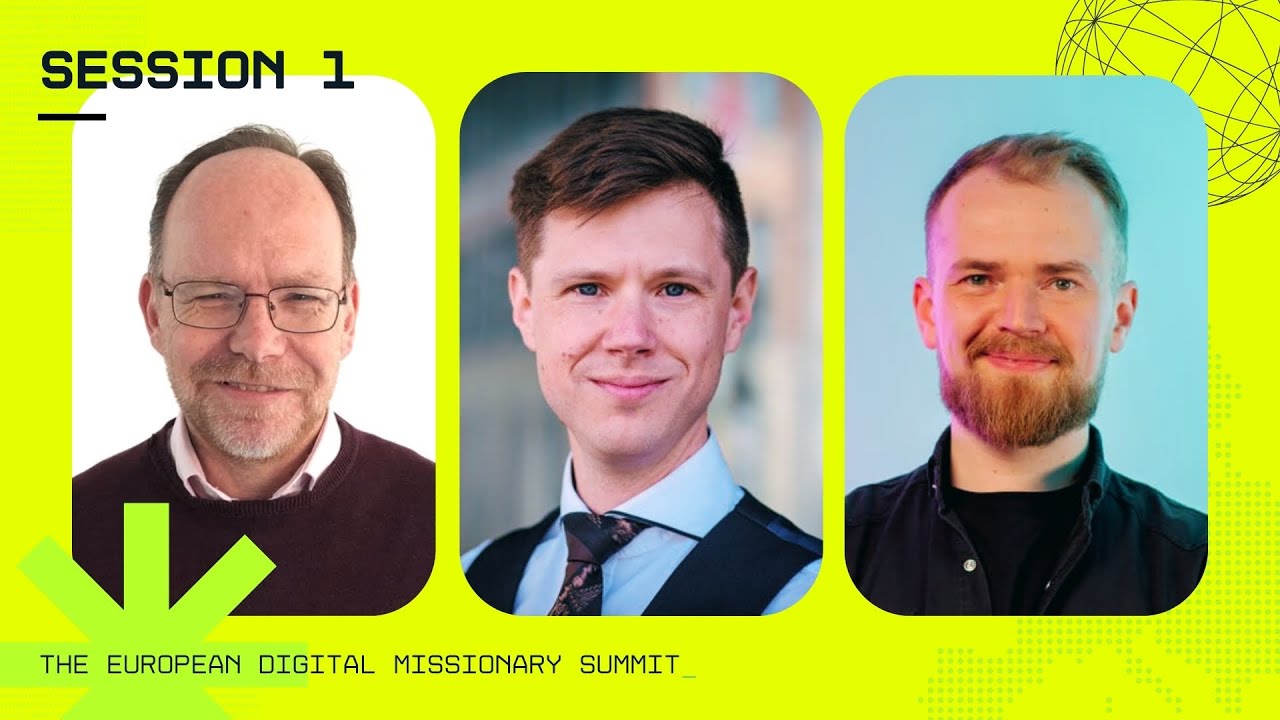
Hey there and good morning. A warm welcome to everyone. Welcome to the third of our micro conferences this fall and welcome to the first European Digital Missionary Summit of the Church Digital.
··
We are so happy to have you here and are looking forward to a day filled with insights from people in digital mission across Europe.
··
And when we are talking about digital mission, we are talking about people. People being reached in digital mission across Europe. People being reached with the love of Christ.
··
People like Lars. I remember Lars joining our midday prayer at our digital church plant here in Germany last week and it was the first time for him to pray together with other Christians.
··
I remember Dier, who is deaf mute and connected to me through the VRMO church in the US to find someone to pray with him through chat, of course.
··
I think of a gamer starting to read the Bible after losing a match in a first-person shooter and connecting with a digital missionary in his team.
··
I think of a woman who's chronically ill, finding a refuge in a digital house of prayer with one of our digital missionaries. I think of Alvaro, an ex-Muslim coming to Christ through a TikTok live chat with a digital missionary, a digital evangelist.
··
These are just some of those many, many stories, many stories you have to tell, how people find Christ in digital spaces and places and that that is what we are here to reflect and pray about today.
··
Thank you. Thank you for all the digital spaces and places where you are on the move in digital communities in social media networks and gaming spaces in digital chatbots and so much more.
··
I want to start this day off with a quote from the Bible from Romans 10. It's a call to all of us, I guess, and I like to read it.
··
But how can people call for help if they don't know who to trust? And how can they know who to trust if they haven't heard of the one who can be trusted?
··
And how can they hear if nobody tells them? And how is anyone going to tell them unless someone is sent to do it? Well, to say it quite frankly, we are the ones sent to do it.
··
And I like at the beginning of this day introduce myself. I'm Simon Durks, leading the Outpost Europe at the Church Digital and also the Region Digital of the German mission agency Alliance Mission and I'll be leading you throughout the day and I'd like to love to start this day with a prayer for you out there across Europe and across all of the globe and also together with all of our speakers today.
··
Lord Jesus, thank you so much for connecting us, connecting the global church through digital ways and for calling us into digital spaces and places just as all the spaces and places and countries out there. Please use this day to encourage us to sharpen your calling for us in digital spaces and places and to connect to each other.
··
Please help making meaningful conversations, meaningful meetings today. Amen.
··
All right, we're getting going into the European Digital Missionary Summit and we are thrilled what is going to happen today.
··
We are really happy that 550 people signed up from more than 70 countries. And it's also interesting for us to see that the majority of those people having signed up are not actually from Europe but from all of the other continents.
··
So welcome to wherever you are. We want to honor the variety of cultures and of languages throughout the continent of Europe and that is why we decided to provide translation today.
··
So there will be an AI powered translation and we're providing that in 10 languages: in Spanish, French, Portuguese, Polish, Romanian, Finnish, Russian, Korean, Hindi, and German.
··
So you can choose if you go on the language tab, you have the opportunity to choose in which language you want to have audio dubbing or want to have live subtitles.
··
So you could also mix that like listening to me in German and also in Finnish and having like Hindi subtitles. That's just up to you how you are willing to join in.
··
We want you in your language, in your heart language to be able to participate in this conference.
··
This conference is not only about sitting back and listening. This conference is about interacting, getting in touch with others. They have a lot of opportunities for that. You can step out in the lunch and sit on the table with other peoples during the breaks.
··
You can use a chat here to chat with each other. You can interact with other attendees directly or make up a meeting with them.
··
Later on, you have the opportunity to sit to join in tables with the speakers to ask you further questions. And we got really a lot of nice speakers on the road for today.
··
We're going to have 11 speakers who will be reading really showing us the variety of what is happening across Europe and also a lot of great sponsors who make it possible that we can have this conference with you together with you joining just for free.
··
That is so great. So we'd love to get the conversation going and we'd love to keep the conversation with you and that is why we'd like to invite you to become not only part of this conference but also become part of the family and join one of the Church Digital communities in WhatsApp or in Discord. I posted that in the chat as well.
··
Okay. So for today, for this morning, we're saying a big thank you to all the team who put this together, to all speakers, and of course to you for attending and being with us.
··
And now we're going to hear a little bit from Jeff Reed, founder of the Church Digital. Let's get started this conference with an intro.
··
And I'm giving over to Jeff Reed.
··
Awesome. Hey, thank you very much, Simon. It is a pleasure to join you here from North America.
··
It is a whopping—I don't even have my watch on. It is 3:07 a.m. my time and so Nicholas, uh my friend Nicholas in chat is saying he wants more conferences European time and I agree.
··
Uh that being said, I actually am drinking coffee to make sure I stay awake for this conference today. Hey, my name is Jeff Reed, founder of the Church Digital. Very much.
··
The flat cap Leighton is doing the cat emoji because that's me right now, trying to stay awake and so anyway, hey, I'm Jeff Reed, founder of the Church Digital, so excited to see this happen here. Let me just share a little bit about the Church Digital and then I'm going to get out of the way for this conference.
··
So the Church Digital, we're a digital missionary sending agency. I met Simon I don't know somewhere in COVID 2020, 21, maybe 22. I think I was speaking at a German conference in the middle of the night. And it was funny. I ended up doing a talk on an evangelism system called BLESS. Uh and it was the first time I publicly taught that.
··
And it didn't even occur to me that I was going to be speaking and I was going to be translated in real time into German.
··
And the BLESS acronym didn't make sense in German, much less any of the other languages that were international. And I felt like an idiot uh like right as I started the keynote.
··
Conversation for a different day. But we are very excited to help people become digital missionaries to be sharing Jesus online in digital and virtual space.
··
Uh platforms like Facebook, Twitch, Discord, WhatsApp, virtual reality, video games, the metaverse, whatever it is, um taking evangelism, taking Jesus, taking the gospel into these spaces through conferences like these through streams.
··
Actually, um Leighton Flat Cap is one of our streamers on Twitch and I stream on Discord. Uh I shoot uh YouTube. Uh but in addition to that, even uh blogs and cohorts and trainings uh that we're literally offering in time zones around the world.
··
Nicholas, who was in here earlier talking, I actually taught him uh in some other Oceania, Southeast Asia type, southwest Asia I guess uh type countries uh Asia Pacific uh earlier this year.
··
And so all that to say, hey, we would love to hang out with you, learn more about your ministry and how we can help what you're doing and maybe amplify what you're doing in digital virtual space.
··
So the Church Digital is a great place to connect. I'm going to be hanging out for the conference in tech support. Uh in your web browser, uh to the lower right hand side, you probably see uh a reddish kind of chat widget.
··
It's two chat bubbles on top of each other. If you're bored in the conference, which you won't be, but if you are bored, say, "Hey." Um, maybe like talk to me every once in a while to make sure I stay awake, especially in like three hours where, you know, it's going to be a little uh 5:00 a.m., 6:00 a.m. maybe my time.
··
But I am really looking forward to uh what's next with the conference. Let me make sure I did everything I was supposed to and it looks good.
··
Um, join our community. Simon already discussed the Discord and the WhatsApp. That is a great place to connect with us uh and stay up to date with everything that's happening as we're out there in encouraging, empowering, and equipping uh digital missionaries uh at a global scale.
··
And so, thank you, Simon. Let me uh hand it back to you.
··
Yes. Thank you very much, Jeff. Thank you much for being up in the middle of the night.
··
Jeff only had like an hour of sleep today. So, it's an honor for us to have him with us. So, we're going to start into our first session.
··
The sessions will also be uh will always be with a couple of speakers just speaking after each other. We're going to have a little bit different uh angle of viewing uh on the topic of digital missions in Europe.
··
In each of the sessions and we also be having um short talks from our um sponsors which make it possible for us to um go to this conference.
··
So the first uh session of keynotes we are going to be focusing a little bit on the big picture the question of what is happening across Europe.
··
For that we got um the regional one of the regional directors of the Lausanne Movement Europe uh Jim Memory with us and he will gonna give us a big picture on what we can see what is happening in missions in Europe.
··
We're also going to have one uh a big picture on the question of how is the digital space shaping changing and what new opportunities grew up uh that we're seeing.
··
Touch Stadleman is one of the um most um elaborate persons I know on um the topic of AI. He's teaching as professor in Switzerland and will be talking um on uh AI and um the opportunity for evangelism and mission.
··
And we also be hearing from Andy Fronos. He's living in Romania and is uh focusing a lot equipping content creators and investing into the Gen Z.
··
He'll be teaching a little bit um talking a little bit about his ministry and giving examples of how that is happening. So I'm really really thrilled and I'm really thankful for our speakers to be with us.
··
And before we start with our speakers, I'm going to give a short um uh short view on um uh one of the uh sponsors that is quite close to me and that is Alliance Mission.
··
That's a German mission agency I'm working with. And um what we did as a mission agency here located in Germany but part of a global mission movement is what I want to share with you is we started a Region Digital um one or two years ago.
··
Why did we do that? We did that because we recognized that digitalism or connectivity as a global mega trend is changing the way global missions are taking place and we need to learn how to do so now not in ten years when it's all when the time has gone farther.
··
So I want to take you just a short dip into why we did that and how we did that to give you an opportunity with you with the organizations you are with to think into that direction and to shape your mindset.
··
So um one great part of resource for you to dive into get an overview on how the global mission the global church is developing is a state of the great commission report that has been released before the fourth Lausanne Congress of the Lausanne Movement um last September 2024.
··
So that's really an overview of mission experts from all over the world who asked the church which are the big gaps you see in um fulfilling the great commission until 2025.
··
And there's a lot to learn in this report. One thing that is really astounding is that um asking this question to the global church they found out 25 gaps.
··
These 25 gaps are the most concentrated view on what the global church sees as a big challenges for mission until 2025.
··
And if you walk through these gaps, it's great to read through that and to dive deeper. If we walk through that, you see that at least 10 of these global gaps of the global church to reach the great commission until 2025, 2050 is um connected to digital life to digitalism, to connectivity and that is why we said okay we want to learn how to start a region digital. We are thinking not only about geographical regions like like Africa or Asia.
··
We are thinking of the digital spaces as of a region and uh a region with digital cultures with digital countries so to say places and spaces and digital ways to engage people.
··
So we started with working for a couple of years uh among gamers. We started with digital evangelist on social media with um learning how to do digital church planting with learning how to leverage AI for automated evangelism and thinking about so much more future topics.
··
How did we do that? We asked on the one hand side where are development fields that we need to go along as a mission agency.
··
We need to think about what is digital church about. What does a digital ecclesiology look like? We have to learn how the new work changes people of life.
··
We have to think about new ways of a digital me. We have to think about how to do covered operations um in countries with creative access or how to leverage business funding in digital spaces.
··
And we also have to think about think on different levels like what do we need to think about digital theology? What structures do we need to be on site of digital missionaries?
··
What culture do we need to build up? Where do we need to ex do experiments? And which new skills do we need to learn?
··
There would be much more to say. I just want to shape your mindset for you and your organization or the organization you're with to start thinking on how to do digital missions in your context for our continent and beyond.
··
And the question, the one question I'd love to to pass forward to you is what digital stories of hope will God tell through you?
··
That might be a question guiding us throughout this day. So much that um so much that um from Alliance Mission as uh one of the sponsors of this great conference and uh if you're um thinking about becoming a digital missionary and are from Germany or from the neighboring country then you're invited to join um a weekend of um asking about your digital calling uh here in Ivaspach. You're invited to join up there. If you're interested in what we are doing as Alliance Mission and you can just find some more information on the websites I post here in the chat.
··
I also post a chat to dive a little deeper into the state of the great commission report. Gain deep insight on what what is happening with the global church.
··
You can do that by reading it online, downloading a PDF in one of six languages or chatting with a Lausanne chatbot. I love that opportunity of course.
··
All right, so much said, let's just straight dive over to our first speaker into our first talk and that will be Jim Memory, uh, regional director of Lausanne Movement Europe.
··
Jim, over to you.
··
Well, good morning, good evening, whatever time in the world it is for you. Uh, it's a pleasure to be with you.
··
Yes, my name is Jim Memory. I'm British by birth, but I've spent most of my life as a missionary in Spain with the with ECM, European Christian Mission.
··
Today, I have the privilege of uh co-leading the Lausanne Movement in Europe. If I put my sunglasses on, everything gets dark. And frankly, that's how most people see Europe as spiritually dark, godless, secular, post-Christian.
··
And it's not even not just politicians or journalists or academics over and over again, even in Christian conferences like the one that uh you'll be showing your screen in a second, um say that Europe is post-Christian.
··
And when when we repeat something, we start believing that it's true even when it's a lie. Sadly, I think most European Christians, many if not most European Christian leaders, and maybe even some of you on this call have internalized the myth of the inevitable decline of European Christianity.
··
Rather than holding on to the hope of the Lord's return demonstrated in the resurrection, we've internalized an eschatology of despair. So brothers and sisters, this morning I want to encourage you to take off your sunglasses.
··
Because as I've been saying for the last five years, Europe is not post-Christian. It is pre-revival. And out of the spotlight, an extraordinary re-evangelization of Europe is taking place.
··
The first area in which we see that is what's happening with church planting movements. In short, almost every European country today, there is an acceleration in the number of new churches that are being planted.
··
Whether that's through denominational initiatives, mission agencies like Alliance Mission or ECM or many others, individuals, platforms or ministries that facilitating church planting, new models of church and in traditional form and some in more radical form.
··
New Christian communities are sprouting up almost everywhere we look. Perhaps the most exciting thing of all has been to see the proliferation of national church planting movements, national networks of planters from across the denominations that are connecting and collaborating in reaching their countries.
··
Now, as I said at the beginning, I spent 15 years as a church planter in Spain. Church planters tend to be entrepreneurial mavericks. They're focused more on their own church and their own locality.
··
So collaboration between church planters is a new thing and I think it's a sign of revival happening in Europe. Secondly, what we see with diaspora churches, God is using people on the move to sew the seed of the gospel across the continent of Europe.
··
Some of these diaspora churches are European. The photo in the bottom right of your screen is Betania Church in Dublin. It's the largest church in Ireland and it is a Romanian diaspora church.
··
Over the last 30 years, Latin American migrants have planted hundreds thousands of churches in Spain, Portugal, and beyond. It's difficult to find a major European city that does not have a large Spanish-speaking or Brazilian church.
··
African initiated Pentecostal churches number in the thousands in Europe. Uh tens of thousands probably. Just one of those, the Redeemed Christian Church of God, has planted nearly a thousand congregations in the UK over the last 25 years.
··
If you live in a European city, if it has a significant African population, there will almost certainly be an African diaspora church, even if you're not aware of it.
··
And Asian Christians have also planted churches wherever they've migrated to. There are twice as many Chinese evangelical churches in Italy as the total of all of the evangelical churches of any kind in the neighboring country of Slovenia.
··
This new reality is a huge opportunity for the gospel. But it's also a huge challenge because the presence of thousands of diaspora churches isn't having anything like the impact it should because so many of the church leaders are not able or willing to adapt their cultures their churches to the culture and to the context. I spoke to a Chinese church leader recently. He said this. The Chinese diaspora churches are like beautiful flowers that have been planted in European soil, but they've forgotten to remove the pot.
··
We need to encourage diaspora and native church leaders to work together. And maybe digital media can be one of the ways to break those flower pots to see these churches reach this next generation of Europeans.
··
Thirdly, what's happening with the next generation? Amazing things are happening amongst Europe's youth. We regularly hear about new revival movements in different countries of Europe.
··
This one really caught my eye. It's Shrock Fest in uh in Croatia, a Christian festival for young people from across the Balkans. It was the first event of this scale that's brought together a young generation from across the whole region since the the the war that there was in that part of Europe a generation ago. But I also want to highlight another sociological reality in Europe. Europe's birth rates over the last 25 years have collapsed. Some Mediterranean countries now have rates that are amongst the lowest in the world.
··
This chart shows Europe's old age dependency ratio. The number of people aged 65 plus per 100 people of working age is expected to rise from around 30 in 2015 to between 50 and 60 and in some cases in the case of Italy and Spain to between 70 and 80 by 2050.
··
In other words, for every five people of working age, there will be four pensioners. All these older people also use digital media. So, as you innovate, I would plead with you to think about people like me as well, those who are entering into this older generation because they are also using those tools and we need to think about them. There's going to be so many more older people in Europe in the years to come. God has not given up on Europe.
··
It may be out of the spotlight, but whether that's through church planting, which is accelerating, whether it's through diaspora churches, which are multiplying everywhere, or whether that's through revival amongst the next generation, God is at work in Europe.
··
I would love to say when I do this presentation again that there's a fourth thing happening in Europe. What is happening in the digital space.
··
So I'm here today as much to speak as to learn from you. And so I would, as I say, I would love to have a fourth thing that I always say when I travel around what God is doing.
··
So I'm really excited about that. Europe is not post-Christian. It's pre-revival. And I say that not only because of what I see, but also because of what I believe.
··
Europe is not post-Christian because Jesus Christ is risen from the dead. The resurrection of Jesus has transformed the vision of the disciples and it should do the same for us.
··
How can Europe be post-Christian if Jesus is still alive? Secondly, Europe is not post-Christian because the church is still here. The church is here.
··
The spirit of God is here. And through history, whether through persecution or corruption, there have been many times when it seemed like the church was destined to disappear.
··
And yet here we are. How can Europe be post-Christian if the church is still here? And thirdly, Europe is not post-Christian because we know how the story ends.
··
And it ends like this with people from every tribe and tongue and nation standing before the throne and before the lamb. Every nation of Europe will be represented there too.
··
So I want to encourage you to look at Europe in a new way, not through dark glasses. Let's let's change the story about what we're saying about Europe.
··
Let's stop talking about Europe as post-Christian. Let's start to believe that it is pre-revival because that is what God is doing right now everywhere we look.
··
So again, I want to challenge you this morning um and this evening wherever you are to to look at Europe through new eyes to um pray for Europe, but also to consider how digital media might be impacting in each of those three areas and how it could impact into the future.
··
I'm thankful for this gathering, thankful for this time together, and as I said already, I'm here to learn. So thanks so much for the opportunity to speak into you this morning and pray a blessing on this day for you. God bless you.
··
Wonderful. Good morning from my side. My name is Tish Stleman. I'm speaking to you from Germany this morning and we're talking about the unexpected opportunity for missions because of AI.
··
And we are not going to talk about the opportunity of AI as a tool that can help us in our work as missionaries as Christians. But for the opportunity that arises because of the way we can talk about our worldview about spirituality because everybody has questions about the future because of AI.
··
I am a computer scientist, not a missionary, not a theologian. I'm a computer scientist leading a research center of 40 employees developing AI systems at a public university in Switzerland in Zurich.
··
And let's dive directly into our topic to use our time. Well, so how can AI be an opportunity for missions? Think about it like follows. Maybe let's do together an experiment. Do the think about the following for a couple of seconds. Given AI, how do you envision the future of our human societies?
··
Try to envision it. What picture comes up of the future given that we now have AI systems? Does it look anything like this?
··
Maybe you can bet on it that for most people you're going to talk about this question, our future societies with AI being with us now evokes pictures like this, like in the Matrix where we humans are like Morpheus who's tortured by AI systems agent Smith in the background, very dystopian pictures, lots of fear because of the technology being bad for us and maybe eradicating humanity or killing our jobs or at least making our lives somehow miserable and taking away what we love.
··
This is what people very often have in mind. And I conducted a lot of research into what are the reasons for this. And what struck me is that these dystopian narratives that are around everywhere, these narratives that you read in the books by Professor Harrari, the Homo Deus and so on, that you see in movies like The Matrix, that you see in open letters by the Future of Life Institute, that you see basically in every major news outlet.
··
These narratives, these fear instilling narratives are all based not on the technology we have or certain scientific facts. They are based on the worldview of those interpreting these facts.
··
So let us quickly dive into these worldviews that give rise to dystopian narratives. Ethicists Tim Net Gabriel and Emil Torres, two researchers have recently analyzed these philosophies or worldviews and came up with an acronym to talk about it. I give you the reference there on the slide and they talk about the so-called TESQUE wheel bundle of philosophies or worldviews. TESQUE wheel being an acronym standing for things like transhumanism, extropianism, singularitarism and so forth.
··
So what do these worldviews encompass? And let me tell you first these worldviews are very predominant in Silicon Valley amongst people who are building AI technology, amongst very people with high reach on social media like Mr. Musk, Mr. Altman from OpenAI and so on. All these people you hear about every week, they basically subscribe to these philosophies. What do these philosophies say?
··
Well, let's do a quick tour through this. By rationalism, they are saying, well, we as humans are nothing but information processors. We are basically a machine. We are a computer that takes input, processes it, and outputs something, some information. So basically we are the same as computers. And then by virtue of the next philosophy, singularitarism, they go forth assuming that when we are the same as technology, technology can basically do everything that we can.
··
So they don't need to prove for their assertion that AI can become conscious, can become basically on eye level with humanity or even more, can become super intelligent just by self-improvement. There is no scientific proof for that or even an argument. There is, well, it's a belief system that this could happen because, well, we are conscious and we are the same, and then it goes on to the last philosophy I want to touch upon here, the transhumanism, that basically says, well, if we are the same as technology, that doesn't make us equal to AI. We are actually lower. Why? Well, because we are running on biological hardware so to say, and biological hardware is somehow rotting. We have, we need to digest, we need to sleep, we age. At some point we will die. That's somehow inferior. We should all become less human and more like machines. That's transhumanism. And so if this is the worldview shaping our most powerful narratives we have in the public sphere, it's actually no surprise that people get fearful listening to them.
··
Why? Because these philosophies show little regard for human worth and dignity. Now, well, if this is all based on worldviews, and that's good news, we don't have to subscribe to that worldview, and actually we don't. As Christians, we have a completely different worldview of what is the human and what our future is. Just to give you a couple of quotes I believe you're totally familiar with them. The Bible says we are not anything like just information processors. It says we are fearfully and wonderfully made. We are relational. We are made in the image of God. We have dignity just because of that.
··
And God so much loved us that predominantly he gave actually his only son. And we have hope. In Colossians 1 it says Christ in you the hope of glory. We have hope of glory. That is our worldview. That is distinctly different than the view of people shaping a lot of the public discourse on AI.
··
So we can, because everybody is spreading their view of the future with AI based on their worldview, can utter a distinctively different and much more hopefilled and so much better worldview by talking about our view of the world given also technology.
··
We need quickly to talk about a Christian perspective on technology because I have the feeling that many Christians somehow have inherited from I don't know where a predominantly critical view of technology.
··
Let me try to challenge that quickly. What could be a positive Christian perspective on tech? Well, the dictionary says and the Encyclopedia Britannica, technology is the application of scientific knowledge to the practical aims of human life.
··
So I'm no Greek scholar. I'm a computer scientist. But my theologian friends told me the original words in Greek for technology are techn, meaning arts, craft and skill, and logos, that we know very well from the Bible. It means word, reason, and especially in the biblical context, word of God. So here's a not so literal translation, but I think a translation that has a lot of value for us, of the word technology. A free translation could be technology is the art of applying God's word to make life better. And here's some evidence for it.
··
In the first ten chapters of the Bible, every time humans create some mess, God gives them some sort of technology to deal with the consequences of their mess, to deal with the consequences of the fall. For example, here the first one in Genesis 3, we see that God gave Adam and Eve coats of skin to clothe them.
··
And well, you can find scholarly articles on the internet in scientific journals explaining in detail how producing clothes from animal skins has been high-tech a couple of centuries before.
··
So God gives humans technology. So we can I think say with a certain confidence that technology is a God-given tool in a fallen world.
··
And yes, it's also our temptation and things can also go bad with technology. But let's put a focus on technology is a God-given tool in a fallen world.
··
And so AI is a tool in a fallen world. It's not in itself safe, in itself good or bad. It's a tool that we can use. Others will use it for their purposes. We can use it, and for us it's predominantly also an opportunity to speak about what we believe. So let me conclude.
··
The scarcest resource today as I sense it is hope. The thing we most need in our world today is hope. People are so hopeless.
··
And we have a tremendous opportunity here to spread hope because of our worldview. Because our worldview is originally rich in hope. It's a hopefilled outlook on the future.
··
And it's now the time to sow this hope. It might be the biggest opportunity to speak about our view of the world since maybe C.S. Lewis's time, because well, if you listen to Elon Musk, if you listen to Max Tegmark, president of the Future of Life Institute, they all speak from their worldview. They make it explicit. They say I believe this about the world, that's why I think we're going this way or that. So that's an opportunity to make our invitation to make our worldview explicit as well and talk about it boldly and say we believe this, and because of that we see the following opportunities. So AI's most welcome side effect is that now worldviews are everywhere, everywhere in the public debate, everywhere in the public discourse.
··
It's not anymore like thirty years ago, oh it all needs science and facts and what we cannot see and cannot prove we will not talk about. No, it's the opposite. Worldviews are everywhere and everybody needs to, is asking, okay, who is the human in the light of this powerful technology? Who are we? What is our place in this world? And we have so much to say about that as Christians from the Bible, from a biblical worldview.
··
So I encourage you to use this opportunity and talk boldly about your faith because everybody now asks us questions because of AI. Thank you very much. Be richly blessed.
··
Good morning from Romania. It's so good to be here with you. My name is Andy Fronius and I have been a missionary as long as I can remember. My mom is a missionary and she started a women's shelter in Romania. My wife and I, we adopted four children and we're living in Romania.
··
Because of that, after seminary, we joined Young Life, a mission organization, and we did youth ministry for seven years. We developed new works for Young Life work with international school students and with local students.
··
And that whole package of being passionate for missions but also very interested in technology has led me to be fascinated with the entire world of YouTube.
··
And halfway through my youth ministry journey, a young person approached me and said, "Andy, you need to check out this YouTuber from New York, Casey Neistat. He's a vlogger. Vlogging was very on vogue at the time and he was inspiring. By video six that I watched of this creator from New York, I knew I had to buy a camera and I had to become a YouTuber myself.
··
So this kicked off this entire journey of acquiring gear, you know, gear acquisition syndrome. I'm sure many of you guys here on the call are familiar with it. And then I learned I had to niche down and I picked a niche which is Christian parenting and youth ministry and started creating resources there. And God has blessed that over the last seven years to the point where today we are partnering with a Czech youth organization called Josiah Venture and we're taking everything that we have built over the last seven years with a team and scale it to all of Europe.
··
Here's a little backstory. I started making videos, started doing youth ministry and combined those two things and that has grown. We also had presentations on Gen Z on how to reach them better.
··
So my main focus is actually training adults, training youth workers, parents and pastors. And we do that with a platform. This platform you can see over here, it's called Mr.
··
Yung Abite. Mr. Youth Ministry in German. What makes this platform so special is partnerships. Over the last seven years, we have invited and partnered with 200 individual Christian creators and mission organizations that let us translate their stuff.
··
So the content mix on our platform is 80% translated, 20% original content, which has allowed us to grow to one of the leading platforms on parenting and youth ministry in the German language sphere.
··
And with a friend of mine, um Dave Patty, you can see him over here. He's the leader of Josiah Venture. We have decided that we'll merge and we will build an entire digital missions track for all of central and eastern Europe by taking this platform and scaling it to multiple languages and multiple countries. But on top of that, we see the need to train Christian creators. So, we established uh an in-house event, an invite only event.
··
We called it a digital mission summit. We have done a few of those and you can see um our first schedule uh take a screenshot if you want of of how we did it.
··
So we we invited um Christian creators from all around Europe that um present the gospel um via their um avenue. For example, there's Alex.
··
Alex is a 14-year-old was a 14-year-old young man from uh Bulgaria and he had an old broken phone and he used an orange I kid you not and a little orange as a tripod.
··
So he leaned the phone um uh to the orange and he started doing Bible studies because his grandpa who happens to be the pastor of his church wouldn't allow him to preach saying he's too young.
··
So he did Bible studies on Tik Tok and if you're familiar with Eastern Europe, Tik Tok has a very high saturation of that market.
··
And today when he uploads a video, does a Bible study, he has usually like 500 people being there with him in the live streams and many people give their lives to Christ as a result.
··
So we're gathering these people from all across Europe and putting them together to train them. And I'm sure that we will do more of these in the future to train Christian creators and then give them also the platform um to grow.
··
Here's another example of what I'm doing. I am part of a creator uh community uh by April Alter. If you don't know her, she's on YouTube.
··
She's really good. Um I have learned a lot from her. And as creators, we're hanging out uh in a creator crew for 6 months at a time daily.
··
Um, we have thumbnail clinics, we have title clinics, we have masterminds. So my my time is spent mostly focusing on how can we have a stronger presence as Christian creators on YouTube and and with these things in the background um I would like to focus on the task um how can we encourage small churches with resources and how can we walk alongside them to help them introduce adolescence to Christ and help them grow in their faith.
··
And for me it is clear that young people are spending a majority of their time on digital platforms. There is this is fascinating talk on YouTube by a young man.
··
Let me stop that here real quick. uh by a young man and he says if you look at our entire life and put a dot for every month that is available and if you subtract the time that you will sleep and work and um groom yourself have hygiene and all those things you have about a third of your time remaining and at the current course of action 92% of that free time will be spent looking at a screen by any person not just by Gen Alpha or Gen Z, but the majority of people will spend 92% of their free time looking at a screen.
··
And that is why we have to be present um in their world. Um what I've noticed in Eastern Europe especially um but also in Switzerland is that Tik Tok and other social media avenues uh are usually the first point of contact for young people to hear about Christ and specifically it is worship videos the entire genre. Um, for example, there was this uh girl um in Vintatoua in Switzerland, and she showed her mother um one of these videos, Yeshua, the worship song that goes for 18 minutes or so, and said, "Mom, I want to go where they do this." And the mother didn't know what this was. So, she took this piece of information to her hairdresser um and asked her hairdresser if she knows where they do this um worship.
··
And and she says, "Yes, I'm going to a church. You can come with us." And that happened two years ago and they have been faithful members found a home in that church.
··
So worship music is very powerful. And then a young police officer in our church he joined about half a year ago. He saw again coming from a non-faith background a Tik Tok video on somebody just explaining a Bible verse.
··
So the word of God. There was no hype video, no trending video, um no clickbay video. It was just the Bible explained one verse at a time and that spoke to him so that he started looking and he joined a digital community and the digital community said you have to find a local church. So he googled our church and joined and we baptized him a few months ago. All of this shows me two things. The Holy Spirit is already alive and active and working on those digital platforms.
··
And the second thing it does not depend on me. I just get to uh water to put um nutrients there and to disciple as as things grow along.
··
But we have to be present in these digital platforms. The way I achieve it personally is I i have built this ghost publication. This is the German version of it.
··
And Ghost is similar to WordPress. Um it's a free um open-source project. You can download it and self-host it. um if you want to or you can go with their hosting which is more expensive.
··
But what's so beautiful about Ghost? If I log in in the back end here, I have everything in one place. I can create articles.
··
I can see my database of members. I can see the tracking of visitors and numbers. So, I no longer need Google Analytics or Plausible.
··
I no longer need ConvertKit or similar email uh service providers because it's all in here, all in one piece of software. And what we'll do going forward is we'll take this, put it on one German server and then have clones for each language version and then have an API connection and then have an AI pre-transate content. So let's say the ministry leader in Romania wants a specific series of articles on Easter. um he just says pull request it gets pre-transated article and then can push it out which is super easy and fascinating and lean and simple.
··
So I'm very very passionate about this as you can tell but the future um is not this because I see at the same time a very risky thing going on.
··
If you look at the um traffic that Google provides that has dropped since Easter this year so significantly that we had to correct our calculations.
··
We thought that by the end of this year we will have a million individual visitors spending about 2 minutes on the platform which we won't.
··
We won't even have half a million anymore as we used to in the past but we'll have less visitors. And I I assume that the day will come where we will have probably 10,000 visitors a year as people are moving towards AI solutions and getting the answers directly from their LLM.
··
This leads me to push for email newsletters. We have to own the community and my high recommendation like if you're in digital ministry, build your newsletter and build it fast and partner.
··
So that's it from my side. I hope it was a little inspiring and shown you what's happening uh around Eastern and Central Europe. Thank you so very much.
··
These have been three intense first talks we heard um having an overview on the situation in a not pro postChristian but pre-revival Europe looking at the opportunities of AI and seeing how digital uh platforms and Gen Z should be um utilized and brought together um working in um uh learning communities together and empowering those going forward. So now we want to step forward and hear from one of our sponsors who's making this conference possible. And uh we first going to see a short video and then hear a little bit about next steps by the Jesus film project.
··
So let's watch a clip first. Do you remember the last time you watched something that moved you spiritually? Maybe it was a sermon clip or a short film or even the Jesus film.
··
But what happened next? Most of us just scroll on to the next thing and the impact fades. For the last 40 years, Jesus Film Project has been at the forefront of visual storytelling, capturing and translating thousands of hours of media that have touched millions.
··
But pressing play is no longer enough. To truly change lives, we need to help people go beyond just watching content. Everyone everywhere needs a next step to discover and follow Jesus.
··
Let me introduce you to Next Steps, a revolutionary tool that lets viewers seamlessly engage and take action directly from the screen they watched our content.
··
With a further tap, users can hear the gospel, ask for prayer, connect with the local community, and grow their faith through experiences called Journeys.
··
Journeys combine clips from the Jesus Film Project and custom content with interactive elements tailored to each viewer's needs and interests. Across the world, Next Steps is already proving effective.
··
In Ukraine, Pastor's Wives are using it to guide faith communities and invite people to church. In Malaysia, Campus Crusade for Christ is using it to help students follow Jesus and invite others into prayer groups.
··
And even in Korea, digital missionaries are using culturally relevant journeys to share Christ with their communities. Imagine the ripple effect if every viewer could take a personalized step towards discovering and following Jesus.
··
Well, now they can. Join us in providing next steps because everyone everywhere deserves a next step to take. Let's give that to them. Good morning everybody.
··
My name is Khloe Hannon and I'm coming to you from Dublin in Ireland and it's a pleasure to be with you here this morning in this innovative event.
··
Kudos to the organizers. I'm loving engaging with conference content from the comfort of my office where I get to have no awkward small chat while on my coffee break which is you know the always the most awkward part about a conference.
··
So my name is Chloe as I said and I serve as the regional strategy director for Jesus Film Project in Europe. I have been with crew for over 16 years and I just joined Jesus film project um as a digital strategist about three years ago where prior to that I had 13 years in campus ministry with a specific focus on digital ministry. So for me digital is more than just a strategy. We have lived through a revolution in our time.
··
We can call this the digital revolution sure um but really what has changed is how people send and receive information. something that is fundamental to our our existence has shifted on its axis thanks to that revolution of the digital worldwide web.
··
In a short period of time, the power of digital has changed how politicians are elected, how corporations sell, and most importantly, how individuals see themselves in this world.
··
Europe is somewhere where we have Bibles in every language, we have churches in every city. So according to popular Christian metrics, we're a reached continent.
··
But I live in the reality that is very different to that where churches plus Bibles does not equal believers. And as missionaries in a digital space, we are competing in a saturated market with opportunities and challenges that are fast-paced and ever evolving.
··
As a continent, we are technically more connected than ever, but spiritually maybe just still as disconnected as ever. Jesus Film Project is a media and technology agency for mission and we are working to develop resources that our partners are using in real time on the field.
··
We are very passionate about the power of media. As you saw Rya in that video tell you, Jesus Film has a history of standing over 50 years of impact from the original Jesus Film that has brought the gospel into over 2,000 languages and cultures.
··
But the digitalization of information is at the heart of our strategy. Now moving into 2026, while we are developing media that reaches the unbeliever, we are also looking at a missional digital strategy.
··
Leading me to introduce you to why I'm here: Next Steps. Next Steps is a platform where you can create customizable, tappable journeys that can be deployed within your digital ecosystem.
··
It offers a practical bridging solution in the gaps that naturally exist between channels, creating digital journeys that can be tailored to your audience. Within the platform, you can access the full library of Jesus Film media, sure, but you can also upload your own media.
··
The user experience is modeled after that social media modality of tap, tap, tap with options within the journey. And then the overall design allows you to facilitate online to offline connection with direct integration to text apps like WhatsApp or Telegram.
··
The design behind Next Steps is reflective of the overall digital revolution that I'm talking about: the individualization of the world. How the individual has seen themselves has shifted.
··
So we see this emerging of agency and choice being paramount. The days of that corporate mentality are dwindling, and anything that has centralized control has been railroaded by that transformational principle of radical trust, which is what the communication theorists termed when they looked at that release of control from the centralized, linear, and singular sources to the empowerment of the user, the individual in the grand scheme that I would like to call the multiplication of choose your own adventure books. Which, if you know, Next Steps allows you to facilitate a self-directed journey while also holding on to your core convictions of mission, destiny, and ultimately introducing them to Jesus.
··
When someone encounters Next Steps, they are invited to choose their own path forward. They might decide to watch a short video that sparks curiosity about life and faith. They might want to ask a big question that's been on their mind for a while. Or they might take the bold step of chatting directly with someone who's ready to listen.
··
We know that faith journeys don't look the same everywhere. In fact, they rarely look the same from one city to the next, never mind across the 40 plus countries in Europe.
··
We are a patchwork of languages, histories, and cultures. What resonates in Warsaw might not resonate in Lisbon. What feels natural in Helsinki may feel foreign in Athens, but Next Steps allows us to do two things at once.
··
First, to share content and pathways that can cross borders and languages, and secondly, to adapt so that churches and ministries can shape it to fit their own voice, their own culture, and their own way of connecting with seekers.
··
It's flexible enough to carry the breadth of Europe's diversity, but structured enough to give teams a clear pathway for engagement.
··
A friend of mine who was involved in the development of Next Steps from New Zealand and one of his home teams began experimenting with Next Steps to connect with students online. And before that, they were using mostly cold contact evangelism, which I'm a big fan of and spent 13 years doing on campus. And sometimes it can just feel super weird, you know? You're walking up to students and starting an awkward conversation, and at times also you can feel like you spend a lot of time approaching people without getting much traction.
··
So the New Zealand team introduced Next Steps, and something shifted for them because instead of randomly approaching students, they were able to connect with those who had already engaged online and those who were already spiritually curious.
··
So Next Steps became the bridge. It gave those students an easy, no-pressure point, and it gave the team a way into real-life conversations about faith.
··
In Slovakia, one ministry leader told me that students often avoid public religious events, but they are very open to engaging privately through digital platforms.
··
So a tool like Next Steps gave their team an ability to create a safe space for students to talk about faith in Western Europe.
··
In places like the UK, France, or the Netherlands, we often encounter what I would call a polite indifference to faith. People aren't hostile to it, but it's really just not on their radar.
··
And Next Steps allows us to gently put it back on their radar in a way that isn't confrontational. Different cultures, different challenges, but one digital tool that is adapting to them all.
··
The next generation is not waiting outside church doors hoping for someone to invite them in. They're online. They're searching and they're asking questions, scrolling late at night when no one else sees their doubts or fears.
··
And if we don't meet them there, someone else will. Next Steps empowers teams to do just exactly that: to engage seekers in ways that make sense in their cultural context.
··
It allows us to bridge the online world and the offline world. And crucially, it gives us a way to move people from digital curiosity into real relationship with local believers.
··
Let me give you a couple of practical examples of how this can work and how we're seeing partners adapt it. So we have some churches that are integrating Next Steps into their websites or their social media, giving visitors a way to engage with their culture and their experience of church before they even show up in person.
··
We have campus teams, like I said the New Zealand one, who are using it to filter through hundreds of digital contacts and finding those who are ready for deeper conversations.
··
We have regional ministries that are adapting content in different languages, ensuring seekers don't just get information in English but can hear it in their heart language.
··
In particular, one of my favorite stories comes from Serbia. A team there has developed a Next Steps journey with a poster that they put in a bus stop and a QR code, and it's just got a smiley face and a sad face, and it just says, "Are you good or bad?" So where people are waiting for public transport, which is notoriously slow in their city, they can scan this QR code and take a quiz, and it ends up with them encountering options for spiritual content. And that has resulted in them having contacts that have gone from offline to online, the other way around, online to offline.
··
So as you think about your ministry, your own context, I would encourage you to ask: what would it look like if seekers in my city and my nation could take that one small next step towards Jesus?
··
That's the power of Next Steps. It doesn't do the work for us, but it gives us the bridge, the starting point, and the connection we need to walk with people as they explore.
··
And in a Europe that is digitally connected but spiritually searching, that could make a difference. Please go to nextsteps.is, make your own account, and start making some journeys today.
··
Thank you for having me.
··
Thank you very much to Chloe and of course to Next Steps by the Jesus Film Project. We also provided the links in the chat.
··
And now we are at the end of the first session. You really heard a lot so far. We had some big overview topics, and you got the opportunity to engage further.
··
So when we're going to a break time until 10:20 CET, when we start the second session, you've got different opportunities. You've got now 15 minutes where you can of course get another cup of coffee or tea if you're British, or you can step into the lobby and just sit on a table with people, with other people, and just get engaging in a one-on-one chat or in chat with those people also on that table.
··
You can also click on rooms up in the header and engage with the speakers you just heard. May it be TLO, may it be Jim, may it be Chloe.
··
You can go into the rooms, join them, and then ask your particular question that hasn't been answered throughout the talks.
··
I hope that you'll have a really good 50 minutes, taking a breath, taking a break, connecting to each other. May it be through the chat on the site, may it be through the lounge, sitting on tables with others, or through joining a room with one of our speakers.
··
And we're happy, happy to see you here back on stage for our second session. We'll start at 10:20 CET, and then we're going to have a second session where we're going to be focusing more on practical insights from different ministries here in Europe.
··
We're looking forward to talks from Daniel Shinka from Aki Gibson and also from Global Church Movements.
··
So far, thank you for joining the first session of the European Digital Missionary Summit. And now have a good time on the tables, in the rooms, engaging in the chat. And see you at 10:20, 50 minutes from now.
Auto-generated from audio, lightly cleaned for reading. · Watch the full episode →
