⌕
··
Well everybody welcome back to our third session here in the European digital missionary summit. So great, great that you are joining us and I see people coming in for the third session.
··
Take your time, take your digital space or digital place. Um, make yourself comfortable. I hope you had a good break, perhaps um, perhaps getting in a room and asking a question to um Aki regarding uh Christian hip-hop communities in in uh Finland or just engaging others in the launch throughout our table. We will have these opportunities throughout the day and after the conference there will be another hour of um time where you can just interact with each other until we close the sessions.
··
So now we are heading into our third session. I'd like to introduce myself for those um who joined uh later on. My name is Simon Dix, Simon Durkx, and I'm leading the outpost Europe at the church digital, also leading the region digital as a German mission agency, Alian Mission.
··
We are looking into a third session. So the first session was the big picture and the second session was a little bit looking down on practitioners in the European context.
··
In the third session, we want to look a little bit on frameworks because frameworks are often so helpful because you don't have to start it all again from scratch.
··
That is also what many of our sponsors are about. You don't have to start it all from scratch, but you can find frameworks other um uh provide so um you can um get started with your digital ministry that God has called you to.
··
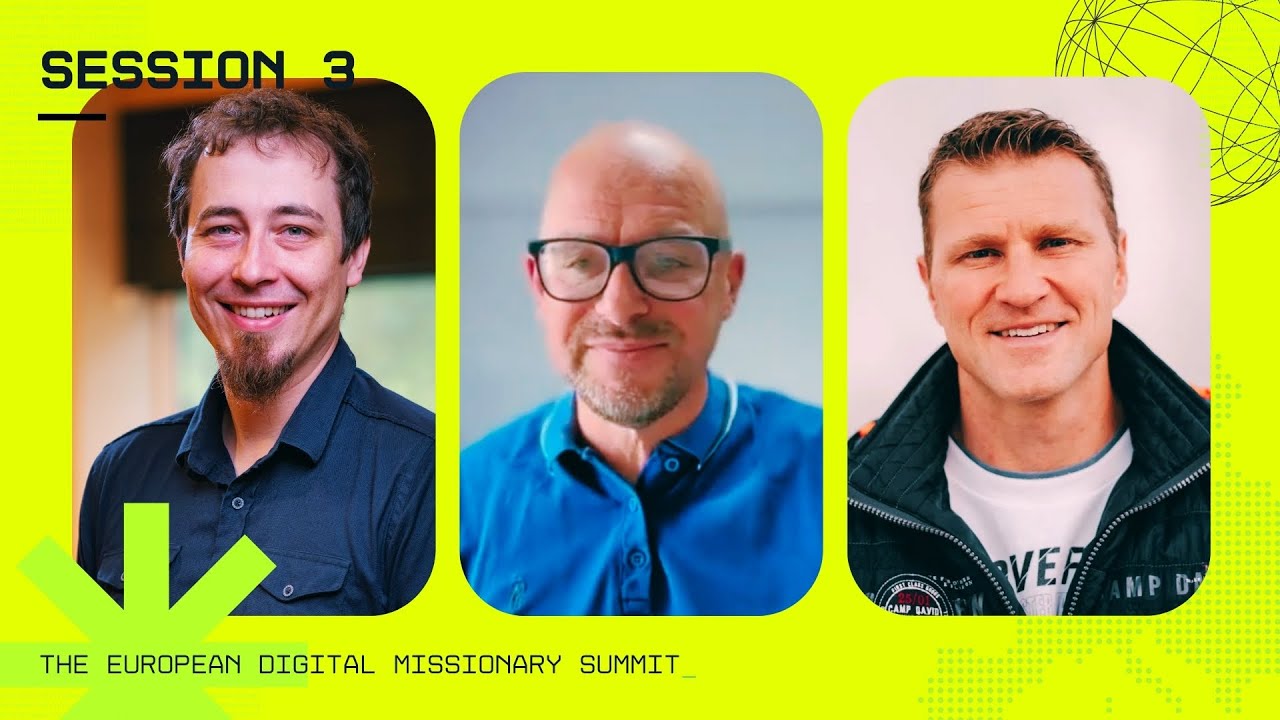
We're going to hear two examples from Poland uh with Dolink, Philip Crawl will be talking about that, and from Germany with Credle, Tobias Clay will be talking about that. Will be really inspiring and fascinating and we'll dive into another practical example um regarding redeem your digital ministry with um Dimma Lavough joining us from Cyprus and he is with Transworld Radio and we'll be sharing a little bit on his insights. So if you say it's great to find these people from Europe here to got a shared mindset on how we see um our context as a continent and as well as how we are able to shift what is um said about Europe, more shifting the focus on seeing Europe as a pre-revival continent, then one of the opportunities to connect is through the outpost Europe within the church digital community. There we are a um, there you got the possibility to interact with other digital practitioners from across the continent and I'll just drop you the link in the chat to uh join our WhatsApp community um, especially the channel for outlook outpost Europe. Here you got the chat in the link and now we're ready and set to go for our third session at the European digital missionary summit and we're going to start off with one of our sponsors and Jeff is going to telling us a little bit about Right Now Media. Jeff, here you go.
··
Awesome. Hey, hey, thanks. One of my favorite things I get to do with these conferences, by the way, it's currently 5:18 a.m. Eastern and coffee is still good.
··
Um, but one of the favorite things I get to do for these online conferences is to share resources. And the best part of resources are the ones that are free.
··
And so let's go ahead and play this video from Right Now Media. Heat. Heat. All right. So, I, this was a, this was a marriage made in heaven.
··
Uh, I don't know why we didn't figure this out sooner. Uh, but the church digital now has a partnership with Right Now Media. Uh, Right Now Media is the uh, forgive me, I'm Netflix is global, right?
··
Like it's, it's the Netflix of uh digital discipleship resources. They've got thousands of uh Bible studies available digitally from well-known people, multiple languages, multiple cultures.
··
Like this is an incredible online resource and and we the church digital uh have a relationship where now we can give accounts away for free and and so anybody that's watching uh this uh this conference right now media loves you and so the church.digital, right now media. If you go to the website, thechurch.digital slash and then right now media, all one word written out there. Uh, that'll redirect you to your free online account to watch Right Now Media.
··
Download the apps, watch it on your iPad, your iPhones, your Android. Uh, it even works on Windows. I'm kidding. I'm taking a shot at Simon.
··
I'm a Mac guy and uh we can still be friends even though he's a Windows user. Um, I know. I'm sorry. It's a thing.
··
So anyway, check out Right Now Media, get your free account. And any questions, feel free to let me know down there in the in the tech support chat widget lower right hand corner.
··
And uh looking forward to moving on here with the conference. And so ready to go uh with what's next. Thanks y'all.
··
Hello. Good to be with you today.
··
My name is Philip Croll and I lead the team here at Doling. We are based in Poland and we are involved in the online ministry both as doers but also as accelerators with multiple partnering ministries around the world.
··
So before we start, I'm really curious to see who is here today. Can we maybe take a minute and do a short poll? Um, the question would be what's your involvement in an online ministry?
··
So let's uh let's do the poll now. Okay, we get her answers. So just picking in the uh entry level, let's say then solo missionary posting and sharing on socials or maybe gaming.
··
Then team player serving in an organized online ministry and mastermind helping lead and shape the digital strategy. Okay, so we have a lot of or some people curious.
··
And then team players so part of some online ministries. That's great. That's useful to know. Yes. Thanks. Good to know that you're there. Cool.
··
Thank you for this feedback. Um, this year uh in our ministry we are celebrating 50 years of ministry and u it was really always about using uh innovative and current ways of communication to reach people for Christ.
··
So over the years you can imagine that we've been involved in different tech and media strategies. But then uh year 2008 came and in 2008 we've entered a new era for us which was the era of online evangelism and in July of that 2008 we recorded first decision for Christ on our website looking for God and everything changed. No, finally we had easy and accessible, scalable, 24/7 way of sharing the gospel. Together with Jesus, we've created a great experience.
··
It was starting with Google ads leading to a website with testimonials with information about who was Jesus and uh gospel presentation. And then there was a sinner's prayer.
··
So people could pray and then click the button. Yes, I prayed the prayer. And then we were connecting people through the form to online coaches, our volunteers.
··
And they were having this conversation on email. So the goal was really to bring people to the local church. So on paper it all looked great.
··
The problem was that it wasn't really a great experience because people were dropping from that process. And if there were some people who were brave enough to go to the church, uh very often this was also not great experience because uh at least at that time uh the churches were not really welcoming and not thinking about newcomers, especially from internet or something like that. So so there was a lesson for us there. Uh, we learned that to see some real impact.
··
It's not as simple and a quick thing. Uh, it's rather walking with people towards Jesus with love and care personally and best one on one by one.
··
So we realize that this walk takes time and we need that time to really understand when the where the person is and how we can help and we need time to build trust which is not so easy online and also we need to have a direction and be intentional uh and we need a process that we can follow. So the first lesson was that if we really want to see some lasting fruits from that ministry, we need to move away from simple interactions and move to a to a journey.
··
So in other way you can say that uh we need to move beyond views, clicks and likes. And we we love these and they're great and they are easy to measure and the whole marketing machine is optimized to to really gain these but we are called by Jesus to make disciples and this means much much more. So we want to help people start the journey but how to really start it, we say that when you design the journey it's good to start the journey wide uh because we have this opportunity the internet is huge. Yes, you can reach billions of people.
··
So you can start with social media and I am here, there is I'm sure there there are a lot of great experts here that can talk much more about that than me.
··
Uh, so social media is a great starting point or also you can optimize your blogs or pages for SEO or now the broad SEO, especially important in the age of agentic AI and of course there is also paid ads providing you with a pretty cool way to reach new audiences.
··
But the question is where we want to lead these people, how to invite them to actually a journey. Uh, this February uh at digital ministry conference in Dallas, there was an interesting talk from Chris Martin from Moody Global about the role of social media and uh he said uh shepherd your audience away from social media, create depth on other platforms and this really resonated with me very closely because it was exactly our experience. Whenever we tried to do something deeper on social media, it didn't work.
··
People were giving shallow answers and sometimes our volunteers got a lot of hate or their private conversations were published. So we knew this wasn't the way to go.
··
We need to go deeper with our connections. But what does it means? It means that we want to focus on the individual. Each journey is different.
··
And we can look at Jesus uh what he was doing. And also Paul uh he, they had time for crowds but also they were intentional about individuals and small groups.
··
Uh, we want to see relationships happening, not just interactions but you know longer time chatting with people, praying, they showing care and love. Uh, we we need time.
··
We need to walk with person over days, maybe weeks, maybe months. Uh, and we need to be very intentional because it's very easy to get distracted on the journey.
··
So we need to stay on track, disciple people to Jesus. So in our experience the the solution was to really go with our own platform and why we believe the platform is important because we want to create and control the journey experience.
··
We want to have deep conversations in a safe environment. We want to own the data and set the rules. Um, also on the digital ministry conference somebody said that uh if your ministry is only on Facebook and Instagram then you don't have a ministry because you know in a short moment the political wind may change and you can use lose your profile or access to your profile and this already happened to some ministries in different places in the world.
··
So it's important to to have what already somebody mentioned to for example build a list, at least an email list to have an ability to contact uh people.
··
Uh, we also want to invite and manage volunteers because it needs to be relational and it needs to um it needs to be manageable because when you are training people you need you want to see how they are doing and so on and we want to see and measure the outcomes uh because it doesn't make sense to do things that will not bring actually some outcomes and impact. This is at least what we believe. So this is some of the theory, but what can you do with with that presentation?
··
Uh, you can of course move on, but there's a huge opportunity here for us as Christians uh to reach out to the lost in these new engaging ways.
··
And this uh this approach works uh every day uh we see on our platforms hundreds of new people starting their journeys and maybe God is showing you to do something about it.
··
So if you're here just curious or maybe you're a solo online missionary finding your bottles somewhere in the comments or private messages, here is something for you, practical and available right now.
··
Uh, join our English speaking platform growyoulife.net and become a coach. Uh, and you can lead people to Jesus and uh, receive training and support from experienced coaches.
··
Um, you can serve of course on the flexible schedule and be a part of this active missional community which is very exciting. Or maybe you are in a position of influence where you can shape the strategy for online ministry and for organization or a church, and then uh, I would invite you to explore Growpoint. It's a platform that we've built for the ministry because there was no tools like that and we needed them. So it's a white label platform designed for evangelism, discipleship journeys.
··
It's really proven in the field over more than ten years and you can build a lot of stuff there. Uh, but basically it's really meeting the needs of missionaries in the field and there are some great partners that are using it today like Billy Graham Association or Jesus.net community Bible studies or some crew partners. Uh, but we also work with a number of small organizations, sometimes even individuals, and then we provide everything that's needed—the training and everything—to launch this kind of ministry.
··
So I would be really happy. I would love to uh, connect with you uh, maybe later this day in the room or you can uh, email me or find me on LinkedIn uh, because I think and I believe we believe there's really something there. There's a huge opportunity uh, to meaningfully connect and engage with people and this is happening uh, every day. So yeah, thank you very much for this time together.
··
Hello everybody. My name is Dimma Lavro and I come from Cyprus. So I can um, share my uh, presentation with you today.
··
You know, I start with this uh, marvelous event that happened in 1992 and I was there. You can see I'm right there singing in this big choir at this huge evangelistic crusade by Billy Graham in Moscow in 1992.
··
And um, I want to show you the power of an offline event. And um, we can see um, now like thirty plus years later now uh, an organization like U.Version is about to celebrate a billion downloads of their mobile application. What a huge impact that they have. I was visiting their office back in February and it was really marvelous to see what they've been up to. It's really great—from a huge offline event to a digital outreach and the downloads like beyond the million. Who could imagine that this could happen?
··
The topic of my uh, talk today is "Redeem Your Digital Ministry." So basically, by the word, by this term "redeem," I mean recover what's captive, buy back attention from distraction. And attention—remember this word because I'm going to refer to this word also in the end of my presentation—buy back attention. Your attention as a digital minister. I've seen in the poll that there are many team players who are present today, so you guys are welcome um, um, to maybe learn something from from my experience in previous seven years in digital ministry with uh, TWWR.
··
Number one, I want to say that heaven counts differently. Don't just chase numbers. Follow God's model uh, of success. You know, find a solid biblical foundation for your ministry, for your digital ministry, for your digital outreach, for the work of your team.
··
And one of my favorite verses is First Samuel 14:6 that says the Lord can save by many or by few. So we're all geared toward billions, thousands of subscribers. But you know, the research confirms that Jesus balanced his ministry and actually spend uh, um, fifty percent of his time talking to crowds or groups of people, but also one-on-ones.
··
So focus on one-on-ones, deep meaningful conversations. Teach the multitudes, but chat with Nicodemus and the Samaritan woman. Collaborate boldly. I'm going to present you one uh, case from my ministry and um, where we took kind of a holy risk.
··
So we reached out to an influencer in the Muslim region, five million subscribers on Instagram, and for eight hundred bucks we got like one hundred fifty, one hundred sixty followers in just thirty days. You can see the economics. It was really, you know, we liked it. It reached out the audience that we wanted. It was a native voice uh, nominal Muslim, clear CTA, and we really gained a lot.
··
And I will get back a little later to this example. So it sounds absolutely fantastic. I mean, we reached uh, more than one hundred subscribers in one of our channels. So really, collaborate boldly, take some holy risks, and see some holy results in your ministry. And it's really, really amazing. But before you do this, and this is probably the most important lesson that I learned over my years of ministry, is that before you touch the keyboard, guys, before you touch the keyboard, heat your knees because there lays the success of your ministry. Heat your knees because God will humble you in many different ways. And it's not about knowing the algorithm. It's not about budgets. It's not about having more people on your team. It's about the Lord because he gives you the success. Hit your knees.
··
No prayer, no power. This is a spiritual battle. Ephesians six. So everything we do in our ministry, in our digital outreach, is not different from thousands of ministry and missionary work that has been done so far. We just, you know, change a few things. So hit your knees. Don't forget about that. That's another example. So I continue with this case study in the Muslim region.
··
I call this Muslim region myself, and this is in Russia, the Quran belt in Russia. You see, from the Caspian Sea to the Black Sea, there's a Quran belt. Ninety percent of the Muslim population, and we wanted to reach out through digital some of these people, Muslims living in this republic. So seven million Muslims and few Christian groups among the forty people groups in the North Caucuses, and that's that's really amazing.
··
So know their story, learn about their languages, people's groups. So dive really deeper into the culture, love the culture of people. Just go live there, eat with them. Uh, get to know them better. This is really, really critical. Begin where they live, not where you wish now they were. And uh, to those of you guys who reach out to secular audience, become fluent in secular. It's like a language, you know, stay where they are, lead where he is. And uh, start where they are and lead where he is.
··
Become fluent in secular. I'll give you one example. Again, I find it in the Bible and it's really amazing because, you know, in the book of Esther, you know, God is not mentioned. But when God isn't named, but he's noticed. And uh, for instance, in Russia, we broadcast on fourteen FM stations, but also we broadcast uh, using different digital streams, and ninety percent of those streams or of those um, uh, social media are secular people, and we speak with them fluently. And I can tell you, I know, because our programs pass station legal review and government screening in my home, previous home country. So speak secular fluently.
··
I hope you like this statement. Number six, get black swan ready. What is black swan? There is there, there is an economist by the name Nassim Taleb, but maybe some of you read his books. Black swan is an uh, an event in human history that is not obvious beforehand, but it is extreme and it can be explained only after, and has a huge impact. It reshapes markets and politics and the society. So you, COVID-19 is one of those examples. Yeah, you can see more that somebody already mentioned here during our sessions that basically, you know, that when you do your ministry in social media, you have to understand that this audience does not belong to you. You borrow these people. You think they follow you and belong to you. No way. You borrow these people from the social media network as long as the social media network allows you to use their network or the government, and uh, the way you have to have a plan B basically to migrate your audience using your own database and uh, keep them separate where you can reach them out. That's another case study.
··
Same case study with the one hundred fifty, one hundred sixty subs that we have, and we grew in one month, then we were down. That was obvious uh, but that's what we have, and these are the uh, Instagram channels that we have right now in that Muslim region uh, among the unreached people groups in the North Caucuses of Russia. I can I can show you different channels reaching out to different groups, and guess what our black swan event was? Since 2020, 2022, when the war broke. So the country blocked basically every social media. So so um, and our Instagram accounts were blocked, and uh, the use of those accounts, I mean, went down.
··
We were not able to manage. We didn't know that we have to, you know, keep the audience on a separate database. So I give you one, a simple example, that you really have to take care of that because it's not the matter of if, it's the matter of when this is going to happen. Okay. And a couple of final moments, I want to say that we stand at a bifurcation point in history. Um, a bifurcation point is like five hundred years ago there was a Reformation, and at the same time there was a printing press that was created, right? And you see the number of manuscripts and the number of books printed, okay? And that's exactly the moment five hundred years later. We have Internet, 1990. We have social media, Web 2.0, 2004. We have blockchain and Bitcoin, 2008. Do you guys use blockchain and Bitcoin? We do use blockchain in our ministry. Web 3.0, decentralized, 2020. AI, ChatGPT, 2021. Quantum computing. There should be another line, AGI, but we're coming to this. So this is uh, the moment. And the final, I started with attention. Redeeming attention. Attention is the new commodity. It's just like natural gas, gold, Bitcoin, and among those like crude oil, wheat, copper, coffee, gold, and human attention. Okay.
··
And my final thirty seconds. Ephesians 5:15-16. "See then that you walk circumspectly, not as fools, but as wise, redeeming the time because the days are evil."
··
So connect me via LinkedIn. Um, I can share more with you. Thank you very much. Hey y'all. Great to see you or to hear you, to be with you. My name is Toby Cly. I am from Germany. I'm married to an American. We have five kids, four boys, one girl. And I'm not a digital person.
··
I'm an evangelist and I love to be with people, share the gospel with as many people as possible. When I went to seminary, the guy who um, did the service, he prayed for each individual Bible school student. And at the time, he prayed for me and said, "God, grant that Tobias reaches more people with the gospel than Billy Graham." And I remember listening to this prayer and I thought, how stupid is that?
··
So I always thought about how can we reach more people than Billy Graham. And over the years, it became more and more obvious it needs to be something digital. It needs to be scalable and and and huge, and you need to reach people where they're actually searching for. And this is how Creedle started.
··
Creedle is a digital ecosystem of many, many different platforms. Um, the prayer behind it or the vision behind it started actually through a prayer group of many old women, and we go to old people residencies and we go to monasteries and so on, and we ask especially older people to pray for it, and we pray for a digital reformation. We want to reach people where they're actually searching for Jesus. And most of the people who search for Jesus or life questions search online.
··
What Creedle also does, it brings the Christian world together. Lots and lots of ministries are involved in Creedle because Creedle is, sizewise, it's impossible to do as a single ministry or single church. It needs the whole body of Christ, and the overall vision is "all for all." So if all Christians bring to the table what they do and have already, we can reach the whole world together with the gospel.
··
We want to make Jesus Christ visible together as the body of Christ. So let's see for whatever reason. Here we go. So you can Creedle is like a as I said a digital ecosystem.
··
It's not one building, one platform. It's many many different platforms and over time all of these individual applications they will portray the whole life of a human being every topic of us human beings that interests us.
··
Every every little bit of our daily life and in every application we want to bring Christ and what Christians have to say concerning these topics into the daily lives of people through their smartphones.
··
If you want to um just serve and search for stuff, you don't need to register. Um but if you want to participate and share content through Credle or whatever, you need a personal account.
··
In the middle on the bottom, you see that personal account, my Credle, and it's going to be the first Christian identity provider in Europe at least.
··
So you can log on with my Credle in every platform and wherever you want to log in. Most people said this is impossible to do and yes from a human perspective it is impossible to because it has a Google like character but what we said is if many many people participate it will be possible if you do it together. So all the platforms you see listed here they are with the black um flag post kind of or signal post these platforms are online already.
··
The green one is not online yet for the user but we tested already it's an AI chat and then all these yellow applications um they are in the process of being established and built.
··
So let let me give you an illustration for one of the platforms. Um on the left bottom you see a platform called Credle Prayers.
··
It's going to be a digital house of prayer like a huge church building with different rooms people can walk through it and whatever and this platform is initiated by the round table for prayer of the evangelical alliance in Germany.
··
So just in this round table there are 40 to 50 prayer ministries involved and it's not just the evangelical alliance who's involved it's also different houses of prayer and 24/7 prayer movement and so on.
··
So it's a huge network of people who have a passion for that topic and who want to reach people with this topic and what they have to offer.
··
And so this is how it is with every application. We started in 2022, so not long ago. And we made a five year development plan.
··
And we said by the end of 2027 or 28, we want to have the first version of this ecosystem ready. So right now, we're in the middle of developing it, but we can say with all of our hearts like God has um just overwhelmed us with all the things he has made possible.
··
Um as well on a a tech level but also on a theological level how people from different denominations are working together to share Jesus with people and to focus on who unites us and not what separates us.
··
So the first platform that went online is Credle Rocks. It's simply a Christ centered database and the goal of this database or this platform is it needs to have topical authority concerning the name of Jesus Christ because people don't know Credle but people Google or use AI jets to find Jesus and so in this platform we simply measured what kind of questions do people ask online concerning Jesus in Germany and the most frequently asked questions we start to answer with theologians. So right now there are more than 200 well almost 200 more than 200 approximately 200 theologians involved from all over Germany just to answer these questions that we measured. There are 10 seminaries involved and it's absolutely incredible what God has done in the last few years. In the last half year, this single platform had almost a million page impressions, which is incredible if you think about it.
··
If I go and travel and speak in conferences, I reach a few people and often I don't reach people who are actually searching for Jesus.
··
But online, we know exactly these are the people who ask these questions already. So Google gives each platform a score how well they perform and how visible they are through Google.
··
And this is the score Credle Rocks got. It's 100% or 100 points in every parameter. Like on the bottom you see Amazon in Germany or Apple in Germany, Mercedes-Benz in Germany, big companies, they have whole teams just working on these factors and they are less successful than this Christ center database and all the developers that are part of it say we can't explain what's happening here but what we do know is Christ wants to be found.
··
But we Christians have to understand that people are searching differently than they did 10 or 20 years ago. So these for instance are questions where uh the AIs like Perplexity, ChatGPT and so on give the answer already from that database.
··
Here are some videos. You'll have the presentation ready later. Um, let me just switch real quick uh to a live presentation because ultimately the only thing that matters is what do people find when they Google stuff.
··
So when I Google sorry here let me go over here. So I go to Google and if I Google the question and I have to type it in Germany now because we started in Germany and that's where it ranks best.
··
Which job um did Jesus have? This is a question that is Googled many many times in Germany. So if you look at the rankings here, you can see the very top um is the Credle Rocks platform and then it's Wikipedia and and then Jehovah's Witnesses, the Mormons, and all kinds of other platforms.
··
If you go into the um AI answer, and by the way, almost 70% of the people who search for something just look at the AI answer.
··
You can see three different um platforms that are listed here. One is Wikipedia. Second one is Credle Rocks our platform and then it's another one a secular platform.
··
So if you click on Credle Rocks then you are in the ecosystem of Credle. So Credle Rocks of course this is in German right now.
··
So let me just switch over to English that you see it. And again this is just Google translated now. that the whole system is built in a way that it can be transferred into any country all over the world immediately.
··
So this platform here is very simple. You have answers. If you click on the answer, you can read a short little answer. You can read a long answer.
··
On the bottom, you can read who gave the answer. And in a couple of weeks with the my Credle the personal account people who are willing to have a personal account authors and and people who bring content into the ecosystem they can be directly contacted uh contacted by the person who's searching.
··
So our main goal is always yes reach people digitally but then connect them to real people and real things they offer as quick as possible or as people are willing to connect with real people.
··
It's a very fast platform. So if you type in a few letters you get the answers automatically. Um the really complicated thing um to make all of that possible and to have all kinds of churches and organizations involved is the personal profile.
··
So you can you can have a personal profile here with this um um with this account and with a few um in a few minutes you can you can create your own account.
··
You can have a dashboard um and with this dashboard you can have different organizations or churches you belong to or whatever and then these data that that you actually um type in here we can play out through different platforms.
··
So one platform for instance um where it is played out is Cr Medias. Cr Medias is simply a platform um with a lot of content, videos, sermons, um preparations for different topics.
··
You can search by um Bible verse or you can also search by topics. And here for instance, we had a a guy gave a topic this morning, Mr. Jürgen Arbeit. Let me just look because Mr. Jürgen Arbeit, see this here is let me just open this real quick. This is from Mr. Jürgen Arbeit, he shared it this morning. And so all kinds of Christian ministry ministries push in their content now on these platforms. Um since I only have a minute left, there's also an AI chat that works perfectly already.
··
We just testing it right now. And the AI is being put over all the individual platforms next year, Lord willing. And then users can only use the AI chat to communicate and search everything.
··
And the AI will tell them on this platform you find a testimony on this platform you find um a sermon on this platform you can connect with people who are in your area and talk about this topic and so on.
··
So to close this talk, Credle yes it is being built by all kinds of programmers from all over the world but it is being built here in Germany and so far it is only available in German but it is built in a way that it can be transferred into any country in the world in a heartbeat. So you can imagine you take the whole digital infrastructure and the only thing you need in your home country is an organization with people who check um who is valid to push content into the into the infrastructure so that it's not Satanists or whatever but that it's real Christian who believe in Jesus and who want to make Jesus Christ known. So, as I said, it's available for everybody in every country for very low cost and it's like a Lego system.
··
You put together different building blocks and then you make it work for your country with the platforms you need in your country. So, thank you so much for um being at this conference and I'm excited to connect with you in the room to talk about it.
··
That has been such a powerful um third session with our speakers here. Thank you very much to all the three of us. 50 years of learning how to leverage digital missions with Dolink from Poland worldwide.
··
Then this uh quote from Dimas saying before you touch your feet touch your key keep key uh keyboard go down on your knees and also the um idea of um recognizing that Christ wants to be found but people are searching differently.
··
Let's become topical authority for Christ in this world. It has been really great and we are stepping into uh at least near our next break and transition to tables.
··
We're going to hear a little bit more from one of our sponsors and that is God Tools. And we're going to see a short video and afterwards have some more information and break.
··
Hey everyone, my name is Justin. I'm the external product leader for Campus Crusade for Christ International, also known as Crew. Um, very glad to be here with you all virtually.
··
I'm sorry I couldn't be live with you at the moment. Um, I wanted to just take a quick opportunity to say thanks to Jeff and the church digital team for allowing us to be with you.
··
Um, I have the delight and pleasure to share with you about God Tools, which is an app from Crew Global that is available for you all.
··
Um, and if I don't say it at the end, I'm going to say it now. It's entirely free. Uh, you're part of no marketing funnel.
··
Just please take it, use it. Um, that's all that we want from you is just for you to enjoy using this thing. Um, let me tell you a little bit about God Tools.
··
God Tools is an app designed for Christians everywhere to talk about Jesus. We believe in helping people have more and better conversations about Jesus.
··
Um, now I believe if you're like me and I assume if you're coming to this conference that you care about fulfilling the great commission.
··
You care about making disciples, sharing the gospel um, until the ends of the earth. But if you're like me, the idea of sharing your faith is actually pretty hard sometimes.
··
Um maybe it's easy to go share with someone on the street. Maybe if you're in an alpha group or a Bible study, right, you can talk about the gospel.
··
What happens when it comes down to being your mom or your brother or your best friend at work? When relationships are on the line and it's just fragile and you're very afraid to get into that conversation, that is what God Tools is for.
··
We believe that even though it might feel hard or risky or complicated, that God has designed you uniquely to share the gospel where you are.
··
This is the vision we have for God Tools. Imagine if all over the world more Christians shared their faith because they had a clear, simple, and engaging way to have a conversation about Jesus.
··
There are four big ways that God Tools helps. And yeah, let me give you a quick overview, but actually let me say this first.
··
We sometimes get asked where does God Tools fit in? Is it just for missionaries? Is it just for, you know, students on campus?
··
And it's sort of yes and, uh, yes we're we want to help missionaries and yes we want to help students on campus out there sharing their faith.
··
But where we've really found an interesting niche is, uh, not just in people who are sharing their faith 20, 30, 40 times a year.
··
And of course we want to help them turn it into 50, 60, 70 times a year, but we've actually found a really, uh, interesting spot where and a lot of resonance and people going from zero to one.
··
People who have never shared their faith before with God Tools in their hands by going through our content by, uh, really just finding practical ways to get into those conversations.
··
We're seeing a lot of people go from having no gospel conversations to their very first. So, uh, yeah, let me give you guys a quick overview.
··
So there are four big ways that God Tools helps. One is with tools. And, uh, I'm going to cover each of these more in depth, but tools are basically the way that you actually have a conversation about Jesus.
··
Lessons are essentially the, uh, short learning tutorials that give you practical ideas. They're all Bible-based, uh, that help people listen better, have better conversations, ask better questions.
··
Uh, we are a multilingual app. We currently have like 123 languages, um, and we're always in the process of adding more. Uh, and then lastly, screen sharing.
··
Screen sharing is a huge value that we offer, um, people and, uh, it's been really fun to see how that's been used. Uh, all right.
··
So, talking about tools, um, we have a variety of tools. And to use the name tools, yes, it's kind of like a toolbox. Um, each tool has a different reason for existing, a different way that it presents the gospel.
··
Um, things like the four spiritual laws, the four, uh, knowing God personally are very, uh, sort of classic content that help present the gospel.
··
But, um, there are even newer ways like emoji survey and honor restored and my personal favorite, which is openers, which is, uh, I'll just give a little promo here because I'm just a fanboy of actually using this thing myself.
··
It, uh, allows you to have conversation starter questions compiled just for you to go through, uh, with someone you just met, maybe your neighbor, your friends, and, uh, yeah, it's been a really successful tool in just opening, thus the name, more conversations. Lessons.
··
As I said, these are short, uh, practical tutorials that teach people how to use, um, simple ideas that to get them into more conversations and have better conversations.
··
Um, this is where you go in the app to access them. And this is a personal favorite lesson of mine: how to move your everyday conversations to a deeper level.
··
Um, this has been really, really helpful in that it's actually a huge gap that we find that tons of Christians actually don't know how to get into the gospel conversation.
··
They're happy to present the gospel. They're happy to talk about Jesus, but, um, sometimes it's actually crossing that line, um, or starting that conversation with someone for the first time is really hard.
··
So this has been incredibly helpful and it's designed to be, uh, actually less than five minute read. And, um, oh I don't know if I mentioned this but they also have videos, uh, English and Spanish currently working on French languages.
··
As I mentioned we have a ton of languages and, um, I won't cover a ton here but yeah we have over 120 languages now.
··
We're always adding more and if you want more write in ask for them because then I can actually prioritize those. Um, and lastly screen sharing.
··
This has been a really fun feature to see, uh, used especially given the, uh, you know whole thing that happened in 2020 in case you guys didn't remember called COVID where people couldn't be physically next to each other and so you can actually initiate a screen sharing, um, link together and then, uh, what you see on your screen can be shared on someone else's screen if they don't have the app which we assume they don't, uh, it takes them to a web version where they can walk through that.
··
So that has been my little mini presentation on God Tools. Thank you all for listening. I hope you guys have a wonderful conference and, um, thanks for, uh, being here.
··
Thanks for being engaged in the Great Commission. Um, lastly, just if you'd like to download the app, like I said, it's totally free. It's a simple way to talk about Jesus with your neighbor, your friends, your mom.
··
That's the vision. Uh, so please feel free to download God Tools. Thank you all. Thank you again to our sponsors who make this day possible for you to attend just for free.
··
This time I'm also, uh, not muted but, uh, just live but I guess just as Jeff stated everyone did this fault some, uh, time of their life.
··
So we're going to, uh, next and the last break, um, take the time to swing by the crew tables or jump in the crew room to get more information on God Tools.
··
You can also jump on the tables. Just go ahead to, uh, tables and then you can, um, uh, ask all the questions that Philip Dimma and Tobias have not yet answered.
··
One fun thing you can do as well is, uh, when you're back at the reception, you can look into the leaderboard. If you, uh, go on the right side, um, you find that there.
··
At the moment, I'm, uh, leading the leaderboard. After me there is Misha, Hana, Matias and Phillips. So if you want you can take some time to do interactions and, uh, get up the leaderboard or just sit on tables with other attendees of this conference.
··
And a question that has been asked again and again in the chat is is it possible to watch the, uh, sessions afterwards? Yes, it is possible.
··
We will provide recordings of all the sessions, um, within the next day or within the next days or, uh, week and will be possible to, um, access them through missionary.digital/base.
··
And one more thing I'd like to point again to is we want to, um, learn together with you and we are inviting you to sign up for a free equipping digital missionaries cohort.
··
Five weeks learning together with others. We got one cohort starting in October for people from Europe, but you can also sign up for a future EDM.
··
Just, uh, take a look over there. So, for now, we are finished and stepping into a break. You got the opportunity to go to the launch to the tables or just have a break and we'll be back with our, uh, fourth and last session at, uh, 12:22.
··
1222, um, uh, CST and we're going to focusing then on, uh, shifting to an academic and a workplace view will be quite interesting. We have Daniel Federian.
··
He is dean of a Baptist theological institute in Bucharest, Romania and Stefan Eel, um, will be talking, um, to us on business leadership and AI for the kingdom.
··
Really good things. Stay connected and have a good time, uh, during your break and, uh, connect to some people. Get up the leaderboard. See you soon.
Auto-generated from audio, lightly cleaned for reading. · Watch the full episode →
