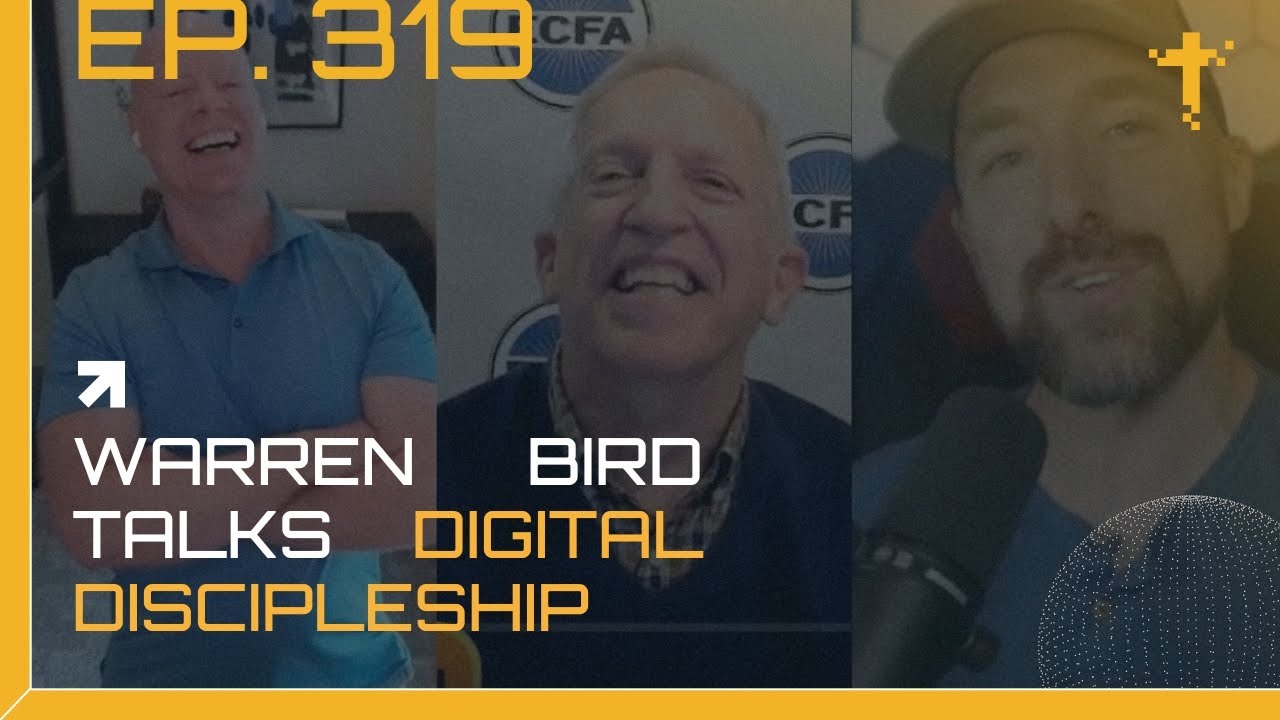
What happens when discipleship steps away from the methods of past generations and meets people where they are—in digital spaces? Today’s digital missionaries are operating beyond physical walls, beyond "church-as-usual," finding new ways to connect and disciple where…
Welcome to the Church Digital podcast. Through this podcast we'll talk about the technological innovations within the church, but more than tech for tech's sake, we'll address deeper questions. Is discipleship making possible digitally? How should we approach the digital mission field? Can a biblically grounded church operate in digital space? And where does the metaverse and artificial intelligence fit into all of this? Whether you're a big or small church, the Church Digital's goal is to help churches like yours learn to be a multiplying church digitally and physically. And now here's your host, Jeff Reed.
Hey everybody, welcome to the Church Digital podcast. I am not Jeff Reed. There was some music happening in the background. I am joined by two handsome, handsome fellas. First we want to say hello to everybody on Twitch and on YouTube. Yes, Jason, you are handsome. Yes, Dr. Warren Bird, you are also handsome. We have Phantom Methods and we have dear Fudge Jeff Reed in the chat. Jeff is supposed to be hosting this. We're praying for him. He's had a little bit of like a health thing happening. He's able to watch us on the internet. Everybody waved, Jeff. Thanks for joining us, Jeff. Thanks for allowing us to be here. But enough about me and everything that's happening on the Church Digital podcast, we've got a live stream happening on Twitch and YouTube, and I am going to back out of the way and kind of introduce our two amazing guests.
First off, to that side over there—by the way, I am a professional streamer and I don't—I do know which way to point on camera—to my right on the screen over there is Mr. Captain Jason Morris over there of Church Digital fame, of Westside, of everything, of Resi fame. I feel like you are the man that kind of needs no introduction on the internet. Do you want to give us like a list of your plots or do you want me to just keep going to Warren, which is going to make you feel—no, it's not worth it. I just feel like one of the things I do say though is I feel like my, you know, Warren is kind of figured out. He'll be able to introduce himself. Warren has kind of figured out his life purpose and brings to the table for the kingdom, and I wanted to be kind of like him in that way. So I feel like my life's purpose, you know, what I bring to the kingdom is I leverage the collective digital might of Jesus's church towards achieving global gospel saturation. Yeah, that's kind of what I do, you know, and it's had a lot of different expressions over the years, but that's just the way that Jesus made me, so I don't make an apology for that. But I want to hear from Warren. Yeah, so let's—this guy who is kind of below us needs no introduction, but if we do need an introduction, Dr. Warren Bird, you are also of like a million different things. The VP of research over at ECFA. Um, my goodness, I feel—um, I met Warren actually—well, I experienced, let's put it that way. I experienced Warren at Exponential 2024, and it was in a tent. I don't know if you remember this, Warren. It was a tent. It was about a thousand degrees outside. We were doing like a panel or something. There was like three or four other guys, and if you cut on the fan you drown everybody out, blow their hair. We were playing this like game of like, do we keep the air conditioning on or do we be able to hear? And so it was like I had to run out and like kick the breaker on and come back in. Warren, he was wearing, I think, the same sweater vest that he's wearing now or at least a version of that. He was wearing pants like khaki pants, and he had more energy than anybody in that tent. Was immune to the heat. I don't—he must have been a missionary in sub-Saharan Africa somewhere because he was used to it. Dr. Warren Bird, thank you so much for joining us on the Church Digital podcast today. How has life been for you so far, Andy?
I've never had an introduction like that, and I will long remember that. And Jason, I love your mission statement. This is like global impact for the gospel, and here's my run in it, and that's very exciting. Absolutely. And I feel like, um, along the way, I don't know if you remember this—it's probably back in 2010, 2011, something like that. That's when we met. It was at Lead Net Gathering or something like that, and we sat down and talked about, you know, leveraging Google ads and things like that back in the day, and what I love in the day when that was a new topic, that was a breakthrough idea. Yeah, exactly, exactly. And so what I love as I've been following you is the way in which you are contributing with data for the kingdom and your mind for that sort of thing, and what have you written, like, or co-written, thirty books or something? I don't know, thirty-five, but who's counting? Okay, right, exactly, right. And you've got what I've heard is you've got a new book that I didn't know about that's coming out that you said is just came out or it's coming out or something like that that has some digital components to it.
Becoming a Future Ready Church with three authors—Daniel Yang, Jen Xer, Adele Banks, a Jen Wire or Millennial, and myself, a Boomer—talking about eight forks in the road that every church has got to deal with. We're more comfortable with the year 1950 when the church was at a heyday than we are at the year 2050, but we're a lot closer to 2050. And like Wayne Gretzky with the hockey puck—well, Wayne, how'd you win so many awards? Well, I don't go to where the hockey puck is. I go to where it's gonna be. And if church can discern where is culture moving and how do we speak the gospel—unchanging gospel—in a way that the rising generation and the culture they're inhabiting will be able to hear, then the gospel impact will be multiplied. And frankly, if we stay with 1950, that year might not be coming back too soon. It's not spoiler. Yeah, totally agree with you. Spoiler, you know, we had we were supposed to talk about this article, but I don't care about that anymore for right now. Um, you said that you mentioned eight things. I haven't read this book yet because I didn't know. Um, I was waiting for it to come out, but I did hear the talk that you gave with Daniel on one of the sessions that in my mind was just spot on. And so I want to hear what insights you have on those eight things before we even get to the article and all these other things that I had planned. I want to hear about this.
Well, but let me just set it up with First Samuel 17 with David about to head out to Goliath. And he comes to King Saul, and King Saul says, "Look, I got the best armor in the country. I'm the king. I got the best, you know, everything in the country. I'm giving it to you, buddy, because what's won my battles are going to win your battles." And David says, "Um, these aren't tested by me. I don't know these. I'm not comfortable in them. I'm really comfortable with a whole different methodology. Same giant, same goal that we want to, you know, take care of Goliath, but I want to do it a whole different way." And Saul blessed him and said, "Okay, you know, you don't have to wear my armor. You don't have to do this. I'm gonna let you take this sling and a few pebbles, and all of Israel is riding on it. May God be with you, buddy." And that's really what the next generation can say to the current generation to say, "Thank you so much for all these wonderful institutions and patterns and stuff that we've inherited. I get the gospel. I'm not going to leave the gospel. I get Scripture. I'm not going to change that, but how we communicate it, the vehicles we use, has to change." And the whole book is about the conversations around eight of those changes that need to happen intergenerationally, lest the next generation say, "I don't know what to do with all this stuff. We don't need it. It's not going to help us reach our lost friends."
So Warren, on that real quick—and I know we have like other things to get to—do you find that there's almost—so in tech, I'm highly online. I am, uh, I'm technically a Millennial, but I'm also the creative pastor for a completely digital church. Um, I find that I work a lot. I'm, you know, I've got kind of an engineering and IT background as well, and what IT people and engineers talk about is tech debt, where you continually program things and you don't ever really kind of clean up the code. You just code over it until you have so much of this kind of coded-over tech that you have to go back and clean it up, and that's called tech debt. Are you finding there's almost kind of like a tradition debt in church right now? Almost like a liturgy debt? I get that's probably like the wrong term for it. Are you finding something of that, or are you finding it's more that the next generations are so quick to transition into like fluid spaces that we just don't know how to talk to them right now?
I love your term tech debt, and I think your latter comparison is better, but it's not like it's a yesterday-today shift. This is a shift over time. For example, if you ask people in church of all ages, "How many of you read your Scripture, the Bible, this week and did so online—meaning on computer, on an app, on your smartphone?"—almost all the hands will go up. Yeah. And yet that same audience, if you say to them, "Is digital discipleship the future?" they're gonna go like, "I don't know. There's something about being in this room where we really—" I'm not so. Yes. So one of the pastors I interviewed for what we're eventually gonna talk about, Kyle Ransom at Cincinnati Crossroads, said, "Look, isn't that what the Apostle Paul did with the New Testament? Is like, 'Hey, I really want to be with you in person. I get being in person is really important and helpful, but I can't, so I'm gonna write you a letter. I'm gonna explain what to do for discipleship, and I want you to follow this, and then when I get there we'll talk about it some more.'" So even there in his generation, it's a mixture of online—well, in his case, it was the printed letter that's read to people—and in person, and the two were integrating. And so today, have we figured out how to value each piece of that integration?
Well, let's make the turn then. Hold on, Jason. I just want to make sure we make this turn before we keep saying like, "Ah, let's push this out. Let's push this out. Let's push this out." So the kind of this article that has been, you know, being talked about here, I'm actually going to post it in all of our chats. If you are listening to this via podcast or watching it on VOD or on YouTube later, you'll be able to find this in the show notes. Warren, you authored essentially a manifesto, I want to call it, about the things that are kind of changing in the church, and the title of it is "Digital Discipleship: Can Churches Grow People Who May Never Attend in Person?" Now, like you were just saying there, Warren, that feels almost like a shot across the bow, but I don't think it actually is. Where did the genesis for this article kind of come from?
Well, it came in part from talking with people like Jason and a whole bunch of others, and we went through this pandemic, and all these churches went digital, and now as they're able to gather in person and build momentum there, there are so many of them questioning, "Well, you know, do we really? What is the value added by the digital component?" And there are a couple of high-visibility examples of churches that said, "No, we're killing our streaming totally. You know, if you want to connect with us, you got to be here in person." But there's a small group of churches that went the opposite direction that said, "Thank you, Jesus, for opening up the world as our parish, and how can we disciple anyone, anywhere?" So in fact, that's to connect to Crossroads. They call their online—
Campus Crossroads anywhere, and actually in house they call it Crossroads in your underwear because you know you don't necessarily need to be dressed well. Jason, you're standing up where you could we could see you, but you know the rest of us we could be in our pajama bottoms for all you know.
And there was one meme early in the internet where that's just what happened with one of the meetings. But at any rate, I thought okay, let me find these pioneers and ask them where they're struggling and where they're finding breakthroughs. Because what so often happens—I know from kind of the innovation curve and all that—and this happens in all of life too—that you have people who try this and you try that and try that, try, and eventually somebody finds a path that works. And then a larger group starts saying, "Well, duh, of course, haven't we always done it that way?" And no, we haven't. But the pioneers are the ones who are learning.
So I started with like Outreach 100's list of fastest growing churches. I thought, well, if anyone has cracked the nut. And then I asked a lot of people. Andy, I asked you. I asked Mark Lutz. I asked Jason. "Who do you know that's making serious progress with digital discipleship?" Then I figured out emails and we did kind of an online panel to say, "So what do you want to know from your peers?" Because right now there's not a term, there's not wording, there's not clear leaders of the pack. There's that kind of a watering hole where this is where we all gather to share our ideas. As eventually happens with most movements, I thought, okay, let me find who those people are and ask them what they want to know about each other. And then I built that into a survey. I sent the survey to them in a larger group, and 112 churches that in my view qualified gave their answer.
By qualified is they either had more people online than in person, or like Andy, for you that's pretty easy because you have zero in person. Or they said they're growing fast. And I didn't mean that as a put down because there are in fact in the book, Becoming a Future Church, we highlight one church that is entirely digital and the pros and cons of them as a future. But anyway, are we either growing faster online than in person, or are we having more people online and in person? And are we seriously committed, as evidence by a full-time staff member if you're larger, or one of other evidences, to doing digital well?
And of those, I ask them a whole bunch of questions. And that's where three reports came out. The first of which went into Outreach magazine. The other two of which, if you'd like to download them, just go to ecfa.org/surveys and they're right there at the top of the page. And it's ECFA as in the Evangelical Council for Financial Accountability, who was the sponsor of this.
And you say, "Well, why were they the sponsor of this?" Well, it's because we're all about building trust so that the world can be evangelized. And in a certain way—and we'll get to this—people are giving money online who are coming in person. And you know, is this, if you will, a new fundraising? And I don't mean that in a cheap way, but a new way of fueling digital discipleship for funding the ministry. And we'll come back to that when we do eventually talk about this article. But anyway, the backdrop was just as fun as taking the findings because I got to knock on a bunch of doors and find a bunch of trailblazers and pioneers. And that was a way long answer. I won't do long answers like that the rest.
No, that's okay. That's why we had you on. You know what I find fascinating is your initial question that you had brought up. You know, do you read the scriptures digitally? And the answer to that is yes. One could argue that is a big piece of digital discipleship. Another piece of digital discipleship—instead of digital fundraising, in my mind that's a little different—to go back to your ECFA conversation. If you look at online giving as a step of obedience, as a step of discipleship, then you can also say, well, you kind of are doing digital discipleship. You just don't know it yet. Yes, you're reading the Bible digitally. You're giving digitally. There's a few things left that you could probably do digitally for digital discipleship, but I don't know of any church that is so rabid about their physical gathering and the physical expression of church that they would be willing to be intellectually consistent and cut off their digital giving for that philosophical difference. I don't know of one. And because of that, in my mind, that proves all the more that digital discipleship, at least in some forms, is not only valid but it's already happening.
Yeah, and if the market already—if the market is already wanting this to happen and we're resisting it, what could it do if we went with what the Spirit is already doing?
Yes, yes. Yeah, and if that's where people live their lives. I mean, this is what Second Life and all this online stuff did. And what, right? I've never done a podcast. This is my first one on this Twitch forum. And when I mention Twitch as an illustration to someone and said, "Well, do you know how many millions of people use Twitch?" Like, "Whoa, this is like a whole different world of people who connect." And that's the point.
So Jesus said, "I got other cities to go to. Take the gospel there." And he ended up saying, "You know, take it to the ends of the earth." Well, why wouldn't that include going to gamers on Twitch if that's where they hang out, just as much as hanging out at the bar? Like, my wife and I are discipling. We do apprentice couples for like Bible study groups we lead. And you know, our next meeting with our apprentice couple is going to be online because they're going to put their kids in bed. They don't have to get a babysitter. And all they do is sit on the sofa together, and they and my wife and I can talk. Well, that's going to be no less a discipleship than had they gotten a sitter and we met, you know, at a restaurant or the church or anything. Because that hybrid world of back and forth is now so seamless. This is how people live their lives. So why can't we figure out how we do church and outreach as well?
I'm totally with you. And to go back to your other point on, I think it's 2 John 12, if I'm not mistaken, where John's like, "I'm writing you with pen and ink. I long to be with you face to face so that our joy can be full." He's mentioning in the first century that same tension that everyone feels in the hybrid environment where you have this ministry that you're doing remotely, and at the same time you want to be together, but you can't. And so what do you do? You do both. That's what you do. Because it didn't keep John from sending the letter. And John had no idea of the reach and longevity of what he was writing that we can benefit from today because he was thinking in his mind, "Oh, I want to be with you face to face so that our joy can be full." Well, full for who? For John and his buddies, not for me 2,000 years later in a completely different country. But because he took the time to do both with hybrid discipleship using the digital—it's not using the technology of his day at his time. Now I get the benefit of it. And the way in which digital technologies can get multiplied for outreach is crazy.
So I want to go into this Outreach article. In question number one, or you know, this manifesto that you made, one of the very first statements that you said was online ministry can be spiritually fruitful for any church. Because a lot of times pastors are thinking, "Well, I'm not big like, you know, Life Church or Church Home or Crossroads that we mentioned. You know, this works really well for larger churches, particularly multi-site churches that already have somewhat of the technology in place, and they can do online stuff." But what you're saying here is that this online ministry can actually work for any church. So tell me a little bit more about that.
Well, one of the examples I bumped into in researching this was a very small church of largely immigrants from a country where Christianity is illegal. And here in the United States, and the guy married someone from a different country. And I was talking to him about his online ministry, and he's like, "You know, there are other groups just like us in pockets around the world from this country where we have two different nationalities represented that historically didn't get along. But because I married someone, they do. And we've found incredible fellowship in the gospel." And I'm just thinking, "Oh God, this is just so. We didn't need an airplane to go fly or money. All we needed was the internet." And you know, this relative who spoke to this relative who spoke to this friend and said, "Oh, let me connect you with this church." And you know, this started. And to think, man, is that possible?
I first got that idea on Easter 2020 when we were all shut down. And I thought, "You know, more people are going to hear the gospel this month than at any time in human history," because you know, this small Cambodian church in New York City is broadcasting their service, and everybody's doing it in their language and culture, and it's out there now. And how exciting that the gospel can be spread.
So that's the experiential answer. A church of any size—the survey actually asked that question and said, "You know, do you believe that you have to have an app in order to have effective online discipleship? That you have to have a certain size or staff commitment to do so?" And the answer is no.
And the one thing I always encourage churches when I see—like, I was part of a church plant years ago, and we had what we called an overflow room. Not a good term. And I wish you could have seen the jerry-rigged cameras where one guy brought this from his home, and you know, these patch cables that were duct-taped on. Seen it all. You really need to take a picture of this because the humble beginning had vision, and it led to—and it's going to lead to—and the church did grow. And eventually, you know, was able to pony up and buy some real equipment and everything. But it wasn't that the money led the vision. It was the vision led the money. And the vision was, "Let's use the tools we've got to get where we are." And it's just so inspiring to me to see that churches of every size are able to figure out, okay, so I'm going to take my iPhone and we're going to clip it here. You know, not ideal, but it works. And if it helps grow and strengthen the body of Christ, they keep doing it. Let's see where it goes.
Yeah, you know, I just came back from Korea being at Lausanne Congress there. And what fascinated me was with all of the research that they were showing on global shifts between now and 2050, very similar to what you're describing. What really stood out to me was the parts of the world that are now being connected to the internet with smartphones and that higher level of connectivity happens to be the same parts of the world where there is so much persecution against the church, which happens to be the same groups of people that are migrating as refugees all around the world. I don't think that those converging are by accident to your point with your story right there. I believe that Jesus is setting us up for global world evangelism in ways that have never been able in human history like they are right now. Not to mention that because you can minister to persecuted places at so much lower risk and cost to both the missionary as well as the person who's exploring matters of faith like never before. Not to mention the fact, and here's something to think about too, because I was a former missionary.
Right, my heart beats for a certain part of the world, and I can still be a right where I am right now, just north of Austin, Texas, without changing anything. Isn't that awesome?
It is. Probably street from you. Exactly, exactly. What about the latent potential of all ex-missionaries, former missionaries, former pastors that are in the states, Canada, in the developed world, still have a heart for mission and are now able to minister to the emerging connected world like never before? That happens to be the world that is also being persecuted for their faith, and to do it in a way that is low risk. I mean, come on, let's get the job done. I love this conversation.
Now, when we talk about—now that said, in every development of innovation, there's always the appro—there's always someone who asks the following question, and in some ways I want to validate it that it's appropriate. And the question is: but what are the toxic side effects if we make this shift and we give up certain things? Or what, you know, what is it that we're going to lose? And I appreciate people asking those questions in a certain way. You have to—you have to not put the brakes on the trailblazers and pioneers to say, "Well, okay, let's get everything all figured out," because you'd never go anywhere. But you do have to ask those questions. But for the first—for the meantime, to your first point from the article, can any size church have a digital discipleship impact? Enthusiastically, yes. We should probably move to the second point.
Yes, yes, let's go to the second one. People are gonna decide we're pointless. I love you. Yes, we can go the second one. Um, yeah, I'll save some of my commentary for later because there's a few little nuggets in there. Uh, one, the second one is one of the hardest nuts to crack: connecting online participants into relationships. Anyone who's done online ministry knows exactly what this means. Can I get any in from everybody in the back, please? Yes, yes. So Warren, tell us about your survey and your findings there. Particularly, you said anyone online can say an amen, but it's actually anyone who's ever been to an in-person gathering of any kind.
Oh, it's the same. It's the same problem. It's exactly the same. I got these people, you know, here, and their body is here, and I'm preaching up a storm, and then they go away, and it's like, "What happened? How do I? Why? How does the Holy Spirit use our venue and circumstances and the power of the word of God and all the other things that happen to prompt people to take that next step?" Now, of course, in person you have a leg up in that you can say, "All right, I'm gonna run back to the door and grab that guy before he goes out the door and say, 'Hey, I got a tattoo like yours,' or or whatever that helped me start a conversation." Um, and online you don't have that at all. However, I was so impressed by all the churches saying, "Well, you know, for those who give, we do know about them. For those who we do an after-service gathering, and I always ask everybody three questions like, you know, what's your name? Where you from? And something about yourself?" And over time, people begin to share. Or we have an online Bible study of some kind or prayer group of some kind, and we need to exchange emails in order to be part of it. And churches that work at it can—and especially those who are relationally in-tuned as the online pastor or equivalent or volunteer leader—can begin to say, "Oh, you're Charlie, right? And last week we prayed for your daughter. Do you mind telling us how she is? And what's her name, by the way? And you know, tell us a little bit about your family?" And as that trust just begins to grow, you build community. It's harder, but this is where software, which in itself is a digital thing, can help us to track who's in the room and how they are processing in their discipleship journey.
And just an interesting side note, I asked two questions in the survey about discipleship journey. I said one: "How would you rate the clarity and effective—I think it was effectiveness—of your discipleship pathway for your in-person attenders?" And nobody gave it top marks. They all were like, "And so they're all like, you know, okay, you know, we're maybe seven or six or five or whatever." But then I asked the same question about their digital discipleship pathway, and the only commonality is it was always lower. So in other words, we're not doing the best job in person, but we're doing an even worse job online.
Oh, well, that makes total sense because digital things, online stuff, tends to be a force multiplier or whatever you're doing. It just magnifies it. If it's good, it'll magnify it. If it's weak, it'll magnify that too. So that actually doesn't surprise me. And it kind of goes back to what I'm looking at here on the third thing that you mentioned: churches just in general aren't clear about their discipleship pathway, let alone the online pathway. So if you don't have clarity physically, online is not going to fix it for you.
Exactly, exactly. And the strategies should feed each other. The things that we're learning about—um, you know, it like one church runs the same marriage strengthener over and over, but every time they try a different title for it. They even got ChatGPT, you know, you know, "Here's what we're doing. Help me come up with a better title." And then they measure how many people sign up for it. Well, they came up with "21 Days to a Better Marriage," and that's what people will sign up for in droves. Well, if that's what works in person, does that also work as a connector online? Which they tried, and it did. So the two worlds really need to feed each other in figuring out how do we do this discipleship pathway well?
Yeah, totally with you. They're synergistic, doing them together. And you find that even in the New Testament, it's really not a new strategy at all, um, let's let's move to—like, but just before we move, I had an open several open-ended questions for: give us your best idea about whatever. Oh, the good news is none of them were rocket science. None of them were like, "Oh, nobody has ever thought of that idea. No wonder I didn't even reproduce them in a list because it's like, 'Well, yeah, I mean, sure, you just figure out how people want to be connected and you connect them.'" And you exactly. So okay, at the end of the day, what you have—and this is, I think, what you're surfacing, Warren, is so insightful—because for whatever reason, I don't know why this is, but people feel like, "Oh, if you're doing digital church, you know, it's got to be radically different. The way in which you relate to people." But at the end of the day, it's just people ministering to people. That's it. And that has never changed. And that is something that Jesus said up from the very beginning. We're just using newer tools. That's all.
Yeah, and the same needs that people have are gonna be true whether you're in a physical environment or a digital one. It doesn't matter. The—I agree. But this is where the book comes in: "Becoming a Future Ready Church," in the sense that people's needs are the same. And like, but different needs get accentuated at different times. Like right now, you can't go a day without hearing something about emotional health, mental health, loneliness, anxiety, and all. Well, sure, there was an era in the church that that was really a low point of need or awareness or willing to talk about it. In society today, if I start with that, I get all kinds of responses. Or to use another analogy, if I'm talking to you about my church maybe twenty years ago, if I say, "Oh, we have this killer youth program and children's program, and this is—we have a handbell choir," let's say that the twenty—and maybe that was a point of residence that people go, "Oh, cool, I'd like to come to your church. I'd love my children to be part of a handbell choir or whatever." Today, now, back then, if you had said, "And we volunteer at the nearby soup kitchen," people would have gone, "No, I don't know if I want—" now some people would have thrived on that. Today, that's a great front door. We're the church that sponsors the soup kitchen that meets our community's needs in both physically and spiritually. We treat the whole person, and come be part of it. Well, that's a great entry point. And so while the needs are always the same, what the response level and the words and the values and how we approach them are different. And that's all part of things you can experiment with both in person and online.
I mean, we talked earlier about Google ads. Um, take your sermon, have ChatGPT slice it up into different needs that are addressed, post those on the internet—just not, you know, "sermon about First Samuel 17, slaying Goliath," but about anxiety and not feeling adequate. Um, and see which one people are searching for. Are the things people are searching for that the gospel speaks to that your sermons speak to that you can point people to? And that's just a whole new way of thinking and addressing people's felt needs today.
So Warren, as you were talking, um, there was a couple of things that were mentioned in the chat that I did want to ask you about. When you did the survey, um, was it only US churches?
Yes. Because, sorry, I did talk to Steve Fog in Australia. Was one of the many people interviewed. And Dave—Dave Adamson. As long as I'm hat-tipping Australia, I talked—I think to three people in Australia who got up at some ungodly hour to talk to me because that's hard. And I talked to—oh, Canada. Talk to people. Just I owe Carrie Newoff an email reply today. He spoken. But I only surveyed US churches.
Okay, because one of the interesting things that you just described is um, digital stuff doesn't really matter, and no one—no one really cares what country it's from. Um, and so if it works, it works. And what I love about your approach is a little bit more casting a wide net of different ways in which you can package the content that meets a felt need, wherever that might be. I know that in some cases we've done things like that, and it springs up in the most random places. Like the way that things are crafted really resonate well for folks in Germany but not so much in the United States. And it's fascinating to see how sometimes the content in which we're already creating can resonate in different parts of the world in a global sense, even though we don't have data for that necessarily.
Um, I've anecdotally found that to be true. One of the—um, moving on to like, um, assertion four that you had: churches want their online attenders to connect with in-person church whenever possible. This was where I felt like, okay, as a digital person, I don't really care. I think Andy probably feels the same way. Um, where we don't really have an in-person thing that we need to maintain. It's something that the in-person church is the need to have. It's an add-on. It's the cherry on top, not the main course of what we do. And I'm curious of the people that—because you mentioned, you know, doing the survey with a lot of digital churches—was there a segment in which there were differences in opinion on this particular topic?
Yeah, there sure was. And Jason, very discerning question. I ask: are you trying to reach people largely in your geographic area? And there was a bit of a fork in the road in that some churches are saying, "This is our focus. We want to try to reach people in this metropolitan area or community or whatever." And predictably, if that's what you're focusing on, it's much easier to gather people in person to say, "Hey, we're doing a serve project for this needy area. You know why don't all of you who are connected with us that are within a reasonable drive show up at this school or park or whatever?"
Trying to do to serve your community in Jesus name. Others have the philosophy of, "No, we want to make this so that anyone who connects can just as fully participate." And so therefore we need to make everything have a full-orbed parallel for what we can offer in person. Now that's a challenge, you know? Giving a hug in person, I get how to do that. Um, how to do hugs um online, that gives a few challenges. But sharing coffee online, you know, I may not be able to stand up at the same coffee urn, but we can all hold up our coffee cups and figuratively clink and everything else online. So can you, what can you do online that replaces or that substitutes for things that are readily done in person? And can what can digital do best or even better than in person? What can in person do better? And can we just agree that it's never going to be fully parallel? And I think the jury is out on all this, and I don't want to tell anyone, Mister or Mrs. Edison, you cannot invent that light bulb, because this is how discoveries are made.
Exactly, exactly. And I feel um like churches, like churches that are using the digital expression of two in hybrid, using the digital expression as the primary expression of church, they're the ones that are discovering how powerful the digital tools are, and at the same time are well aware of the weaknesses that can be bolstered by occasional in-person gatherings. They don't necessarily have to be every week. They could be, you know, here's the interesting thing. You have in the Old Testament a very similar pattern where you had the children of Israel that had an identity around following God, but they didn't get together every week, not as a nation. They didn't, not as a big gathering. They did get together in homes to celebrate Shabbat every Saturday, right? But that was just their family together. That wasn't their identity as a nation. But they did have feast days. So you know, it was like once a month is where they would do these big feast days and have gatherings in tribes or gathering as the nation. And I'm looking at the Old Testament and I'm thinking, wow, how genius is that particular ministry design for connectedness, belonging, and of all of the people who over the millennia have maintained their national identity and national cohesion, it's the Jews, without without a weekly expression where everybody has to get together. And I, I know we need to land on the plane uh when our final minutes, but my community has become predominantly Hasidic Jewish. The hat, the curls. Oh, and that's exactly what we marvel at, that they have the meetings in this, the small minion of of ten men uh gathering, and then they have these incredible high energy uh uh gatherings, some for worship, some bar mitzvah or other, uh right? But that community is so tight, it's amazing.
Yeah, it really is. I, when you said that, I'm just like looking out my window and thinking, yep, that's the case here too. Okay, let's focus on the plane. Yes. Um, we'll get to the last one. Uh, churches project a big rise in online giving beyond those who attend in person. This is fascinating. This might be the gateway drug for online ministry, I think.
Well, prior to the pandemic, I and others had done research that that validated something that would not be a surprise to anyone, that the more involved you are in a church, the more you give. So if you're a greeter and you lead a small group and your kids are involved in the youth group and all that, your likelihood of giving is far higher than if I'm a fringe person who just occasionally attends on right. What about online? And from what we can tell, not just from our survey, did very little on it, but one called EPIC, Exploring the Pandemic in Implications for Churches, found the same thing, that that the more involved online you are, the more online you give. And again, this is preliminary, but it it raises the question of, could we do a better job of discipling our online um participants? And if we did, and discipling them financially in and in generosity, then could their generosity increase? And could it be, and I'm just raising this as my concluding question, could it be that online becomes self-funding in a certain way because those being reached and discipled then fund that aspect of the ministry? And again, jury's out, but I'm raising that question. And um, I'd love to see if this is a new way of funding by by developing generosity as a discipleship trait, funding the mission of God church.
So let me, I'm going to peel that onion just a second. When we're not going to go deep into this because we haven't really revealed this to the church yet, so there's nobody watching that, there's nobody listening to this, it's just us two. Don't worry about it. Um, but the the idea of generosity is something that Lux is going into its fourth year. March, March of 2025 will be its fourth year. Congratulations. It's like for God to sustain a church, any sort of church plant that long, is it, it's a miracle. It's through the work of Mark. It's also through through the work of the Holy Spirit kind of inundating our church. I've been with them for two, uh, it'll be two and a half years now, and one of the things that I've seen is an actual increase in generosity. And that's only because we've talked about it. I think what happens online a lot of times right now is that we are inundated with, "Hey, give ten dollars to this thing. Buy my Patreon or subscribe to my Patreon. Hey, give me fifteen dollars to this influencer." Y, y, y, and there's a there's a culture built around almost tipping. And we have had to actively push back against that and say, "No, no, no, no. God's church, not necessarily, doesn't demand, because that's like that's very forceful and draconic and all that, but God's church is substantive in a way that the internet is not." And that means that we need to pay bills, but also we need money to actually do things that are going to fund the spread of the Gospel, be it giving to be giving to an orphanage in Uganda, which we're doing, we're giving many, many, many, many thousands of dollars to orphanages in Uganda, or whether it's just simply, whether it's just simply like, you know, keeping the lights on in the studios and the taking care of people in need in your digital church. That's where I was going with that is that now we're getting to the point where we can actually start sending meals to people and we can start DoorDashing things to people that have had surgeries. And you know, we've always been able to do it nickel and dime, but we're able, we've now gathered up ahead of steam where in this next year, our emphasis next year is going to be, it's just, it's the, it's the word "home," and we're talking about the church as a home, and we're talking about digital church can be a home for you. And here's why. And we're, you know, labeling all the rooms and doing the whole thing. It's this big thematic thing. Love it. But the idea of generosity is that, hey, if if you are able to give, whatever you're able to give, because most internet denizens, especially in the Lux area, are gamers, and gamers most of the time don't have a whole lot of, you know, moola around, and that's fine. It's whatever the Lord lays on your heart to give. It's that act of generosity will spark other acts of generosity, which will then spark a growth of discipleship through the actual act of giving, and on and on and on. That's what we're seeing there.
Wow. The other thing that's interesting too, Warren, is in the prevailing model of church planting, you have to raise so much money to get the thing going initially that it creates an immense amount of pressure for the church planter to recover those funds, get critical mass, do all of those things. The what's so great about digital church is that it allows the digital church planter to focus on what's really most important, and that is the digital relationships, without that pressure and overhead, because the costs of doing a digital church are so much lower than what the prevailing model would ask of a church planter. That it allows them to run to launch lean in ways that your prevailing model just can't allow. Y, and therefore you can get to self-sustainability so much faster than would otherwise be possible.
I totally agree. I'm gonna make my final comment because then I, I, I've got a break. As a caution, it's it's easy to go lean in a way that says, "We're just going to be lean and not challenge people to discipleship." Say, "Okay, well, this is all we got, and so this is all we're going to spend." But what if you challenge people to develop their generosity muscles and still stay stay lean? How much more can you do? It's much like the bivocational church planter. Often, well, you know, because I was depending on my income, I really didn't try to develop uh generosity as discipleship. And now that I'm shifting over to full-time, I'm realizing we're not really that strong of a giving church, and I really haven't cultivated that in our people. So yeah, so my pitch is, my caution is, still press for digital, um, I'm sorry, press for generosity development, but still stay lean if you want, and uh avoid the church uh facility challenge.
Awesome. Okay, I'm gonna need to sign off. Is there anything, any final word for me?
Oh, other than me saying ECFA.org's surveys, you get three reports free downloads if you'd like. Give me the book one more time, Warren. And the book is "Becoming a Future Ready Church," love, by Daniel Yang, Adele Banks, and Warren Bird. We love it, Warren. Thank you. Jason, thank you. ECFA loves church. We love ministry. We love getting the gospel out. This is our investment. They're uh behind me doing this because they want to enhance trust in donors so that the Great Commission can be fulfilled. Love it. Thank you, Warren, for being here. Thank you so much for just blessing us with all of your wisdom. Jason, thank you so much for being here. Everyone on Twitch and everyone on YouTube, thank you so much for being here. We will see you next time. Love you guys.