What if your ministry is stuck in connection but never steps into real impact? Let’s unpack the digital mission flywheel, a framework that challenges you to rethink connection, community, equipping, a…
Jeff Reed kicks off Season 11 with a solo deep dive into the Digital Mission Flywheel — TCD's four-part framework of Connect, Community, Equip, and Mobilize. This episode zeroes in on the connection stage, and Jeff doesn't pull punches: connection without community is powerless, community without equipping is pointless, and equipping without mobilization is reckless. He also unpacks niche casting — the counterintuitive discipline of thinking smaller to reach more — as the foundational shift every digital missionary needs to make.
Welcome to the Church Digital podcast. Through this podcast, we'll talk about the technological innovations within the church, but more than tech for tech's sake, we'll address deeper questions. Is discipleship making possible digitally? How should we approach the digital mission field? Can a biblically grounded church operate in digital space? And where does the metaverse and artificial intelligence fit into all of this? Whether you're a big or small church, the Church Digital's goal is to help churches like yours learn to be a multiplying church digitally and physically. And now here's your host, Jeff Reed.
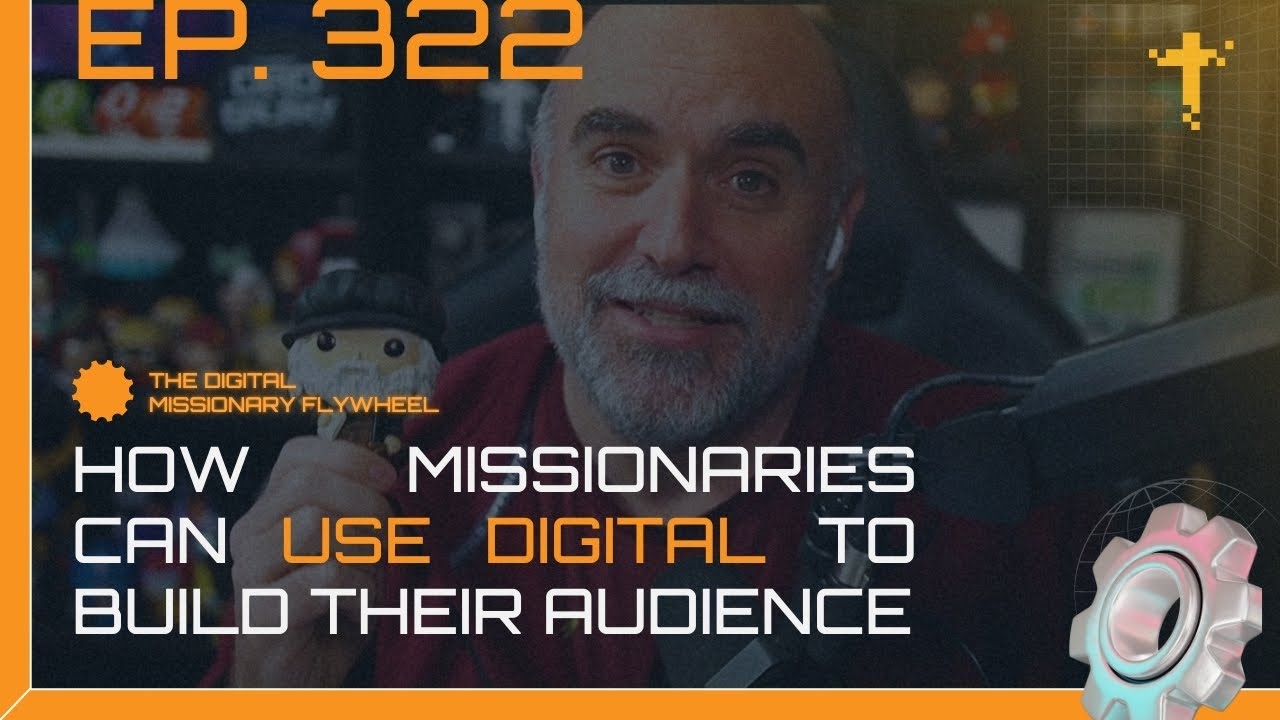
All right, hey everybody. Welcome to the Church Digital podcast. It's episode 322, kicking off a new season here, season 11. We're doing a deep dive on the digital mission flywheel. Now I've used this language before—digital mission framework—and the flywheel just paints this really interesting picture. I'm going to get into that here a little bit with the flywheel, but you know, the framework we've talked about it so much here with the Church Digital: to connect the community, the equipping, and the mobilization. But here today, I want to focus on the connection piece. So in the season, we're going to do a deep dive. We're talking about each topic: connect, community, equip, mobilization. But really, the heart behind the framework—well, I'm going to reference my Funko Pop friend here. You want to say hello? If you want to guess who this is, this is Leonardo da Vinci. I know some people have already alluded. I made this joke even in a later episode. Some people made the joke, "Hey, Jeff, he kind of looks like you." Hey, you know, beard, maybe. What it is, in the next episode I'm actually wearing a black hat, and so it really, really does kind of look like me a little bit there.
Leonardo da Vinci actually invented the flywheel. He's a famous artist, famous inventor as well. Not a Ninja Turtle. Now, Leonardo is a Ninja Turtle. I think he's the one with the swords with the blue, right? Leonardo DiCaprio is the guy who evidently can't float in the water and drowns in Titanic. No, Leonardo da Vinci is an inventor, and among the things that he's credited for is the idea of a flywheel. And the flywheel is basically this device that has a crank on the top, which then has a wheel that spins around on its side. Now, what's unique about this wheel is there's four wood blocks attached to this wheel, and as Leonardo spins the device in the correct—I want to say clockwise—so it'd be this way. As he spins it clockwise, the weight of the wood spins out and provides, I think the word is centrifugal force. I have to ask my wife on that, but the gravity, the force on those wood blocks extends out, and the forward motion of those wood blocks creates what's called a flywheel, where the wheel continues for a vast amount of time on its own.
And I would propose to you, digital missionary out there watching this space, that we can apply that theory to digital missionary work. And I don't want to say "with these four easy steps," because it's not easy, and it needs to be contextualized and adapted into your context. But I do believe this: if your ministry is connecting digitally or physically, and if you have some level of a digital community in place to establish trust, to build relationships for digital evangelism, relational digital evangelism, relational discipleship, if you're doing that at the community level and through your discipleship you're helping equip people to discover what God is calling them to do, and you're mobilizing them out to do that calling, I believe that is the digital mission flywheel approach. And that by doing that within your mission or by partnering with others to help complete that mission, your digital mission, your digital missionary work is going to be more effective moving forward. And you're going to see it not only reproduce, but you're going to see it multiply because you're sending people out to be on mission with that same effect.
So through the Church Digital, we're going to do a deep dive on that: connect, community, equip, mobilize. And so today, you know, we're going to talk about connection. Now, let's talk about up front what connection is, but before we get there, why don't we talk a little bit about what connection isn't?
Now, if we're connecting, if we're connecting with people digitally, and I hate to say this—this may be strong language—and so I'm going to apologize right now on this series here in season 11, talking about the flywheel. I'm not going to mince words. I'm going to speak. And hate mail, you can send it to Andy at the church.digital. Andy Mage would love—no, I'm kidding. Here's my cell phone: 484-324-8724. If you are in America, it's plus one. You can always find me. If you're not in America, it's plus one. You can always find me in WhatsApp and Discord. We'd love to have a conversation with you. But the fact is that I really believe strongly in this, and I think we're seeing a lot of digital ministry flounder because they're not utilizing some of these basic principles. And we're seeing a lot of success, honestly. We're seeing God move when we're utilizing this. And in many ways, we're going to get into this. I think what we're doing here is biblical. There is a biblical drive towards the stuff that we're talking about here with connect, community, equip, and mobilize. We're going to scratch the surface on that in this broadcast, in this show today.
So let's get in. This is me not mincing words. This is me not pulling any punches, all right? If we are connecting as digital missionaries, but we are not providing a community to engage with, to deepen relationships with—we're only at that connection level. Connection level is social media, is streaming, is broadcasts, is podcasts, is blogging, is email—anything at the superficial level. If we're not doing community to deepen relationships, then our ministry is powerless. It's powerless because all the power—okay, short of the Holy Spirit moving—all the power is in community. Community without equipping, community without a purpose, community without intentionality to get people connected to an equipping level, without giving that community a purpose—well, then the community is pointless. And really, if we're equipping people with a better understanding of ministry without mobilizing, without helping them, without sending them out, without holding them accountable for what God is calling them to do, if we are not doing anything other than equipping and letting people go, well, shoot, then I think that is reckless.
And so: connection without community is powerless. Community without equipping is pointless. And equipping without mobilization, at minimum, is reckless. Once again, hate mail, send it to Andy Mage at andy@thechurch.digital. He would love to hear from you.
Listen, my—I don't know that this is my word for 2025. You know, people are always like, "Hey, what's your word?" I've had so many people: "Jeff, what's the word for the Church Digital? What's the word?" I don't. This may have been my word for 2024, and I didn't realize it because I discovered this word maybe in October, November 2024, and I just love it. So we all know what broadcasting is, right? Broadcasting is where you shout something from the rooftops. We talk about Omni-channel. You want to get your church online, broadcast on as many platforms as possible, just to maximize exposure. You know, in the biblical sense, you are just casting seed wherever it'll go. Some of it's going to fall on fertile soil. Some of it's on thorny bush and rocky path. It don't matter. You're just throwing it recklessly, right? That's broadcast. That's Omni-channel. That's the painting of broadcast.
Now, the word for 2024—and this was the—oh yeah, the word for '24, last year—niche casting. Niche cast. It's an actual word. I didn't come up with this. Actually, it was Trizzle, Tyrell Good, who told this to me in an open office, and I was like, "I want to look that word up." Googled it: N-I-C-H-E-C-A-S-T-I-N-G. Looked it up, Googled it, and I was shocked. It's this idea: we talk about it all the time. If you try to reach everybody, you reach nobody digitally. If you try to reach everyone, you will effectively reach no one. But if you niche, if you target, if you have a focus, if you aim at an individual, you will reach multiple of them.
We are seeing huge success now. The physical church audience—Jeff, what do you mean? I can't. Like, the church is for everybody. The physical church model, you want to reach everybody within 20 miles of your physical radius. We all know that. And digitally, it's not that different, except it's not the audience you're dreaming at. It's not the 20-mile radius around your physical building. Digitally, I would challenge us to aim a little differently, and that's some of what niche casting gives us an opportunity to. It gives us an opportunity to think smaller, to narrow down audience profiles. Well, who are we called to reach?
It was interesting. I had a conversation the other day with one of our new friends here at the Church Digital, and he was wrestling with, you know, who God's calling him to reach. And he just loved the idea of digital ministry and digital mission work, and it was really exciting to him, some of the stuff we're doing at the Church Digital. And you know, this is—listen, I'm not getting into ageism here. Please don't read too much into this, but he's on the older side of the equation, into his retirement age. And you know, was just very much, "Man, I just love this idea of trying to reach people on the other side of the planet. I love this idea of reaching people in India." And I can't remember the other country. Maybe it was Nepal. He listed a couple countries on the other side of the planet, literally on the other side of the planet. He's like, "I just love the idea of reaching into those cultures and reaching people over there." And I was like, "Hey, so tell me, what do you know about anybody in India? Like, do you have any exposure? Do you have any understanding? Do you have any experience?" "No." "Why do you want to reach it?" "Because I just think it's fascinating that digital can reach people all the way over there."
And that is phenomenal, by the way. Digital, you can literally broadcast and try to reach everybody. A million people don't care about anything you have to say. Any smaller, you can try to, you know, use digital to reach the person on the exact opposite side of the planet from you or on the other side of the street. Like, digital is a tool that can be used however you want. And this person was very excited about reaching people globally over there, but because of his context, like, you really don't understand anything about Indian culture. There's 2,000 dialects of Indian, of Hindu, of Hindi. Why? How would you even start to unpack? Now, maybe he can. I'm not judging him on that. But his ability to connect over there is going to be dependent on his willingness to dive in and understand the culture. You can't reach everybody. And instead of trying to reach everybody, if he wanted to reach people in India, go understand Indian culture. Go, almost as a student willing to learn, ask questions more than you're making statements. And like, if you're a missionary actually physically going to India, the first thing you're going to do is study up on India. You're going to learn the language. You're going to go over there. You're going to get a job. You're going to prayer walk the town. And you're just going to meet people. You're going to soak up the culture. And then you're going to talk about Jesus. And blessed.
Going to begin with prayer and you're going to listen way before you share Jesus. You got a lot to do. You got to eat together, you got to serve. There's a lot to do and bless sharing Jesus online. The book you should check it out, sharing Jesus online.com. But you, there's a lot to do before you get to evangelism.
And my friend here needed to focus. And what was interesting, really in his context, this a story for another different day. The audience that I think he's best equipped to reach was not on the other side of the planet. It was actually one that was in his literal backyard. And we're actually having conversations with him now, helping him niche down, help him target, focus on an audience that he didn't even realize he had access to because of his general ministry. He's using people that he was already building relationships with, not on the other side of the planet, but mostly here locally, local to him, and using digital to connect, to invite them into the community that they're already in. And now relational evangelism, discipleship, relational evangelism, discipleship, those things are happening and are beginning to happen with him digitally.
Niche casting. Thanks. Smaller. Don't think larger. That's the biggest lesson in digital ministry, in digital mission work. It's the biggest deceit. It's the biggest, I don't know, catfish. It's the biggest fake. It's the biggest distraction. It's the hardest lesson. I can reach everybody. I'm going to try to reach everybody. You're not going to reach anybody. Understand what connection is. Connection is a very shallow relationship. It's very shallow and it's very superficial.
You know, let's take your influencer who's got, I don't know, pick Instagram influencer, whatever, TikTok. Am I still allowed to say TikTok? I Trump when I'm doing this recording. Trump's already vetoed it back in for another three months. We'll see what's happening around Easter, but for now, TikTok. So take your TikTok influencer here in America. They've got hundreds of thousands. They've got millions of subscribers and followers. Their videos are getting millions, hundreds of thousands of views. That's who are these people? What relationship does a subscriber have, one of these hundreds of thousands of people, have with the influencer? Is it depth? Do they have one-on-one conversations?
Now listen, I have seen evidence of how Justin Bieber utilizes his influence in the kingdom, connecting with Church Home up in Seattle and Los Angeles and wherever. Church Home, I think is primarily online now. And so there is ways to use even that connection level. But it's interesting, even Bieber, with some of the work that he's done, he connects it to Church Home as a ministry and uses Church Home as that community partner.
So recognize that connection has a purpose. But when I say connection without community is powerless, well, shoot, all you're doing at the connection level is superficial stuff. You're building, you know, the proverbial house on the sand without a foundation, because you are not building a community. The people that are engaging are shallow. The roots are not deep, and they will leave. They will go somewhere else. They will disconnect, because that's what happens at connection level, unless there's some sort of a relational equity that's put in place.
So start thinking about digital missionary. If you're trying to reach everybody, don't. I'm not sure I want to say this. I'm not going to say this with emphasis, but I am going to say it. I'll say it this way: I cannot think of the last digital church or digital missionary that was effective in their work by trying to reach everyone. I cannot think. Somebody's going to come to me and say, "Jeff, this person." I'll be like, "Oh yeah, you're right. I'm sorry. I'll take it back." On the top of my mind, I cannot think of one person right now that was effective doing ministry work digitally by trying to reach everyone.
The people that are effective are niching down into geographical, into platforms, into age. Like, they are narrowing their focus. There are more people, there are more active Facebook accounts right now globally than people in India and China combined. Short of the Antichrist coming back, I am not sure of anyone who can effectively reach everyone on Facebook with one fell swoop.
That's actually an interesting observation. The Antichrist uses a broadcast method. What I'm actually suggesting would be the opposite of that. Don't try to reach everyone. Reach someone.
Actually, if you look at the biblical method of how Jesus grew his church, he narrowed down to twelve disciples, and the first church was about seventy-two people. Now, actually, if you look at Luke 6, Mark 6, Luke 6, dang it, I forgot to look that scripture up. If you look at one of the sixes, maybe it's John 6, one of the Gospel sixes, was one of the feedings of the thousands. And Jesus was doing signs and wonders and had thousands of people following him. Literally, this was one of the feedings of the five thousand with five loaves and two fish. And everybody went to bed. Jesus not only met physical needs by doing healings and miracles of people, but he also fed everybody, and they went to bed.
The next morning, Jesus and the disciples go away. And what happens? The people wake up. I'm hungry. It's brunch time. Where's that Jesus guy? Let's go find Jesus. Luke 6 talks about how the people go and find Jesus. And what happens then? Jesus recognizes the crowd for what it is: a crowd of hangers-on. Jesus wasn't interested in a crowd of hangers-on. The group that would actually walk away with Christ at this moment was the group that Christ would build the church on. And Jesus needed something a little more, with a foundation, a little more core, a little more people excited about what was happening.
And so because this is the community of the church that is basic foundation, Jesus starts talking crazy, like, "Eat my flesh, drink my blood." And I think it's Luke 6:66, whatever Gospel it is, 6:66 says that literally Jesus's words offended the hangers-on. They offended the people that were following Jesus. Some of the disciples even walked away from Christ that day.
What was left was the foundation of today's church: church, twelve disciples, seventy-two individuals that were jacked up on fire for God. These numbers up here at the connection level, they're vanity metrics. I mean, I listen to the church digital, and even at my own personal level, I know some of my vanity metrics. I'm excited by the number of people that we're connecting with. But connection without community, Jesus's thousands of people who wanted to have their physical needs met and wanted brunch, were pointless unless Jesus could get them in the community to start a community.
Jesus is powerless at this level. Jesus, nobody knows who Jesus is two thousand years later unless he says, "Eat my flesh, drink my blood," and filters down the crowd to this. Because at this point, he's got nothing that's going to last last millennia. Get some people that are jacked up, excited about this, that paints a different picture.
And so understand the importance of getting people into community. Without connection, our community is stale. We need connections. We need new people coming in. We need fresh ideas. We need to connect with new people. We need to resource new thoughts that are out there.
As a digital missionary, there is plenty of opportunity for you to connect with people. Virtual reality, walk around and share Jesus. Do a virtual reality church service and connect with people. YouTubers, Twitch streamers, engage with people and bring new life into these communities, new ideas, new spiritual purpose. Connection has purpose. Write a blog. Do a stream. Be creative. Do something that nobody's ever thought of before. It's a little harder today in 2025, but it's still possible. Think outside the box.
I have heard, it's been a minute if I'm honest, it's been a minute since I have heard somebody cast vision about how to use blockchain and crypto. Metaverse has kind of calmed down a little bit. There is a lot in digital mission space centered on the metaverse. It is an AR mission field even for today. And so there's importance on how we can utilize that connection level.
But digitally, we cannot get stuck at connection. Connection is the equivalent of, and once again, I don't mean to offend my friends, I'm sorry, in the physical church space, but getting stuck at the connection level without community really is the equivalent of being all about that Sunday morning service and not taking it into the next. By the way, Sunday morning service is a connection level event. If all you're doing is Sunday morning, it's shallow. Yes, you're getting teaching, but you're not getting community. You're not getting one another. And so you need that community even at the church level, even at the physical church level.
And so don't get stuck at connection. Start to recognize that we need more than connection.
So let me paint the picture here, because some of you, we are really good as digital missionaries and digital churches. We're really good at broadcast, and we're not understanding that niche cast and community. So here's what I want to do. I want to challenge us, maybe start to talk about what community is not. I'm sorry, what connection is not, and start to focus on community. I want to start to talk about what connection is not and highlight the importance of community. All right, ready for this? Let me read this through some scripture here. You tell me, can this happen at a connection level?
Proverbs 27:17, "As iron sharpens iron, so one person sharpens another." Watching an online church service, having a Twitch stream conversation, can that happen? As iron sharpens iron, so one person sharpens another. You know, the great point of this is in your context, maybe it can. Like, I don't want to assume that I'm right or wrong here, but I want to paint the picture for you. If you are focused only on connection in your context, this is the standard.
Ephesians 4:32, "Be kind and compassionate to one another, forgiving each other, just as Christ in God forgave you." At the connection level, do we really know enough about people even to get close to the level to talk about forgiveness?
Colossians 3:13 and 14, "Bear with each other and forgive one another if any of you has a grievance against someone. Forgive as the Lord forgave you. And over all of these virtues, put on love, which binds them all together in perfect unity." How do you put on love at a connection level, at a superficial level, at a shallow level? It's important to make connections, but you draw those connections into a community to deepen. I mean, you're literally deepening the relationship. You're going deeper down the funnel. You're building trust in order to get to the level of love. You're establishing those relationships in order to get to the level of love.
Here you go. Here's another one. 1 Peter 4:8-10, "Above all, love each other deeply. You're deepening those relationships because love covers over a multitude of sins. Offer hospitality to one another. Willing, each of you should use whatever gifts you have received to serve others as faithful stewards of God's grace in its various forms."
I love this. The reason I put this in was because of gifts. All right, so can you use great gifts at a connection level? Through reading a blog, I mean, yes, the person writing the blog can do that. But can the person reading the blog, are they using their gifts? They're consuming content. Content's important, but it's superficial. At the community level, you know, there was some people that actually would challenge me. Let's call it for what it is. There are some people would say, "Jeff, at a digital community, you can't really show gifts." I would argue if you don't.
Believe that you can show gifts digitally, then you can't, and in your context you're not wrong. You can't show gifts at that level. My understanding and what I've seen in Discord, I I I disagree. I think you can. Virtual reality, I think you can inside video games, of what I've seen of MMO video games, Rust, Black Desert Online, Final Fantasy. Yeah, all right, so some of you gamers, can you show spiritual gifts in Grand Theft Auto? GTA? Maybe, actually you can very much so. It looks like, I actually would be intrigued if somebody wanted to show, create a church environment in Grand Theft Auto. There are some experiments that were done historically, but that would be an incredible experiment to be the love of Christ, to show, um, to live the Beatitudes in Grand Theft Auto, to show the fruits of the spirit, to exhibit the fruits of the spirit in front of others in Grand Theft Auto. It's community by doing community.
I'm highlighting really what connection is. Not Galatians 6:2, carry each other's burdens, and in this way you will fulfill the law of Christ. Can you carry burdens? No, but you can connect. You can engage. You can dialogue. You can meet new people. You can target, focus, and you can listen to people in those environments, and you can learn from them. And by learning, you can establish trust. And you can start to, with that trust, funnel them into a relationship to strengthen, to deepen those relationships.
We need to connect. We need that superficial engagement. But without, with only that superficial engagement without community, we have no power. At that superficial level, really think about digital missionaries that are out there, people that are interested in digital church, digital mission, um, ministry in general. Even if you're at a physical church hanging out with me, what are you doing with these people digitally? What's the, what's the endgame? What's the purpose? Getting them to consume a church service content? Or is there an opportunity to do something more? Is it superficial? Or is there longevity? Is there discipleship happening? Disciple making? Is there multiplication happening? Up here at the connection level? Or do we need to challenge to do more? The flywheel in order to see this thing even reproduce, to get off spiritual milk and to get on solid food?
I would challenge your ministry to take the four approach where you need connection. You need to be connecting with people. But through those connections, you need to get them in a community, establish trust, build relationships, take relationships deeper. Digital evangelism, digital discipleship, all happens in a digital community. From there, you get down to where now you're some of these people you're discipling. You're helping them find what God's calling them to do, and you're equipping them on how to do that. And once they find their purpose, you're mobilizing them and sending them out and seeing their mission, their mission work happen.
This is really nothing to do with a sermon. This is nothing to do with a service. This is leaning into the relational aspects of digital. Yes, there's teaching. It looks different. Yes, there's worship. Yes, there's prayer. Yes, there's falling before God and saying, God, I need you in this space. God, use me. God, I'm a broken vessel and heal me and use me, rebuild me and use me for your purposes. But it looks different. And by doing something different, we can reach someone different.
I want to wrap up with this. As we're talking about the flywheel this week, that my good friend here, Leonardo Vinci, my twinsy, built, I want us to think about this. If our ministry we're connecting with, but we don't have, we're not inviting, we're not including in community, we're not utilizing digital community, we're connecting digitally, but we're not using community, our digital mission work, our digital connections are powerless. Our communities, if we don't have some sort of equipping and a purpose overall to it, then our community is pointless. And if we're equipping people without mobilizing, without helping them, and without holding them accountable to what God's calling them to do, then our ministry is reckless.
That's the scope. That's the focus of where we're going to church digital. And I got to tell you, friends, as excited as I am about where we are today, I cannot wait to see what God has next in store for us. So come back to us, episode 323, coming up right around the corner. We're going to be digging into community and what's even next here at the Church Digital. All right, thanks everybody. You have a good one.