What if incarnational ministry wasn’t limited by geography, but expanded through presence in digital spaces? What if the Church started seeing platforms as neighborhoods instead of just pulpits?
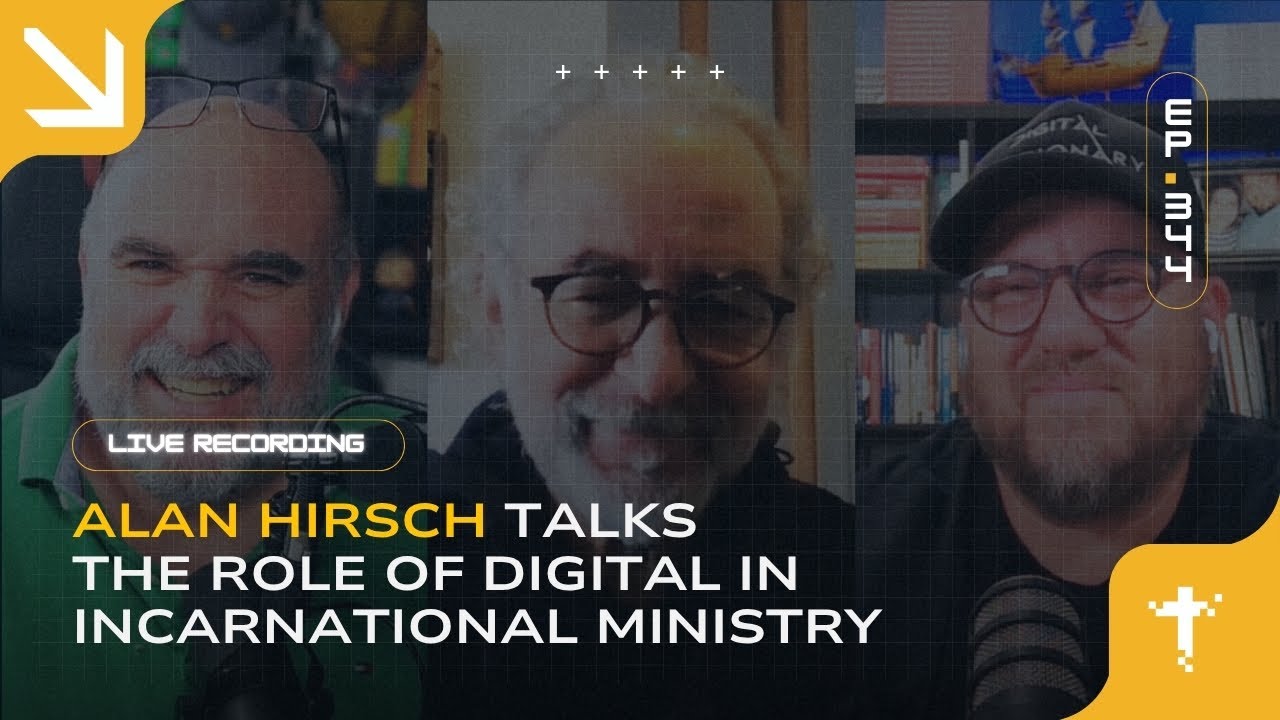
Jeff Reed sits down with missiologist Alan Hirsch and digital missions advocate Jesse Carbo to wrestle with a deceptively hard question: can incarnational ministry actually happen in digital spaces? Alan unpacks his six-P framework for incarnational mission — presence, proximity, powerlessness, prevenience, proclamation, passion — and the trio stress-tests each principle against platforms, Discord communities, and AI. The takeaway: digital isn't a cheap substitute for physical presence; used intentionally, it's a legitimate missionary frontier.
All right. Hey everybody, welcome to the Church Digital. We are doing a special live stream. I want to call this episode 344.
Numbers escaped me. We actually were talking about this yesterday on the normal stream. Like I just lose track of numbers these days, but I am very excited about the conversation at hand.
We're bringing on, we're bringing on, uh, maybe you know I started to call him the father of like modern church movement, but I don't know if that's weird. Anyway, we're bringing on Allan Hirs into the conversation. Very excited, um, about Allan, a visioner, uh, for many church multiplication organizations and movements, and really just an inspiration to me in general. And we're going to get into some things. Allan's been a supporter of Digital Church, of Digital Missionary for a while.
And really what we're going to get into today is the heart of digital. What's the role that digital plays in incarnational ministry?
Now, right there, that question already escapes my general knowledge, consensus knowledge. So probably we're going to start the conversation with, "Hey, Allan, what exactly is incarnational ministry?" and then we'll get into the deep end of the equation, because, you know, I just ain't that bright.
But hey, before, while I ain't that bright, we do work a little hard here with the Church Digital, and I've been promising this. So we, the Church Digital, we did a Digital Missionary Conference back in April, early April, April 2nd, and had 1,100 people show up day of from 80-some countries around the world, an incredible online conference. Super excited about it. And you know, of course, when you do one thing well, you've got to build on that. And so we had announced that we were doing a fall Digital Missionary Conference. And so we, but we didn't just want to stop at one missionary conference.
We are doing four. We're doing a series of summits for the Digital Missionary Conference in September and October. And I told everybody that we were going to tease them. We're going to come up with the titles. We're going to announce them today. And so I am a man of my word. We're going to get to Allan Hirs in one second, but I told you we're going to be rolling out the new Digital Missionary Summit Series, the series of conferences we are going to be doing online, 100% free for anyone and everyone around the world this fall.
And so, you know, someone somewhere has got to have a drum roll happening. Jesse Carbo is not doing one off camera right now, even though I wish he were, but let's just go ahead and roll this out. Um, we've got four of them coming up. First up, uh, let me see if I can zoom in. I can't. Can I zoom in? Yeah, there. First up, we're doing on September 17th, Digital Neighborhoods. Discipleship happens where life does. Now, um, this is probably of the four that we're doing in the fall, this is the one that is the most discipleship-centric, digital discipleship. This is probably the one that's the most general across the board that we designed one conference for everybody. And so that's going to be September 17th.
Information is available at missionary.digital. The website missionary.digital. The second conference of the Digital Missionary Conference is, ooh, that, oh, and is actually this is the third one. The fourth one is a secret. I see what we did here. The third conference, October 1st, the European Digital Missionary Conference. This is we're in partnership with European, German missionary conference, um, Mission Alliance.
And so we're excited about the European Digital Missionary Conference. This conference is going to be interesting. They're going to have like 10 or 11 TED talks, like 11 or 12 minute TED talks, boom, boom, boom, boom, rapid fire. Excited about how this one's going to be coming out with the European Digital Missionary Summit. The third summit that we're doing, actually it's the last one timewise, October 8th, is the Digital Missionary Gaming Summit. Now, this one we're actually hosting in Discord. Excited about this one. But it's a gaming summit and designed for people that are doing ministry in and around gaming spaces. So Twitch, Discord, inside video games, uh, even some metaverse VR stuff's going to be happening in this one. And so we've got neighborhoods. Uh, second, we've got European. Third, we've got the gaming. Now, we had announced those three previously. There, Jeff. There's nothing new here. I know, I know, I know. Be patient. The next one, this is the new one. We had not previously announced this one yet. And this is going back to September 24th.
We are doing a Christ-centered recovery, a digital recovery conference, creatively titled Control Art Recover. Uh, I'm going to be honest, that was ChatGPT. Let's give credit where credit is due. ChatGPT is a freaking genius. Uh, yes, it will take over the world one day. Yes, but we're going to enjoy the time leading up to that as much as we can.
All right. So we are doing a conference centered around, uh, honestly the necessity for recovery in digital spaces. And, uh, well, if we're going to shine light into the darkness of digital, we need to be prepared to shine that light on ourselves.
And so recovery is not just for people with addictions. It is really for all of us. And at a personal level, I can tell you that it has highlighted, that it has magnified, it has amplified my ministry after going through that, in resolving some of the issues, some of the baggage that I've carried in my own weight. And so we are doing, in my own life, we're doing four conferences overall. Uh, first off, September 17th is going to be the Digital Neighborhoods Conference. September 24th, Wednesday, um, Recovery Conference. Third is going to be the European Conference, and fourth is going to be the Digital Gaming Conference, Digital Missionary Gaming Summit.
Yeah, that's all I got commercial-wise. I told you, like, I people have been wanting me to say this for a while. Even my own team were excited putting this together. Uh, we have been busy booking people from all sides of the planet, um, Europe to South Africa to California. You know, I'm trying to find somebody out in like Singapore to book in, to get like the Asia-Pacific islands. And hey, for the stream today, we're bringing in someone from Oceania, and so excited for this. So let me, I tell you what, let me push the button and bring everybody on.
Uh, but let me set up how we ended up here. By the way, uh, Allan Hirs, thank you for joining us once again. Uh, Jesse Carbos, no stranger to the Church Digital, founder of Digital Missions Project. Missions is singular. Singular or plural? It's plural. Plural. Digital Missions Project, and is on the board of the Church Digital as well. So excited to have both of you all on today.
Now, Jesse started, um, was writing an article for Missio Nexus that actually got published, uh, maybe ago. Missio Alliance. Missio Alliance, I'm sorry. Uh, and it got published a month ago. Uh, Jesse, maybe you want to highlight that a little bit.
Sure, sure. Yeah. Missio Alliance. Um, you can find them at missioalliance.org. And we wrote an article called Beyond Twitch, Incarnational Ministry in Everyday Digital Spaces. Really just talking about, can you do incarnational ministry in the digital space?
And so yeah, I'm looking forward to this conversation with true missiologists here with us from Australia.
Yeah, yeah. So what I really found out is while talking to Jesse about that article, the more that I was like, "Oh my gosh, I really wish we could get like Allan Hirs and ask him a couple questions," about this. And so we did. And so really wanted to invite Allan to come on and start to talk to us a little bit about this. And so, Allan, is it, I can call you a digital supporter? Like, I don't want to put words in your mouth there, right?
Yeah, sure. I certainly support this. I do not claim any specialty in it. Um, I follow, uh, a bit of a distance, uh, somewhat amazed at what's going on. But, um, certainly I think we need to explore this whole field.
So you're very much a supporter. I love this. And so a digital-friendly guy who understands incarnational ministry. Let's bring him in and let's start to maybe pull back some of the curtains here and get a better understanding.
But hey, I don't want to assume anything because I'll be honest, I, and I'm not kidding, I don't think I really understood what Jesse meant when he said incarnational ministry until I said, "Hey, Jesse, when you say incarnational ministry, what do you mean?" So, Allan, uh, the missiologist that you are, uh, in less than, I don't know, two million words, what exactly do we mean when we say incarnational ministry?
Yeah, Jeff, you've picked up on the fact that I call myself the lord of the long answer, right? So in less than two million words, I think I can.
Yeah, I've got a counter over here. So talk slowly.
Yes. Uh, no, I'll go as quickly as I can.
Well, incarnational ministry essentially is a form of mission engagement with the world that models on what God has done in Jesus Christ in becoming a human being. So when we talk about the incarnation of the Son of God, and the incarnation of logos, whatever that, we, I mean, it's a remarkable act, right? So like here we have the reality of the eternal God, the maker of worlds, with words, um, who speaks the universe into being, is eternally present, actually becomes one of us and is in the neighborhood for 30 years. And no one even noticed, right? No one figured it out. Hey, the person who created the universe is, you know, right there in my neighborhood. In fact, um, they mostly missed it. Um, and even his disciples don't get it until much, much later in the game, right? Who they dealing with here. And, uh, so there's something about the hiddenness of God in the human or in the ordinary that he's kind of played out here.
And I often, so in forgotten ways, I play it out this way, that I talk about the six Ps. This is a way of trying to frame the incarnation and then translate the incarnation into our mission, incarnational mission.
So first, let's look at the incarnation. You look at Jesus, what you discover is that Jesus became one of us. Is present. I talk about presence in the neighborhood. The reality that in Jesus, God became fully and wholly present within human existence, right? So that's the first one. Presence is fully present to us.
Proximity. It's kind of similar to presence, but is not only in the neighborhood. He's not only a human, but he's in the neighborhood, but he's also involved where other people are. So he's in the marketplaces, the pubs, uh, you know, in the streets where people are. Is in proximity to them. This will relate a little bit to maybe when we talk about this, you know, in third places and fourth places, engaging in those kind of spaces.
Um, other one we say is powerless. That he comes not as the kind of conquering king, but as a kind of suffering servant. And this also says a lot about the incarnation, the kenosis we talk about in theology, of the self-emptying of the Son of God, um, powerless. Uh, prevenience. This an interesting one. Um, uh, when Jesus says, "I only do what I see the Father doing," is recognizing that God has already gone ahead. And then he attempts to pay attention to what God's doing and do what God does, right? Um, and this is really important. It'll, you know, in our going into kind of areas where we're unclear what's going on.
We just find out what God's doing and join with him. Proclamation. That's an we proclaim the gospel. Jesus did proclaimed the kingdom. Um but it usually this plays out very well once you've done the other ones.
Um you know once you've actually established credibility, presence, you know seen what God is doing, you're acknowledging it. The only other one I would add is passion.
And this we my wife added this into the equation. She talks about the incarnation of the heart. Uh where we engage sympathetically with the pathos or the suffering or the anxiety of the human situation and condition.
So you know where we feel what God feels and these are all based uh on the on what Jesus experiences the six Ps but they translate into incarnational mission as well.
So we follow, you know, we do the same thing. We need to be present in the neighborhood. We need to be in proximity with people, be in contact with him.
Uh we find out what God's doing. We proclaim the gospel and the kingdom. We and we feel what others feel. We we have an incarnation heart.
So yeah, that's broadly the way I kind of talk about at least in one of my books called ways. That makes sense. No, totally.
And uh even with the accent um like just once again, you know, I'm hearing very smart words uh empathy, proximity, uh presence, eternal um this is it's it's a it's a rich picture I I think that that you're you're painting here.
Uh but you know a lot of this like the presence the proximity um often it's perceived to be missing in digital or it's it's the absence of it.
Digital is the um is the cheap version of it. I cannot be with you in person and so instead I will FaceTime you. Um I I cannot be with you in person so I am going to write this email instead.
Um I I I would love to maybe just dialogue some with you just even like a shooting from the hip. Um what what is the role of of digital?
What is the the what part does it play in a uh in a incarnational uh ministry in an an incarnational relationship? What what what should digital be for this?
Well, um Jee, I can't I I mean I I I can't, like I said, speak as an expert in digital. I'm not. But I I am aware and I've spent a lot of time trying to think about the role of technology in our lives and um the digital space uh VR kind of spaces uh that you often engaged in are simply expressions of how technology impacts us. Um for instance I mean like 100 years ago whenever the phone was uh invented it creates the same conditions maybe less impact but you know when you know people at a distance can talk to each other and uh this you know that already starts the process of depersonalizing to some degree. Um which can be problematic. Um but we have somehow managed to kind of integrate it pretty well and in fact uh I think telephones and and cell phones etc etc now are actually ways in which we keep in touch with each other and probably have a more relational connection than simply what what was before that was letters which is another tech technology if you will uh you know that was used much slower and also deeper not personal but yet personal you know but I I just think playing that out.
I think digital is is is an is an example of that but taken at a whole different level and um there are problems in it.
I think we need to be very clear but they're also opportunities kind of presenting to us and actually challenges which we as Christians who have got an obligation to be present in all spaces where people are um when we follow the incarnation we you know we say what would Jesus do here I mean what's the incarnation mean in the digital space I think we have to be present have to be have to have proximity we need to kind of feel what you know to engage where people are at to feel what they're feeling to humanize them um to bring dignity to bring good news in in those kind of spaces. So I think it's a very much a it's a good challenge for us and I think you guys are doing good.
Yeah. Go ahead. I think Alan a good a good follow-up question would be is would Jesus use digital? Uh yeah that's an interesting question.
Uh you know I'm I'm much more engaged uh with AI um and the same question might come about with that um the one the way I actually think about AI it's going to be as I think Jeff has already said it's going to rule us entirely but um but the the when you see this in in a broader context um AI is not God even though it's going to pretend to be omniscient and omnipresent it's going to actually be highly problematic in that regard because it displaces God in in in a lot of people's lives.
You're going to turn to AI for all your answers. You're not not your prayer. You know, that's going to be an issue. No question about it.
But um but but God's still sovereign. Um AI isn't independent uh reality. And even it was, God is still a Lord over all things.
So it fits within God's overall frame and in his purposes. It's not that he's surprised. Oops, they created AI, you know. Um, I think he knows what's going on, but it doesn't mean it's not going to cause great confusion and complexity for us down below here.
And, um, and I think the same as digital. I mean, it's would he use it? Um, yeah, I think it's a created form. Uh, I think he would.
Um, but I I do think, you know, there might be a challenge there to constantly remember that actually embodied relationships, you couldn't have a marriage online, could you?
I mean, you could you could head in that direction, but you couldn't really you certainly couldn't make babies. And don't think about that too much online.
Um, which kind of shows you like somewhere along the line, you know, ultimately these things are personal. Yeah. And relationships are deeply personal and embodied experiences.
Um, I think that might be just a, you know, just to just to keep it. It's it's it's not ultimately real, but it's definitely real, if not not perfect, right?
Yeah. Yeah, you're right. It has its limitations, digital um like like a lot of things in life, there are limitations to it to its use um and you know, to its use case, right?
And um uh using the phone analogy like like and I think I I would even want to go back and say that even if we take digital off the table when we talk about incarnational ministry and we look at ministry leaders, church leaders, I think that's a struggle for a lot of pastors to even live it out. Even if you take digital off the table and and we're not trying to figure out like what's the digital solution.
Many pastors that I you know even myself when I pastored for 25 plus years like the temptation to shut the door to my office at the church building and be totally unaware of what's happening in the neighborhood, right? And expect people in my church to invite people to this gathering on Sunday morning and consider that ministry and all I do is preach and maybe counsel during the week and we really miss the picture of what it means to be incarnational.
And so, so going to your phone analogy, I can use the telephone to promote my product or I can use the phone to be present and to listen and to connect and to build relationship.
Yep. Right. And so it's really about the question isn't so much for me would Jesus use it, but how would he use it? How would he use technology to be present in people's lives to to bring truth to bring the gospel to build relationship and I think that's the real like if we really get down to it like the church right now in the west like we're introducing all the technology is just moving so fast like I think you know you were saying you don't want to be an you don't want to be a self-proclaimed expert I don't either because I don't think Jeff does either because technology is moving so fast and changing so much. I mean, I'm the generation that the internet, you know, started, you know, and I tell my kids, you know, my youngest is 17 and I'm like, "Oh, baby, I remember when internet was, you know, that dialup modem and you had to wait 10 minutes before it was ready to use." You know, it had to warm up and it had all these weird sounds and she has no idea and she has to watch a YouTube video to kind of see what that was like, you know, and um technology just moves so fast.
So, it's so I think there's an incredible opportunity for us to help encourage pastors to think more like missionaries today. I'm I'm even though I have an organization called the Digital Missions Project, it really is a project because a lot of my conversations really are coaching and encouraging pastors to to really think about intention like what is the intention behind your ministry and and and how do you live that out? Even with digital off the table, forget about digital like like how do you live that out?
Like what do how do you do you know what's going on down the street? Do you know your neighbors? Like I'm in a church office here and you know this church has an issue with like they don't even know who their neighbors are.
They have the same people that have been coming here for the last 40 years and that's it. And hopefully with this new pastor they just got there'll be some revitalization work and they got to knock on the doors and get to know the people that live here.
So yeah. Oh, I think that's very very very useful and a very good comment. Um, and I do think um, you know, we can be highly disincentivized in ordinary ministry.
So, you know, any any criticism we might put into kind of issues of digital, I mean, it's just applies all around as you've well stated.
But the other I think that in your article uh you you you said as well which I think is a really good point is that not to simply use the digital space as a place for marketing or selling something but for actual being present to people that are there and uh and and having regularity in that um being there for them listening humanizing like I said you know properly rather than simply using you know internet as a kind of way of kind of getting your ideas out.
And I think it was a useful comment too, bro. Yeah. Yeah. 90 I think 99% of churches right now in the west, the way that they use digital is really just a marketing tool.
They're blasting. Yeah. They're Yeah. It's a platform. They're just blasting information about their events. Um the next thing that's coming up and they're not they're not having conversations.
They're not engaging. I remember one time I was at a a pastor's retreat maybe about a year ago, last September, and um we were talking about this digital and and this pastor, new church planter from from from Los Angeles, he said to me, he goes, "Man, I want to use digital and social media, but I don't want to be a Tik Tok dancing pastor." Like in his mind, the way to use technology is that he had to be like one of these Tik Tok dancing pastors.
And I said, "No, not at all." Like he's like, "Well, how how would you like what would I do?" And I said, "Well, here's a thought.
Like, do you use WhatsApp?" He's like, "Oh, yeah. Every day. Do the people in your church use WhatsApp?" Okay. What if you said that on Sun, you know, if you preach your sermon on Sunday morning, what if on Sunday evening, you said you were going to be on WhatsApp for an hour answering questions and having dialogue and conversation about the sermon that that morning? I mean, this was like a mind blown moment for this guy. He left there goes, "Man, I'm going to do that.
That's so simple. I don't got to be a Tik Tok." I'm like, "Technology can be used in meaningful ways to build relationships and engage people and take people further." But we just haven't we haven't I think part of the reason why we haven't thought about how to do that digitally is because we're
Not even doing that physically like in the IRL, right? In real life. We're struggling even there. Yeah. Yeah. Yeah. Do you think your TikTok pastor, your TikTok dancing pastor, Jesse, if he had one hour a week to give, would he rather do like that be available in physical space or be available like that digitally? I don't know. I don't know if he would rather be available physically or digitally. But here's what I do know.
Culturally, people are less and less willing to do things physically because of busyness, calendar competition. People just have so much on their plate and because of the ability of digital technology, right? People are just I mean, look at the trend of church attendance. It's in decline. Yeah. What's not in decline is the number of people that are following Christian content online.
Like there's a movement of young people that are coming to Jesus because of Christian influencers online. So it's not that people are disinterested in Christianity, Jesus, spiritual truth. People are more guarded about what they commit to physically, you know, participating in, right? So I don't know if the pastor, you know, he might say, "Yeah, yeah, I'm willing to get together with people physically." My point is that like if you live in a community where people aren't willing to get together physically then how do you reach them? Yeah. How do you disciple people who are less committed? Like we, so we, Jeb, you and I live in Miami, that culturally here in Miami people are very non-committal.
You know, when I led the network here for eight years, we would invite hundreds and hundreds of pastors to come to events and I would get all these invites, you know, all these yes, we'll be there. But it was always like, I'm just, it's more like I'm saying yes in case I don't have something better to do. So what do you do in that situation?
Like, yeah, you want to challenge people and encourage people. There's times like you can't make babies digitally, you know? You got to get together in person. So there's times when you have to challenge and push for that physical connection and get in person. But then the question is like, you know, what are, how can we think creatively about using technology in a way that allows that, creates the room for us to have discipleship-oriented conversations and not just discipleship-oriented. When I say discipleship, I'm talking about not just spewing content out at people that they would consume. But conversations that motivate people and encourage people towards obedience of the lordship of Jesus.
Yeah. Yeah. Allan, maybe you can help me with this. It's funny. We used to, you were talking earlier about, you know, even the having babies, uh, you know, you can't do that physically or you can't do that digitally. I'm not gonna prove you can. But I would say that there's a conception, a perception that I'm totally confused now, but there's a perception that a lot of humanity is lost digitally.
Like even that's the knock on ChatGPT is the more that we use AI, the more that we lose our humanity. And often times I have found, you know, this is non-scientific study here, but you know, the converse is true as well, that digital is a tool that actually can allow you to engage relationally. It can be used as a communications tool, but it is also a very powerful tool towards being able to be in presence with one another.
You know, when my wife and I were in college 25 years ago, we were paying Ma Bell 10 cents a minute to talk on the phone cross country. And now, you know, we can pick up any device and I can be looking at her for free essentially. And so like technology is moving and is overcoming some of that human trait that was once lost or that has taken a while to really start to understand. What do you say to a pastor? Now, you don't delve much with the technology, but when you talk with people that are very locked into a way of doing church, you know, so much of what you're doing is even on that outskirts of new norms and an established kind of challenging the established norm, so to speak. How do you help them try to see something different?
How do you coach them, walk with them? What do those conversations with you normally look like? That's a good question. I would just make a comment just briefly before I get to that. About like, I found this very medium, or Zoom. You think about over, I know that you're in Florida, you didn't experience COVID and all that stuff, but the rest of the world did. We were, you know, we were living in New York where it was getting really quite hectic, so we actually left to go back home with family. And then, you know, almost up was it two and a half, two, three years of kind of messy kind of life lockdowns. You know, we were in the most lockdown city in the world in Melbourne here in Australia.
But Zoom, you know, it and I realized I mean this was a way I kept connected and in fact it's a very useful way of being connected with a lot more people than I could normally be and it's kind of pretty much free and secondly I don't have to travel so I'm saving on all kinds of technological and you know producing too much kind of carbon emissions etc. So no, I think there are a lot of really really good things in technology.
But in terms of like the, you know, people looking at things differently, one of the things we, you know, because we deal with a lot of people helping them think about church in a different frame. So often people think of church in the legacy model as a building and I kind of picture it like this. It's got a steeple. It's always got a steeple, got pews and all that stuff in it. That's what the church is and helping people think differently about that.
You often have to help them to go on an unlearning journey in order to learn new things. You have to unlearn things that are kind of holding to a certain paradigm. So actually, you know, developed a process of that called the metanoia curve or metanoia journey. Metanoia means paradigm shift by the way and it's a biblical word for repent. Well, repent is a very bad translation actually. You translate metanoia. Meta, you know what that is, don't you? Mm-hmm. Meta is beyond, over. Noia is your thinking or nous is your mind. So your thinking, what comes out of your mind. So thinking fundamentally differently to the way you're thinking now.
So in other words, experiencing paradigm shift, and this is cooked into biblical spirituality. We're meant to have an ongoing experience with this. I would argue any move towards God requires it because God's ever greater. God's going to always blow your mind, right? You can never put God in a box. If you put God in a box, you got to repent. It's called idolatry. And it's not God that you've got in the box in your little boxes and all that. So the idea of having always having your mind blown, willing to think differently, it's absolutely critical part of biblical spirituality actually and you're never going to learn about anything without unlearning stuff that got you to the point where you are now. So I that's kind of the thing we take very very seriously in whatever you're grappling with.
In order to learn something new, radically new, what are you willing to unlearn first? Sometimes our commitments to past traditions or ways of thinking limit our capacity to engage what God is doing in the current moment. So being open to the present means being open to having your mind blown, to learn again. Yeah. So we're using digital beyond a communications tool. We're not just selling something with this, but if we're leaning into creating community, if we're developing, using this technology for presence, to reinforce proximity, to maybe engage with people using this technology as an on-ramp, maybe there are people that are digitally friendly that we want to engage with in that way before we get to engaging them into a physical space. Is that, is this what I'm hearing from the group, from the two of you as we're talking about the role of digital in incarnational?
Jesse, I think you've got this, brother. What are you feeling on that? Yeah. You know what? So my ADHD like just went into hyperdrive because he said something about unlearning. And now I can't help but like I've been processing this idea of like, you know, with technology, it's always forward movement. It's always like learning something new. And then you just presented this idea of metanoia and how we have to unlearn. And it's got me, it's got me processing like how do you help in a culture where everything's about like learning, you know, think about like all the pastor conferences that are out there.
You know, pastors go to, there's so many conferences and you know, we want to learn like what's the next thing to get better, more efficient, more effective, reach more people, grow, get bigger. And then you're saying for us to be able to do this, we actually have to unlearn. That seems almost impossible or incredibly difficult.
Yeah, it is very difficult and changing a system is, it takes real commitment, but sometimes circumstances kind of force us into that. So like, you know, again I lament this, friends. You know, like what COVID had the opportunity of teaching us is about decentralized forms of ecclesia, you know, in smaller, more reproducible, homegrown, locally-owned kind of version of ecclesia. Worked as a movement was a fantastic opportunity for the church to unlearn and relearn and to find a new and far more productive, less expensive way of doing church. But hell no, we're not going to go there. So we double down and most churches just gone back to the standard form because that's all they knew.
And it's partly because people weren't willing to let go of prior ideas that they deeply invested in. How to get someone to understand something when their salary depends on them not understanding it. And often the leaders are the ones most vested in the prevailing system. So actually winning them over is a difficult thing. But I would like to think that the kingdom of God ought to challenge us, you know, to constant unlearning and constant growth. And not sitting with kind of prevailing forms of church that were for us largely settled in the 16th century. We're not even living there now.
Why would we insist on running churches like in the 16th or 18th? Depends on your tradition, right? If you're Catholic and back further, you know, why would we assume that the ecclesiology, which is the idea of church, is really not just a physical building. It's kind of a set of assumptions about how the church relates to the world and the purpose of the church in the world. And the way that we normally conceived it is profoundly ineffective. It's not effective anymore and it's incredibly expensive. So I know this because we've done research that in America when you put the budgeting, the cost of running the church in America on an average on an annual basis up against the conversion rates in America, 1.4 million dollars per convert in America.
Wow. $1.4 million per convert. Yeah. You talk about an expensive system that's ineffective. I mean, that's a good enough reason to change. Yeah. And yeah, sorry. But again, for us to often be bound up with the fact that we invested in this, so often it's a financial issue.
Yeah. I need to get money for my family, to get committed. You're locked in. Yeah. And so you're locked into a system like that.
But we have to free ourselves as leaders from those kind of constraints in order to kind of lead the church into new ground. And I think again the digital it could prove to be a really a wonderful way of actually investing our resources.
Imagine if you put $1.4 million into your digital strategy. You know, I think you'd get a few more converts if you did it well and you did it incarnationally.
Uh you'll get a few more converts than you would by running the standard system or company. Yeah. Yeah. Are so are you saying so I'm just cur I want to go back because you said since COVID it seems to you as you because you I feel like you have a pretty good pulse of the church landscape. I mean, I'm not assuming that you know about everything everywhere, but you're talking to network leaders.
Um you know really on an international level it so you're saying your sense is that people have doubled down on the old way of doing church and are unwilling to do because and only reason I'm asking is because from my perspective which again is very limited compared to your perspective like I'm friends with the guys over at the Tampa Underground you know Casey Underground those guys you know they've been doing what they've been doing for so long and all of a sudden post-COVID it seems like there's been this burst of people very interested in kind of a decentralized approach to ministry that conversation has gained a lot of momentum from my perspective again which is very limited. No you're absolutely right Jess I I think you are uh but I would say the overwhelming um predominant kind of church has gone back to running Sunday services.
Yeah, but now there are actually real live, we call them proof of concept movements that are around now and the microchurch movement being one of them that are actually demonstrating another way.
And that's the proof of concept idea is really important because it'll show us a new way of doing things. And by the way just on that fellas you know they the reason why you one another reason why you want to get this right is that when you think about church growth theory well it was a theory it was brought by a guy called Donald McGavern comes to Fuller Seminary becomes a professor there and he's a movement guy he's bringing movement thinking uh from from his experience I think it was India and um um but this is combined with marketing and management theory, you know, with S. Peter Wagner and those dudes and it becomes what they call church growth theory, contemporary church growth theory. Um, no, it's a theory until two churches came along and gave proof of concept.
They were called Willow Creek and Saddleback. Um, no, I mean there were more, but fundamentally those two were were they created took this idea and they created two different systems.
They created huge platforms that proved that this is a way is viable and it's it's a way to go. The rest of the church in the world went in the same direction.
And so all you need to do is to have a few examples of these where it's really kind of working properly theologically aligned and discerning your way properly.
You do that and everyone's going to follow. And I think you might very well become one of those proof of concept organizations that we're looking for right now, you know.
Yeah, I agree. I Yeah, makes makes a lot of sense. And I've had this conversation with Jeff many many times because you know, not to put Jeff on the spot, but there's times when you know, you know, like anytime you lead an organization, there are moments when you feel like giving up because you don't know if it's worth it anymore. There's this there's these moments of uh is the word liminality right like like this this tension this this like is you know should I keep doing this and then you know and I just keep saying to Jeff like because he he's an early adopter like he's a true early adopter he's been doing digital ministry since how long Jeff since 2000 maybe like yeah so uh so and I'm like man I to me the sense at least in my gut is that we are one to two years out before digital ministry breaks loose across the church globally because well not not even globally in the west I I say not globally because like I'm connected to people that are doing things in the 1040 window and that's the only way Christianity is growing in the 1040 window is because of digital there are more converts that come to Christ because of digital tools um because they can't do it in person immediately and so digital has become one of the mechanisms for allowing the movement of Christianity to grow in places where it's illegal.
So, but yeah, I think yeah, digital has it's it's a hard it's hard to adopt because they see it as a marketing tool to promote their their products and services.
Um when it really needs to be more. So yeah, that's the conversation we've been having is like yeah but guys I think this where it becomes critically important to uh bring integrity to this practice uh online.
I think the incarnational um frame gives you a very good example of how you can maintain um a Christlike presence, not something that's manipulative or unchristlike, which is there's more than enough of that crap going around.
Yeah. Um you know but to actually um commit yourselves to you know what does it mean to be a genuine Jesusy presence online and then working that out which I think again um you know just your article was very good bro and I would say I think it still needs work and I think um guiding people because I think most folks go on board and they just they're pragmatic or they you know they want to market or sell ideas and create their own platforms Um, we're seeing where that goes, right?
And we see what social media can do. Every idiot's got a bloody pulpit now, haven't they? You know, and they just ranting. And I mean, I can't even follow X anymore.
It's just vile, you know, and but so we as Christians need to actually embody a very different way here. And I think uh the discipline of actually you guys actually laying down the template um the default mode that might follow I think is very important to build in the kind of the character character issues maybe is a word or the kind of a good ethical approach to what does it mean to engage online. Also kind of an awareness of technology and how it changes us.
We invent our tools and then they reinvent us. Social media that's caused all kinds of problems in the world because people weren't aware of it.
So bring awareness, bring thoughtful approaches to this, you know, in in in your pioneering or or apostolic work and what you're doing now. Very very important.
You're laying down the template. Yeah. It's interesting cuz Yeah. Yeah, I mean you're talking language like you know like the pioneering work that needs to be done and in some ways it feels like well some a lot of this technology has been around for a while but it's still so new and there's still so much to figure out and it moves so rapidly. Um Yeah. Yeah. And I think yeah we need to invite God's spirit in this process to help guide Yeah.
Cuz there's things we're going to get wrong. Yeah. Um the other thing I would also challenge again is something to really think about is you know um just you would know this particularly I'm very big on movement so that's my stick right you know idea of getting things that can scale and have large impact you know over time and uh and distance and I think the the the kind of digital world gives us incredible options there to actually start movements of common concern or Jesus movements, discipleship, what does that look like online, you know, being, you know, building that out.
Each of these become clearer as you build it out. But the idea of movements and and getting, you know, an idea to spread um Jesus' idea to spread virally, I think is something we need to put our minds to and again with, you know, with some ethical guidelines to it as well.
Yeah, it's really good. Really, really good. So, you know, for me, it's been By the way, if there's questions uh in the audience, um Kiwi is having like a side conversation uh as Kiwi normally does when he's on these things.
It's a lot of fun to see. Um he's a he's a genius. He should be on yet. Yeah, Meta. He she should. Um yeah, he can take my spot.
That'd be awesome. Um Metanoia is you wrote the book back in 22 23 published it. Uh 22 23 somewhere. Somewhere somewhere in there. Yeah.
Yeah. We we've talked we've talked about that that in the past. Um, and and coming from a guy who's been doing digital ministry since the 2000s, like it's literally I launched my first online community uh April 15, 2000.
Um, I uh often times I I've been told, "No, it doesn't work that way." Like literally the same argument to for 25 years. No, it doesn't work that way.
And and it and it centers around the church's use of digital community that the church should not use digital community. Digital community is um forgive me is the bastard child of physical community.
Um it there's no there's no God doesn't belong in that space. Um, you you can insert you can you can look at my YouTube comments uh centered around virtual reality and and find lots of people that think that uh the devil is uh is in these digital in and virtual spaces.
Yet yet we're we're finding that God is is moving and that people are finding Christ and are being discipled in amongst these spaces. Atheists are coming to Christ.
Um uh agnostics are discovering Jesus. Unchurched are re-engaging and even evangelizing and discipling others. Uh and this is not a once again this is the the forgetting uh the unlearning portion of it.
We're not it's not a broadcast model. It's a it's a conversational it's a relational evangelism model, relational discipleship model. And it's um and it's picking up it's picking up steam.
We're still young with this approach. Um it is a true missionary model. It is going to where the people are at. Yeah. And where that's really the question.
You know, we we've really pushed this idea of platforms as places that we look at at Twitch, the platform of Twitch, the community around Twitch, the community of Discord, the community of VR chat, the community of Facebook in many of the same ways that a normal missions agency would look at uh India, China, Brazil, uh and and in that way like like forcing this digital community is a community worthy of a church mindset. Um, and that, you know, has been well received by some and not well received by others.
I I I would love if if I could maybe just a little bit of your time here. Let's for sake of argument, let's flip the script here a little bit on incarnational ministry.
Allan, you're usually good at thinking on your feet here. Um, incarnational usually would be micro. I'm existing in the neighborhood in I have a presence in the neighborhood.
There's a proximity relationship to that and and that's where it is. And yes, we can use digital as a way to complement that proximity to get people in where they're not or things like that.
Typically where where I, you know, rewrite the script, flip the script and try to do the unlearnings. And this is where it's been a little hard as as of late is as platforms as places where now I'm saying that you know in Discord as it is in the neighborhood and and and Discord is a neighborhood as well. What what are some of the opportunities or constructive challenges of putting um platforms as neighborhoods? If we're looking at incarnational ministry in these spaces, what are what are some of the challenges or opportunities we may be seeing?
Well, I think we've already covered a few of them. Um the um I I I think um you know like going back to the the issue of marriage um which is maybe one of the ultimate forms of uh human love and ultimately the you know we human beings probably do need physical contact.
I wouldn't say that it's either or. I would simply say I think it's a legitimate space to engage and for some people this is where they could go to church.
I think it's quite clear and the fact is, I mean, like, we, you know, the prevailing churches might critique it, but it's not that, you know, most churches are great places to belong either. You know, you go there, you get basically preached at or you get some sort of religious experience, but you know, they're limited. Yeah.
So they can be kind of inauthentic in themselves. You know, so if it is, you know, that, you know, it's Jay Cranda over it. It's so funny you're talking about Saddleback. Jay Cran, the digital Passover at Saddleback. Anytime he sees me, he's like, you know, oh, you know, it's, uh, talking about incarnational. Well, yeah, but you can't, you can't have sex digitally. Well, I mean, technically you probably could, but that's not a good thing and we don't want to get too deep into that. But you know, the Bible, ironically, you know, Paul talks about being single, and then there's the flip side towards a lot of this. And so there are people that live without that. And I do not believe physical or digital, like it's not it's both.
There is, you know, I'm not saying it's hybrid. I don't want to use that term in that. But there's physical selves and there's digital selves in that where there's a proximity towards it. But, um, towards both sides of it, are you see where there's an opportunity to build relationships that exist only in digital space?
I think there will be situations where that is the case. Um, again, I don't know enough about it. Um, but I think like there are some problems related to that with some of the Japanese kids who going to do gaming and don't leave their rooms for 23 hours or something like that. And, um, I think there will be unintended effects of going all out in any technology. Um, we invent our tools, they have an unintended reciprocal effect on us. Um, not all of them healthy. Uh, AI is going to be a classic case in point. It's a big one, bigger than digital proper, because it displaces human intelligence and it does a cracker job of it. And it doesn't matter whether, you know, the theoreticians tell us it doesn't think like a human. I said it doesn't matter, but 99% of people are going to treat it like it's God. Yeah, you know, we're going to be thinking like it will, not it thinking like we will, at some point. It's going to, we're going to sound smarter, you know, but we're going to be dumber because we won't do much thinking for ourselves anymore.
And that in the long run, I don't think is good for us. So we need to be aware of that technology does have a reciprocal effect and that, you know, we need to just be aware of it when we inflict it upon other people, just to try and predict that, you know, again, we couldn't have predicted this with social media. Um, but it has changed things and, you know, the whole anxious generation stuff and, um, you know, kids now just almost completely, you know, posing for the camera, you know, it's changed things, had a huge impact on society and not all of it good. Some of it's very good. I just think we need to think both ways about it and be, I think a wholesale engagement with it, um, you just got to be critically aware. Good and evil in all things. And we need to have discernment of spirits. That's good. That's good.
Well, we solve the world's problems tonight. Hopefully we made people think a little more deeply about it.
Yeah. What, um, it's the other side of the planet where Allan's at. So, uh, it's Thursday morning where he is. So he, we, the future does exist. We do make it to that point. Um, any, uh, I know I don't want to take up too much more of Allan's time, but, um, uh, closing thoughts, Jesse, as we're wrapping up here. Anything on your side?
No, I just, I'm super grateful for you, Allan. Um, you've had such a profound impact on the church at large and in my life. And you know, we started a network here in Miami. And I remember we started this gospel leadership network. And I remember you challenged me. You said, "You should call it the Jesus Leadership Network." And your challenge really like knocked me back. And I was like, I was so gung because I was part of this like young and reformed group of guys and it was like gospel leadership. And you challenged me and I was like, later I look back and I'm like, "Yeah, Allan was right. I should have changed the name right away." Like on that day I should have changed the name. And, uh, wish I had, but I didn't. And then, uh, you and I had a chance, precoid, I think it was the fall of 2019, to go to Cuba and train some church planters. And I thought about this because we were talking about incarnational ministry. And we met with that Cuban actor and got to share the story of the prodigal son. And he was so, you know, a self-acknowledged agnostic, you know, who basically was like, "I don't believe in God," but he loves Patchy. And he just wanted to like be with us at dinner. And I just remember you and Robert and Patchy sharing the story of the prodigal son with him. And he was so blown away. And I just kept looking around and I'm like, "What am I doing at this table?" Like, I shouldn't be here. Like, this is, this is somebody snuck me in, you know? Maybe they don't see me over here. But, um, but I'm just grateful for you and thank you, thank you for everything.
Yeah, thank you. I feel the same way, bro. What am I doing at the table? Uh, honestly, and I often find myself pinching, you know, pinching myself thinking, "Oh my gosh, it's probably because it's probably because Deb lets you be at the table," because she's really the, she's the best one, you know? She's amazing.
Yeah, it's, uh, it's all about the women giving the men permission to be at the table. Mary's up.
That's something we can, can. Hey, Allan, as we're wrapping up, um, any closing thoughts on your side tonight?
No, I, I, guys, just keep going. Um, you know, I'm praying for you, rooting for you. Um, I think what you're doing is absolutely critical. Um, um, let's keep the journey going. But yeah, and just stay centered on Jesus like Jess was saying.
Love it. Well, I tell you what, Kiwis, you can't go wrong if you become more like Jesus. So just stay close, you know? Be good. It's good.
All right, Kiwi's got a question. We'll ask Allan to wrap up here. Uh, how will our effortless and daily connections digitally affect the way we understand the role of the church?
I think he's got to answer that. Isn't that normally what he does? It's like he pokes the bear with the question a little bit, knowing that he's got like the right hook ready to swing. Uh, anything you want to, anything you want to share here?
I think what he's saying is, I mean, we clearly engage, um, digitally all the time, including what we're doing now. These things are already part of what we're doing. How do they affect us as a church? Well, I think they do play a role and, you know, we need to again be very aware of it and enhance it and be more Jesusy in our use of these things. But, um, yeah, but they do. I mean, technology impacts us in so many ways, you know, and we're entering into a, you know, a technologically defined reality. Um, I actually think that there will be, I predict this, there will be pre-AI and post-AI, like BC, you know, AC, but, um, um, I think that if we kind of survive the 21st century, they will kind of, um, mark it as a kind of an era, epoch difference.
Wow. So all that to say, um, because I think everything changes now from this point.
Yeah. I, I, just you just did say if we survive the 21st century. Like, I want to draw attention. You did put an if in there, right?
Yeah, I did put an if. Okay. All right. All right. I wasn't sure if it broke, you broke up in my ears. Just just wanted to make, that's another podcast. That's a whole another podcast. It's, I have all kinds of thinking about what's going on.
No, but the, uh, the post, the AI as the time stamp, the labeler, uh, is beautiful.
Yeah. Yeah. I mean, it's, it'd be interesting as, as, you know, BC, AC, before Christ and Odaminee, maybe that gets replaced, uh, in time. It might be supplemented, but, um, I do think we're going to see the world as before. It's like we can even say internet was just a resourcing information for us. It was unbelievable. But it didn't do our thinking for us, right? AI actually goes into the very core of human consciousness. Language goes to the very center of how we think. The internet distributed us. It didn't replace us. AI, AI has the ability.
Yeah, that's right. No, I, I get you. That's interesting.
Well, in I'll reach out to you in 12 to 14 months and we'll have that conversation then. If we still, if we're still around, there's no promise on.
All right. So we're going to land the plane for, uh, for Jesse, for Allan. This is Jeff at the Church Digital for a special Wednesday stream. Thanks for hanging out with us today, everybody, and we'll see you next time on the show. Y'all have a good one. Have a good one.