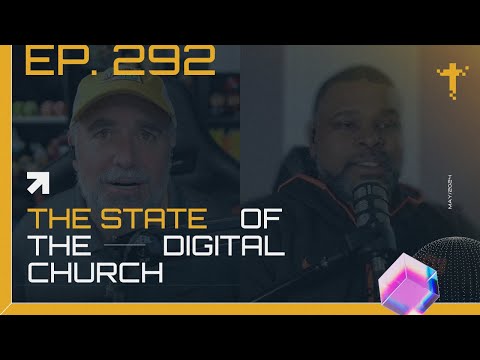
Why is a digital church perceived to be so threatening to a physical church? Rather than see a digital church as complementary to what’s happening physically, a digital church is seen in competition, as if the Gospel means less digitally than physically. Reality is we see…
Hey everybody, Jeff with the Church Digital. I got to tell you, Dr. Harris here is quickly becoming one of my favorite digital-only planters on the scene right now. Every time I get a chance to talk to this guy, I am learning something in a deep way, and this podcast conversation was no change in that pattern.
Dr. Harris, if you've not had a chance to connect with him or meet him yet, he leads a digital church called Hearts Like His. It's a Facebook-only expression, and we get more into that strategy here in a little bit. But through this conversation, man, we got to talk about Facebook, digital-only, the physical-digital threat, the perceived threat that may be out there. We got to talk about race in the church, race in a digital-only expression of church, what is the role of race in that digital church in his specific digital church, many other things and topics that was just a beautiful conversation. And listen, I just want to get to it. I want to get you going. So here we go. We are bringing into the conversation Dr. John Harris, lead pastor of Hearts Like His, myself Jeff with the Church Digital, and we stayed at church planting in a conversation that I'm calling the perceived threat of a digital church.
Okay, everybody, here you go. What's your ministry story? Give me a two-minute version of that, and then we'll springboard into a lot more interesting questions, at least on the digital front.
Yeah, I grew up as a pastor's kid. My dad was an Air Force chaplain. My mom was also active duty in the Air Force, and then when they got out, he was pastoring a church, a Baptist church in Arkansas. So I grew up there and accepted my call to ministry at fifteen. And from there, I went to college, went to seminary, and really focused on chaplaincy because I needed an M.Div., Masters of Divinity, to get into the Air Force chaplaincy. I really felt God wanted me to go in that direction. So I was in the Air Force chaplaincy for nine years. Two different summers—2007 I was in Iraq, 2010 I was in Afghanistan. I'm serving as hospital chaplain because of some special training that I had received there. And that's where it, you know, the military is really a leadership factory. It's a leadership culture, it's a leadership factory. And so when I left the military after nine years and came on staff at a church in Northern California, I didn't really realize how much leadership and stuff I had learned over the years, even prior to with my dad and other pastoral mentors, but certainly in the military. So I came on staff in a civilian context, and I thought, wow, they definitely do things a little different.
So I served as an executive pastor for a little bit there, and about nine years as well—small groups executive pastor, teaching pastor, the whole thing. And then I stepped down from that in 2019 to help more churches. You know, really seeing how God was using me to help the church that I was in and some other local pastors, I really felt the need to help more churches. And so I stepped down from my full-time role to do church consulting full-time in 2019. And then at the same time, though, I'm seeing this decline of church attendance, the rise of the nones and the dones, those who are leaving the church and either going from Christianity to another faith or from Christianity to atheism. And I'm seeing this rising trend, so that's kind of like in the back of my mind.
So in 2020, when COVID happened, I thought, man, this is one—there has to be an answer for all these people who are leaving. And then two, such a shift to online made online-only more palatable for a lot of people, especially those who had already left the church, right? They already left the church, and so they were online. And so my wife and I are just really praying about what to do there. That's why we started Hearts Like His on Facebook.
Yeah, that's a very unconventional ministry route, starting with the military, you know, hospital chaplaincy, which leads back to a more traditional church mindset. But if it feels like you got out of that relatively quickly, started doing consulting, and now you know, a completely non-traditional route by launching this digital-only church. Like, I want to dig into the digital-only church here in a little bit, but military is incredibly, I mean, traditional. I'm not judging, but it's, you know, you do you. It's not, hey, let's think outside of the box. Let's go join the military and be a chaplain over there. It's more like, here's your operating procedure handbook. Do as it says. At least that's how it's been described to me. How do you wrestle with like the years of thinking traditional to now thinking kind of outside of the box, doing this digital church planting thing?
Well, even though the military has tons of traditions, it also is on the cutting edge of a lot of innovation. So you know, when you think of like our aircraft, right, the F-35, the stealth fighter, back in the day, I mean, there's a lot of innovation. So yes, there's like two parallels there—tradition as far as heritage and how we value that, but also, man, what is the military that's behind on technology trends, right?
That's fair.
So always challenging you to think outside the box, to problem solve, to all those kinds of things. And so it's quite a balance of both, actually. And so yeah, thinking outside the box, to problem solve, to lead people to all those kinds of things. You certainly cannot be behind the curve when it comes to leadership in the military context.
Well, awesome. So we fast forward to where we are today, and now you're running Hearts Like His, a digital-only church, or a church that exists primarily in Facebook, I would assume. And so, but why digital? Like, you had a bunch of options. You're doing the consulting thing. What brought you into doing this radical thing of running a digital-only church that so few people, you know, in the grand scheme of things, validate? This is still a very controversial idea, and you like embraced it. What was kind of the mindset?
You know, I didn't see it as radical at the time. I saw it as necessary. So that's that was a different perspective just out of the gate. I, when I talked with pastors about their online ministry, one of the things that always, always, always pops up—if they're struggling with online ministry, the thing that always pops up is their view of it as a threat to in-person. And here's why: from a psychological perspective, when you are already struggling to survive, then you view pretty much anything else as a threat to your survival. So if you are struggling to get people in-person before COVID, then you see online as a way for people to stay at home, to not come. You see it as a rival. You don't see it, you know, you see it as an enemy. So it's not even a theological issue for some people. They're hiding behind the theology of it basically because of the fear that it will create another thing that keeps people from being in-person, right?
So in-person ministry is already competing with sports. Sports has changed, right? Sports on Sunday—that wasn't the deal fifteen years ago. People are working on Sunday now. That wasn't the thing. You used to be able to tell your boss, "I don't work on Sundays," and they will honor that. Not now. So there are already some literal, you know, competitions to in-person attendance. So then when online happened, a lot of people view this as another competition to in-person attendance, which meant that they weren't going to put their all into it. They were just going to deal with it, cope with it, not try to innovate, not try to exploit the benefits of it, but to just deal with it. Almost like somebody, you know, who puts their head under water and they're just holding their breath. So they're kind of waiting for this whole COVID to blow over so they can pop their head above water and breathe again and go back to what they were used to doing, competent in doing, excellent at doing, and that was in-person. So they saw online as a threat, and they're trying to protect the in-person paradigm from it.
Well, for me, I didn't have an in-person ministry, so there was nothing to protect. There was nothing to defend. I didn't see this as a threat because there was nothing to threaten. I had nothing—just me and my wife and Facebook Live. And so the other thing is I enjoyed doing Facebook Live videos. So that part wasn't a hurdle for me. I'm used to talking to the screen, whereas a lot of other pastors weren't. So there are a lot of hurdles that some pastors had just out of the gate that I didn't have.
And so then when you look at the from the practical piece to the theological aspect, if the church is all about reaching out to people, going into all the world, then digital ministry is the absolute best way that we can do what Jesus told us to do. And so again, looking at it as an opportunity, you know, you've heard probably heard of like the SWOT analysis, right? Strengths, weaknesses, opportunities, and threats. And I think the success of a pastor or church's online ministry is determined by which box they put online ministry in. Some have it as a threat. Some have it as an opportunity. I had it in the box for opportunity. And so I think a lot of success comes from that way. If you have it as, if you view it as a threat, you're just, you're not going to think creatively about it. You're just not. You're just going to be one of the things you feel like you're having to do, forced to do, can't wait till it's over because we love being in-person, like hugs and high fives and all those kinds of things. And then you just miss out on some of the opportunities.
Yeah, that is incredible insight right there on the threat. I had a church, pre-COVID, executive pastor strategy. Like, he was senior leadership of a church here in Florida. And I was having a conversation with him. He was talking about multi-site campuses and how he's launching, it was a bunch of multi-site campuses this church was launching. And I asked the senior leader of the church, hey, what role does digital, what role does church online play in where you're putting the locations? And it was funny. His response was literally, "Absolutely nothing. We only count people that are capable of putting on their pants."
Wow.
And I'm like, this is pre-COVID. This is a huge Florida church, and I'm staring at this pastor, and I'm like, are you kidding me right now? You don't have any consideration whatsoever. And it's like, no, because they're not capable of putting on pants and coming to a venue. And it was like, I just didn't have the opportunity to psycho-evaluate that. But hearing you describe threat in that situation, it's so true that so often we look at it as a competition. We look at it as, you know, Peter robbing Paul, or you know, taking from one to the other. And trying to figure out and find the ways that digital, if you're doing the physical strategy, where it can complement that. Or even to your point, man, you're able to operate with a lot more freedom in the digital space because you don't necessarily have that physical balance to try to work through. So that's beautiful.
Well, do this. Tell me a little bit about Hearts Like His. Tell me about the church. What does it look like? How did you guys get started, and what does it look like in any given week?
Yeah, sure. So, I first let me say I learned quite a bit as far as my format from Angela Craig, who has a group called Online Jesus on Facebook, and some of the training that she did as she was a pioneer with Pursue Church Live on Facebook a few years ago. She's handed off recently. And then also Myron Pierce—I want to give a shout out to him and some of the stuff that he's done.
Does to help, uh, help people look at how to use digital space to, uh, create gatherings in physical spaces and and really launching church plants from online. So as I, as I got into this looking to see how do I really do this and also Nona Jones's book "From Social Media to Social Ministry" helped me kind of write my mind around, okay, this is not like far-fetched idea to do ministry online here, just on just on Facebook.
So I use Facebook. The Facebook page is kind of like my outreach, kind of like the billboard, kind of like the front porch, and then the Facebook group is where the community is. And um, and so inside the group, what I've done is, again, a hurdle that some people run into is trying to take what's in person and just replicate it online without changing anything. But the online space is a whole nother culture. It's a whole nother environment. And so that's, uh, that's a miss if you just try to duplicate in person online.
So if you look at the online culture and environment and then you adapt your ministry to that, which is what we've been trying to do and still doing now, then you prioritize community over content. So that's number one. We prioritize community over content. People can get content anywhere, and many church members, many pastors experienced that, that their church members, my church members, they discovered Google. They discovered YouTube. They could get better sermons, longer sermons, shorter sermons, better graphics anywhere else. But the place where you win is that they can't get that community anywhere else, right?
So one, we value community over content. And so what that means is that I still teach, uh, once a week. Me, my wife, we teach on Wednesdays once a week in the evening. And um, but but we don't really, we haven't really called it a church, and I don't think we have to call it a church for it to be a church. Um, because a big part of who we're reaching out to is the people who have left, right? So the target is really part of the reason why we have the model that we have. So the target is people who've left the traditional model, and what they discovered based on a, um, some research by, uh, I think his name was Josh Packard, who wrote a book called "Church Refugees," is that people who've left, they didn't really leave. They didn't leave Christianity. A lot of them didn't leave Christianity. They left a particular model of church, right? One expression of church, which is a Sunday morning. So they're out there floating around, and God's will is for them to be connected. And so in me reaching out to them, and some who are still connected to their local churches, I don't really call it a church, but it's just we call a discipleship community, which essentially is what it's a church. But um, so because it's a discipleship community, everything is geared towards people being discipled, not people being entertained by a great online production, not people being, um, um, I don't know, just like I don't need you to sign up for a bunch of volunteer positions to keep this, to keep this going. There really aren't a whole lot.
So there's weekly teaching and um, and then a lot of community discussion. So if you're on Facebook, there are engagement posts that you need to use so that the Facebook algorithm says that what you're producing is relevant. So that's why people have posts like, do you like apple pie or cherry pie? People just kind of comment on it, right? Just to get people engaged. But but that's not really community building. It's part of it, but a bigger piece, and what we're doing, is we're asking personal questions or posts that things like, like, what's your win of the week? So I want you to share something out of your life into this post. And so it actually creates community content.
So when I put up there on a Friday or Saturday, what is your win of the week? And someone says, I just got a promotion on my job, or or I just got a raise, or or my husband just got a new job. We're looking for a new job, or or I was able to go bike riding five days out of seven days this week, or I was able to get to get a nap, right? So people are actually sharing out of their lives, which is important for building community. And so when they, when that happens, then people are commenting on it. Now, so this is not me. I'm not even doing anything. I just posted, what's your win of the week? Professional, personal, professional, big or small, we celebrate them all. And so the community is sharing about themselves online, which they do not do the same on in person, right? So they're not sharing their birthdays in in person. They're not sharing all these kind of things that that they can do online. And guess what? It's not like it's one live conversation that's out in the air and it disappears from Sunday. It stays there. People are talking about it. They're seeing it all week long. They're seeing your win. So they're celebrating your win all week long with you.
So imagine on Monday saying I got a promotion on my job, and then Monday, Tuesday, Wednesday, people are saying congratulations, congratulations, congratulations all throughout the week. Now, how does that make you feel as an individual? One, it makes you feel valued. It makes you feel seen. Makes you feel loved. You can't do that in person because it's just a conversation that's out in the air and it's gone. But online, there's like this whole record of it.
So so basically what you have, uh, in Facebook, is you have an on-demand community. It's community on demand, which is what you can't do physically because you open and close the doors, right? Which is obvious. You mean you got to do that. But not not online. So building community online with helping people connect with each other, seeing what people are celebrating, uh, putting, creating a platform for that where they can celebrate with each other, support each other. Prayer requests are the same way. Please pray for me. My husband got diagnosed with COVID, or my dad has Alzheimer's, or whatever. And all throughout the week, you're seeing people supporting you. And so it's really cool to see those kind of things happen.
Yeah, I mean, you're referencing a lot of rich strategy here. Building the relationships, utilizing the digital tools, Facebook, and and yeah, I know Nona Jones's book is is kind of rich in in that digital strategy. Were you savvy digital? Like, you're not in the age of digital native. I'm not going to out you on the air, but you and I are closer in age together than than like a Gen Zer or a millennial or a, yeah. So tell me, like, where were you native? Is this is this a new skill that you've learned? Like, what what does that look like in your life?
Yeah, social media, I am native to social media. Uh, what was new for me was trying to figure out how can you do discipleship, uh, online? I love trying new things and experiment with new things, trying to learn the whole algorithm thing. How does that work? What posts will get people to engage and get people to talk? And things like that. Because there still are legitimate concerns about what's possible on social media. However, um, there are some legitimate benefits to social media that you don't even have online. And so looking at those, leaning on those, it just, it just makes the world a difference. It makes a world of difference.
Let's let's lean into that. I'm I'm curious. It's just to be honest, it surprised me that you don't consider it a church. You're utilizing the word discipleship community. I think that was what you said. I mean, that's it's interesting. Even earlier today, I I was talking to a guy that I thought would have called himself a pastor of a digital-only church, and he's like, no, I don't, I don't consider what I do in virtual reality to be a church. I'm more of like a digital missionary. And so where words have meaning, and so I'm curious, like, when you look at what you're you're doing through Hearts Like His, why is it a discipleship community? Why do you not perceive it to be a church? What's missing kind of in that ecclesiology? Obviously, you've put some thought into that. What what what are kind of the strengths and weaknesses here?
Yeah, well, let me just say we're absolutely a digital church. I'm saying yeah, yeah, I'm saying I don't call it that because of all the things attached to the word church for the people I'm trying to reach. That makes more sense. Okay, no, and that because you're working, I apologize, because you're working with that de-churched audience, you're using safer language and safer terminology for them. Okay, and because everything that people think about, okay, so for example, you got way too many people that think that church is an activity, that church is a building, that church is an event. All that stuff. So when you say digital church, they they think you're doing digital event or digital activity, right? So all of the all of the unbiblical connotations that come with our American definition of church get attached when you call it digital. Because I am not trying to replicate what people's experience is with the stage and the lights and the pastor with the microphone and and the worship team and and you sit in there as an audience. I'm not trying to replicate that. That's why I don't use the word church.
Now biblically, if we go Acts 2, I'm absolutely a church. We're absolutely church. But I just call it discipleship community because the people I'm going to reach, I'm reaching for, they want to grow. They want to grow. There's discipleship. They want to be connected. There's community. So I have to call it a church for it to be a church. But it absolutely is a digital-only church for sure.
Love that. The way the way that you said that earlier, and there were other things I was like, wait, wait, wait, wait, I want to come back to that one point that that's that's very good. Um, are you, are you, you know, it's interesting. Just recently we did a podcast on bivocational, co-vocational. You know, some we've done, we've talked about some more interesting funding opportunities and digital-only pastors. I see a larger trend more towards bivocational. Are you trying to be full-time with this? Are you taking a more creative funding approach? Like, what what what does that look like for you at a personal level?
Yeah, for me, I do have a consulting business, and so that's where I, I'm my main income is coming from. I don't, I don't have, um, I'm not taking a dime from what's coming in right now. Although I mean, there's a lot of people saying, man, Hearts Like His, like, this is my church. This is my church. So there's money coming in. There's tithes and offerings coming in. And so we're in the process of, we got our 501(c)(3), and we're getting the whole nonprofit, you know, status and all that, so that, you know, people can get those benefits and all the kind of things. Um, but I I mainly use like funds from Hearts Like His to, you know, get, uh, software or like like we tried to restream for a little bit, you know, or you know, things like that that helped me actually do the online stuff. But um, but but my main source of income is my own. Social income is the consulting business that I do and some of the things I do on the side: emotional intelligence workshop for church teams, vision planning, uh, leadership coaching for pastors, those kinds of things.
It's a lot of fun to do church when you're not trying to make a living off the church.
Absolutely. There's so much freedom. And that's my, here's the deal. If I, if I was to transition to full-time online ministry, to me that means I'm not leading well.
Wow. Okay, unpack that.
No, no, no, no, no, keep going. I love that.
Oh, okay. Because if I, if I turn this into, again, I don't want to replicate the same mistakes that some people are doing in person. They're not empowering the church to do, to be the church. So I don't want to lead everything. I don't want to. So if I create more work for myself online, that's a problem. Part of my goal is to empower people to, um, to
Do the work of the ministry because, you know, Ephesians 4, it's the same online as it is in person. We are to equip the church to do the work of the ministry. So I don't want to make the same mistake a lot of pastors are doing right now. Everything focuses on them. Like, if they can't do stuff, then the ministry doesn't go forward. No, that's not where I'm at. So I have no intention at all, ever, to be full-time online. Online pastor, because that means I'm doing some stuff that I should have equipped other people to do.
Yeah, we did a podcast conversation with Sam, uh, Choco, who's one—he's with Stadia. He's one of the project managers at Stadia. But he's, oh man, Sam, I'm sorry, I'm blanking on the name of your church. He's lead pastor of another church. I can maybe pull it up real quick, but I'm not going to make it in time anyway. Sam made the statement. He's like, "I never want to be bivocal. I lead my church in such a way that I know what my limitations are, and we're able to connect with other volunteers, other people to that." And so it's not an overworked scenario. It's a dispersion, and it's really a disciple-making strategy, which, uh, and any—even hearing you say that, like, that was it. When Sam said it maybe a couple weeks ago in the podcast, I was like, "Man, this is incredible. I hadn't never thought of it that way." And hearing you resonate with that same idea, it's just a beautiful thing. So love your heart behind that.
Um, do you find it difficult? I'm just curious. Do you find your volunteers, the people that are active in your church in your new nine months or whatever kind of down this road, um, do they understand that? Or do they view you as the professional Christian that needs to do the things that the pastor church person would do?
Yeah, no, they get it because I talk about it all the time. And, um, so I have a couple of groups that different people lead. I didn't start off leading those groups. I wanted them to start off leading those groups. Um, and some that are, um, there are in person. And so, um, like, there's another group starting here at a city about an hour from me. Um, and they're starting to get together more frequently. Like, I want them to gather and things like that. And I could drive down there and lead it every other week or every, but I'm not going to do that. I was down there one time. One lady opened up her home for those who are geographically close together, who are in this hearts like his group. I went to speak at a church down there, and because of that, a lot of folks came out to hear me speak, and they live in a local area. And so one lady opened up a home for everyone to gather. And, um, my encouragement to them was, "Keep on gathering. Continue gathering. Continue without me doing it." But, you know, being there, and they're doing that. They're doing that. And so that's where, uh, now my role is to back up that leader and say, "This is not that. Help, encourage you, train you, things like that to keep it going, keep connecting." And but again, you know, one—okay, so here's the thing. One of the things I say to answer your question: yes, they know. Because one of the things I've said frequently is that we're not going to have a movement, a gospel movement in America, without the redefining of two words: pastor and church.
Um, as long as people think it's an event, an activity—number one, they think they have to go to it. That they're not actually it. Um, one of the things you said before is like, "Pastor, don't be upset that you didn't have a building. Be upset that your people didn't have a purpose without the building." Right? You're absolutely right. And why is that? Because the church has an identity crisis. And so, you know, like when COVID happened, pastors like, "You know, now it's time for us to be the church, right? Don't worry about not having the building. It's time for us to be the church." No, it was always time for us to be the church. If you have to say that, you are confessing you missed the mark. If you have to tell your people, "It's time to be the church," what are you talking about? It's been time to do the church. And you're actually hinting to the fact that they don't know how to do it without the building. And so I'm not going to replicate some of those same things online. So I didn't shift people's perspective.
What does it mean to be a pastor? Um, biblically, it's the word shepherd, right? What does it mean to be a church? If you are the church, like, I was talking to this lady a couple weeks ago, and she had—she has a group in her home of eight people that she started on her own, right? And she has a recovery background, so a lot of these folks are recovering people. Some are there, they just now got saved, or they're not quite saved yet, but they're coming, right? They're coming. And so she has quite a few who are saying that she's discipling them. And I said, uh, I said, "So how long have you been having this church?" And I did it on purpose. "How long have you been having this church?" And she goes, "Oh, no, it's not a church. It's just a Bible study." "Oh, okay, okay, right." I said, "Let me ask you this question. If you're doing exactly what you're doing right now—same number of people, same activity—and you're out and you're in a remote province in China, would you call it a church?" She goes, "Well, yeah." Theology changes in China? Who knew? Isn't that something? I said, "What's different? What's different in America then?"
Anyhow, my whole point is that's my approach. And so to help people who are in my group, I want them to create house churches. And they know that—unless they're brand new, like two weeks ago or something like that—but they know. I want to empower you. Only I talk about it all the time. On top of the church, hey, send me a DM, put in the comments if you're interested in hosting stuff in your home. Let's talk, let's talk, let's talk.
Um, and so redefining pastor, right? People, I'm not a pastor all the time. I'm not a pastor. Well, Tim, what does the pastor do? Well, a pastor, you know, they're speaking about a microphone, they're on stage. Okay, okay, see, no, no, no. In the Bible, no pastor had a microphone, a stage, a worship team, a salary, a building, a staff, a seminary degree, an ordination. Like, let's get real. And so these, so I'm creating a whole different culture for people in this group. And so many people are just relieved because the passion that they had stirring inside of them was kind of boxed up into a particular model where pastor didn't see them as being valid gifts, valid callings, valid, whatever. So here, as we just get to what does the Bible say about church, what does the Bible say about being a pastor or slash shepherd, people are being freed up. They're being freed up to go out and do what they need to do. And it's not like they're just, you know, random rogue people. I'm encouraging them, right? I've got a doctor degree. Like, I'm legit. I'm ordained. I know what I'm talking about. You know, and so if I say, "No, this is what the Bible says," and let's look at it, you can see this is what the Bible says. And you're separating biblical truth from your American version of what you were taught. Now we're looking at some freedom, some empowerment, um, and some people are just off to the races.
So there's a lot of deconstructing of religiosity—not deconstructing the Christian faith, but deconstructing some religiosity. We're getting down to the power of the gospel. And I'm doing it in digital space. Um, yeah, it's just, yeah, it's beautiful.
I didn't realize—I didn't realize you were doing micro as well. So you've, I mean, really like the Angela Craig strategy, and she grew Pursue Church Live towards micro at the end. So you're adopting, I mean, pretty much that philosophy and doing that through Hearts Like His. That's beautiful. I love digital churches that grow micro. It's funny, just even today, like I was talking with Rob Wagner about some things about how digital—Rob Wagner's with Casey Underground—and how the digital and micro are so tightly intertwined together. And philosophically, the practices that micro is used to grow micro churches and into plant micro leaders and missionaries, and digital can apply many of those same philosophies. And they're examples of church. And man, you're showing that that's beautiful, even with His His. Rob's book, The Starfish and the Spirit, it's the same concept digitally. You can do it digitally, and it's much easier to do it digitally. Um, and it's natural. And here's a thing I want to throw out. In Church Refugees, Josh Packard, uh, the book came out in 2015. The book came out in 2015, or I saw the report in 2015.
My point is this: uh, you, we all know the 80/20 rule, right? Twenty percent of our people are doing eighty percent of the work. I mean, these volunteers, I mean, they're gifted, they're talented, they're serving, they're tithing, they're giving, their whatever on staff, whatever. Uh, the millions of people who are leaving their churches, right, this exodus from the church—it's not out of the eighty. It's out of the twenty percent, which is a massive problem. So then if I'm targeting those people who have left, I'm not targeting brand new believers for the most part. I'm talking to people who've left. But the people who have skills, they're leaders, they're gifted, they're experienced, they're mature, right? And so they're not people who need to start from ground zero. There are people who need to discover that if one church expression was not working for you, then there are other church expressions that are out there that are valid, biblical, kingdom-advancing, and can fit for you. It could be digital. Could be how—I don't, I don't care. I'm for the church to win in whatever expression, right? And we talk about multimodal with Stadia. I'm for the church to win in whatever expression: mega, micro, digital, physical, um, house church. I really don't care. But I want people to become like Jesus by the power of the Holy Spirit, and it is what it is. And so in this context, people are finding that freedom because they were discovering some change that were holding them back. And, um, lava is just being released. It's just being released. It's really, it's really good.
But I will also say this: a big part of the discipleship, spiritual formation that's happening in our group is not just the model itself as far as digital. It's my message. I'm talking about the gospel every single week since January 5th. It has been the message about the Father's love through Jesus Christ and how the Spirit of God is making us more and more like Christ. And so that message, that's the other track. You're looking at like the railroad tracks. You got digital ministry is one of those rails, but the message of the gospel, specifically the Father's love, is the other rail. And that's what that's transformational. Love. So much there. Oh my gosh, we had Rob on talking about Starfish and the Spirit here on the podcast. Chesley Lundy was on as well. He's a digital planter with King City Church, uh, just officially launched maybe early September. And man, what a great podcast talking about that. And love the kind of the multiplication heart behind all this stuff. Even the things got gospel since January, I mean, just reinforcing that. Um, and the focus of the one where you're trying to reach to the de-churched, to the damaged, um, and the restoration of that, not back to a model. Like, I'm gonna—we'll put the book in the show notes. Um, I've got the info here. Josh Packard, Church Refugee. I'm going—
To put that on my list. I wasn't familiar with that book. I'll be reading that one here very soon. Well, hey, I want to pivot towards something and I'm going to ask just even with the audience. So I'm a 44-year-old white man who is trying to understand things that he doesn't understand in context of race. And so some leniency here. I'm even afraid like to have this conversation that I'm gonna say something stupid. I'm gonna try not to. And the good news is I've got people who edit me after I say it. And so even if I say something stupid, it'll probably be cut out. And even this conversation right here may not even make it to the podcast. But I mean, and obviously if you're watching this on YouTube or on social, you know Dr. Harris here is a Black man who's leading a digital church. And you mentioned earlier the context of Myron, you know, who's done a great job championing digital and planting things out of that over the years in the grand scheme of things. And actually, I had an African-American pastor tell me this once, a lead pastor of a church I was working with pre-COVID. Jeff, African-American churches are easily a decade behind the rest of America technologically speaking. And so honestly, like we don't, I don't see a lot of, or I do now, you know, and started in COVID, a lot of African-American churches are stepping up and running to that. And through Stadia, we've helped a number of different culture churches kind of address a digital approach within your church. Does what role does race play in? And I mean this completely innocently. Like, is it culturally? Is it an African-American church? Does African-American culture or any culture, does that transpose into digital space? These are questions that I just wrestle with, and I'd love your take.
Yeah, I think if a church is homogeneous in person, it's going to be homogeneous online. And you know, if the church is multicultural in person, it's going to be multicultural online. And so Hearts Like His is multicultural. And you know, not just multi-ethnic, but multicultural. And I would define the difference. Multi-ethnic is really kind of like being integrated. You have multiple ethnicities that are present, but their issues are not talked about. Their concerns are not talked about. Their heritages are not talked about. They're just there. And you still have in a lot of those contexts the predominant, more of a Caucasian theology and bent, even though the congregation is integrated. People say, "Oh, it's multi-ethnic." I don't think the goal is multi-ethnic. I think the goal is multicultural, where everybody is embraced, which is a little different.
So for example, in Hearts Like His, at the very beginning of the year, matter of fact in February, I was like, "We're not going to just talk about African-American History Month because I'm African-American, right? We're going to talk about and highlight other ethnic months and celebrations." And so like right now it's Hispanic Heritage Month that started in the middle of September going to the middle of October. So we're going to highlight that. And we highlight, and I encourage other people to put things in there, highlight things from that particular celebration, ethnic celebration of interesting fact that you learn and share it in the group. We're going to highlight it. And so because I think that's kingdom. Kingdom isn't "come and sit at the table because we want to be politically correct and look diverse and equitable and inclusive." It's not about aesthetics, right? It's not about that. It's about, "I see you, who you are, and I accept who you are, and I want to hear your story, and I want to hear how your story and my story fit in the God story." Now, you know, all that. It's just so there's a different dynamic there.
But to your point, no, Hearts Like His is multicultural. And so there's people all over. If you go, one thing we recently started doing, which I didn't think about this until just now because it actually shows this, is that me and my wife when we're teaching on Wednesdays, we should do just Facebook Live like from our computer, iPad, whatever we're sitting there. And everyone who's participating is commenting in the chat. You can see people's names and little profile picture, but mainly just their chat. What we start, what we just started to do is combine the teaching with small group time, right? So now the 5 to 6:30 is now broken up. We're meeting on Zoom. Zoom streams live into Facebook. We're meeting on Zoom. I send out the link so people can actually join the Zoom call. So now we can talk live with the discussion. But then after my teaching, which is shorter now, I put them into small groups. So I combine two and small groups all in the same night.
Now here's my point. When we're on Zoom like that, you can see everybody's face, yeah, which is a little different. So you can see people all across the country, all different kinds of ethnicities, all on here. And you know, earlier this year when the George Floyd, um, what the cop's name now? Uh, wow, can't believe I forgot his name. But the guy who killed the officer who killed George. Derek Shelvin, right? When Derek Shelvin, when their verdict came out, we're not going to ignore that. We're going to talk about it because even though some people in our community might not actually care, there are others who care very deeply about what happened. So we're going to talk about it from a kingdom perspective. We're not going to ignore that.
So in a quote-unquote multi-ethnic church, right, without a white pastor, they might not even talk about it at all. They don't want to offend anybody, right? But if you're multicultural, you're going to talk about it because it affects other people and their cultural experiences. See, that's an example of what I'm talking about with the difference.
So now we're going to talk about that in Hearts Like His. It's just something. And I've wrestled with this in the COVID season as we've seen more and more churches come on. And you know, being down here in Miami, there's very, um, very culturally it's very blended. And so like, you know, the churches that I work with, the church that I attend, Reality Church, it's a beautiful mix of Hispanic, African American, white. And what's fascinating is it's so blended down here. Like it's very common to see blended nationalities, blended race, where children are a mix of Black and white or Hispanic. And it's just like race doesn't mean anything down here anymore. And just within my little bubble, it's funny. Like I talked to people outside and they're like, "Man, I wish I could live in Miami because of how race is down here." And I'm like, "If you can afford it, come on down." But it's kind of hard. It's kind of hard to afford living here. Just a little side thing.
Well, I'm in California, so here we go.
Oh, so you, yeah, you feel the pain. Um, but you know, the heart of it is, are we really? And I like that because you're separating multicultural with multi-ethnic. Like if your culture is being seen, if you're having cultural conversations, if you're representing from the stage, from like the environments that are there, so often it's a, um, I don't know what the word is, but it's very monoculture. I think you said that earlier. It's very monocultural approach with a multicultural environment. And that to me, that doesn't make your church multi. But you separate it. It doesn't make your church multi-ethnic. I think is what you said. It makes you may be multicultural. That make it multicultural.
Okay, you may be multi-ethnic, but you're not multicultural.
Correct, right? The ethnicities are present, but their cultures are not embraced.
Yeah, and that's been, I'm just going to be completely transparent here. That's the separation I've been looking for because I'm like, just because you got different people in the audience doesn't make you embracing to your language, the cultures of those people. There's ethnicities that are represented, but their cultures are absent. And so understanding that multicultural peace, you just helped me in a big way. And so even in my own life, man, I wanted to, I want to start to have some of those conversations and wrestle with that more. So thank you for that.
Hey, I want to ask you one last question. And this is another one of these. These may be loaded. I get people asking me this, and I don't know how to respond to it. You, I mean, you've referenced the Facebook book earlier, Nona Jones. Um, and so she's with Facebook, wrote that. Literally it's a playbook for church strategy on Facebook. Incredible resource on the Facebook platform. You know, and then we'll see Zuckerberg do something stupid, and then you'll see news about stuff they're doing with their apps and privacy. And you, do you, I mean, but you built your entire strategy or the chunk of your strategy digitally on Facebook. Like, do you have a backup plan? Do you trust them? Like, I sometimes I love Facebook. Sometimes I'm like, I don't know that I want to like actually trust them enough to build something like what you've done on them. I'm just curious kind of what's your mindset on that.
Well, when you join the Facebook group, there are three questions. And question number one says, "What is your email?" And then in parentheses it says, "We are not going to spam you. We'll send you an occasional announcement, but for the most part, should we choose to leave Facebook, we want to be able to connect with you." That's smart. That's question number one. So when you join the Facebook group, you know from question number one our departure from Facebook could happen. So I'm gathering everyone's emails because if they decide to act crazy, then I can just email everyone and say, "Hey, here we are, and here's a link to our new software, to our new community, and looking forward to connecting with you here." Boom, that's it. Just done.
But that's the main reason why I collect everybody's email when they join the group. So I don't have, because there are people who, you know, when Facebook centered them, whether they be on Facebook or Instagram, accounts got shut down. I know one influencer, Christian influencer, the account got shut down. She lost like two million followers overnight. Bam, couldn't even, I mean, just all the years of the content, whatever reputation and relationship, done. I don't want anyone to have that kind of power over the ministry. And so no, no, we're not. Yeah, so it's possible that I'm ready to go whenever if they decide to do that. But the thing is, what I don't want to do is hesitate to connect with people on Facebook because of the drama, because it's digitally dangerous, right? I'm a missionary, and an online space is uncharted territory for a whole lot of people. So I get that there's risk. For me, it's not the Congo. It's not poisonous snakes and spiders. It's a potential for them to act up. But I've got, from a military perspective, right? We, talking anybody in the military who's active duty, they call it a, um, oh, I kept nine years, I can't remember what it's called now. It's a little bag with all of our stuff. Like if anything went down, we grabbed that bag.
And we're out. I'm guessing fanny pack is not the right word. That is absolutely not the right word at all. It's not. It is. You can't put this on your fanny. I tell you that. Um, but it's kind of, uh, uh, it's on the tip of my tongue. I can't believe it. There are veterans listening to this right now who are saying it out loud. They're trying to help me out. Um, anyhow, I'll think of it as soon as this is over. But yeah, but the point is I can I can up and leave any time and I put things in place to do just that. So I think that's so important. Even if you're a physical church that's doing this digital ministry, um, have a backup plan. Have an escape route. Have, uh, listen, and I've heard even outside of the church world people say this: if you don't pay for the product, then you are the product. And Facebook has control over a lot of things if you're utilizing Facebook for it. And maybe we can trust them. Maybe we can't. Maybe there's legitimacy. I don't know. But at the end of the day, I would definitely have an email list, a database. Um, I would, you know, maybe not publicly talking about it, but privately be talking about, okay, if something happens, what's the plan? You know, as I read the book, you know, it doesn't end well. And so having a backup plan may be helpful for churches out there to be thinking through some of those things.
Absolutely. It's called a bug out bag, by the way. A bug out bag. There you go. That's much better than fanny pack. Definitely not fanny pack. Bug out bag. Cool. Hey, sir, thank you very much for the time. This has been excellent. If, um, maybe I mean just landing the plane in any closing thoughts here?
Um, I think that we need to look at some of the opportunities online and not see it as an alternative, not see it as a potential replacement to in-person. No one's thinking about replacing in-person. It's not either or. It's both. And both of these can live in a symbiotic relationship where they're benefiting each other. Um, I'll say this, uh, there because one thing people think about, um, in-person versus digital: like, well, you can't build community online. You absolutely can. And just being in person by itself doesn't mean you're a community. I, there are people in your church right now who were there in person for years and you don't even know their name. So being in person doesn't mean community. On the other hand, the same things that build community in person build it online. Um, being transparent, being able to trust people, being able to value people, love people, pray for people, encourage people—you can absolutely do that. If you were to ask anybody to define church or to define Christian community, none of them would say in-person. They wouldn't. Everything that they would say in their definition, you can do online.
Can you do discipleship online? Absolutely. People's lives are being changed. God does things the same way that Jesus could speak to the Samaritan woman and say, "Your daughter who has that demon is okay," or the same way he can speak to the centurion and say, "That you're a servant, go ahead home. Your servant's already well." He can do the same thing to the screen. God moves in people's homes. He moves in people's living rooms. And, uh, and we're just using, we're trusting that the God who we say can do any and everything and doesn't need to be in the box, but he does things like that online. And, um, and yeah, we're just seeing him do it. We're seeing him do it.
I'll give one example, then I'm done. One person that said it was in our group, one of our small groups last week—we used Facebook rooms for small groups—he said, "I've been saved for, in my, in my 30, 40 years of being saved, I shared Jesus maybe twice. Maybe twice." Thirty-four years. He said, "Since Hearts Like His in January, I've shared Jesus ten to fifteen times." Wow. He lives in Reno. I've never been in person with him. You know, sin, you know, this year I remember a few years ago, um, him and his wife, but yeah. So what happened there? What happened there? Now, in person, you talk to any pastor and see the struggle you get preaching in life in person, trying to get them to, try to get them to share Jesus. But what's happening? Again, it's not just the digital method. It's the message. It's the gospel. It's the gospel. I talked about the cross for nine weeks and I talked about the resurrection for eight weeks after that. So seventeen weeks just on Easter. I want folks to get it. I'm not in a hurry. We ain't going nowhere. I'm not trying to entertain you. So I don't need to switch it up to a graphic every three or four weeks because your attention span is low. No, wait. This is a discipleship community. You're here to grow. If that's what you had to do, then that's what we're going to land on this thing until you grow, until you get it. And so, you know, God has forgiven you. You know, God loves you. Like, that's why we're here. And then you're going to spread it. My theory is if you really are a satisfied customer for the gospel, you're going to spread it. And that's what's happening. That's what's happening. So over and over and over, there's all kind of fruit that just being expressed. People: "I feel more confident, confident talking with God. I feel more comfortable talking with God. I'm sharing the gospel with my family at the table," you know, based what's happening in this group. You know, people, "I just love the transparency in this group." I love this. Other one person said, "Being in Hearts Like His has exposed to me what was lacking from my in-person experience." Right? So it's the real deal. It's out there. The opportunities out there. If you look at it as an opportunity, then your creative juices will be flowing. Innovation will be flowing. The Lord will lead you to how he wants you to do ministry in your context. But ultimately, man, always have global ministries. We all have global ministries with the internet. Bottom line. That's so good. And what's interesting is your best selling point has absolutely nothing to do with technology. Your best selling point is that there's maybe an option to really look at training, disciple-making training, multiplication training, evangelism. And the individual who in forty years shared the gospel story twice and has now done it ten to fifteen times—I can't tell you how many different times I've heard that exact story from different people. Now, some of them are in digital plants. Some of them are running micro churches. Some of them are running more organic structures. But what's interesting is this isn't even about the technology as much as it is, "My gosh, there's an opportunity to do something different and connect with people in a different way and challenge people to own the message of the gospel and not to hand it off to professional Christians who are paid to stand on their stage in front of thousands to exude their spiritual gift. But instead, what if we would train our thousands, equip them with the gospel, and let them reach their circle of influence? They're ten, they're fifteen, they're twenty."
The oil costs the people in their lives. Like, that's beautiful. Oh my gosh, I didn't even think we were gonna go there. That was not why I wanted to have this conversation. But you just made me really excited. So thank you for that. Hey, we are gonna land the plane here. This has been an awesome time, Dr. Harris. Thank you for joining us here with this. Um, oh, listen, we're gonna do it again. And, uh, we're looking forward. It's funny. As soon as I hang up this call, we're gonna end up talking about some things that we're gonna do together with Stadia and with, uh, with Dr. Harris. So definitely looking forward to seeing you more and having more conversations. But we're gonna wrap the podcast here and move on to the next part of the conversation. So for Dr. John Harris, this is Jeff at the Church Digital and with Stadia Church Planting. Thanks for jumping on the show here. We'll see you next time on the pod. You all have a good day.