You see, I thought I was walking into a conversation about creating and utilizing podcasts in discipleship. Instead, I walk into a conversation about empowering people digitally, and mobilizing people in the pew to start a movement. Incredible conversation. Patrick Miller…
Digital has a profound place in people's discipleship because here's the thing: if you're consuming podcasts or news shows consistently, they are discipling you. That's not neutral content. You are taking in information and it is shaping your view of the world. It's shaping your view of yourself. It's shaping your view of God. And if you're not taking in content that's helping you actually recalibrate yourself to Jesus, you're going to be discipled in a different direction. You'll begin to be apprenticed by Tucker Carlson or the New York Times or whatever it is that you are constantly taking in.
Welcome to the Church Digital podcast. Through this podcast we'll talk about the technological innovations within the church, but more than that, we'll protect itself. We'll address deeper questions: Is disciple making possible digitally? How should we approach the digital mission field? Can a biblically grounded church operate in digital space? And where does the metaverse fit into all this? Whether you're a big or small church, an established church or a startup church plant, the Church Digital's goal is to help churches like yours learn to be a multiplying church digitally and physically. Our heart is that churches like yours will discover a newfound focus on disciple making that will revolutionize your church.
And now here's your host, Jeff Reed.
All right, hey, welcome to the Church Digital podcast. Jeff here, founder of Church Digital, Digital Church Network, and the guy who really likes to work with digital churches. And so looking forward to this conversation today. I met a guy on Twitter, and we didn't hate each other immediately, unlike, you know, so much else of what happens on Twitter. And so I brought him into a conversation and really looking forward to where this is going because it's like whenever you meet somebody on Twitter, you never really know where it's going to go. And so this may be the greatest podcast ever or maybe a giant train wreck, but either way, you will enjoy what's going to come from this conversation today.
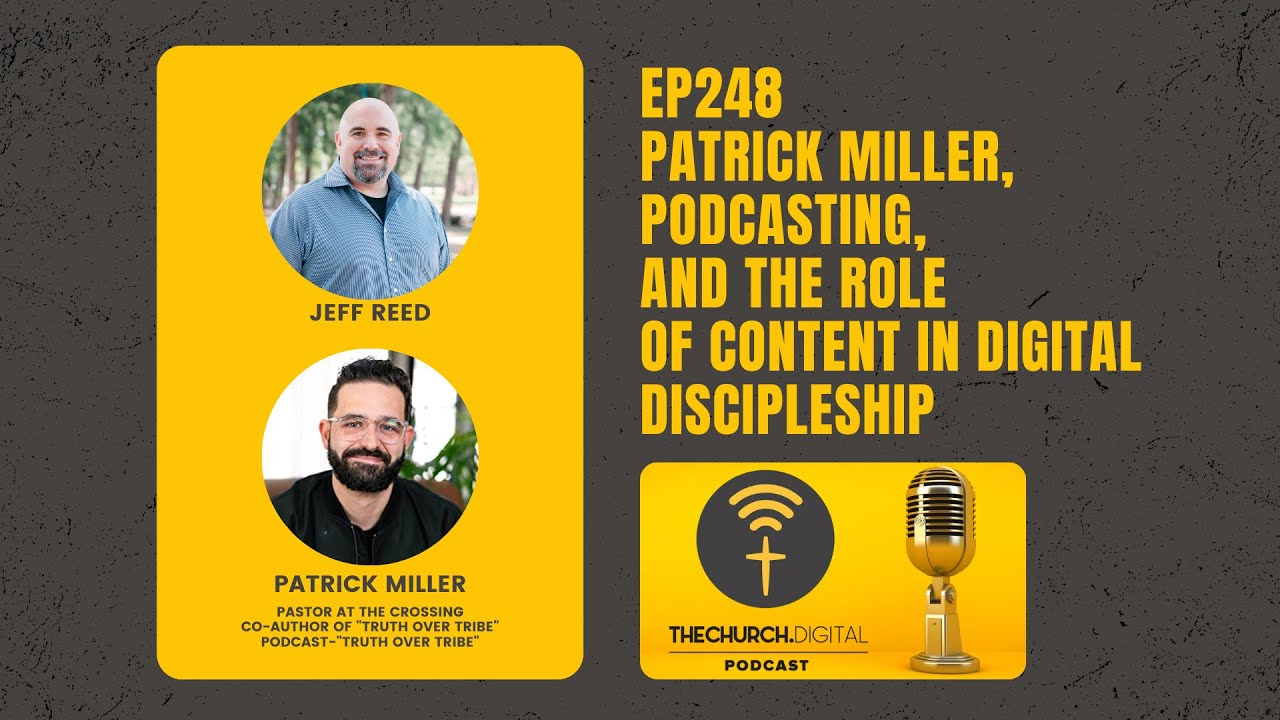
So hey, I want to bring into the conversation—and I joke this is going to be awesome—I'm bringing in Patrick Miller into the conversation. Patrick, thank you for joining us on the podcast today.
Thanks so much for having me. You know it's going to be good when a podcast starts with "I met a guy on Twitter."
Pretty much it just happens. It does happen. The people I meet on Twitter, those podcasts do typically end up being good, except for the one guy, but we're not going to talk about that one. Now you have to go back through all the episodes and find it yourself.
So hey, listen, Patrick wears a lot of different hats. He works with the Gospel Coalition. He is digital relationships pastor, among other things, with The Crossing Church in Missouri. And dude said something on Twitter and immediately I was like, "I want to talk to that guy." And so I want to unpack this. But before we get into the Twitter comment, can I say the tweets? I'm going to stick with it. Before we get into the tweet comment, um, Patrick said something. He just finished writing a book, "Truth Over Tribe," and so that published in October. Patrick, why don't you just briefly give us a synopsis of what the book is?
Yeah, so the book really has nothing to do with technology. There is one chapter though in it about Facebook and, well, I should say Meta and Google and how that's changed our political discourse. But the book in general is about how political division is dividing the church and that Jesus wants us to be united on what we share in common, which is of course his death and his resurrection. We don't argue in the book that there isn't a place for politics. We think that's part of loving your neighbor in the world. And yet we also think that the way we talk about politics has become incredibly toxic. And so we're—it's a really practical, conversational book trying to help people to detribalize, to leave behind their political ideological identities and instead focus, as the subtitle says, not giving your allegiance to the donkey or the elephant, but instead giving that deep allegiance to the Lamb.
It's interesting. I'm going to be completely honest: I am scared. I am like petrified about having political conversations in digital space. You just won't see me do it. And I love—I mean, I love the idea "Truth Over Tribe." You know, I've just, even in my own—this is my own personal theology, it's nothing to do with the Church Digital or anything else. It's just I really don't like getting into political conversations because, you know, especially in '22, '23, social media, I just have seen this explode where all of a sudden different people are arguing about different things and none of it has anything to do with the kingdom. And so like for me, politics almost feels like it's the great distraction of the 2020s where it's taking us away from maybe some of the things that God would rather us be.
So here I'm asking the author. I'm inviting the author into this conversation. Like, I want you to—whether it's helping me, correct me in this—but the question that I struggle with is I want to be a political—like, I almost don't want anything to do with that space, especially how it drips in the digital. So correct me here, guide me here, reshape me here. How? What do I need to do? Is it completely apolitical? Should I be more political? Like, help me understand what my role is.
Well, I have to say politics is subsuming everything. And so there's a lot of people out there who would suggest that if you want to be apolitical or if you want to avoid political conversations, there's something wrong with you, or maybe it's just because you're privileged and so your life's working out well and so you don't have to worry about things like politics. And well, I suppose there might be some good things to think about in that critique. I don't think that every person's call is to be highly engaged in politics and political discourse. And to be frank, I think the average American who's interested in politics isn't actually engaged in politics. They're engaged in political hobbyism. This is where you are focused on what's happening in the horse race in Washington DC. You're always, you know, what's happening on the federal level, but you aren't engaged on a local level. You aren't caring for the widow, for the refugee, for the homeless in your own local community. And I think that's where real politics actually happens because it's a place where you have the most influence.
Now, as far as talking about politics online goes, I do it all the time, so clearly I don't have a problem with doing it. But I don't expect everybody else to do that. I think there's a place for it and I think the manner in which we do it matters. God doesn't need a bunch of jerks for Jesus out there dunking on people on Twitter.
Jerks for Jesus dunking on people on Twitter? Oh my gosh. Okay, all right, so Patrick, um, that's a tattoo-worthy comment right there. I have this thing that with quotes—if quotes are so good, it's good enough that I would tattoo it on my body with the name of the person who said it. And you right now have made the short list: "Jerks for Jesus dumping on people on Twitter." So good.
Well, Patrick, thank you for that. Appreciate the heart and the correction.
Diving into this, okay, so let's get into what we want to talk about here because the conversation is centered around content and discipleship. He tweeted—we'll put a link in the show notes, by the way. This is like, I'm not going to read the whole series, but it was a series of tweets, maybe thirteen, fourteen deep. It's long-winded. It was good. But basically, discipleship—quote unquote—"This is one tweet: 'Discipleship is face to face correction.' Parts of discipleship. Our church produces 365 podcast episodes, 100 blog posts, 100 plus newsletters, 100 plus videos. It's changing lives and energizing discipleship in profound ways." And then it goes into a series to describe how he does it.
So what I found fascinating about this, and Patrick, what I want to dig into, is you're a disciple maker. You're a digital relationships guy. In so much of the world, when we talk about discipleship, we talk about it being relational. And actually, I was shocked when I saw the tweet talking about, "Hey, here's content that we use for discipleship," and then on top of that, the content has nothing to do with the Sunday morning sermon. It was kind of like the one-two punch that you're not just using a relationship, you're using content, and it's not Sunday morning content. It's other stuff.
So maybe start to unpack for me: what was the mindset? What was the genesis as you were creating this tweet and then the series of posts following?
Well, I think there's a lot of people out there who have a strong partition between what discipleship is and what you do online. And for them, discipleship is exclusively something that happens face to face. So maybe that's a Sunday morning worship at a church, maybe that's a small group, maybe that's a one-to-one meeting with someone. That's where they think discipleship takes place. And I think that those things are all important and they all do have a place, but I don't think that's the exclusive domain of discipleship. I think that discipleship is far more holistic and involves far more than just what happens in relationship with someone when you see them face to face.
By the way, I think part of this is ridiculous. So I think about my wife. Her closest friend and they all love Marco Polo. It's this little app where you take a video of yourself and you send it to someone, then they send one back. And it's almost kind of replaced phone conversations for millennials like me, especially women who want to see each other talking. And her closest friends—that's how they keep up. And she'll tell me all the time, she's like, "I know what's happening in their lives because of digital technology. It's not putting a barrier up in our relationship. It's deepening our relationship." And when we get together, it's not weird when we see one another. It doesn't create some bizarre dynamic like "I don't really know who you are."
And I think that you can draw that principle out in so many other digital spheres, whether it's text threads or you're engaging with on Twitter or Facebook. There's so many different places where we both build relationships but also, to the point of content, where we're deepening our understanding of Jesus and our love for him. And I think that if you think about discipleship as being holistic, you cannot exclusively put it into in-flesh meetings. And I don't think anyone is consistent with that. And I would sit down with them and I would challenge them: "Okay, put away your texts, put away your phone, stop using it because it all doesn't count anymore." You know, and they'd say, "Well, that's ridiculous." I go, "Yes, you're being ridiculous. That's why that's a problem."
It's beautiful.
Now, we've said the word "discipleship" I don't know fifteen times already in this conversation, so let's back up here a little bit because, you know, I have a running joke: if you line up ten pastors and ask them what discipleship is, you'll get like twelve different answers, different takes along the way. With that, so maybe help me here, right up front. Let's define: what do you define? What is your church? What is The Crossing define discipleship as?
Yeah, that's a great question. And when I...
Think about the gospel that is most about discipleship. I would go to the gospel of Matthew because it's somewhere where it shows a lot of the conversations that Jesus actually has with his disciples. And of course the gospel ends with him telling those disciples, "Go therefore and make disciples of the nations."
And that word, the Greek word, is "mathetes," which just means a learner. I would actually prefer the word "apprentice" personally over discipleship because that's what discipleship is all about. It's about apprenticing yourself to Jesus. And apprenticing yourself to Jesus is a holistic task. It means I learned to speak like Jesus. I learned to walk in the way of Jesus. I learned to have the practices of Jesus. I learned to think like Jesus. And there's so many different ways in our walk with Jesus that we're going to be discipled.
And again, I think digital has a place, especially when it comes to the learning aspect. Digital has a profound place in people's discipleship because here's the thing: if you're consuming podcasts or news shows consistently, they are discipling you. That's not neutral content. You are taking in information and it is shaping your view of the world. It's shaping your view of yourself. It's shaping your view of God. And if you're not taking in content that's helping you actually recalibrate yourself to Jesus, you're going to be discipled in a different direction. You'll begin to be apprenticed by Tucker Carlson or the New York Times or whatever it is that you are constantly taking in.
Well, let me ask this. Because when we talk about discipleship, you know, I read books like "The Other Half of Church" by Michael Hendricks and Jim Wilder. I don't know if you're familiar with that one. It's a book that came out maybe within the past year, but it dives into the brain science about how so much of what we're doing with discipleship, the content model, didn't work. And actually our brain operates more with it being in community. And that's where, like, I'm surprised at what I'm seeing. And even when you told me before the show, "Hey, my role is actually digital relationships guy." When your church is doing digital discipleship, what's the role of content? What's the role with relationships? Like, how do you get the balance? Is it fifty-fifty? Sixty-forty? Like, what does this thing operate between the content and the relationships?
Well, of course that's going to depend person to person and how they're engaging with what we're doing as a church. For better or for worse, I think most people approach the church as kind of consumeristically. You know, we come in asking, "What are the services that you have to offer me?" and "What on the menu am I going to try and taste?" And I don't think that's probably the best way to orient yourself towards church if we're going to be honest, but that's how the average person does it.
And so what we do as a church is we have all kinds of in-person opportunities for people to build relationships, whether that's through small groups or that's on Sunday mornings or elsewhere. And so we have those offerings. And yet on the other side, we realize that people are thinkers. And so that means that we do need to give them good content.
Now, part of what we do with content is start conversations. Because if you both listen to the same podcast or you both download the same video, now you have an opportunity to get together and dialogue about it and engage with it. And I think beyond that, on a digital level, we try to be really intentional about building relationships with our listeners online. So I have a lot of people who are engaging with the podcasts that I do who are talking to me on Twitter and we DM with one another. And I'm not saying that it's the exact same thing as being face to face with them, but in a lot of ways I've gotten to be a pastor to them.
I'd say probably once or twice a week I'm helping someone find a church in their local area because they haven't found a church to be connected to. I'm giving them advice on how to deal with a problem in their marriage. And that's all happening. That's all being mediated by digital technology. And so I don't think that content is everything. I think a content-exclusive model is always going to be a mistake. But I don't think that content is nothing.
It's interesting. You're literally producing a podcast episode every day of the year. Like, is that how I'm reading this? Three hundred sixty-five podcasts a year?
Yes, yes.
What? Help me map me out. Like, what is this stuff? Because I'm assuming there's nuances, there's contextualization, you're reaching different people. There's some strategy behind this. So walk me through, forty-thousand-foot level, what are y'all doing?
Yeah, so we didn't wake up one day and say, "Uh, let's have a podcast for every day of the year." It's not like the first ten minutes of the sermon just breaking it up piece by piece, right? There's got to be something more.
No. And to be honest with you, and we could have this conversation, I think that Sunday-morning-centric, sermon-centric digital ministries, in my view, make a slight mistake. But I'll set that aside for just a moment.
What we did was we started identifying needs in our congregation. So it started with realizing that we had a lot of people who wanted to spend time in the Bible but didn't know how to do it. They didn't know where to start. They didn't know how to apply it to their lives. We said, "Let's start a little podcast where we release two ten-minute devotionals on Bible passages, and we'll just go through books of the Bible and do little devotionals."
And slowly over time, we started adding in new hosts and adding in frequency. So that's one of our podcasts: ten-minute Bible talks. And it's been incredibly successful. I mean, there's, I think we average something like three hundred thousand downloads a month. And that's obviously across the country. We don't have that many people in our church.
But then we started identifying other needs. For example, we knew that there was a lot of women in their twenties in our church who were trying to navigate their early twenties. "I'm out of college. I'm working my first job. Maybe I just got married. How do I do this?" And so this is where you have to have the priesthood of all believers. We identified people in our church who were good communicators. They're not on staff. They're not pastors. They're just two women who love to talk about life and are deep thinkers. And we said, "Hey, why don't you put together a little podcast that deals with the topics that women in their twenties are asking?" And so that became another one.
Another one of our pastors is really into prayer and meditation, meditative prayer. And so again, we realize there's a lot of people struggling with anxiety and they're interested in meditation. So guess what we did? We started a podcast for that. We started one for our counseling ministry. We realized that politics and culture were an issue that people were being discipled by the news media. So we started one on that topic.
So what we essentially did, if you catch it, was we found needs. We came up with an idea to meet the need digitally in terms of content. And then we found and located people inside of our church who could speak to those needs. And then we began to produce the content.
So it's not as though there's one podcast with an episode coming out every day. No, we have a whole kind of backlog of podcasts that are doing different things for different people, that are speaking to different felt needs, that hopefully address where they're at in their walk with Jesus right now.
All right, do you have like more ideas? Are people coming to you with ideas? Like, how would a new podcast work? What would that process look like if you were doing something different?
Oh yeah, I mean, this definitely happens all the time. For example, we have another couple in our church who has a neighboring ministry. So these are people who are really intentional about getting to know their neighbors. They live in a suburb and kind of becoming a hub for relationship and community in their neighborhood. And so they've practiced this for years and they have an incredible talent for neighboring. They have all of these ideas and skills that they can teach people to do. They even wrote a book on the topic.
And so I was talking with them and they're again good communicators. I said, "You guys need to turn this thing into a podcast." So that's often how it goes: you're talking with someone, they already have the itch, they already have the need. I see a problem and it's right. That's that sweet spot when someone identifies a problem and they want to help fix the problem and solve the problem. That's exactly the kind of person who you can bring in and start having create content.
I mean, assuming that they're creative and good communicators—those are skills that have to be present for people to be able to do a podcast. But that's often how it goes: again, we find a problem, we find someone who has a heart for the problem and who has the right skills, and then we equip them. We know how to do it. We have the system down. So we make it super easy for these people. They just show up and do their thing and leave.
Yeah, I love this because you're finding people that are passionate about this and you're helping them develop a voice to multiply those ideas into others. Like, what? Let's just keep flowing here. Like, what training? So you've got a couple, maybe they're charismatic, you know, this neighboring group. Do they have they ever done anything with podcasts? Do they even know how to spell podcasts? Like, what are you helping them do to get started?
Yeah, so we have a pretty well-established process when we bring someone on with the idea of starting a podcast. We begin with what I call target personas. And this is pretty normal marketing speech. We identify and we literally create a little one-page document describing who their target listeners are. And we make them like real people. Like, this is Ben and this is Tom. And we describe where they're at in life, what they do, what their education is, what their fears are, what they're interested in, what questions they have.
And we do that because one of the hard things in a podcast is that it's a one-way conversation. And it's really important to keep the person that you're talking to in view, so that you're not just talking to yourself.
So we begin there. And once we have a target persona laid out, that's actually when we move more into kind of the titling and branding and brainstorming of what the different episodes could be. That's when we get into that phase of ideation. Because again, if you don't know who your audience is, your branding and everything you put together is not going to hit the right target.
And by the way, if your goal is just for you to become famous or celebrity, that's in my mind not very worthwhile. I'm not interested in it. If your goal is to help people, then I want to help you. And that's again why starting with the audience—you want to help people. So you got to start with them.
Once we get that down, we get them into our studio space now. But we haven't—I mean, this is brand new. So we've done this largely without having anywhere to record. But we just developed a really simple system for how people could record things. And what we actually have them do is record probably three or four test episodes. We tell them to send it out to kind of their key essential people, get feedback on it, and they use that feedback then to change the format of the podcast and frankly just to learn to figure out how do we talk on the podcast.
And those episodes never get released. It's just kind of practice. And of course I listen to those and I give them feedback and kind of help coach them. I mean, part of podcasting, and you know this, is your first one hundred episodes aren't going to be great.
That's not, that's not going to be your best. You get better over time. And so that's where we just try to coach people and help encourage them. And then on the back end, like we're really strategic about actually marketing these podcasts, making sure that people in our church know that they exist, making sure that people outside our church see that they're out there. And so that's kind of the whole package of what we do to go from idea to execution.
That's incredible. This I was not expecting this conversation coming out of this, but you're what you've done is, you know, we talk about here on the show a lot, the greatest resource the church has is literally sitting in the pews. We just got to figure out how to tap into it. And you're platforming others, helping them do what they feel like God is calling them to do, and multiplying those ideas into others so that other people within the church can follow suit.
How did you get there? Like, this is not something that happens quickly. There's multiple levels of culture here. One, you've got to be okay doing something other than Sunday morning. You've got to be okay empowering other people. You've got to be okay with failure or lack of connection or people walking away. Like, there's not your typical church that could pull some of this off. How did you get to this point?
Yeah, I mean, part of it is our church culture. We have a few values. One of them is agility—the ability to move swiftly in new things and accept change and to not be resistant to change. Another one is extreme ownership, which is the notion that when I'm doing something, I see myself as an owner of it. And that goes to our last value, which is excellence—doing things well, making sure that things are executed at a high level.
And so back in 2019, when we started our first podcast, I mean, we haven't been doing this for that long in terms of years. It was agility. It was saying, hey, we want to reach people in between Sundays. We don't want church to just be something that you show up for one day a week and then it checks out on you. It's almost a parish model. You know, back in the day, a pastor could walk around to people's houses and workplaces and check in on them. And that's when I see podcasts as it's kind of like a little parish where you get to be a part. And people tell me this all the time. Like, hey, I was out running on the trail yesterday listening to you, and that was a great episode. And that's a funny thing. Like, that's the relational side. Yes, I wasn't having a conversation with them, but they felt like I was. They feel like I'm a part of their life. And I want that. I think that's really lovely.
But again, we had agility, and then obviously COVID hit in 2020. And because our team had already been working on some of this digital stuff, we just as a church really reallocated resources and people so that we could focus more of our actual man hours on digital content. And that was a major shift. That was a financial shift. That was a big risk. But in the end, it's really paid off for us because we've realized that using this digital technology, we're able to reach a tremendous amount of people.
We just put a number on it. We lost about thirty percent of our church during COVID, which is pretty standard for most in-person churches. Since then, though, we've added an additional forty percent. And that's largely been through our online content, the stuff that we've used. And these are people in our local town. We're not in a big town. This is a town of one hundred fifty thousand people. But we've added an additional forty percent into our church. And a lot of these people are baby Christians. They're new to their faith. So it's a different kind of person, maybe, than that that left initially. But that to me, this is why it's so important because we're in a post-Christian culture.
And in a post-Christian culture, the expectation that someone's just going to walk inside your church and they've never done that before in their life—are you insane? Especially with social anxiety the way it is. Like, when's the last time you walked into a building that had some sort of participative element and you had never done it before? We don't do that. People don't go into spaces that they're uncomfortable with. And so again, we're just using digital as an on-ramp to becoming more connected to the church.
All right, so I'm actually one of my next questions was going to be the post-Christian because you mentioned that in the threat as well. It's interesting when I say things like the United States is in a post-Christian environment, that's next to churches operating a virtual reality. That's probably one of the more offensive things that I tend to say, just because people balk at that idea so much. But you, I mean, you're openly talking about that. Unpack that for me. Like, how? Why do you think the United States is currently operating post-Christian? And how does that, what are other examples of how that affects your ministry?
Yeah, I'll go so far to say I don't think it. I know it. So I'll offend people by making it a factual statement. We actually, as our digital team, funded the most expansive study of dechurching that's yet been done in the United States. There's a book that'll be coming out in a few years exploring this. But I'll give you the down low early on so your listeners are kind of getting in on a secret here. We are going through the largest religious shift in American history, period. And for the first time in American history, it's not a move toward the church. It's a move away from the church.
Something around forty percent of Americans who have previously been involved with church have dechurched over the last decade. In other words, they have stopped walking with Jesus. They've stopped connecting with their faith. They aren't doing anything Christian in their lives. Add to that that Gen Z, our youngest generation, the majority of them now have grown up outside of church. They haven't been to a church in their life. And that's because their parents were the ones dechurching. So their parents did church. They didn't take them to church. And so they have no church experience.
So we are now hitting the point where the majority of Americans really have no connection with church. Maybe they would self-identify as Christian, but again, the rise of the nones—N-O-N-E-S, not nuns—the rise of the nones tells us that this number of people who don't identify as anything. They're not atheists. They're not Christian. They're not Buddhist. It is the fastest growing demographic in America. And so by every statistical measure, Christianity is vastly shrinking.
And again, this is the largest religious shift in American history. So when I say that this is a post-Christian culture, I'm talking about a sociological fact, not my opinion of where we're at as a culture. I mean, you have a whole different conversation about how cultural mores around sex and sexuality and gender—I mean, there's so many other areas that we could get into to say, see, we're moving away from kind of a traditional Christian way of seeing the world.
Now, I'm not necessarily mourning that. It's not as though there's been a golden age in America where everybody was Christian and everything was right. You know, people look back in the fifties. Oh, that was great. I'm like, well, it's great if you weren't a Black person. I mean, there's never been a great time in American history to just be a Christian. But because people aren't used to being in church, it has to change how we engage them.
We aren't dealing with this. This is not Billy Graham doing a crusade to a bunch of people who've been in church their whole life. We are living in a different moment. So is your response then to empower individuals and lean more on individual personal evangelism? Is your response moving outside of the because you're a physical church, moving outside the physical church walls and moving more towards a community pastor instead of a campus pastor?
Like, I don't disagree with the words that you're saying, and it's interesting. I just read a stat something out of England. You know, we're doing this recording in December, in England, which is a post-Christian environment. There are more people that are going to pubs for Christmas Eve than are going to a Christmas Eve church service. So we're seeing what life looks like in post-Christian environments. We're seeing, hey, you know what, we're not that far away here in America. Maybe what's some practical pivots or things that you're wrestling with on doing ministry in post-Christian?
Yeah, I mean, again, I think the answer is going to be holistic. I think what you just said, that we're going to need community and we're going to need one-to-one evangelism, is a key critical factor in the conversation. But I think moving beyond just community, there's a place for digital. And that's the topic that we're talking about.
So I want to sit there for a second. Here's what's interesting about those dechurched people. The vast majority of them did not leave angry. They didn't leave because they stopped believing something. They just stopped. They just stopped showing up. And the vast majority of them are open to coming back to church. They're very open. They just need an invitation.
And I think this is where both the one and there's different scales of this. Like, there's some people it's going to take a lot of relationship before they will ever step into a church. There's also a different subset of people that it's not going to take a lot of relationship. They just need an invitation.
And to me, digital content is one of the best ways to invite people on two levels. One, if you're listening to digital content and there's someone you want to have come be a part of your church, it's a lot easier to send them a podcast or a video and say, hey, this made me think of you. I'd love to talk with you about it, than it is to say, hey, come with me on Sunday morning to church.
But number two, using marketing and, you know, essentially target audiences on Meta's platform and Google's platform, we've had them rather good at targeting people who aren't in church. And all we have to do is give them—we've used email marketing to do this as well—but we just have to give them a little bit of content that helps them warm up to us to where they're not even coming to our church, but they begin to think about us as, hey, this is someone who's adding to my life spiritually. This is someone who is kind of pastoring me right now. And that becomes the on-ramp down the road. Maybe it's a year later or two years later that they come.
In fact, using our email marketing, what we've discovered is about ten percent of the new contacts that we gather will show up in person in the next year. And so if we can gather a thousand contacts, one hundred people. Or this year we're going to gather around nine thousand contacts. That's about nine hundred new people that are in our church. And it's not anything fancy. We were just offering them devotions. We're just saying, hey, come back to God. Don't you miss this? Wasn't your life better when you're with Jesus? Here's something really simple and easy for you to read to do to reconnect with God. And again, that eventually leads them to walking inside those doors.
Yeah, and it's something that's, I mean, that's a low-tech solution, right? I mean, you're emailing a daily devotional through MailChimp or something. Well, this isn't TikTok. This isn't something crazy. And that's interesting. Ten percent, which is a low number maybe, but not, you know, like you said, nine thousand to get to nine hundred. Like, that's a significant footprint that you're able to move.
You know what I love, Patrick?
I love that you've got the stats that are backing up what you're doing. So many times you have these conversations like there's qualitative but not quantitative. We can tell the stories but we don't actually have the numbers that are matching it up. And you've got the numbers that are doing that. Is all this been within your, like you said, 2018, 2019? So three, four, five years? That's how long you guys have been pushing digital where you are?
Yeah, so you know, I started in college ministry, then transitioned to leading a 20s ministry that was primarily focused on getting people in their 20s into small groups. And that had about 500 people involved. It was doing well, but obviously I wanted to reach more people. And this is probably 2017-2018. And so I'm just thinking about millennials at the time and how do you reach millennials? And the answer is obvious: we need to reach them online. And so just as a part of that ministry, I started doing more online ministry and more online content. Like I said, we launched our first podcast in October of 2019. So not that long ago. Around that time, we made our first hire kind of in the digital space.
Now, again, COVID really changed everything for us because a lot of our jobs disappeared all of a sudden. While people were kind of living through the pandemic, there was no more in-person church. And when in-person church started back up, the church, because where agile, said, "Hey, we're actually going to keep you guys on this digital stuff because this is changing lives and it's drawing people to Jesus. And we're not going to pull you out and make you go back to what you were doing before."
Now, again, that's a cost. That's an investment. And we're a large church, so we have a little more freedom to make those kinds of decisions. But that's how it developed. It was just slowly over years trying strategies. And like you just said, we're very quantitative. We don't do things that are ineffective. So we've tried lots of ways of gathering content online. We just realized that email devotionals are by far the best one. They're really easy to do. There's nothing complicated about it. And we tried lots of complicated things. They didn't work. So we did think that works.
And you know, is that the great news? That it's easy. And podcasting is really similar. You know, people want to start a YouTube channel or do some video thing, but they have no videography experience. I'm like, "Why would you do that? You can just get behind a mic and no one has to see you. And you could reach thousands, tens of thousands, depending on your podcast, people with your content and help them draw closer to God."
That's fascinating. How do you know, as you've been developing all this stuff and developing the strategies, keep working the analytics, the measurements, trying different things, exploring different areas? How do you know if something's a win? Like, what are you looking for? How do you know if it's succeeding? Maybe what's an example of a failure? Something you tried and it didn't work? At what point did you pull the plug on it? Talk about some of these successes and failures with the processes you got.
Yeah, so you know, this has a lot to do with our digital team. We set what are called lag measures and lead measures. So lag measures are kind of your long-term goals. We want to have X, 100 thousand downloads, right? That's our long-term goal. Lead measures are more immediate-term goals that hopefully affect the lag measure in the long term. And so we run usually six-week campaigns. These are little six-week chunks where we'll focus on a theme. We'll have a particular target that we're trying to reach, and we'll have a short-term goal that we're trying to reach during that period.
For example, we might say, "Right now we're in the Christmas season, and so our goal is to get 3,000 people to subscribe to new contacts." So not total, just new contacts to subscribe to our Christmas newsletter, right? So that would be the goal. And then we create content, whether that's advertising content or blogs, that'll point to the devotional. We create content that points people in that direction so that they will sign up for the Christmas devotional. And that's how we evaluate: did something work or did something not work, right?
If we don't hit the goal of the target that we met, we can go back and evaluate: why didn't we hit it? Was this our fault, or was this just a bad idea to start with?
One great example of this for me—you said failures—you know, in kind of the inbound marketing world, there's the idea of dated content. So this will be like PDFs that are behind paywalls. Not literal paywalls—you're not paying money. You give your email contact and you get, you know, this three-page document on how to pray the Lord's Prayer. You know what we've discovered? The vast majority of gated content, free gated content, doesn't actually generate contacts. And you can spend a lot of work creating these documents and literally no one will use it.
And we had to discover that by repeatedly trying different ideas, different forms of gated content. We did things for parents and children. We did things for about every demographic you can imagine. And we just realized no one was interested. No one wanted to sign up for this. And the people who did sign up for it were people who were already consuming everything else that we did. So we weren't reaching new people with it.
And so again, that's just how we've evaluated. And my point here, by the way, is not to say that gated content is bad. I'm saying our team doesn't know how to do it. So we're not going to try to do it. We tried. We couldn't do it right. Your team might be great at gated content, and you might be able to make some amazing stuff. Awesome, good for you. But you have to evaluate what your skills are and where you can be successful. And the only way to do that is by measuring, setting goals, measuring success throughout, evaluating why you did or didn't reach that goal, and making sure those goals are towards your long-term ends of what you want to accomplish in this ministry.
This is beautiful. This is so good. By the way, gated content works for us. So once again, it's not the technique. There's plenty of other stuff that doesn't work for us. But we've had some success with the gated content piece.
Where are you going in 2023? Like, as you're looking at the future, where you're going? Is it more of the same? Is it adding new shows, new content? Is there a radical shift? Like, what's the future look like for you?
Well, that's a great question. We've kind of started an internal organization called Endeavor, which is not so much about helping people inside of our local church create content. It's about identifying great content creators outside of our church and equipping them to reach wider audiences. I call it the anti-celebrity model because our goal is actually not to make a bunch of famous people. Our goal is to make what I call middle-class creators—people who have a following of maybe five to ten thousand people.
Now, why I say that number is because I find that once you break the 10,000-person threshold, your ability to build relationships with your audience decreases dramatically. At about ten thousand people, you're going—most people aren't going to want to talk to you who are engaging with you. But you'll have a subset who really wants to have engagement, and you can keep up with it. You can be a presence in their life. And so we don't really want to go beyond that.
And so Endeavor, that's kind of our thing: finding these creators and helping them, whether it's starting new things or taking what they're already doing and leveling it up, reaching more people with it because it's great content. We want to help them reach more people. That's what we do there.
The name of the game, though, just to be frank with you, even this is a word to all people in churches: data is everything. The battle is not for who can produce the best podcast. The battle is not between Christian organizations. The battle is between us and Disney, us and the Fox News Network, us and the New York Times. These organizations have collected massive amounts of data on people. They know what they like. They know what they're watching. They know what they're engaging with. And they're using that. They're feeding that into AI, into algorithms, into nodes of connected machines, which will then target their content to the right person. And this is how they're growing their subscription audiences.
And so you have to understand that the most important asset you have as a podcaster or a church is your data. It's the information that you have on specific people. And if you can get good at collecting that data and cleaning up that data and using that data well so that you can target ads to those people inside your church using various ad platforms, you are going to have tremendous reach and tremendous success.
And so that's really one of our big focal points. We are constantly, constantly, constantly collecting data. We don't do it in unethical ways. We abide by all the standards. This is not kind of a no-holds-barred, take-whatever-you-can approach. That's not what we're trying to do at all. But that's where we're going. I mean, the next year is really the year of more data collection for us.
Yes, I want to come back to the data, but Endeavor—what's the end game? So you're helping to create mid-level influencers, helping them grow in their influence. Are you trying to get people into the church building to reconnect with them? Are you trying to drive people to an asynchronous community for ongoing discipleship or relationship? Like, what's the why behind Endeavor?
Well, I would want to say all of the above. Endeavor is at its heart a missional organization. We want to reach people who are far from God. So when we're thinking about the kinds of people that we want to bring in, we're looking for people who aren't just talking to Christians. They're talking about topics or issues that have kind of a Venn diagram overlap with the interests of non-Christians. And that's because, again, we believe that the internet is a mission field.
And so finding content creators who can cross the gap between Christian community and non-Christian communities is key to welcoming those people in.
To your question of what's the end goal, I want to say all of the above. We would love to see more asynchronous communities. To be perfectly frank, we've never had a great level of success developing those things. But we're also developing some technology and strategies for helping people connect into local churches who are listening. For example, in podcasting, there's now the ability to do geofencing, where you are targeting specific ads to specific geolocations. And so our hope is to partner with churches in major metropolitan areas and essentially advertise their church to anybody listening to our podcast in that metro area because we've connected with them, we know who they are, we trust the church, and we can send people that way.
And so, you know, those are just a handful of strategies. But that's our long-term goal: we want people who don't know Jesus to meet Jesus. And once they meet Jesus, we do want to help them move in the community. That's beautiful.
I mean, I say that's beautiful a lot. That's like my stall phrase while I try to imagine like whatever the next question is. I'm saying that's my knee-jerk. I'm going to confess right here on the show. But literally, the words that you're talking about in either connecting into physical space, connecting into an async or multiple asyncs, like that—this is incredible. This is what's it. There's a handful of churches, but by the way, Patrick, that are...
That are thinking the same way we did a podcast with Seacoast, um, man, maybe not that long ago, maybe a couple months at this point. I love this podcast. They literally listened to the twenty-year-old intern. The twenty-year-old intern came up with an idea: hey, let's start to what exactly what you said, let's start to find some mid-level influencers and connect them in, and they got like thousands of people now in an async, and they're trying to figure out how to disciple people in in Discord. I think they're in Discord. They were talking about moving into another platform, but it's beautiful to see churches that like yours that are not wanting to wrestle and explore a different idea. Like, I honestly, I could have, I like I want to bring it back and just have a whole conversation about what that looks like.
That's this is a new organization for you in twenty-three, something you're starting new. Um, so Never Endeavor launched, and let's see if I can get my dates right here, it launched in April of twenty twenty-one, so we're about a year and a half into the organization. Um, but we have a charter and we have a very well-laid plan for where we're going. So in terms of the actual part of bringing content creators in and helping them be successful, that's kind of the last step on the line. Um, we're very much in tool-building mode right now. We're developing the tools we need to help them be successful, and again, a huge part of that is data collection.
Awesome. So let's dig into the data piece. I because I could talk all day about the Endeavor, the data piece. Um, like, you know, I know Glue Insights was a thing, and they've paused that insights platform. Where are you pulling data from? This may be, this is like the advanced level conversation. We're going deep into here. Um, some of my audience is going to tap into this. Some of this are going to be like, no thank you. Um, but where are you pulling the data from when you're trying to figure out what's going on at the local level?
Yeah, that's a fantastic question. Um, so there's multiple sources, and let me just state this up front: I am not a data scientist. We have a data scientist on our team, okay? So if there are data scientists listening to this and I say something that sounds wrong, it's because I'm not the data scientist. My purview is a little bit higher level on it. So I understand how the system works. Um, we draw on data from multiple sources. We, for example, I already talked about our devotionals. One of the best ways that we draw on data is just by getting people's names and email addresses. That's our currency. That's our goal. The thing that we want more than anything else is your name and your email address.
Now, we have all of our websites integrated with HubSpot, but you can integrate them with really any CRM out there, so that we're able to track what people are looking at, viewing on our website, which of course then begins to give us a picture of who is this person, what are they interested in, what are the topics that they read, what are the things that they spend a lot of time on? And you can track those things on HubSpot and you can create tags, so that you're again essentially building a profile of who this individual is. And then you're able to take that contact information and plug it into Meta or into Google's ad platform, and you can, uh, you can't really do direct targeting to grab that person, but you can create what are called look-alike audiences.
So let's say we've got a pile of a thousand contacts who we know, because of what they've looked at, are highly interested in prayer. They're very interested in pieces on anxiety. They're very interested, um, in Bible studies on the Gospel of Mark. I don't know, like, let's just get a really narrow target. Well, we could then come up with a Gospel study on the Book of Mark that talks about prayers in Mark that focuses on anxiety, and we could create look-alike audiences and go reach more people who are just like them.
Now, if those are successful and those people click on the link and they go fill out the forms that they can get the devotional, well, now we've gotten their information. But because we know where they're coming from, we know what they looked at, we know what they want, they're kind of coming with a pre-built profile from that point. And now you're going to get the idea of data is a flywheel. The more it's, it's exponential in growth. When you only have a hundred contacts in your database, that's useful. It's not nearly as useful as a thousand, and that's not nearly as useful as ten thousand, because the more contacts you have, the more you can compare and cross-analyze those people, and the better picture you have of the kinds of people that you're bringing in. So that's where we're drawing in a lot of our data and information.
Yeah, so when we've gone from podcasting the content to data to async, this has been a really good conversation. You have not been a train wreck. This has been, you know, considering a stranger on Twitter, like, this has been a really good dive into the strategy that you guys are operating out of in Missouri. The look-alike audiences you're developing, do you limit, because you're a physical church, do you limit based on physical location? Do you do discipleship digitally outside of the physical reach of the church? Like, what's that limitation look like for you?
Yeah, I mean, it's that's going to be on a case-by-case basis. And uh, the kinds of content that we're getting inside of our city versus outside of our city is oftentimes going to look quite different. If you're inside of Columbia, Missouri, where we live, and we reach you, we want you to come to the Crossing. We want you to step inside our doors. If you're outside of Columbia, that's an expectation I can't have of you. You're not going to walk inside our doors. And yet that doesn't mean that this online content isn't going to be good for your walk with Jesus.
So when you think about those look-alike audiences, they're going to look different in a kind of local area than they do nationally, and we do both. I mean, we're reaching a national audience with our podcast and our content, and we also have a very local audience that we're reaching with it. But how we target them, the kinds of ads we create, they do look different.
This is great. So good, man. I feel like I could just go on and ask more and more, and we're going to bring you back to talk about the async thing because, um, that's that's just an area that I'm really intrigued by. But man, Patrick, thanks for thanks for being on here and thanks for starting to unpack some of this for us of the strategy centered on the role of content with discipleship. So, hey, as we're landing the plane here, any closing thoughts?
Oh, man. I I just want to say to your listeners and to you, I'm so grateful for Christians who are being creative and inventive. I think that's the spirit of, or the image of the Creator inside of us, to see problems and to create new ways to resolve those problems. Um, and when you look throughout the history of Christianity, um, even though right now we kind of have this Luddite fetish where we're resistant to technology and technology is bad and get it out of my house, I don't want anything to do with it, it's kind of the normal Christian response that hasn't always been the response historically.
I mean, Paul walked on roads made by Romans. That was a new technology. There was not a road network like what existed in Rome anywhere else in the world until the time of Rome. And of course, that was used to trade slaves and to move an Imperial War Machine, but Paul saw the possibility of the roads, which is, I can plant churches across the Mediterranean, and he walked on them. And whatever it was created for, he used them. And the same thing can be said about the printing press. The same thing can be said about radio and television with Billy Graham. These new technologies, they present incredible challenges that we do have to be serious and sober about and acknowledge. And yet on the flip side, I'm just encouraged by you and by people who are listening to this who say, you know what, though? Let's walk on the road. Let's use the printing press. Let's use the radio. God's spirit isn't limited to in-person networks. He can work through digital networks.
Yeah, so so good. You know, what's his name, Gutenberg, uh, was considered a heretic for creating the printing press because he put, um, you know, the scribes, the scribes were out of a job. And uh, and so there's several historical references to Gutenberg being the heretic for creating the thing that actually caused the, you know, one of, anyway, it's a whole well-documented in books and things, Industrial Revolution. So anyway, uh, thank you for this conversation, Patrick. It's been, it's been so, uh, we'll have to do it again, but uh, we're gonna wrap. And so for Patrick, this is Jeff with the Church Digital and Digital Church Network. Thanks for uh jumping on this podcast here. We'll see you next time on the show. Y'all have a good day.