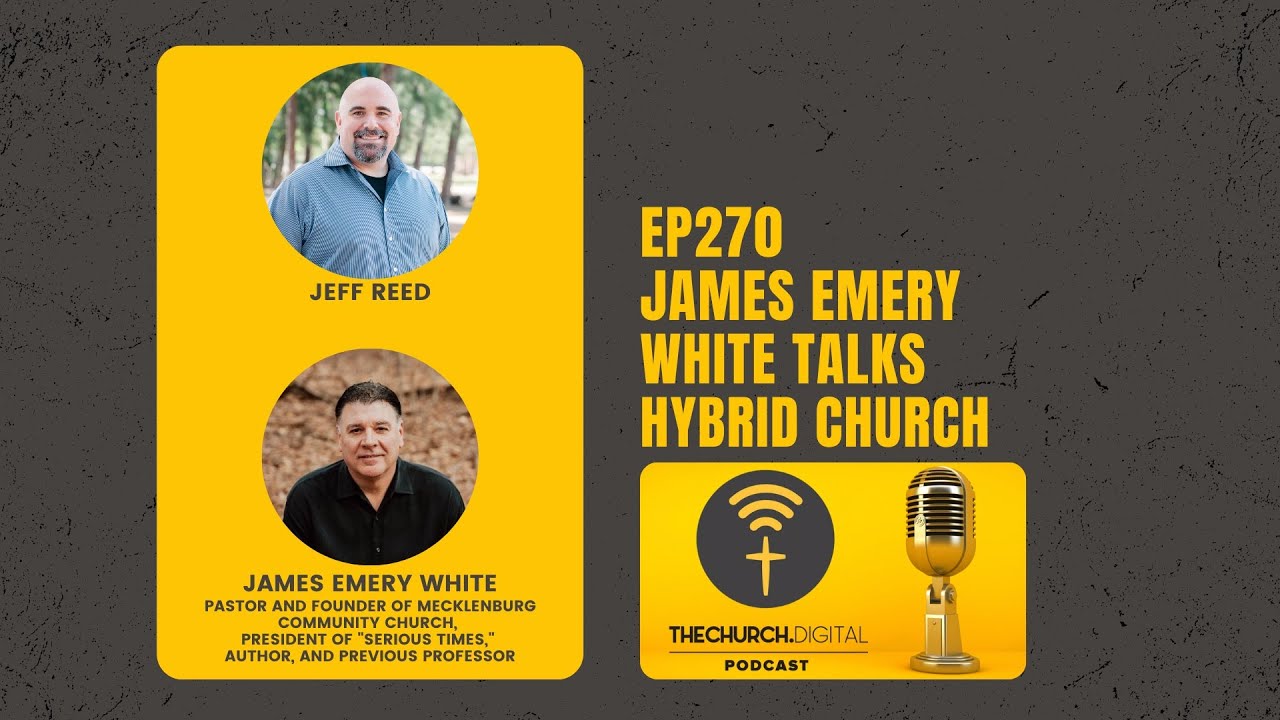
I’ve had a mutual respect for James Emery White for a while now. His church, Mecklenburg, has gotten some attention in recent years for abandoning their multisite strategy and instead focusing on their digital strategy. So, of course I feel a kindred spirit. Then he says…
Welcome to the Church Digital podcast. Through this podcast we'll talk about the technological innovations within the church, but more than tech itself, we'll address deeper questions. Is disciple making possible digitally? How should we approach the digital mission field? Can a biblically grounded church operate in digital space? And where does the metaverse fit into all this? Whether you're a big or small church, an established church or a startup church plant, the Church Digital's goal is to help churches like yours learn to be a multiplying church digitally and physically. Our heart is that churches like yours would discover a newfound focus on disciple making that will revolutionize your church.
And now here's your host, Jeff Reed.
Hey everybody, welcome to the Church Digital podcast. Jeff here, founder of the Church Digital and Digital Church Network, and I'm excited about today's conversation. We're digging in a little bit more on the physical side of church and what physical looks like in a hybrid environment. And so, you know, we talk a lot about digital church planting, better church planting, virtual reality, some of that bleeding edge stuff. And in today's conversation, I think it's going to be bleeding edge just in that it's a physical church that's doing something different with their digital strategy, and I cannot wait to get into this conversation.
Maybe a couple months ago, a book was published, "Hybrid Church," by James Emery White. And I'm very excited to get into this conversation with James today. James is lead pastor at Mecklenburg Church, and I'm gonna—James, I like, I wanna have this conversation with you right now because you and I are linked at the hip, and I don't even know if you realize this, but you and I may be the only two people in America who have used the word "phygital" in church in the same context in the same conversation. Like, most people are afraid of the word digital, but my first exposure to you was you were talking about digital pre-COVID and using that physical and digital as that term. Um, well, I'm just curious. Let's—because I don't know if you've experienced this, James—but I was mocked for using the word "phygital." People were like, "That sounds like a dirty word. That sounds like you're trying to kill somebody." Phygital. Like, there was definite mocking centered around the word "phygital." Did you experience anything like that?
No, because the term certainly wasn't original with me. It comes from the marketing world, in the business world, where it's very common and well understood. I think that in the business world it's a very, very common term.
Yeah, so evidently your friends respect you more than my friends do, which is probably very evident for many reasons. But yeah, so you don't use "phygital" anymore with your terms. You pivoted more towards "hybrid church." And so I'm really interested to get into hybrid, your book, and maybe some of the stuff you're doing with Mecklenburg. But let's start there. You're lead pastor with Mecklenburg. Tell us a little bit about yourself.
Well, the most important thing is I've got a lovely wife I've been married to for forty years, and I've got four children and fifteen grandchildren.
Wow.
And Mac is a church plant. I planted it. I had the privilege of doing that back in 1992, so we're a little over three decades into this. And the biggest headline probably about Mac is that we really are very focused on the unchurched. Seventy percent of our growth throughout all thirty years has come from people who are previously unchurched. And so we're very laser sharp in that aspect of our mission. So yeah, you know, it's a young church, almost entirely constituted of twenty and thirty-somethings. On the resident old guy.
Yeah, I gotta tell you, I was expecting somebody younger, not somebody with fifteen grandkids. And in a conversation you know, talking about hybrid church. And so that's intriguing in itself. Well, tell me a little bit about the book you wrote, "Hybrid Church."
Yeah, um, it has a thesis that, if you'll give me a moment to explain, I think will be important for it. Um, I've always had a foot in the church world and a foot in academia. And as a professor of theology and culture, one thing that has always intrigued me is the flow and the interplay of church and culture. And this book is a genesis of something that I believe is happening right now, which is only for the third time in Christian history, a shift in both our mission field and how we communicate to it.
Go back in time. There's only been three eras of the Christian church: pre-Christian, Christian, and now post-Christian. In the pre-Christian era, the mission field was obviously largely Jews, Judaizing Gentiles, and pagans. Form of communication to that mission field was largely oral in nature. Even when Paul would write a letter to, for example, the church of Corinth, it would be read to the church of Corinth as an oral event. And much of history was kept alive orally before it was written. And so you had a pre-Christian world that was the mission field and an oral form of communication.
Well, fast forward. You can largely point to the time of the conversion of Constantine, but you had certainly around that time the shift from a pre-Christian world to a Christian world. And that was the nature of the mission field. And you also had a change in how communication took place. It went from oral to written, and then later to mechanized writing, and that dominated culture for over a thousand years.
And then in our day, what is happening right now is, for only the third time, we have a new mission field and we have a new way of communicating with it. The mission field has gone from pre-Christian to Christian to now post-Christian. And the way of communicating with it has gone from oral to written to now digital. And this is a significant revolution. This is a significant shift. And I'm not convinced that the average church or church leader is aware of just how significant this shift is, how deep of a paradigm shift it is. Even though that phrase is often misused, here is a time where it is appropriate. This is a paradigm shift—change in our mission field and how we communicate with that mission field.
And so it calls for a different model church. I argue that the first era was Church 1.0. In the last thousand or so years, been Church 2.0. And now we have to have Church 3.0. And I'm arguing that that is going to be a hybrid model. I think that's the best term—not solely physical, not solely digital, but a hybrid of the two going forward. And that is going to be everything. And the book explores this model. It makes the case for the changes and then explores what that would be like in a working model, which we at Mac have been about now for at least, well, in one form or another longer than this, but in full effort for about five years.
Yeah, that's when Mecklenburg first came on my radar. It was pre-COVID. And so as you're talking about, and I believe I was—funny, I was trying to remember if it was a secular posting or if it was ChurchLeaders.com—but I distinctly remember reading an article, pre-COVID, about how your church was abandoning the multi-site strategy and pivoting more towards digital. And this is well before the pandemic. So like, yeah.
Yeah, it was. And we were, I guess, maybe the first or one of the first large churches that was multi-site and been successful with multi-site, and that purposefully ended it. And the reason was fairly simple for us, really. And as I've explained it, I think it has resonated, and more and more churches are considering something similar. But here is our thinking.
We got into the multi-site approach purely for the mission, purely for evangelism and outreach. And it was never to make Mac more convenient to attend for our existing attenders. It was always to make it easier to invite our unchurched friends to overcome the perceived geographic barrier. People used to talk about a fifteen-minute barrier. And so you needed to have physical sites to invite people to throughout the city you're trying to reach because people psychologically wouldn't attend. But here's what we found.
When the world changed—and it changed—and I would argue, and I have argued in the book, and I'm not the first to do it, that really the digital revolution, though it began much sooner than that, really kicked in culturally in 2007. From 2007 forward, when the world changed, then all of a sudden everything about the multi-site model, which actually is a fairly dated model—I mean, some of the earliest books about it came out in the 1980s, so it's not like a cutting edge thing—but when the digital revolution took place, you were dealing with this physical multi-site approach. What you had is you had a physical approach in a digital world. Even worse, you had a physical response to a digital demand.
We were finding that when people invited their friends, it was intuitive for them to invite them to check us out online or to attend an online campus. It wasn't to attend a physical campus. And that was what people naturally wanted to do anyway. They weren't going to just attend a physical campus. They were going to explore things online. And so geography was just no longer the outreach issue. It wasn't the barrier to remove. We had a digital barrier. We didn't have a geographic barrier. And it was a digital site, if you will, that we needed to build, not a physical site that would facilitate this.
And then also, once someone's hooked on, say, a church or something of that nature, doing whatever it takes to connect with it in a physical way, in an embodied way, if they felt so led, was no longer a barrier. People will drive quite some distance if they want to attend, for example, a church service. That's what the multi-site model is based on, quite frankly. You already had a core of people, maybe two or three hundred people, attending thirty or forty minutes away. And so the multi-site model itself was built on the reality that if people are fans, geography isn't that big of an issue.
So we shut down our sites, which were doing well, but they were expensive. And we made the decision to put all that money—I mean, physical sites, a multi-site model—we don't talk about this very much. It's extraordinarily expensive model, which is fine if it's missional, it's fine if it's effective. But we were looking at what we could do with even half that money digitally in terms of reaching people, and it just made us want to throw up in a corner.
And so we closed down our sites very strategically at a certain point in time and pivoted and put those resources and more into our online campus and staffing that as a full campus and other digital marketing and so many other things that we were doing, making our main eighty-acre campus much more of a digital model and much more easy to be engaged digitally. And we made that shift, and I kid you not, almost overnight the increase in our size was dramatic. We increased in attendance both online and in person and never looked back.
And so when the pandemic hit, we looked a lot smarter than we were. But we were, you know, full going and we had made that digital hybrid pivot. And so even though there were challenges that every church faced, us included, with the pandemic, we were outliers in that during that time we thrived, quite frankly. Financially we thrived. Numerically we grew faster and larger than ever, reached more people than ever. And when we did...
Have you even during full shutdowns select embodied events they were the largest embodied events we'd ever had. Um, and turn people away. I mean, we were capping events at ten thousand people because we couldn't have more than ten thousand at a time. So it was, it was a so yeah, so the decision to move from multi-site to much more of an intentional hybrid model and realizing that what this hype with the multi-site model was trying to overcome was best overcome digitally. The challenge was best met digitally for us has been, you know, a game changer. And I make the case in the book that I really do think that this is the way for all churches. And I don't, I don't, and I don't say that in an arrogant way because there's all kinds of ways to be hybrid. So it doesn't have to look like Mac, but I think hybrid is the way for all churches because it is a reality that the digital revolution has taken place. It is the way we communicate. It is the way you interact with our mission field. And so if you're not going to be hybrid, you're going to be painfully irrelevant, removed from missional effectiveness.
Yeah, I mean, obviously I mean you're saying missional over and over again. It's interesting. There's another church, um, Church Home from the other coast over in California. Mark Minty, executive pastor over there, is a good friend, and he talks about how you can spend millions of dollars to reach thousands of people in the building, or you can spend thousands of dollars online to reach millions of people online. And they have had a different strategy. I would probably suggest and what you're doing, but once again, it's tapping into the mission field that exists in digital space. And so both of your churches are very missional with that view. Um, and there's a lot of churches that do have a missional view, and in twenty twenty-three it's so important to utilize digital for that. Um, but I'm curious just to pull the thread here a little bit. Does digital, like aside from the mission, or getting into more of the discipleship, more of the relational, helping people grow deeper once they are connected into the church, does digital play a role in that at Mecklenburg? What does that look like?
Oh my gosh, it's everything. Yeah, I mean, when a hybrid model is, you're hybrid through and through. And all the hybrid is is that you're both physical and digital. You're both embodied and online. And it's kind of, and often you're both. And in fact, the typical person at Mac is both. They're engaging the church in both ways. And depending on any given week and on any given issue. So that's what a hybrid is. It's bringing both together. It's not solely one or the other. And that's where a lot of people, I think, make, um, uh, draw some erroneous conclusions because they just instantly hear digital, digital, digital, and you can't do this digital, or if it's all digital, that isn't church. And I keep saying, whoa, I chose my terms very carefully. Hybrid, a combination, a blending of the digital and the physical. And when it comes to something like community or discipleship, you hear people say all the time, well, you can't do, can't you do community online? You can't, you can't, can't do church online. And I, and I really bristle at that. And I, and I hope that I explain that carefully in the book why that's not a carefully awarded or thought through statement. You can, in fact, if you talk to someone, say you're talking to a twenty-year-old, and you're fear to tell them you can't have community online, they would just simply say, well, I'm sorry, you can, and I do. And studies have shown that there's some aspects of that community they can even be deeper than what it was experienced prior to that embodied. And so I think some of this is we build theological fences around our personal taste. And so if you don't like to read a book on Kindle, you all of a sudden are anti-that being a legitimate way of reading. And that goes throughout so many different areas of life when it comes to the digital. And so, uh, and I don't think that's a merely a generational thing. I've seen people in their thirties just as resistant to some things out of personal sensibilities as someone in their seventies. And so I just think we just all have to be very careful with that.
At Mac, discipleship is strategically served by all things digital. I mean, because really the heart of what the digital revolution allows is an entirely new approach to delivery and engagement. And so we have the bulk of our classes and courses are online, if not on demand, or a blend of live and online. For example, we just did, I'll give an example like, um, uh, we have this thing called the Mac Institute, which is like a community college vibe dynamic to our church. And, um, I recently did a Systematic Theology class. My PhDs in Systematic Theology. I was a professor of theology and seminary president. And so I have that background. So anyway, I was teaching in my wheelhouse of systematic theology. And the way we did it was that I pre-recorded a dozen lectures that were edited and, and then made, you know, with nice overlays and other things. And so that it was a good consumable content that way. Production is produced with post-production qualities, things. And then we had a large Zoom class. And, uh, I think it was about two hundred, two hundred fifty students. And, uh, and so they with a live host and they were live coming in for this lunchtime lecture. And then there was that interaction and live element. And then they showed my lecture. And then when that was over, I came on live for Q and A. And it was this wonderful blend. And you know, people gathering in Starbucks and other places all over. And you know, for this class. And that was, um, we got more people through Systematic Theology through an online course like that than we ever would have had if we would have had it, you know, Thursday night at seven o'clock for ten weeks. So it's delivery systems. Um, and also the building of community is much the same way. I mean, we're very intentional about fostering online community, um, largely beginning through our online campus. And we could talk about what an online campus is. It's very different than just a Facebook feed. So it's a real campus. I mean, it's an actual staff campus with service times and everything else. So and, um, and we were, we've been told we're among the first to offer a full online campus. We were doing that for years prior to even our digital switch.
Let's ask the question. Let's dig into that. So what makes, what makes a campus a campus? An online campus a campus at Mac?
Yeah, I mean, what most churches do, which I applaud, is some type of Facebook feed, some type of live stream, and or they just tape it and, uh, whatever they did on the weekend and slap it on YouTube for just people to just watch whenever they want. An online campus is just that. It's a campus just like ourselves. We say we kind of joke we're still multi-sited. We just have one that's physical and one that's digital. The digital and online campus is a time with select, very clear service times, pastors hosting it and other guests and guest services and greeters in the chat room and such. It's a, it's, um, it's designed for to be an event. And, uh, I'd encourage people to go check it out at mecklenburg.org and they can see what an online campus looks like and feels like. It's very different. It's very interactive, very engaging. You're showing up for an event, a service. Um, and people are building community through in the chat room. They can go offline and having prayer time with pastors. They can, so it's a live interactive thing, um, involving thousands and thousands of people. Um, and, um, it has its own kind of unique community environment. We have people like there's a group of thirty or forty that gather around it at one office bank office building here. There's another group of seventeen that meet every Sunday at Starbucks. It started with, and most of them still aren't Christians. Um, and, um, and on and on it goes. So it's creating its own, their own groups, their own little gatherings around it. But obviously the average person is a single there's an attender or a family. But it's an actual campus. And every, all the content is curated for online consumption. It's not something that's just a taped weekend service. I have a separate taping of my talk for the online campus with that that is presented, uh, for an online audience. And that does change how you present because you're not talking to thousands. You're talking to one, maybe two. Um, what our arts team does in terms of worship and other creative elements is completely filmed and created and curated and crafted separately from anything we do on the weekend. Announcements, everything about that, the online campus is developed, curated for online consumption through the online campus. And, um, and, uh, and it's extraordinarily effective.
Is your staffing for it, for this, like, like producing it? It's funny you mentioned the first thing you said is like we got pastors together. Are those physical pastors that are praying online? Are you staffing pastors?
Yeah, yeah, yeah, yeah, it's all live. Yeah, I mean, these are, I mean, we have, um, pastors and staff populating the chat room present for every one of the online campus services. Uh, volunteers, tech, uh, folk, uh, people like when you go into the chat room from our campus, you'll say hi, somebody will be there, say hey, I'm Pastor Robbie. If you want to talk or pray, we can go to a private area. And other people say hi, I'm the tech coordinator for this service. You running any problems? Let me know. And you've got a host and guest services team and everything else in there. And so we'll probably have at least, I don't know, maybe half a dozen staff minimum staffing every online campus service.
Forgive me, I didn't ask the right question. What I was trying to get into was, are your staff exclusive for online or are you sharing responsibilities, physical and online church?
Some are. Can you detail like some of who's exclusive for online? What roles or what roles are shared? Do you know?
Well, I mean, our director of our online campus who heads it all up is fully exclusively for that. We have a producer, a host, someone who is the main anchor for all that who's totally dedicated to the online campus. We have, um, now our production folk and our creative team and our graphic arts and videographers and such work across the board. But there are some that are more dedicated to online campus consumption than others. And so we're a large staff. So I probably wouldn't be the right one to ask how exactly like met creative how they've divided up all their responsibilities or how, you know, the production team has done that. But, um, but I do, we do have, you know, some staff completely devoted to the online campus. And, uh, but everybody there isn't anyone. And this may be really where you were going. There isn't anyone on our team that isn't somehow engaged in serving, producing, facilitating, uh, the hybrid model, which means not simply the physical but the digital as well.
Does this drip down the kids and students? Uh, Gen Z, Gen A?
Like, oh yeah, yeah, yeah, yeah, we have full, our full Met Kids, Met Kids is fully online as well. And so that you can engage on any given week whether if you want to, if you come to a physical, uh, campus, physical service for Met Kids, if not, you can engage it entirely online as well with material there and content and a full program, if you will. That's one of our real commitments is that everything that we offer, we're committed to a digital counterpart, a digital reflection. And if there's something we're offering digitally, we try to think through how can we offer that physically? But we're more concerned about making sure that what's physical gets digital because not everything that's digital can go physical.
I mean you have much more opportunities and much more freedom, much more creativity when with the digital. But they don't often—that doesn't often work that way. I mean, sometimes we just simply say, okay, this is simply an embodied experience and it's we really can't have a digital counterpart to it. And sometimes it's vice versa. So we're very clear about that. And even then we try to make it hybrid. Like, for example, we have an eighty acre campus here and we have this thing called the Mecca Trail, which is a one mile nature outdoor chapel kind of vibe with benches by a running stream and select, you know, scriptures tastefully put. It's a place where people just come and walk and sit and think and reflect and get away from the world and immerse themselves. And you feel like you're in the mountains away a thousand miles from any city.
So one of the things that we did—and we've done several things on the Mecca Trail—but besides just leaving it open as a chapel year round, but for example, on Good Friday we had the fourteen Stations of the Cross throughout the one mile loop. And then you could download through the Mecca app a program that would take you through it like a museum guide and stop you at each one of the stations. And you could pause, go further, do anything you wanted to do to the degree that you wanted to with the content and create this very spiritual experience of walking through the fourteen stations with the history, the biblical background stories, and you know, thousands of people went through that and just on their own. We just said, okay, then Friday, just it's gonna be open from nine to five. You know, take, bring your app and your earpods and come, go through it.
And so you can—it's easy to blend those things too. Is what you're describing is blend. It's a great word. You're blending the physical and the digital. You're, you know, whether the digital term—it doesn't matter if I buy the rake at Home Depot or homedepot.com. The rake is still the rake and I use it the same way and I can intersperse. I can return it online if I bought it physically and things like that.
Yeah, and again, we probably use the word "phygital" and I use the word "phygital" in the book and I explain it. But I use it in more the, you know, for me—and it doesn't mean this is right—a hybrid for me is a large umbrella term for this model. Phygital is what you do with your building and your campus and that's kind of the way that it's used in many business circles, meaning there's a seamless integration between technology when you interact with them physically. So when I can put in my order and go pick it up at the store, or what I see online is what's going to be like it in the store, and if I go in the store I can then just whip out my phone and I can do this or I scan that QR code. Or I can—there's this, like, the building itself, everything about it, it's very much like the way airports are. Um, before I get to the airport I've already onboarded. I've already gotten my boarding pass. I've already let them know I'm coming. I may have already secured my parking space all through my phone, all through an app. And then I'm able to seamlessly walk through with my phone to physically get my boarding pass, scan to get through security, which also gives them my TSA. And so far as I'm doing this physical act, but it's completely integrated with technology. And that's really what you're after with a digital church building where you have everything. Where I'm on my way to church and I've ordered—I've got coffee waiting for me at the bookstore that I've already pre-ordered and it's there. And I've checked my kids into children's ministry. And when I'm in the service I'm looking at the notes on the app that go along with the talk as well as where I can go further with it and maybe a class that I can register and go ahead and shoot that off. And maybe I'm shooting off a prayer request as well. And there's this seamless integration between the physical and the digital with that.
And we've found that's critical because we reach people first online, largely through our online campus and digital marketing. And so if and when they ever do come to the physical campus, we want there to be an absolute seamless integration between what they've already experienced and done and how they've engaged with us digitally. And so that's just thinking it through.
Beautiful. You know what, to be honest, I may adapt. I like that digital approach. Um, in that terminology, I may adapt. I may steal that. I'll give you credit the first couple times. And you wrote it in the book, so you get credit for that publicly, I'm sure.
Um, do you have people at Mecca or Mecca Online—Mecca, the hybrid campus, the online campus—that aren't physical? Like, do you reach different states, time zones, countries, continents? Like, what's the reach of this thing and what does it look like pastoring and shepherding people long distance?
Yeah, we really don't try to have it be beyond a tool for us as a local church to reach our immediate community. Um, it—we do have on any given weekend our online campus is attracting almost every state in the United States and probably an additional fifteen, twenty countries or more on just any given service. But seventy or more of attenders at our online campus are in the Charlotte area. And for us that's a win. That's what we're after.
Um, because I do think there are some significant theological questions related to ecclesiology and the role of the pastor for the digital church and a larger reach and how that begins to manifest itself, which we can talk about if you want. But for us it's very much—we have a large reach, but our mindset is local, very strongly local. And again, it's all designed for outreach. And so we, but yes, we're reaching people all over. And like I said, seventy percent of our growth comes from people who are previously unchurched, which includes online. It's, I mean, when you go into the chat room on any service and there's—you're gonna throw a rock and you're going to hit an unchurched person and somebody's not a Christian and they'll tell you they're not a Christian. They're much more open online.
Well, let's go ahead and poke the bear a little bit here and maybe be respectful. For because there are a lot of digital pastors and planters that are on here. And by the way, you need to know that like my approach towards a digital church planting and what we promote through Digital Church Network and the Church Digital is far more relational. It's much more like a probably like a micro-church approach of utilizing digital. And so it's building on those relationships and more discipleship-centric and heavy. But you know, I've had plenty of people on here that disagree with me and have had some hard conversations. And we wear big boy pants and so it's okay.
Um, so I like—I would love—what can you do? What would be the issue? What would be the challenge where what's the obstacle in reaching somebody and discipling somebody, I don't know, in California, in Eastern Europe, like somewhere that's not geographically centric? What are you sensitive to theologically, ecclesiology in that standpoint?
What I'm sensitive to is not so much, you know, are there challenges of reaching someone digitally for Christ? I think that's how you're going to need to reach them. Or even discipling them digitally? I think discipleship is significantly going to increasingly be digital in nature. All education is. I mean, that's just simply the delivery system. And I make a strong—I hope I make a strong case for this. I mean, if the people who read Hybrid Church are the ones that are going to be made uncomfortable or the ones who are not particularly open to digital things, so. But here's the theologian in me. Um, it's not so much problems with evangelism or discipleship digitally. The concern that I have is being the church in the fullest biblical sense and theological sense. The doctrine of ecclesiology is one that many Christians, certainly evangelical Christians, but Christians as a whole have really dismissed and have not been careful with. And they've made ecclesiology just whatever they wanted to be in their own image. And there's much more in the scriptures and in church history than that, I would say.
And so I think it's more or less, how do you pastor? How do you function as a biblical community? What does need to be embodied? And when there is a need for embodiment, um, then how do you do that? Like, there was an author—the author's name is—he wrote Sapiens, a very famous book. Um, the author's name is—or Sapiens, I'm sorry. But anyway, he was saying that the challenge for the online world is that he said, you know, if I'm sick in London and I've got a cold, you know, you can express concern for me, you can check up on me, we can talk to each other, but you can't bring me a bowl of soup. And so there's limits to sometimes embodiment. And when there is a need for embodiment and when there's a need for the practice of presence, as Douglas Steere would talk about—the great Quaker writer—or when, um, and we are physical creatures, and so I do think that what we need to wrestle with—and it doesn't matter how we come out, we'll come out with different answers—but what we need to wrestle with as thoughtful, thinking, biblical Christians, I would argue, is what is optimal in terms of embodied, what is just as fine if not better digital, and when can it be both, depending upon someone's personal tastes and sensibilities.
And so as a pastor you do have to ask yourself, okay, are all the "one anothers" possible digitally? I would argue the vast majority, if not most, are. But it's a good question, you know. Um, we do the Lord's Supper online. Does that work for baptism? Um, and if you're going to have somebody be baptized and not baptize themselves, if there's going to be public profession of faith, and how are you working those things? They're going to be ways of solving this, but I mean, we have to wrestle with solving it in a way that's biblical and theological. And so that's what I mean. So what does it mean to be the church? And how? And so I personally don't know that Mecca could be the church fully for someone who never could do anything of an embodied nature. Um, I'm not. At least I would be concerned about them because I would at least want them to try to get connected with people in that area for embodied community when they need it, you know, um, even if it's something as simple as someone who can stand with them by their side at a funeral.
And you know, you bring up a lot of great questions. Um, and there are people that are, and for the most part, I want to just say I agree with you. Like, there are people that um that need the physicality. And by the way, there are digital churches that meet physically periodically. Uh, it's not necessarily weekly. Uh, I can tell you Cornerstone VR, Cornerstone Yuba City, uh, they fly in people from the virtual reality campus once a year and they do a family reunion in San Francisco, Northern California area, and it's an incredible experience. They're actually talking about doing the next family reunion in London because they've got a lot of—
Of London and England people that attended the virtual reality church. And so physicality, there's options. You know, I wrote this in your book that we're talking about, Hybrid Church. But the book that I wrote, Sharing Jesus Online, we talk a lot about serving people. And it's interesting, you're nobody. You can't. Digital church can't serve a coffee or serve, would you say, chili soup? And that's funny because when I had COVID, actually I had people sending me Gatorade and my favorite candy via Uber Eats. People I've never met were sending me things to encourage me. As a matter of fact, a percentage of the bobbleheads that are behind me, I actually have no idea where they came from. They just show up at my house because people send me random things to encourage me. And so it's reimagining some things, whether that's, you know, it's funny. James, I literally tell this to people all the time. I will stand before God one day, and my opening question is, "What did I get right and what did I get wrong?" And I'm sorry for what I got wrong, because I know that we're reimagining some things in this.
Yeah, well, it's that season, Jeff. And I think we're all doing it. And I would rather, you know, it's I'd rather the church kind of be pulled back a little bit if it goes too far than always having to be pushed to try to get going. And then, you know, if it's reaching people, my default mode is to like it. If it's connecting people to Jesus, my default mode is to like it. And I think that with all things hybrid and digital right now, it's going to be a little theologically messy at times because we're thinking through things that we don't have historical precedent for. You know, we can't go to Origen or to Augustine or Barth or Bruner to give us insight into some of the questions that we're raising here. But that's also what's exciting about it and wonderful about it. We can go to Elon Musk, but how much do we really trust Elon Musk to speak into this stuff? But I, you know, I mean, I love the challenge of this, and I think that in concert with you, I think that we need to be aggressive in our embrace of all things digital. What are you guys doing? Is metaverse? Is virtual reality? Is this on your radar? Like, what's your opinion or take on this?
Well, it is obviously. I think it's been interesting to see how that, like, one news cycle, it's the next big thing. The next news cycle, it's oddly absent. And it's like, I think everybody's trying to figure out exactly, is this going to be the next huge thing, or is it gonna be something that people dabble with and say, "I'm not sure that's my cup of tea"? The, I think everybody needs to have their eye on it. I think every church should, if they can, experiment with it and see, you know, look at it through a missional lens and see if it has potential. I do have some questions about what, how much a virtual act should replace an embodied act, and what that means for spiritual formation as well as what God actually is asking us to do. I don't agree. I do have problems with virtual baptisms because I don't think that really is a public profession of faith. You're, when it's your avatar doing it but not you, I think that's a that's tricky theological waters, and I think that we need to go very slowly there. And so I do think there are some things that, those are the kinds of questions we need to be wrestling with.
By the way, the people that are even doing the work in virtual reality, that are in that metaverse mission field, most of them would agree with you, or at least they're asking the same questions. Where I don't know that I'm comfortable with that, probably the most controversial thing I've ever said in my life is virtual reality baptism. At least according to my YouTube comments and the negativity surrounding that. So definitely understand the controversial nature of that. The opportunities for evangelism, the opportunities to have conversations with people without getting f-bombed, because I mean, some of these worlds, literally, this technology is designed to connect people together in a virtual environment for a conversation. Like, that's what virtual reality is meant to do. And so the ability to represent Jesus, to champion that idea in these mission fields, is incredible. And oh, I totally agree. And in that sense, I don't think there's any barriers, any hindrances, anything that we need to be pulling back from, and using the metaverse for that or anything else. Again, it's kind of going back to what we talked about earlier. How far do we go with that? Like, do we create an entire virtual church and have many of the acts be simply virtual? Like, even the Lord's Supper? Do you simply have that taken virtually, or is there something biblically and theologically? No, you physically have to take that. That's part of the body and the blood of Christ. And so you have these things that were, that, um, where I think people who are evangelistic animals, which it sounds like you are as much of one as I am, but if you're an evangelistic animal, it's like, "Okay, I'm not gonna let my evangelistic zeal blind me to what happens maybe after someone has become a Christian and what is best in terms of that and next steps." And I would argue, as you would imagine, that whatever happens after that is probably going to have some dynamic of a hybrid nature to it.
Yeah, and so it's interesting. Like, I can actually tell you stories of people that have accepted Christ in virtual reality. And that the church that, um, that one person, these are two separate stories. One person got baptized, and the avatar went under the water. Other people saw. But the virtual reality church said, "Hey, why don't you go to a local church and get baptized?" And so this is a true story, I promise. This girl went to a local church here in America and had a conversation with the pastor about getting baptized. The pastor said, "What actually happened to you?" And the girl described to the pastor what the baptism process, the conversations, everything. And literally, this physical pastor at this small town church, I forget what state, said, "We don't need to baptize you again. You're already baptized, but you did count it." Now, that was his take. I get it. There's another story of a girl, another girl. This girl's in England who accepted Christ, and the church encouraged her in virtual reality. The church encouraged her, "Hey, why don't you go to a physical church?" And so this girl, twenty-four years old, went to four different churches over the span of six weeks. And according to her, no physical person in the physical church said one word to her. Now, she's a little bit of a wallflower. I honestly can understand from the church context how this probably could have happened. It's not okay, but it's almost understandable because she's so socially awkward as an individual. And so, you know, even at the physical churches, there's challenges with some of these things. And so she feels pressure. I want to go back to my virtual reality friends because I wasn't able to make physical friends in that space.
And see, and see, and see, I would not like, for example, just to be clear, if someone is attending Mac through the online campus, we don't say, "Hey, the goal is when you get to the physical, okay?" We don't. We actually say, "No, no, we say we're very content with you to be online if that's how you choose to engage and attend. That's fine." But you know, that doesn't mean there aren't steps that you can take toward whether it's membership or discipleship or community, and much of which, if not all of that, can be done online. But what we're very content for someone to say, "I attend online. That's Mac. I attend online." We're very comfortable with that. But see, here's what's different about a hybrid model. The hybrid model is able to say to that person, "Hey, when and if you ever have an embodied need, when and if you need a physical touch, when we're here, there's a community of people here that is not simply digital but is also embodied." And we found it really interesting. We have people that will attend online, they'll come to a physical campus and say, "Oh, I don't like that as much. I'm back online." And we're saying, "That's fine. We're not after that. But we want you to feel comfortable with that. We want you to take advantage of everything we have to offer you as a church, both digital and physical." And it's interesting that people love that hybrid nature where they, and most people are largely physical or largely digital, but they love the freedom when they can swing to the other side.
So yeah, for physical churches that are listening to this conversation, what he just said is gold. Like, I think having the hybrid approach where physical people can connect, digital people can engage physical and get the embodiment access. And so this is what you built Hybrid Church around. And so I would love for anybody listening, we'll put the link in the show notes. Download it or buy it from Amazon.com or churchandculture.org. But I did want to bounce this idea off you, and I didn't know I was going to have this conversation with you walking in. We're actually getting ready to launch season five of the Church Digital podcast next week. So this is a teaser even for this. But what we're talking about doing there is taking digital ministry or metaverse ministry even to the next level. We're doing a learning community with Leadership Network in the fall. Leadership Network Exponential. Are you familiar? Okay. And so I work with Leadership Network as their digital and metaverse guy. And so with this learning community, we're helping churches go on a metaverse mission trip. We're helping churches get exposure to virtual reality to the community and engaging in that mission field. Our hope is to get two hundred fifty people here through Leadership Network. We're also working with GACX, which is Campus Crusade globally, for international mission partners, but empowering two hundred fifty people through a number of churches to go on metaverse mission trips and start to explore the idea of these communities and what church would look like in that space. And so we'd love to invite Meck into this. As forward-facing as you are in digital, giving you a space and an opportunity to explore that. We can talk off air on that. But just as I was not expecting in you, um, and provide grace for this comment, I was not expecting in you the missional nature. I've lead pastors often. You're a former multi-site church, so it makes sense. But like, this was a surprise how you're recognizing so much of the mission field digitally because oftentimes lead pastors of large churches, transparently, don't. And so I really respect that. And I would love to take Mecklenburg through this journey, start to explore, and maybe even help to see you start to wrestle with some of this stuff. Plus, I would love to be proven wrong. And so somebody like you to really come through and hammer this and make these ideas better would be really exciting to me if you were interested. We can talk off air on that. So thank you.
Hey, as we're landing the plane here, any closing thoughts?
No, I hope people will give the book a read if they're interested in this. We, you know, I have sections on the metaverse and other.
Things, but it's a cultural tour as well as a practical tour that kind of is what I try to do is to, you know, hear the signs of the times and here's how we should live. And so, and it has really two angles to it. It's not just a digital revolution, but the new post-Christian world and the challenges that brings to bear for the mission. And so it gives equal treatment to that because it is the reason that the digital revolution is so important is because it's the way to communicate to this new mission field, which is the post-Christian world. And understanding the nature of that post-Christian world is as important as being adept at all things digital. So it brings all that together. So I hope people will give it a glance, and if something that they feel would serve the wider church, that they would share with others.
Beautiful. So check out Hybrid Church, the book, Amazon, or churchandculture.org. More information I will put the link in the show notes. James Emery White, thank you very much. It's been a pleasure to have you on the podcast, and would love to do it again sometime as the book expands or as more things expand in the life of Beltline Church. But for James, this is Jeffrey, the Church Digital, Digital Church Network, Leadership Network, and a whole bunch of other fun stuff. Thanks for jumping on the podcast here, and you'll have a good day. Talk to you later.