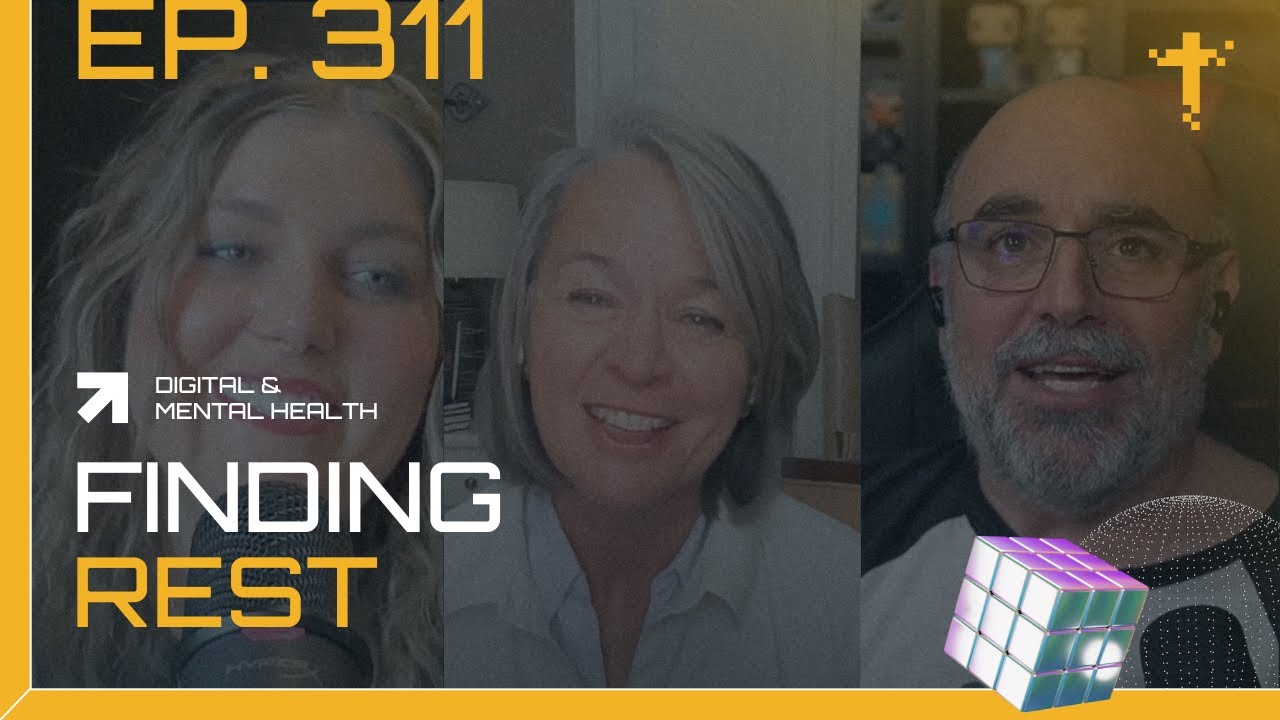
Productivity becomes an idol. Explore the need for rest, not fake rest, in a world obsessed with productivity. Leaders face huge challenges during transitions, often getting stuck because of egos, fears, and past investments. Rest isn't just a luxury; it's crucial for…
I think there's an idolatry to our productivity when we're weak, when we're tired, we start looking for hits, you know, almost like an addictive language it could use. We start looking for hits to feel better. A lot of the public acclaim and the productivity that comes with the wins of our leadership can become quite addictive.
Welcome to the Church Digital Podcast. Through this podcast we'll talk about the technological innovations within the church, but more than tech for tech's sake, we'll address deeper questions. Is discipleship making possible digitally? How should we approach the digital mission field? Can a biblically grounded church operate in digital space? And where does the metaverse and artificial intelligence fit into all of this? Whether you're a big or small church, the Church Digital's goal is to help churches like yours learn to be a multiplying church digitally and physically. And now here's your host, Jeff Reed.
All right, hey everybody. Welcome to the Church Digital. We are doing a live recording here. We're in the middle of—oh, that's right. I'm doing this on YouTube as well. I forgot that we're broadcasting this live on Twitch. Little screen popped up here on Riverside that said don't forget about YouTube. And so hey, we're doing this live on Twitch and on YouTube at the same time. And so, but here on the Church Digital, we're in the middle of season nine. Uh, is it season? Crap, I did it again. I always forget the numbers. I had an executive pastor told me one time. He's like, "Jeff, never forget your numbers." And, um, yeah, I forget the numbers all the time. But I know this is episode 311 of the Church Digital Podcast. And we're doing a season here in digital and mental health, and I am excited. I am excited about this conversation because every time we bring this guest on, um, it is informative. It is heartwarming. It is challenging. And this is like, we're talking off air, it's like one of my favorite people. And so right off the bat, let's just bring on Mindy Caliguire to the conversation. Mindy, how are you, my friend?
Jeff, I'm good today. I'm doing really well.
Oh my gosh, it has been way too long. And I am so glad to have you on this podcast and looking forward to the conversation we're going to get into the digital mental health. And I want to talk about rest and founder of SoulCare.com. I mean, you are so good in this space. And I'm so in need of this at a personal level. But before we get into that, you've got a book like coming out next week or something?
It is a week from today. It's so exciting.
Yeah, yeah, I'm very, very excited about it. Tell me about it. Ignite Your Soul. Give us a give us an inside scoop.
Yeah, yeah, it is. And I do have one here I can show you because the pre-ones came in. Ignite Your Soul is the main idea, and the subtitle is significant as well. The subtitle is "When Exhaustion, Isolation, and Burnout Light a Path to Flourishing." And what's really kind of sweet about this whole book is that it emerges out of two parts of my own personal story, and they get kind of woven together. And then introduce a path for people who might similarly have been in seasons of exhaustion, isolation, or burnout. And the two parts of my story is, um, one was the burnout that, you know, I had experienced so many years ago that was the whole genesis of my discovery of Soul Care, very unexpectedly and very transformationally. So there's my sort of journey in the past, but it gets woven together, Jeff, with the story of those fires that ripped through Boulder County about two and a half years ago and the land we have, our property—you've been out there—that had was so badly damaged. And the various lessons that emerged for us and for guests at the ranch as a result of those fires and how beauty has really been coming from ashes. So it's, uh, we're really excited about it. I have not had a new book in over eleven years, so this is really special to me. And it's really been fun to see the synthesis of so many important ideas that I've been working with for so long, but brought into just a really current, contemporary issue. And I'm sure you see the same thing everywhere I go. The organizations we serve, the topic of burnout is just everywhere. And you know, I'm not a clinical psychologist—uh, you always wanted to make me one, I think, but I'm just not. I'm just an ordinary woman. But, um, these, and as important as that is, this stuff is accessible and available, and people, no matter what their circumstances are, no matter how hard it is, can take steps toward flourishing, um, right where they are. So we're really excited to get this message out.
Yeah, so Ignite Your Soul comes out on, uh, on a week from yesterday, so Monday the 10th? Oh, is Monday the 10th? Is what? I don't even know what today is. Today is Tuesday? No, uh, so comes out Tuesday the 10th? Wednesday the 11th? What day did you say?
Yeah, Tuesday the 10th.
Tuesday the 10th. Okay, so this is going to straight go on demand on Monday the 9th. So like, if you're listening to the podcast either way, tomorrow or whatever it comes out, um, live or on demand, it's so asynchronous. It's just crazy. But, uh, where do they get it? I mean, Amazon, Barnes & Noble? Your website? Where?
Both of them. All three of those. They can go to SoulCare.com and you'll see, you know, easy access to it there. Uh, if you do purchase it before the 10th, um, please go ahead and fill out the form on our website because the publisher is giving away the free audiobook to anybody who fills out that form.
So I got to read it. Have you ever done that with one of your books?
I did not. I was about to ask. Is it your voice?
It is. I got to read it. It was really fun, uh, very moving actually, and I loved it.
Yeah, as you were reading it, you know, because like, I with the books that I wrote, like I would read it like literally on an airplane just kind of reading through, and you know, I found myself I had to like say, "I am not editing this book anymore," because it's just like, were you second-guessing like your sentences or wanting to make changes as you were reading it out loud? I feel like that would drive me nuts.
That would drive me nuts. And ordinarily that does happen. But I think credit to the editing process that we went through, like, because there was a lot of, like, because that's how I edit is when I read something I kind of hear it in my head, and then that doesn't match what's written in front of me, and then I have to make it match what I hear in my head. That never happened, Jeff. I loved it. I felt like, "Oh, I can't wait to ship this out into the world. This is timely. This is—" Yeah, I felt really encouraged by it actually.
Yeah, it was fun. Very cool. Well, Ignite Your Soul, we'll put a link in the show notes, and you can get more information on Amazon, Mindy Caliguire, and some of her other books. It's been a season. There was what, two or three, I think, that you had written previously, right?
Yeah, there were four little ones that I wrote within Varsity Press. So that was, um, Discovering Soul Care, and then a couple core spiritual practices. So was Discovering Soul Care, Spiritual Friendship, Soul Searching, and Simplicity. So those were four. And then I did one, was an, uh, for church leaders called Stir, and it was an acronym for Spiritual Transformation in Relationships.
So I don't think I knew about that one.
Inter, it was the one strategic book that I wrote. Like, if you want Christ to be formed in people in your context—which heads up, we assume that's what everybody wants in the church. If not, there may be a problem. Well, it's usually not explicitly stated quite like that. So how do you, um, see your pathway? Everybody's figuring not discipleship pathways and stuff like that, and those are good, but people sit in front of whiteboards and talk for days and days and fight about things. But like the right? Am I right? Megan's nodding her. Oh yeah, oh yeah. So a discipleship pathway is really important because people need clarity. Like, where am I and what's my next step? Those are like some really important things to be able to shepherd people well. And what I find is people—again, this is my context. I'm not saying it's true everywhere. I'm sure there are many exceptions—but people over-index on what content people need to understand. What being a disciple is, and that's first of all not how we learn, and second of all not what we're supposed to do. Jesus didn't say, "Go and make disciples, teach them everything I told you." No, "teach them to obey everything I commanded you," which is an entirely different thing than just teach them what I told you. And so there is a pathway I still believe that is informed by the data we've seen with Reveal, the spiritual formation movement, and a whole lifelong journey that doesn't sort of ever arrive. So those were three big ideas that I was trying to pull together in this prior book anyway. I shouldn't be talking about the prior book, but that's the one I did. Uh, then it's good. It's a good book for those who are like leading systems, leading small group systems, who really care about strategy. Um, that might be a good book. But Ignite Your Soul, people, now that's where we're focused.
Obedience-based discipleship over instructional-based? I mean, that's a whole other conversation. We've had that several times here on the podcast as well. But oh, totally. Oh, that's a conversation for a different day. But hey, you're right. Let's get into the podcast. By the way, we've got a handful of people that are watching us on Twitch right now, and so, uh, you know, can see Melanie on there as well and some others are hanging out. But, uh, and so questions, if you're watching chat, uh, if you're watching on Twitch live, uh, feel free to throw them in chat and engage with us along the way. But, uh, here with the season, uh, like I said, we're digging into digital and mental health. And Megan Carter, uh, has been the brainchild—I did it again. I don't even know what that means. She's been brain. Every time she's been the brains of this. And you know, I'm basically the lack of brains, uh, which makes me the child, uh, in this conversation. Uh, but, uh, Megan has really done a great job of figuring out topics and questions and diving into this, which really just makes me the pretty face, uh, in this equation, which is fine with me. And so, um, Megan, what are we talking about in this episode here this week?
Yeah, so today we're going to talk about finding rest in an exhausting world, which we all live in. There we all know that we go at like a hundred miles an hour, and it doesn't feel like you can stop to find rest. So that's why I think it's so important that we're talking about this today. Um, so I'm really excited to kind of dive in and maybe define what rest really is, talk through that, um, and then what different ways maybe some practical tips along the way we can get there to find some rest. And I think it's really cool because people will find it in a different way. So we can talk about that too. So I'm really excited to kind of dive into that. Jump in. She's ready. I'm ready.
All right, um, Mindy, uh, how do you define rest?
How do I define it? I define rest, um, as sort of it's opposite. It's not pushing forward. Something it's not driving. It's not achieving. It's not those things. And when I think of rest, it's you truly have taken your foot off the gas pedal. You are able to enjoy, able to receive. Now, for many of us, ideally we can still enjoy, we can be present even in the midst of our doing. So I don't want to—
To juxtapose those things with work versus rest, I think it's possible to find ways of work that are not crushing. But when I think about rest, it's you take your foot off the gas. I'm doing things that are restorative, things that are full of delight and some fun.
That rest is also essential. I think of rest as something that is like physically your body. Like when your body is sleeping is part of rest, and we are way sleep deprived as a general culture. And it's sometimes even lauded in Christian leadership, and it's like we should not be giving bonus points for sleep deprivation. This is not the way God made us to function best. Now I think there are ways of resting that are wakeful resting, but let's make sure we include sleep as a piece of that because your body was designed to rest. What are you gonna show us, Jeff? You get a little prop.
So I had an executive pastor give me this book, yep, "Sleeping with Your Smartphone," and advised me to adopt its styles and its practice in my ministry. So this was 2015, maybe summer 2015. So what you're saying is that sleeping with my smartphone is probably not a good idea?
I wouldn't recommend it. Okay, I just, I literally keep that book around just as a reminder. Sorry, go ahead.
I was in South Florida with something connected to the church United guys that we've talked about before, or we were talking about earlier, and they had a neuropsychologist come in and do an evening gathering. I don't know if you were in the room, but there were maybe fifteen people in a beautiful home somewhere in South Florida, which there's a lot of, and this gentleman is a strong believer, strong man of great faith, and he sees the whole world of the brain and sleep and how your brain functions through the lens of God as Creator and the one who has put these systems into place. And the things I heard that man say that night, I mean, completely started to change my behaviors with bedtime routines, with notifications, with blue light, with all these different things that I was relatively unaware of. And I think most of us are.
I ended up hiring him and they did all the wiring your brain thing, and like, oh, it was great. And it proved what I suspected was that I had massive levels of fatigue that could be seen in the readouts. And I'm functioning. I was working on the executive team at Glue. I'm running whatever Soul Care was at that time, like I, and a full life of kids and marriage and all that stuff. And I needed some support. And one of the first sort of low-hanging fruit things was you got to wrap your head around sleep. And I, there's a whole book, "Sleep Smarter," I think is the book I bought. Yeah, it might be around here, but since those fires I have no idea where my library is on any given day. So the fires in Boulder. But yeah, it's a good one.
So rest, back to rest. We are wired to need rest. And some people talk about the brain like it functions in the third shift, like the factory, or your whole body actually functions this way. That like the daytime hours you got the first shift, you got the second shift, and those are all about productivity, but the third shift is the cleanup crew. And it's literally while you're sleeping that your body is regenerating, is restoring, is healing. And yeah, it's a good thing. So I would define rest in all those ways.
That's awesome. I love that. And I think that is something that a lot of people don't talk about. Is like, we all, you hear all the time, especially like fitness stuff or whatever, is like your morning routine is so important, and they hit so heavily on that. It's like you're like going to bed. Like bedtime routine is just as important to find the balance between both those that you can fully get rest. And yeah, sleeping is amazing, but there's other ways to find rest too. And I think we'll dive into that.
I find it really interesting, and I know that I do this a lot and I have to catch myself, is like fake resting. Um, is what I like to call it. Because I think that I'm resting. I'm like, I'm to take, like, say, you know, yesterday it was Labor Day for us and we take the day off. But like, that wasn't restful because like I had my daughter's birthday, we ran around, we did all these things. Or even if you're at home, you're like, if you're like me, a perfectionist, where I'm like, see something, I'm like, oh, those blankets need to be folded, or oh, this needs to be done, or the dishwasher or the laundry. And so by the time I get to the end of the day, like I've done all these things, I'm like, man, why am I so tired? Today was supposed to be restful. So I really would love to like hear your just insight into how do you know when you're truly resting or when it's kind of this, just you think you're resting, that fake resting type feel?
Yeah, I think you just know in your spirit. You know you're cheating it. You know you're cheating yourself. You know you keep making up excuses. Um, I, yeah, I think that's you, and you know, over time, because you start to be really resentful. I'll speak for myself. I get super resentful if I don't ever take time to really rest because then I've taken on the perfectionism. Like, take just one of the things you just mentioned, the perfectionism. Yeah, I mean, it's just like you cannot live under that, and there is, it is never done. It is never. There's always another project. And so I think in order to actually experience rest, and I like juxtaposing it with fake rest, I think that's a really good call out. Um, you do have to come to the point where you're okay with things not being okay, and for a higher goal, for a higher purpose. It's like the law of diminishing returns. Like you keep doing fake rest, fake rest, fake rest, fake rest, and eventually your actual things that you are responsible for and things that do really matter also start to suffer.
Um, there's this great, I'm sure you're both familiar with this and probably everybody listening is, but there's this great line of thinking that C.S. Lewis introduced in one of his essays called "God on the Dock," I think is the name of it. And in it he talks about the difference between, he calls first order things and second order things. And first order things are the things that are of most importance. And you know, we might say like rest or soul care or you know, a holistic vision of your life. And second order things are still important, but they might be your job or the dishes and the laundry and the blankets folded and all that other stuff. And Lewis argues in it, and he gives some really beautiful examples, which I'm blanking on all of them at the moment, but some really beautiful examples of how if you confuse which are first order things and which are second order things and start treating second order things as though they are first order things, um, the real loss, the real, and the insight that he brought is that if you put second order things first, um, well, let's put it the other way. If you put first order things first, then you get both first and second things. But if you put second things first, you don't just lose first things. If you put second things first, you lose both first and second things. Does that make sense? I don't know if I'm repeating it exactly rightly, but here's the basic idea. You put rest as a priority, you get rest and folded blankets at the right time and a birthday party at the right time and other things. If you put blankets, birthday party, the ten next emails that need to get written back, you know, um, if you put those things first and ignore this, over time you could, you will lose both first and second things. You'll lose the capacity to answer ten emails well, and no blankets get folded. Not to be light about it, I mean, these are much more serious issues that we're actually talking about.
I think I could just sit here and listen to you just talk the whole time. I tell you, I mean, that's so true, Megan. It'll be way more fun if we keep talking together. I'm enjoying it now. I'm like, I really need to get your book so I can listen to it. I love audiobooks, so just to hear you. Yeah, definitely have to do that.
Well, um, Mindy, I got to tell you, um, you know, with some of the health issues and the things over the past year, um, my, uh, my attitude and my philosophy has changed in a big way. Like I used to be the guy that would be up till one, two, three o'clock in the morning without going to bed, um, not able to sleep, constantly working, very workaholic approach in what I was doing. And um, you know, at this point I'm still actually awake at three in the morning, but what happens is I go to bed like at eight or nine at night, and I'll sleep from like eight to one, eight to two. Like last night I went to bed at nine o'clock and I woke up at two in the morning, and I was up from, for some reason I'm up at two to five. Watching last night I was actually watching M*A*S*H reruns, if you must know, on TV on, um, on Disney Plus because Disney Plus now has Hulu. And so that was what I did from the hours of two to five. Hawkeye is just hilarious. And then I would, and then I went back to sleep from about five to seven, and then got up and did my day. Um, and so like I'm finding, and I don't know if that's rest or if that's fake rest, willing to have that conversation with you. And then, and then my, but my wife is, is like, you know, it's funny. Uh, it was I think it was Friday night, maybe it was Saturday night, one night this weekend. I literally was like, it was seven fifty, and I was like, all right, I think I got to go to bed. And a lot of it's my medicine just knocks me out, you know? And it's like, well, if I'm tired, I got to sleep, because if I don't sleep, then I'm not going to sleep later. And so it's like, if I'm sleeping, let me take advantage of it and knock out. And uh, and she looks at me, she's like, it's not even eight o'clock. And I was like, I'm sorry, I just got to sleep. And uh, and there was, it was really interesting, like the idea of fake rest and whether that's helpful or not. Like I'm getting the hours. Uh, it doesn't align in my, my kids are teenagers at this point. Like they're staying up to eleven or twelve. Like they're starting to adapt my life, my lifestyle. My wife is starting to adapt my old lifestyle. Like it used to be I used to be a workaholic and everybody was like, what are you doing staying up so late? Now everybody else is staying up late doing the workaholic lifestyle, and I'm the one like, all right, I'm going to bed, see y'all later, and knocking out. I don't know, like, what does this mean? Like, what do you recommend? What are your thoughts kind of hearing me in this story?
Um, I will go on record of saying in my non-clinical opinion, re M*A*S*H reruns is not rest in the middle of the night. Okay? And but what I think is, uh, quoting from this book that I read, um, there are apparently four golden hours in the night that if your brain gets these four hours, uh, it actually does much of the necessary work. And then anything you get beyond those four bonus hours, it's like that gets you back up to level. And the next four of an optimal eight is what gets you in a performance zone. Okay? So the golden hours, according to this author, and he's very well researched, is um, ten till two. So ten p.m. till two a.m. is a really vital. And I had never heard that until I read his book, that those hours are of particular importance. So when you report that you go to bed at eight, you get up at two, you are actually hitting those significant hours. Yay!
I tell you what, one of the things that I've gotten mad about, which who doesn't love a good streaming binge, what you're what is going on in your brain from all that stimulation is actually very difficult for your body to recover from. And it is, uh, there's blue light stimulation that is telling your brain wake up, wake up, wake up, wake up, wake up. It's daytime, daytime.
Daytime and yeah, even putting a screen or a filter, a color filter over it when you're watching during certain hours is said to help improve what it does to your brain. The others, we're just so addicted to our dopamine and it's like, "I want more, I want more, I want more." And who wouldn't be? It's like, of course we are. It's, you know, anyway, those things are wired to keep you watching. And at some point you get a little feisty. It's like, "Wait, I did not surrender my intelligence and my next week of life to you, Netflix or Hulu or whomever you are."
Now, again, Jeff, I love—I love, trust me, I love this stuff. And if we want to do a little sidebar on favorite shows to deep dive into, I'm happy to. But guard your brain. Like, I worked with um, Ben Ceris up at Mountain Christian Church a couple years ago and did some weekend services with him. He was doing a whole series on different practices. And I'm sure I don't know if this one came in on rest or not, but he had a brilliant pastor, brilliant construct for the whole message series. And we did a little riff on the brain. And I was like, "Here's the deal: basically every single one of us have as our brain like a freaking Lamborghini. Like, you have got like the most powerful thing in biology sits in your skull, okay? It is brilliant. It has capacities that you have not even dreamed of."
And I think part of why I hired that neuropsychologist that year is because that January 1st, as I was going into New Year's resolutions and stuff like that, I was coming to—you know, we've all heard the data: "Oh, you only use like 85% of your brain or whatever." And I'm like, "That's a travesty. Like, I want to know what—like, what if I could harness—I don't know, 30% of my brain instead of 50%? 15%?" Like, I actually—the statistic is the other way around. I don't know what I said, but the data is that like you're only using like 15% of your actual capacity. And it's like, "Well, could I double that? It's still not even half, but could I at least double it? Like, how could I better steward and—" And then there you have this idea that like, how you've got this really powerful engine inside, but you're driving it like a beat-up VW. Like, what? How do you? How do we better steward the biology that is the basis of what we bring to the world?
But we're so—I love all these chat messages in here, by the way, about first order and second order and rest is reward. Maybe I am highly distractible here, but I'm loving them. And it's like, "Don't we want to care more about actually living into what we could, what we could be and what we could become?" Like, I get very curious about what that could be.
Yeah, I mean, I definitely feel like I—and I speak for me, but I'll also speak for a lot of the people that are watching this podcast—are type A's, uh, maybe more Apostolic on the APEST charts, uh, Visionary leaders. Um, you know, and truthfully, it's talk about the American Church—we're kind of used to using and abusing um our bodies for the cause of Christ, using and abusing resources, whether it's ourselves, whether it's others. My story. And so as a result, um, you know, I—there's many times in my life, "Oh, this is just for a season. Oh, we'll just do this for a season." And that season lasts two, three, four, five, six years. And all of a sudden it's not just a season, it's life. And at that point, you know, how do I even get out of that?
Um, and a lot of the—like a fake season. It's not just fake rest, it's like a fake season. And we keep giving ourselves this illusion that it ever ends. And it's like, "What is the purpose of that illusion?" It's to have us not question whether or not this is sustainable and if it's right. And if like, "Oh, if it's just a season, well then I don't have to like really give it the full analysis that it warrants." But if that season becomes the next season becomes the next season, then you're not talking about seasons anymore. You're talking about what's real and permanent. And if I—I mean, you know, that's a lot of the work I do is with type A leaders and Visionaries and Apostolic people. I love that. I love all of that. It is precious to God and vital to our world. And I want all of it. I want all of it.
I talk about the people who are like the candlelighters by nature, you know, like the more contemplative, slow. And a lot of people, they kind of assume that that's me because of what I care about. And I aspire to that more and more. But the candlelighters are different DNA type people than the jet fuel drinkers. And you all, this tribe, you guys are the jet fuel drinkers. And what happens is when we don't have a way of integrating these conversations and instead we polarize these two ways of being, it puts everything at risk.
That's why I'm so passionate about leaders because I want—we all should want—what the kingdom has to receive from that kind of leadership. And at the same time, I think we have reached our—I God will, may it be true—we have reached our peak tolerance for toxic leadership, for unhealthy leadership cultures, for unhealthy patterns. Now we are in a sort of a collective, "Well, then I don't know how to do it any other way." But that opens the door to willingness to try new things. And that's where we have got to be.
There's no like one-size-fits-all answer to this, but the first step is a decision: "I'm not going to do the crazy anymore." And sometimes that decision can be made rather—I don't know—logically. And sometimes that decision comes forced upon us by circumstances. There's a health that was my situation, Jeff. You had a similar—like, when all of a sudden the health thing or whatever it is breaks those illusions, all of a sudden you have a willingness to look at your life in a different way and see different options that were always there in front of you, but you just were blind to them when we're in the middle of, you know, "Give me another jet fuel, please." You know, literally as I'm drinking, you know, a venti coffee here. Appreciate that. Yeah, so it's all good.
And so, you know, by the way, you're a—it's interesting. I actually would love to know, maybe, what are you on the APEST? Are you? 'Cause I've never taken the test, but go ahead. What were you going to ask? Because you seem very—um, like your—you're contemplative, but you're also very driven. Like, I mean, from your Willow Creek era, the stuff you do at Glue, the your new book that just came out, your reimagining of soulcare.com within the past, you know, several years—like, I know you, you're half Shepherd, um, but you're very Apostolic and driven in some of the work that you've done. Like, you mentioned the well. You just—you have a rich history. And so like, I love that. That's called being old, Jeff. I mean, I don't want to out you. Sorry, right now that just got weird. I'm just kidding. You're being kind. You're being very kind.
So anyway, you're saying that there's a bunch of history, but you're conflicted on like, "Which? Who? What is my true self? Like, how do I really show up in the world?" Well, part of me is curious how you create that balance because that's a better question.
Yeah, I would say that you're healthily driven, whereas opposed to me in my twenties and thirties was unhealthily driven. And a lot of the health issues and emotional issues I've had over the past couple years have been centered around unhealthy practices that were not treated and were not recognized early on. And so how do you create that as a leader? How do you create that balance? And another question, follow-up—let's do that one first.
Great. Yeah, let's start there. I—and that is the story of my earliest burnout. It's like, you would have—you know, I—yes, you would have still recognized me in my twenties, but it was I was twenty-nine years old when I forced—like, I hit a brick wall neurologically. Like, my optic nerve, my cerebellum, like everything started falling apart. And I was in a season of what I literally use the term "forced rest." And I could not function. I couldn't read. I couldn't write. I couldn't walk a straight line. I couldn't drive. I couldn't eat unless I was blindfolded. I was—I hit a hard stop. Very hard, very painful, very disorienting, very confusing. Very like, "God, I'm on your team. What gives? This isn't strategic." Like, all the midnight arguments that you have with God, or that I do. Um, and yeah, just try telling God that he's not strategic. And that is what woke me up to this other path, Jeff. That I often say, "I hope I would have been willing to listen to someone like myself, that version of me, many years ago." Um, because I couldn't see another way. I had no—and I think the Christian community lacks a rhetoric or a rationale for the integrated life that you were asking about: "How do I balance it?" And because we lack that integration or a vision for it theologically, we have no reason to put rest up on the level of more productivity. Like, if more productivity means more people meet Jesus, more groups get led, more services happen, more studies get taught and written and whatever, then if we don't have a way to counterbalance those two, this will never rise to the top.
And you have to pull back to a much bigger understanding of the human soul before you can get to that rationale. So for me, that became the driving force: I got to learn how to care for my soul as a first-order priority and let all the other things that I feel so very responsible for come out of my being responsible for the one thing that God has actually made me responsible for, which is my life with him.
Somebody put in the notes the idea of abiding. Like, that was kind of vague and fuzzy to me. I don't know what abiding means. Like, sounds great, we got stuff to do. I didn't—I was like, "Does just believing in Jesus—is that abiding? Like, what does that mean?"
Learning a new way. Love, Stacy. Stacy's the one who said the abiding, I think. And you would love Stacy. Like, Stacy, you would love all—everybody that's in chat right now. These are the people I love. I love those who are out on the edge, who see the future, who are compelled out of goodness and love, but you got a little fire in your belly. Like, that's good. Um, and let's always be willing to bless that, but you got to learn how to like slow it down and light a few candles along the way too if you're gonna stay the course.
Yeah, and so on that vein, let's hit up Ukulele for Worship. Actually asking a question here, and that's really tiny, you probably can't read that. But um, how many people are stuck serving in a season where God has something better for them in the next season? Like, what would you do for them? But they can't let go or they won't let go. How? What do you tell the people that are stuck, that are maybe feeling trapped? Like, there's seasons of my story where I kind of need my paycheck, and this toxic environment's paying the bills. Yeah, I know it's toxic, but money's hitting the account and I got two kids.
First of all, I see you. I hear that. I feel it. And have felt it at different times. Um, there's nothing that tries your faith like, "Do I really have confidence in a God who sees me, is for me, is with me, is going to guide and provide," et cetera. There's nothing that tries your faith than those kinds of times because if you can point to like, "Why everything's going to be fine?" and the answer is money and title and whatever, and that you don't really need God for that equation to work out, you're like, "Okay, here's how I know everything's going to be fine." But to take a step of true faith—not foolishness, but true faith—
Um, that's hard. That is hard. It goes against even a lot of Christian advice that you might get. And but everybody on this call is probably sort of seeing a future out there that you're willing to go for. Um, I see the holy discontent. You can we can circle back to that.
But I, I actually, were I was just talking to this on a walk, uh, yesterday or the day before. I have known of some leaders who at a point of transition, like what's the next wave of this organization, what's the next this that, whatever, we incapable in my view of putting, does it need to die on the table as one of the options? And I think there's can be ego involvement in that kind of stuff. There's fear of what else? If I don't do this, then what does it mean? There's the sunk costs of I've already done so much I can't walk away. When we, when we don't have the ability to face a massive shift or an end to a season, um, if you just can't even entertain that, that should be a sign. Like that's like you got to pay attention to that because we should always be able to entertain every option without without fear or anxiety. We should always be able to put any number of options on the table and discern and bring people into that process with us. And when you find, or when someone finds that they can't even put that option on the table, it malfunctions the discernment process from the get-go because you've taken away one of the things that ought to be there. And you know, it's like nobody likes having to close down a ministry that has overdone it. It's, it, you know what, when do we do that? Hey, it did its thing. We did the thing God called us to do. But you can't sometimes hear that new assignment until you are, you let the RPMs fall. You receive what that next thing is. And if you insist on knowing what the next thing is before you're willing to let go, like think about that. Like is that really faith? What is that? What does that look like? Um, that could be a personality thing. All those things could be in there.
Holy discontent. I, I, I, I know what that is. I, I've obviously a whole, so much of my life has been seeing something in the world that I hope will be different and putting tons of energy toward that. So however we're defining holy discontent, but I've been in some pretty holy discontent heavy environments and I've seen when it can just become a driver that is relentless because there will always be something out there that is not as it should be. And yeah, I would say back to the original question, I don't know if you can post it back up there again, but it's like pull people into any discernment process you have because when you're in a burning building you can't really get the perspective of out from the, if you're at the street, what's the best way to try to save this structure? When you're in it, you just don't have the perspective. And it's vital to pull people into that process with you.
No, I, I think that that's such a, we have to be able to try to gain perspective. And when it's like it feels like chaos right in front of us, like we can't see beyond that, um, it's, it's really hard. And even taking it just to it, you know, somebody may be struggling with it with a smaller scale of just day-to-day work, something like that. I mean, I've sat across people and and talked to them and I'm like, what's one thing you can drop the ball on and it's not going to crash and burn? Like, what's that one thing? If you can find that thing, then you know where your priorities need to be like to help you get there. And I think it just all, it goes back to, I heard this said once and it's stuck with me ever since, um, was we wear busyness like a badge of honor. And in especially in the American culture, that's, you know, it's productivity. It's get things done. And so it's the complete opposite of what we're trying to talk about with rest. Like, you, it's not rest. And then I think rest is viewed a little bit as sometimes like, oh well, you're being lazy because you're not being productive or, um, weak, or even just like a fear of like it feeling like a failure if you take time to rest. Um, and even to the point that some people will, that's their identity. Um, where you know, you hear it all the time. You ask people how they're doing. They're like, man, I'm really busy. And I've said that. I'm like, man, I'm really busy. And then I'm like, wait, hold up. Am I that busy? Like, yes, I have a lot of things on my plate, but really, like, I do have time for the rest. I do have, like, I put those things in place.
Yeah, Megan, I'm really glad you brought that back around to the idea of rest because that rest is one of the ways that you get perspective. And if you don't ever pull back, if you don't ever take your foot off the gas, if you don't give your body what it needs, there's no way you can have the perspective to then discern, is the loudest thing in my life actually the one that is most important right now? Well, you won't have the capacity to to say yes or no. In fact, one of the great examples I think in the gospels of Jesus, this is my one of my favorite kind of things for leaders. It's all in Mark one. You know, the whole Gospel of Mark is like immediately and then this and then this and this and suddenly. And it's like this aggressive, driving, youthful telling of the story of Jesus. Um, so in Mark one, you go all the way from like John the Baptist, Jesus is born, all the things happen, happen, and Jesus is out there already doing ministry and he's healing a bunch of people, casting out demons, doing all this kind of stuff. And at the end of that, like, whatever, it's still the first chapter, like literally the first chapter of the gospel. And I think it's verses like thirty-five through thirty-six, thirty-seven, somewhere around there. The next day, says early, while it was still dark, Jesus got up and went off by himself to pray. All right? And when the disciples figured out he wasn't there, they come and find him and they say, mind you, paraphrase, what are you doing? Like, there's all this work that needs to be done. People, the whole town is still ready for healing. And you just healed, like, that three hundred, who knows how many people? And now these ones are ready. And so, like, come on, everybody's waiting for you. And very interesting what Jesus says to them. He says, no. He says, I, we're going to go to these other towns nearby and, uh, for I don't know, for that is why I've got, I mean, whatever, whatever is his answer. He says, no, we're gonna go over here instead. And then they go. And I have said for years that that is one of the most important gifts that we as leaders receive from rest, from time with God, solitude, perspective, prayer, all those things. Is two things that every single person on this listening someday in the future needs. And the first is clarity on what is it that God has asked me to do? Because a people pleaser would have run right back into the town and made sure that the next hundred people have been healed. And there's a part of us that goes like, that's so unfair. I, what if I had waited three days and brought my kid? And we, we can't reconcile all that in our heads. But Jesus, because of his, I believe because of his time away, got clarity on what the father had actually called him to do. And then he had that fierce resolve that Jim Collins talks about in the level five leaders, that no matter how much his disciples, the whole town, the people that needed help were pressing in, he once again knew what he had been called to do and he went and did it, no matter how many people he disappointed that day. And, and, uh, we, every single leader needs that. You got to, you got to be able to get away, let the noise floor drop, reconnect as the beloved of God that you're not valuable because of all this great ministry work you're doing. You are just beloved. You are enough. And out of rest will come great and beautiful contributions to the world under the guidance, direction, and power of the God, not just because you were smart and strong and right and could figure stuff out.
Yeah, that's so good. It's Jesus. He's good. I, yeah, I think that we miss sometimes that as a disciple, you know, and if we're trying to help grow other disciples, like we're supposed to be like Jesus, and he did, he rested. That's, if that's where we want to lay, like he rested, so we should rest. And he was very countercultural and resting in our culture is very countercultural. So let's be a little more like Jesus. Let's be contrarian. Let's end this. How am I busy? Like, yeah, like that is not my identity. My schedule might be full, but my identity is not busy. And when I'm around people who really are busy, you kind of know it. It's, I don't want to be around that. That's not how God is when he's with us. Like, let, let's, let's start a whole contrarian movement around that.
That's why we included rest as one of the six practices that gets highlighted in this book because it's so hard for leaders. Like, I, I find that I could give leaders all kinds of assignments, you know, do this, read that, you know, do that, whatever. And, and this was this did come out of a true story. This was an assignment for a very senior leader that I'm, I'm good friends with to this day. And, uh, this was part of a, like, a growth plan he had. Like, we had all these different things, you know, this, that, and the other. And even two years later, like, that would have taken, I don't, I don't know, three months to work through most of the assignments in this little growth plan. He still hadn't done, wait for it, a two-hour solitude assignment. Two hours. Now, staff had been hired and fired, budgets had been built, board meetings had happened, sermons had been written and delivered, all kinds of heart. And I've just come to believe that this is actually the hardest things leaders will do. All kinds of hard things. Yeah, I think rest is actually the hardest thing for many leaders. And like, I want to see that reversed.
I'll pull the thread. Why? Because you're not wrong. But what is it about a leader? Like, is, is that we don't want to stop and and listen to the sound of our own voice, the, the doubts, the fears? Why is it so hard for a, for a leader to, to, to rest?
I, I think there's an idolatry to our productivity and it validates it. It validates our, when we're weak, when we're tired, we start looking for hits, you know, almost like an addictive language you could use. We start looking for hits to feel better. And a lot of the public acclaim and the productivity that comes with the wins of our leadership can become quite addictive. Like, we're just, that's, I, I think it's that. It's nothing, it's nothing any fancier than that. Uh, we just get addicted to our running, running hard and fast.
Yeah, that's hard to accept as a leader or as, you know, anyone. Just, yeah, sometimes that's where we put our almost our faith in is like getting things done and not in, in God, where we should.
Yeah, and that is a really good thing to, as Paul would say, put to death. Like, to put to death the things that reinforce our sense of control, lordship, sovereignty, all those things. They're, they're just illusions. Uh, and, and the sooner we make peace with it, uh, the better. In fact, I, there's a whole session I did on leadership and it was, what did I call it? It was some sort of turn of phrase of becoming lead followers. Like, instead of learning how to be a good leader, like, how do you learn how to be a, a really good follower of God and let your leadership flow out of your followership? And that keeps it just a little bit semantics, but it keeps it just a little more clear who is really leading, who is really going, who, who's really the main actor here, and what exactly is my part in it?
So a lot of the courses and stuff like that that Soul Care has been building is really to help, help leaders on this very topic because this is where we get sideways. And once we get sideways, it's like you're, you're, you're sideways in water and the tide is pushing the water everywhere and you're in like three feet of water. You could easily stand up and be fine, but you just, you don't know that you're horizontal and you just keep kicking out.
Your legs and you're gonna drown if you do not get upright and stand up. And it's not rocket science, but we are very—I believe the body of Christ is very much at risk on this. And rest is a great, like, intervention that puts to death "it's all about me." And I think a great place to go is like, how do we practically do that? Like, I know that people are going to find rest in different ways. Um, I know one of my really good friends, she lives on a farm, and finding rest is going out and working in the field. For me, that would be extremely tiring and would not be restful. So like, I know for me, I love to go outside in nature, and we've talked about this before, going on walks. Like, that's an amazing thing that helps me find some rest. But what's other ways, maybe that work for you or that you know other people use as well?
Yeah, uh, a big one in our house is a lot of reading. A lot of reading. Which, some people, depending on your academic background, you might have an actual negative association with recreational reading. But reading that's not about being productive, and, you know, because sometimes you pick up the next five books that are sort of like "how to be better, do stronger, la la"—it's like, no, you gotta, you gotta find ways to lighten up and just have some fun. Uh, hanging out with friends is usually a good thing. Uh, I think it's a lost art in many ways, and there's some sociologists that are talking about this now. We've lost our capacity to just hang out with people without an agenda, without a big price tag. We're like, "Oh, we're going to meet for appetizers," and any of that kind of stuff. Uh, like, do we just know how to sit on somebody's back porch and just be with and hang out? And that, that is a way of rest. Not when you're working, not when you're recruiting somebody, not when you're trying to get them to be your next small group leader. Like, all of that agenda stuff has to—we've got to, we've got to move away from the foot on the gas pedal.
Um, for some people, like you said, uh, you know, physical—I think getting outdoors in creation, even if it's in a city context, just getting outdoors, even just sun exposure, is actually really important. All these things are helpful to the body. And then we can go back to sleep. Like, really learning to—like, if you just said for one month, "I want to try to safeguard sleep and see if I can see a difference," that would be a really good place to start. What does that look like? Sabbath. Like, are you taking a day to have the foot off the gas? And for me and for most in ministry, there's not like a—like, when does that happen? It's like my Sunday's my work day or whatever. But you got to find a twenty-four-hour—I call it a twenty-four-hour floating Sabbath—that you just, even like, draw a line mentally in your calendar. Like, Saturday at noon, I'm gonna—I'm not driving anymore, I'm not pushing anymore, and till Sunday at noon. Can you hang out? Can you? In my house, I go play with the chickens. So it's not a full-on farm thing, but like, we got some chickens out on the land, and they make me laugh and they're just hilarious. So like, what, what brings delight to you? Um, those activities can be rest, but it won't just float downstream into rest. And do not—you want to talk about the biggest fake rest? Is uh, Instagram, TikTok, that scrolling. That'll turn into I don't know, forty minutes, two and a half hours, that you just seated gave over to uh, nothingness. And I'm, I love, love it. I love being on there. I love what I learn and see and catching up with friends and learning about people's work that's far outside my network. So within the right boundaries, of course, enjoy, love. But it is not restful. It is not restful. It does not rest your brain. It might waste time or take time, but it does not, does not contribute to actual rest.
Well, wonder. And I know you guys are the digital people, so hope I'm not like throwing down on a bad topic.
No, no, no. I, let me say this because you brought up a good point. Um, like, I, for the most part, I've cut myself off of social media over the past year. Um, and so like, now I invest in digital community. Like, if you want to engage with me, the people that are in Discord, in the TCD Discord, in that community, the four hundred plus people, like, that's that's where I hang out. Um, but having it one inbox instead of, you know, six or seven, like, all the social media networks, for me in my life, that's been great. And it has—there's seasons where where I do it and there's seasons where where I don't. I'll be honest, like, yesterday, um, I went to bed and I missed a really important personal—uh, from a friend of mine, a personal text message. And I got it at like uh, nine, eight thirty or nine o'clock at night last night, um, because I had my phone on do not disturb all day and ignore it entirely. And so like, there are seasons where I, hey, you know what, if if the building's on fire, somebody's going to text my wife, and I'm gonna go through that instead. And social media is great to connect with people, but I, in my place of ministry, I prefer a digital community as opposed to social media right now. And so it's, it's a different strategy I'm implementing, and it it works for me. I don't think that—I don't think that social media is bad. At least it can be restorative. The way that it can be bad, but it is possible to operate in a way where it's healthy. The challenge is that social media, by its nature, is addictive, and you've got to be aware. This is not restful. And if left to its own, it will end in a doom scroll. And you've got a, you've got a schedule, and you've got to say no, and you've gotta—I mean, I know Jason Morris is actually great at this. His phone uh is constantly in black and white. He has an Apple iPhone, but he turns on the thing where it's, it's there's no color. Um, and just looking at those Instagram photos in black and white and looking at that interface, it's less addictive. It's less of that dopamine hit. It just keeps pulling you in. And so being black and white enables him to get out. And there have been seasons where I've done the same thing in my life. And so it's, it's ways to, you know, as digital missionaries and digital pastors and planters, um, yeah, we've got a—that's the reason we're doing this podcast season is because we are doing ministry in an addictive space. But that doesn't mean we run from it. It means that we have to protect ourselves as we're going in.
Totally. And it gives you um, impetus, I hope, to recognize that you're going to meet people who are in deep need and deep in their own addictions, and so this, uh, knowingly or unknowingly, like, good Lord, people, keep doing what you're doing. Just do it from health. Do it from wellness. Do it from rest. Do it from a healthy soul. Do it from your own flourishing. But please be a light in these places. We've got to try to stop this. I mean, seems like an insurmountable tide of loneliness, isolation. Like, my son just wrote a really cool blog post. You would love it, uh, Jeff. That uh was about um, a son that you don't know—you know my other two—um, he uh he wrote about how we spend our days no longer interacting with people. We spend our days watching people. And there was something sad about the way he phrased that. It's like, that those are the people that these digital missionaries, you all, are going to reach. And they're spending their days just watching people, but they're getting more and more alone. They're getting more and more addicted. It's your presence in these spaces is vital.
You, Jeff, you know, Megan, I don't know—you know the story—but Jeff Reed had me at hello when he told me the vision for why digital ministries. I went into this meeting thinking, "I don't know if digital church is like real," and I came out going, "This might very well be the hope for recovering a vision for discipleship everywhere else." Like, we've, guys, we need your strength. We need your vision. We need you in fresh places. We need you on this frontier. But please go in from health and with peace and as one being led and guided by the spirit. That would be my hope and my prayer for you, that your soul would be fully ignited, and that you, out of rest, uh, can be part of changing the narrative of what's real right now. We need innovation.
Yeah, love you, friend. Fun to get to know.
Yeah, I don't even know that we could land the plane any better than she just did. That's that's so good. It's it's like Mindy Caliguire has done this, done this a time or two. So so thank you for that. But hey, those of you in Twitch, thanks for hanging out with us here with the stream and podcast and watching online. Uh, love it. Questions? Feel free to text me. My phone number is four eight four, three two four, eight seven two four. We'd love to connect with you or hang out with us on Discord at discord.thechurch.digital. Mindy's book, Ignite Your Soul, on Amazon—pre-order or buy there. And um, uh, you can check out her, her other, um, life role, what she's doing over at soulcare.com. Hey, Mindy, thanks for hanging out with us today. This has been—
Oh, it's always a pleasure on my side as well, Megan. Once again, we've got just a couple more weeks left in this, and looking forward to what's next. But for Mindy, for Megan, this is Jeff with the Church Digital. Thanks for hanging out with us, and we'll see you next time here on the show. You have a good day.


