Part Two of this Apprenticing Roundtable will happen Tuesday, August 23rd, 7pm Eastern in a Digital Church Network LIVE Roundtable on Apprenticing. Bring questions and let's dig in. More info http://thechurch.digital/apprentice THE NEGATIVE TREND CONTINUES IN 2022, AS…
About 24 years ago somebody asked me to be an apprentice in a small group and the rest is kind of history. I mean the leader apprenticed me, poured into me, met with me, taught me the responsibilities of leading a small group and then eventually I became the leader of that group and had the privilege of investing in other apprentices after that. And a lot of cool experiences I had with that led to me being passionate about it and so I just continued to invest in apprenticing small group leaders and that's where I spent a lot of my time learning this kind of discipline of you know, if you could and if you'd be willing to go on a journey with me, follow me as I follow Jesus and let's see what he does with this time that we have together. And so it's been kind of a fun road, fun journey for sure.
Welcome to the Church Digital Podcast. Through this podcast we'll talk about the technological innovations within the church, but more than tech itself will address deeper questions. Is disciple making possible digitally? How should we approach the digital mission field? Can a biblically grounded church operate in digital space? And where does the metaverse fit into all this? Whether you're a big or small church, an established church or a startup church plant, the Church Digital's goal is to help churches like yours learn to be a multiplying church digitally and physically. Our heart is that churches like yours would discover a newfound focus on disciple making that will revolutionize your church.
And now here's your host, Jeff Reed.
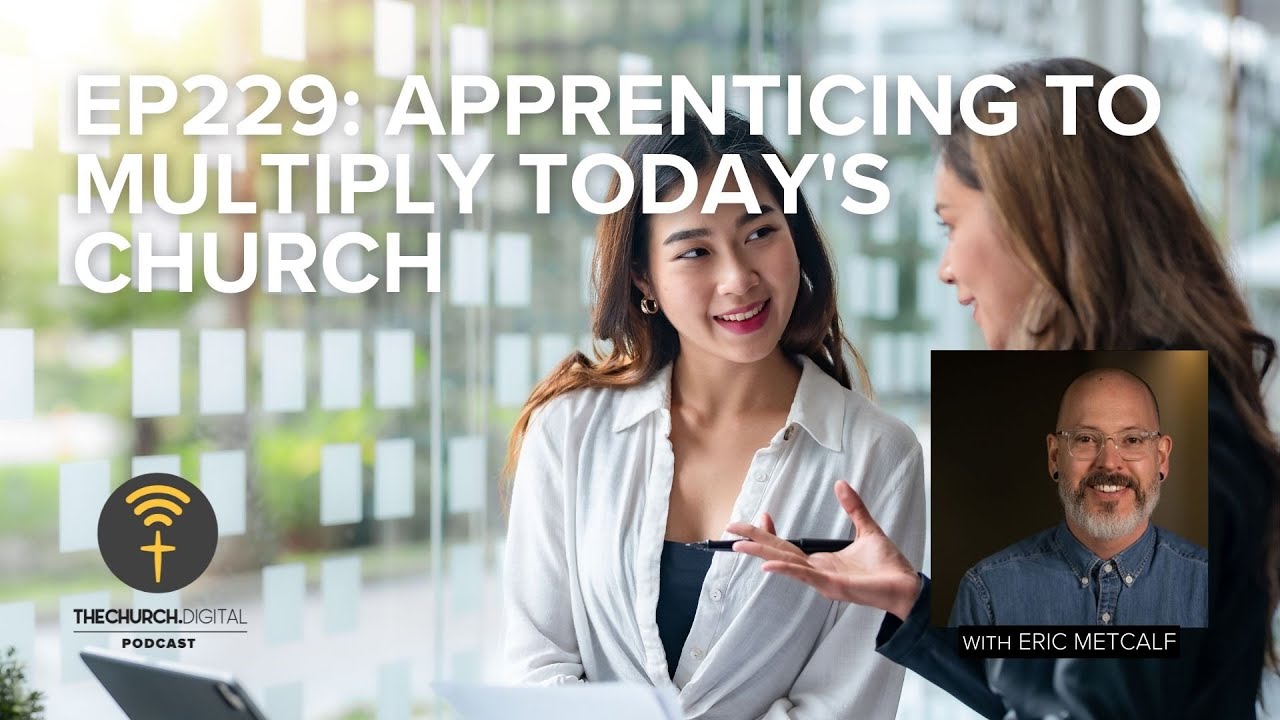
All right, hey, welcome to episode 229. This is Jeff with the Church Digital Podcast and Digital Church Network and all sorts of fun stuff, and I can't wait to dive into this conversation with my friends over here from New Thing Network. Now the topic we're dealing with, this is a two-parter. We're going to experiment. You hear me talking about experimenting all the time like that's a good thing. And so we're going to experiment with a new method here. We're doing a two-part dive here exploring the idea of apprenticing and multiplying our churches, our physical, our digital, even maybe our metaverse churches by apprenticing. And so what we're going to do is we're having this conversation today and then in a couple weeks we are going to do part two of this conversation on apprenticing. This part is going to be on a podcast. We're exploring the whys and maybe some of the philosophical ideas behind apprenticing and behind multiplication. And then in a couple weeks we're going to get far more practical.
So here's what I want you to do. I want you to swing over to thechurch.digital/apprentice. The church dot digital slash apprentice for more information as we get into part two of this conversation on apprenticing. But then this just got weird because I've just totally talked about part two of a conversation but we haven't even had part one yet. And so for that, let me bring into the conversation Eric Metcalf. Eric is a global associate director, associate global director, associate to the regional director of New Thing. So many associates and potentials, but essentially Eric's a man, one of these guys that's making it happen with New Thing Network globally. So Eric, thanks for jumping on the podcast here.
Yeah, thanks Jeff. Thanks for letting me join you as the Dwight Schrute of the New Thing organization. I am the assistant to the regional director, by the way.
Let's just go ahead and go down this road. I had the pleasure. I was traveling last week, was watching a lot of TV late at night, and I had the pleasure of watching the series finale of The Office and then the series debut of The Office back to back. Like, it just, whatever network I was on had them literally back to back, the finales and then season one launch. I cannot think of another show that has changed so much over the span of its career than The Office did, from the Steve Carell slapping you upside the head painful to watch, oh yeah, to the romanticized ending where with Jim and Pam at the end. I don't want to do spoilers or anything, but I cannot believe how radical that show shifted over it. It's been a sad day when it came off of Netflix. That was a sad day. Where is it now? Is it on Peacock? Paramount? Peacock? One of those?
Probably Peacock or Paramount. Peacock, one of those that's not doing well or has already closed. I don't know.
Well, listen, Eric is far more than the Dwight Schrute, although Dwight Schrute ended up ruling everything when all of a sudden done. So you know, maybe I don't know. But at the end of the day, Eric is actually my boss, or at least one of the people that boss me around at New Thing Network. And so it's a pleasure to jump on this conversation, really digging into apprenticing here.
So share with me a little bit, Eric. Like, what is the why? I mean, let's just start with why. On this, we're talking primarily digital churches, metaverse churches, church planters, you know, involved in these conversations. Why are we apprenticing? Why is it so important for us to apprentice?
Yeah, I mean, I think part of it's the life change piece. We need people who are following Jesus that are helping others to follow Jesus. But it's also about having leaders to be on mission with us that can carry the vision and mission with us. And apprenticeship is the key in doing that. And if you look at the life of Jesus, you look at the Gospels, you can quickly turn to Mark chapter three and you can see in verses 13 through 15 that Jesus went up on a mountain and he called to him those he wanted and they came to him. And that's when he appointed the twelve. He called them the apostles, that they might be with him and that he could send them out to preach and have authority to drive out demons. And you know, this passage is just a quick snapshot of Jesus's intentionality of pouring into these leaders and then sending them out and founding the church through those methods. And I think if we look to the Gospels we can quickly see that. And then of course Second Timothy 2:2 is another core passage when we talk about apprenticeship, and you have Paul and Timothy and the multiple generations of leadership reproduction. And we use those as kind of our core passages to remind us why we do what we do and why we're focused on that the way that we are.
Well, that's great. So like, when we're apprenticing, what, like from a practical standpoint, what are we talking about doing here? Are we talking about reproducing ourselves to make the ministry we're doing easier so that our churches grow larger? Are we talking about planting and starting new churches? Like in a practical standpoint, and you were, I mean, you were one of the first guys really talking about this idea of apprenticing years ago. So what does this actually look like?
Yeah, not to alliterate our way into heaven, but role, relationship, and responsibility. That's really what you're trying to do. You're trying to help shape and form and develop somebody into a follower of Jesus and then teach them some responsibilities that you're asking them to do on the other side of it. Sometimes, you know, when you start that relationship, what the responsibilities will be on the other side because they're apprenticing to take on this responsibility. Other times it's a journey and you're kind of discovering that together in the apprenticeship.
Part of why I'm such an advocate for it is because someone, you know, 24 years ago at Community Christian, which is the church where I attend, co-founded by David John Ferguson, and I've been here on staff at this church over the years. About 24 years ago somebody asked me to be an apprentice in a small group. And the rest is kind of history. I mean, the leader apprenticed me, poured into me, met with me, taught me the responsibilities of leading a small group and then eventually I became the leader of that group and had the privilege of investing in other apprentices after that. And a lot of cool experiences I had with that led to me being passionate about it. And so I just continued to invest in apprenticing small group leaders. And that's where I spent a lot of my time learning this kind of discipline of, you know, if you could and if you'd be willing to go on a journey with me, follow me as I follow Jesus, and let's see what he does with this time that we have together. And so it's been kind of a fun road, fun journey for sure.
Yeah, I mean, let's dig into that a little bit. So you, years ago, you were apprenticed through Community Christian to become a small group leader. So let's talk a little bit about that. How did that process go? How long did it take to be quote unquote apprenticed as a small group leader? But maybe even beyond that, like what were some of the next steps in the apprenticing? How did you go from apprentice small group leader to associate global director of New Thing?
Yeah, I mean, it was, I always talk about, you know, it's strange and odd that God would choose knuckleheads like myself to serve in the kingdom because you know, there's really nothing all that special about me personally. I'm from a small farm town in the middle of nowhere. The town I grew up in had just over 200 people in it, and I grew up on 40 acres of land on a farm. And somehow I found my way to Chicagoland through a series of God things and strange events and stepped into this church that I was doing an internship at. And while I was interning at Community Christian Church, I got asked to be this apprentice leader in a small group after shortly joining that group. And my apprenticeship was like 12 weeks. And during that time the leader would meet with me and check in with me and ask me questions and kind of challenge me spiritually. Sometimes we call it the RPMs, so relationally, physically, mentally, and spiritually. And then they would talk to me about how to facilitate a small group. And over time I started running the small group meetings and got feedback on that from the leader.
We talk about that as the five steps of apprenticeship: I do, you watch. We talk. I do, you help. We talk. And so on. And we can get into more of those nuts and bolts later if you'd like. But that whole process really launched me into becoming a small group leader. And because I was taught those things, I just did that with my apprentices. The difference was I recruited three apprentices in my small group and I began to meet with them and meet with them one-on-one but also meet with them as a huddle. And we eventually took that small group I was leading and multiplied it into three small groups, which led me into coaching small group leaders. And so I began doing that and did that for a season, apprenticed some small group coaches, and then I eventually became the director of small groups at that location and came and stepped into ministry at Community Christian. And then I eventually became the small group's champion over all the locations while also leading the one that we had in Naperville, which is our yellow box location. It was our largest site. And I had the privilege of overseeing small group ministry for the entire church during that time.
And oftentimes I'll say everything I learned about church planting I learned in a small group. I believe if you can multiply it at the micro, you can multiply it at the macro. And if you can kind of keep those core principles aligned, you can really start to see movement over time if you're disciplined about it over a long period of time. And so I eventually became the director of New Thing because I was getting so involved in this kind of stuff when we were organizing New Thing in a very
Similar fashion, with the reproducing model and with apprenticeship at all levels, and that's how I became engaged as the director working with John and Dave Ferguson and Patrick O'Connell. Now, it's interesting you were talking micro and macro, and you know, obviously you've had a very storied career with community and moving into New Thing. Did you have intentionality when you started out as the small groups director? Like, or not director, as a small group's apprentice? Like, is that "oh, this is where we start apprentices," or was that where the opening was, or is that where your gifting led? Your the person who was apprenticing you to start you, like, what was the motivation behind putting you and starting you at the small group spot?
Yeah, I mean, I think, you know, Community, if you've read the book Exponential or if you're familiar with Dave Ferguson, who's president and CEO of Exponential, if you know our story at all, we do have the long view in mind when we ask someone to become an apprentice on a team or in a small group, which is kind of at the micro level. But not everybody's going to go through that leadership path and someday start a church or someday lead a network or someday lead an organization like New Thing. It just happened to be true of my story.
I think part of it is, like, on the apostolic, if you're familiar with Ephesians 4 and the fivefold gifts, I'm definitely apostolic and evangelistic, and so I had this like very outward mentality developing leaders, thinking scale, thinking growth and momentum. Spiritual gifting-wise, leadership gift is one of my spiritual gifts, and then from an Enneagram standpoint, I'm an Enneagram three, so like I had this drive that got me engaged in a lot of different things and helped me to be motivated by the new and be motivated by the unknown and always looking for the next adventure. And so it just kind of kept putting me in these kinds of scenarios.
And I think the small group ministry was a great place for me to learn that church and leadership development and apprenticeship and ministry, it's a people organization. And just realizing if I could come alongside people and tell their story and platform them, that over time, you know, their story became part of my testimony and just a lot of cool things came out of that over the years. So that's how I got engaged with New Thing, because it's a very similar organization.
When you, I think you said your apprenticeship went twelve weeks? Was that what I remember you saying earlier, or am I just making this up?
Yeah, I mean, usually we'll say like apprenticeships can last anywhere from six weeks to eighteen months or even a couple years, just depending upon their story, what their capacity is. There's a lot of things that contribute to how long somebody's apprenticeship lasts. So like, what are the pros and cons of where you were? You were quicker because you had more skill sets, or you know, somebody doesn't see it so they need longer? Like, what are some examples of how that would vary?
Yeah, I think if you're asking someone to be an apprentice, and when you're being invited in like that, or if someone's thinking through how long someone should apprentice, you're always kind of looking for what we call the must-haves: teachability, relational intelligence, and spiritual velocity are like those kind of core components to look for.
Teachability is humility plus they're able to apply what they're being told so they grow over time. Spiritual velocity is really that kind of forward momentum in their faith journey, that they are in fact following a Jesus who is alive and resurrected, and so they have fruit from following Jesus. And then relational intelligence is that all-powerful self-awareness that all of us have to continue to grow, and if we lack it, nobody wants to follow that person anyway. So don't even try to invite them into apprenticeship. Look for that relational intelligence.
And we feel like if we can start there, but then a few other components play a part for sure. Like you're looking for the DNA piece of where that person has come from, what kind of church did they come from before they came to yours? If they came from someplace else, how long they've been a Christ follower can be good and bad, so you kind of have to weigh out the pros and cons. Maybe they've been a Christian for a long time but not a Christ follower. There's issues that can come with that. Or maybe they're a newer Christ follower but they're on fire and they're ready for their next step, and that could be something an individual that can be really good, great to work with, because they're malleable and teachable and they're really earnest to grow. But sometimes the immaturity of a Christ follower can slow you down too. So you always have to weigh out the pros and cons of who you're working with and where they're at. But those timelines are such a variable depending upon the person, so that's where it can be a little more of an art than a science.
Sure, that's why the one-on-ones are so important. That's why it's done in the relationship, because you're learning that as you go in conversation as you work with them. Where do you find apprentices? Are these people that you know personally? Are they people that are somewhere in your ministry, or just people that you get connected with on the street? Like, what's the pool you pull from?
Yeah, I mean, I can speak to an example. For the last year I was a volunteer small group coach at our location here in Chicagoland in Downers Grove, which is a suburb of Chicago. And at that location I've been volunteering to coach a couple small group leaders, and I began to meet with them probably once every couple months one-on-one, and then I did a huddle Zoom call about once every other month as well. And as I was meeting with those leaders, I just thought, okay, who might I ask to become an apprentice coach? And so I began to kind of pray through that, think about that, imagine what that would look like, and then I'd talk to my coach, which is the small group director at this location, and I say, "I'm thinking about asking this person to become my apprentice coach. Do you think that would be a good decision? What are your thoughts on that?" And they were excited that I was thinking about this individual, and so I asked them to become my apprentice coach through a one-on-one conversation. I had an ICNU conversation with them, and we met a couple times after that, and they agreed to go on this apprenticeship. And so we met for the next several months and began to talk about what that would look like to be a small group coach and decide the timeline of when that could play out and when they could become a small group coach. And shortly after that, they eventually did, and now they're one of our small group coaches at that location and they're awesome. They're just super talented, much more pastoral than I am, very shepherd-like, and they just very much care for their leaders in a very tangible way. So they're just an amazing small group coach.
And so that's part of how that works: you look at your sphere of influence. To answer your question, people within your reach. Sometimes it's a little bit different than that. You might have somebody that's been recommended to you to go meet with them and talk to them about apprenticeship, and I would say that's an okay way to do it as well, especially if you trust the person that recommended them.
When you're looking at an apprentice, is there anything mentally that you're like, "This person cannot do this"? Like, you design them for a specific role, or is there like an opportunity where you're trying to limit them into what their capacity is, or are you bringing people in with the understanding that they could grow and multiply and expand into a number of different capacities? Like, how much are you necessarily trying to dictate this person's future with the organization?
Yeah, that's a good one, and sometimes tough to discern. I used to say, and I guess I still believe, that time always tells. Over time, you can tell. I mean, give them a little bit of time, helps you kind of see what they can continue to carry as they move forward. And so I think those kind of simple practices kind of help you discern their capacity as you move forward in that relationship. That's the question you're asking, right? Just like, how do you kind of discern what their lid is?
I do think it's just a little bit over time through conversation, and usually it becomes apparent.
Hey, you mentioned earlier the "I do, you watch." You know, some of this process, we talk. Why don't you describe to us a little bit of what that process looks like while you're apprenticing someone?
Yeah, it's funny. I was having this conversation with my wife the other day because our son, who is turning nineteen, going to college this fall, really proud of him. He's such a gifted kid, super smart, and he's going to be hitting the college scene here in the city of Chicago, going to DePaul University. So we couldn't be prouder of him. But one of the things we were talking about is how to equip him in this next season to do some of the administrative things that moms and dads are used to doing for their kids, you know, anything from like buying the right laundry detergent to checking your emails daily, putting things in the calendar, just the kind of stuff that like slowly enters you into adulthood. Still, some of us are still trying to figure that out at our age. I know I'm forty-six and some of those things I'm still trying to figure out. But the point is, her and I were having a conversation. I said, "You know, it's a little bit like an apprenticeship. If you could somehow show him what you're talking about, make a list of those things, and think about it in terms of the five steps." And of course, you know, she just rolls her eyes at me. She's like, "Oh, here we go. I'm gonna listen to my husband give me one of his conference talks." But she, you know, she's like, "Yeah, you're right. It's basically us showing him what we're talking about, and then over time giving him the responsibility and giving him feedback on it."
And that's really what the five steps are. The first one is "I do, you watch, we talk." The second one is "I do, you help, we talk." The third one is "You do, I help, we talk." The fourth one is "You do, I watch, we talk." And then the last one is "Someone else, you do, and then someone else watches," and that's about reproduction. But the key in all of it is that you're having a conversation at every step.
And I think that's where pastors and churches and programs unintentionally remove that part of the game, because we focus so much on the event. We focus so much on Sundays, or we focus so much on the program, pulling things off, that we do not get the cups of coffee, the meals, having people in our home where we're having these real conversations about how they're doing, how they're developing, and then giving them feedback on how they're running with stuff and laughing together and working hard together. And I think when we don't do that, when we don't do the "we talk" part, it just starts to feel kind of like you're just an event-based organization that runs programs all the time. Which we know that that'll give us catalytic results sometimes, but it won't get us the transformational micro movement kind of stuff that we all love to see happen in our lifetime.
Yeah, I got to tell you, I like how you're calling that out and putting words on it. Like, I've seen that: "I do, you watch. I do, you help. You do, I help." Like, that's not new, at least in my context.
I don't know that I've ever heard that we talk portion on each line where it's "hey, let's dialogue, let's build a relationship, um, let's provide feedback" for that. So I don't, I don't know if you stole that from somebody else, but well done because I never we did, okay good.
So we'll just leave it there then and say what it is. But well, he's friends of ours. It's Carl George. He's a wonderful church growth movement guy. He wrote "The Nine Keys to Effective Small Group Leadership." It's a wonderful book. Um, and he's worked with churches over the years, probably consulting more churches than any church consultant in the world. Awesome.
So hey, we'll put a link to that book in the show notes, and so you can see it there. Carl George, what's the name of the book again? "Nine Keys to Effective Small Group Ministry," I believe is the title of my, I might have missed a few articles or prepositions. Who knows, something like that. Good. Amazon's great at finding stuff like that, so find the link in the show notes here.
Um, later on, hey, so even it's interesting with the "we talk," right? That gives opportunity for the person to own the ministry, not necessarily to carbon copy what you're doing, but to put their unique spin on it. That's right. Is the goal on apprenticing to carbon copy, copy paste? Is the goal to let them put their unique spin on it and to own it as their own? Like, how much is too much or too little kind of in that balance?
Yeah, I would say it probably depends upon your organization and what you're trying to replicate. Um, you know, you've probably looked at different, maybe some of us are familiar with different multi-site models within the church. Um, you could argue that on one end of the spectrum you have the "family of churches" multi-site model, which is more like a network of churches. On the other end of the spectrum, you might have a franchise model that's more like if you go to any McDonald's, you get the same cheeseburger kind of experience.
It depends upon what you're trying to scale and what you're trying to replicate is maybe what I would say. But even the franchise church might tell you, "Yeah, we want our programs to be the same, but we don't want our people to be the same." And so I kind of get that there may be maybe some room for imagination even in that structure. But I would say that what you're trying to get to is the heart of a reproducing leader. You're trying to help them flesh out what their biases are, what their strengths are, how their story contributes to who they are and what they're doing, while at the same time trying to run the play of whatever it is that you're asking them to do.
And um, I don't know, I think it's super fun to try to figure out both based on their gifting, their story, their passions, but also what you're trying to do collectively together in a typical ministry.
And you're a guy that's reproduced at all levels and by doing ministry and by doing work. How much intentionality do you put towards reproducing now? Like, look, we've all had the nine to five, you know, ministry jobs, which is anything but nine to five. We all know that Sunday morning's coming and there's, you know, it's just the overwhelming nature of what that is. Like, what percent? But if you don't focus on the apprenticing, if you don't focus on reproducing, it's not going to happen. It gets lost. So how much time do you dedicate towards doing something like this, or what percentage of time would you dedicate towards it?
Man, that's a tough one. Um, and I know it's a real tension for most leaders and most pastors is figuring this piece out. Um, I mean, my whole calendar now is dedicated to one-on-ones and developing leaders. Part of that's because I can, in some ways, I can afford the opportunity to do that in the role that I currently have. But I'm also a church planter. I've planted churches. I've been a part of five different startups. I've led one of those myself. And in those efforts, as much as I got tempted to focus on Sundays and focus on making sure we had a bassist on Sundays and making sure the message was exactly right, making sure that we had the small groups to connect people in, making sure we had all these teams, I cared about all that stuff. But I knew that if I didn't have my one-on-ones on calendar, meeting with apprentices, meeting with existing leaders, that my team wouldn't do that. And if my team wasn't doing that, I also knew that my volunteers weren't going to do that.
And so I felt like I had to show and model what it looked like to have a one-on-one. So I would do that with my team, and then I would do that with a small group apprentice that I had in my small group. And I would make sure I multiplied my small group every six to twelve months. And then I made sure that I was developing leaders of leaders, that I was apprenticing. And I also made sure I had one-on-ones with apprentice church planters or leadership residencies. Sometimes we called them here at New Thing. And I made sure my calendar was kind of chock-full of those types of meetings so I could model for my team what that looks like.
And if it meant, in the words of Neil Cole, lowering the bar on how we do church and raising the bar on discipleship, so be it. It's just what it was going to be because I felt like my life had been changed so much because somebody valued that. I've seen thousands of lives changed because of how community at New Thing has valued that. That I wanted to keep replicating that in the generations of leaders that I worked with because of the responsibilities been given to me.
So but it's not easy, man. It's like so tempting just to pull yourself back into the program and the plans of what we do with church and ministry and stay away from the people. Um, because it's hard. It's hard to stay focused on those things. But the replicative effect is pretty exciting stuff. Um, and I'd rather be on that side of it, definitely.
Oh, and this even gets to the place of, you know, a lot of churches, uh, I'll be honest, like so I've worked on churches that didn't care about the reproducing part of this. Their focus was more on the quality of the product. And so there was not an onus on me to reproduce in my role. There was an onus on me to do my job. And even though I've always felt more of a reproducing, so how do you do? Do you have churches that maybe, or have you talked to people that were in that situation where maybe there was a desire to reproduce, there was a desire to multiply and to pass knowledge and understanding on to others, to disciple others, but maybe the church didn't see that as a value? How do you walk in that tension?
Yeah, I mean, we talk about sometimes there's a tension between reproducing and excellence. And certainly the church in the West has spent a lot of time trying to make what they do excellent. And so that level of excellence creates a certain level of professionalism that needs to be at the table to create whatever that quote-unquote excellence is. Sometimes those churches that are so good at that get to become very large churches.
And I've heard it described this way: if you look at a large church like a rhino, it's hard to reproduce rhinos. But you can reproduce rabbits. Yeah, and so those might be smaller churches that have not this high bar of excellence because they're very relational, simple. That being said, this is why we need ravens, which are networks. So if you can get rabbits and rhinos working together and you can start to see collaboration among these churches, the smaller churches will be inspired by how much impact a large church can have because of the resources they sometimes have and the people that they have and all that. And then the large churches can be inspired by the smaller churches because they see how nimble they are and they see how focused they are on people and multiplication. And they can really inspire one another when they're in a network together, which we talk a lot about from a New Thing perspective.
So I do believe they can benefit from one another. I do think that there's a tension there between excellence and reproducing. Um, but I also think that you can, it's meant to be a tension and that's okay because it's okay to have a professional Sunday gathering. It's okay to have a professional kids program and students program and camps and those things are okay. And not everybody wants to participate in this stuff. That's okay too. We need lots of different kinds of churches that are going to reach people and raise up leaders. But I think when they're in community with one another, they can challenge one another, inspire each other to think differently and think outside the box.
Love it. The rhinos, the rabbits, and the ravens. Actually, I had a conversation just recently with the deaf ministry, and for them it was elephants and rabbits. But not, but I like the rhinos. It kind of alliterates. Is it alliterates? Well, I've more alliterations, more liberation. Yeah, sorry, my seminary degree in alliterations is lacking. Very good.
Hey, so let me ask this. You know, we primarily here we do a lot of digital and metaverse ministry. So digital churches. It was interesting. I made the statement to you that I actually don't know of a digital church that has a structured apprentice program, like where there's intentional focus on apprenticing. Many, I mean, many reasons why. Maybe the first is they're kind of throwing and going at this point. I don't know that they themselves have a system yet where they can teach and reproduce. To be honest, like there's a lot of emotional stress on some of these digital and metaverse pastors and planters because there's so much, um, lack of approval in some of these areas. And I know I've had several conversations there with people that have been hesitant to reproduce, to bring in, because they don't want to expose some of the, I don't want to use the word hate because I think hate's too strong, but just the lack of approval in these areas.
And there, I mean, I would love some insight from you. Now, you're not a, I want to label this. You're not a, I would not consider you a digital or a metaverse, I don't want to say friendly, but you're not knowledgeable in this area. Like we've had conversations, but you're new in the space, so to speak. I do consider you a supporter. If you're not a supporter, you're great at faking it. Um, maybe that's another conversation. No, thank you, no, no. So you're a supporter. New Thing is supportive, man. I love this.
Um, so here's my question. Really, man, I would love for you to talk in the challenge, maybe a little bit here, some of these planters that are operating in digital and metaverse, paving new grounds. Um, it's interesting. Somebody told me, Chesley told me recently, he said, "Pioneers get killed, settlers get rich." In many ways, we're kind of pioneering in this season. But talk to these people here. Um, why should we be focusing intentionally on apprenticing, on reproducing at this point?
Yeah, a great question. Um, so when I, I mean, for some reason, maybe this will apply because I thought of this when you were asking the question. When I planted a church in the city of Chicago on the North Side of the city, the people that we were predominantly reaching were young professionals. Um, so people who are like between twenty-five and thirty. Our average age for our church plant was probably twenty-eight. And so the leaders that I was working with were upwardly mobile, affluent, traveling on a flight, usually consulting. They work for large companies like Deloitte and Huron, and they were flying Monday through Thursday pretty much every week. And so I had to think this...
Was probably six years ago, maybe seven years ago. I had to think creatively about how to apprentice these individuals to lead small groups and how was I going to launch new small groups that were going to connect people that were showing up at the church. And so maybe other leaders were already doing this at the time, but this was kind of new for me. I decided to start using Zoom to apprentice leaders and begin to meet with them weekly and provide small group training and their apprenticeship through a one-on-one over Zoom and then collectively as a turbo small group to equip these leaders.
There were times where I had 16 people on a Zoom call and I'm teaching them how to lead a small group and what that looks like. And I'm talking to them about their spiritual formation, talking about how they're doing in their walk with Jesus, and just really became this very collaborative Zooming context before the pandemic. And it was really fruitful. We were able to launch lots of small groups doing that.
And so I guess what I would say to leaders that are now planting digitally and being digital missionaries and forming churches in the metaverse: I would say in the same way you would do an apprenticeship in an in-person context, I would do the same thing virtually. I would be intentional about selecting capable men and women who could follow you as you follow Jesus and asking them to apprentice. And over time, as you go through the five steps, as you check in on their RPMs, they would eventually become leaders of a small group or leaders of a team. Maybe you're equipping them to become digital missionaries and that's where you're starting them first as you look to the digital stratosphere. But I think there could be some really exciting things that happen virtually in terms of apprenticeship with the RPMs and the checking in.
How, like, is there a time where that matures? Is that a time where you stop and focus on others? Or like, are you checking in with dozens of people regularly? Like, what's the lifespan of someone that you're apprenticing?
Yeah, I mean RPMs is really trying to help us as Western leaders—and maybe it's also a majority of world friends as well, but I'm guessing it's probably a Western issue—we tend to think about spiritual, and we tend to only think about: are you praying and are you reading the Bible? And we don't always think about asking questions around their relational world, which is what the R stands for in RPMs. We don't think about asking questions around their physical—whether it's their schedule or whether it's their physical health or whether it's their pace of life. All those kinds of things. We don't tend to ask questions around mental: how are they doing with their mental health? How are they doing with studying the world and culture around them? What are they filtering from their mind? We don't usually ask those types of questions.
But discipleship is a whole, whole life thing. It's not just: did you go to church on Sunday? Did you read your Bible? Are you praying? And did you give money? Which is the P, which tends to be where we focus our energy when we talk about discipleship. So RPMs is meant to be a holistic approach to developing someone. And there's a whole list of questions you could ask when it comes to those four different areas. And what we're trying to do is get us as leaders to think about: how do we think about growing this person as a human being, as a follower of Jesus? And how does Jesus impact their entire life?
And so that's what the RPMs are meant for. And if you know anything about your own RPMs, you know that you stink in one of those four areas at any given moment. And so we're trying to be an encouragement to that person that might be falling short and also provide some relational accountability that would come through trust. And over time, as that person kind of lets you in to talk about that part of their world, whatever they might be struggling with.
So then it's important for accountability standpoint, almost, to always be under someone apprenticing—like someone that's talking to you at that RPM's level?
Yeah, I mean, certainly we could all benefit from that, right? Especially given the pandemic and given our temptation to isolate during the pandemic and then to try to cope and deal with whatever it is that we're going through by ourselves. And then we find ourselves in some pretty dark places. So we would all benefit from being in an ongoing one-on-one coaching apprenticeship throughout our spiritual lives, throughout our journeys. Absolutely.
By the way, we're going to be doing part two of this conversation on apprenticeship. We're going to be doing it as a roundtable through Digital Church Network. And we're going to be doing it Tuesday night, August 23rd, 7 p.m. Eastern. Now that's 6 p.m. Central, where Eric is. And New Thing is very driven towards Central Standard Time. There is no time that exists unless it's Central Standard Time. So 7 p.m. for maybe the rest of us, but definitely 6 and 3 of those here in California. I'm sorry, entirely. But we're going to dig into maybe some of the more practical insights centered around apprenticing and how we as digital and metaverse churches can apprentice, can multiply, what it looks like to multiply our churches utilizing apprenticing.
So come to that roundtable Tuesday night, August 23rd, 2022. Obviously, for part two of that conversation, Eric and I will be there. For more information, check out thechurch.digital/apprentice—A-P-P-R-E-N-T-I-C-E. Check out the link in show notes.
But you know, Eric, one thing that I would love to just throw at you as part of this conversation overall is just the heart of New Thing to see this collaboration and to see this multiplication happen within churches. Like, it was as I was pivoting away and over the past year trying to find the organizations to partner with. Like, it did not take a lot. It was not a long list of churches or organizations initially to look at. But we didn't have to put a lot of thought into New Thing. Like, it was such an obvious choice. The heart for collaboration. And so maybe you want to talk a little bit about New Thing and maybe tell the story of how you got connected and what it looks like now doing ministry and collaborating and helping churches the way that you do?
Yeah, well, I mean, I got involved with New Thing because I really love the idea of multiplying leaders, of increasing our impact as we develop leaders and develop churches. And some of my first roles was developing our leadership residency program for New Thing North America. This was just about 10 years ago. And the residency program really was multiplication at the macro. It's like: if you could have apprentice church planters, what would that look like? How would you recruit these church planters, whether they're free agent or farm system? How would you send them out? What would that look like to partner with those church plants?
And then we began to kind of push these church plants together in networks. And a network is a small group of pastors who are leading churches that are collaborating together to plant churches together. A network might have four to six churches in it that are working together. And as they collaborate, they might be able to do more together than they could by themselves. And it was really just us trying to live out John 17, where Jesus has that prayer for us as believers that we'd be seen as one and that we'd really begin to champion one another and support God's dream for the world.
And think about: you know, how we could reach a whole city or a country or a region or even the whole world if we could in the name of Jesus? And so that's really what continued to push New Thing is this kind of John 17 mentality of collaboration, to use the word you were using earlier. And really just imagine: you know, what if we could spark a movement and be a catalyst for movements or reproducing churches all around the world?
And a lot of that happens through leaders like you, Jeff. Like, it's guys and gals who are hearing from God regularly. And they're dreaming big. And they're thinking about: you know, what if there were other people who thought like me, who were dreaming about these things? And what if we could work together on something? Wouldn't that be amazing? What if I had this community of friends on mission that we're meeting regularly, we're praying together regularly, we're dreaming big together regularly, and we're holding each other accountable to some big ideas that we want to do together? And we call those potentially apostolic movement makers. These are leaders all around the world, which has gotten us involved in just about 50 countries around the world now. And gotten us to be engaged with what you're doing, Jeff, and your team. And just really exciting stuff as we've been able to serve a lot of leaders in a lot of different places over the years.
Yeah, friends on mission is now like my favorite words. You know, that was something I'd never really heard of pre-New Thing. And then the idea of: hey, we don't have to theologically agree on every jot and tittle as much as: hey, let's agree that people need Jesus. Let's agree that we can help others. Let's agree that we can be on mission together. And that collaborating is better for the kingdom. And I just love that challenge. And it's so interesting to me. Like, when I actually talk with other churches about that, how shocking it is, like they've never thought of that. Like, the idea of denominationalism is so intertwined in so many of our—like, literally, I was at a conference talking about some of the stuff that we were doing through Digital Church Network just last week. And somebody at the conference was like, "Well, then you're like a denomination." I was like, "No, because I don't speak theologically into anything, nor do I want to get into that. I want to work with everybody regardless of what they believe."
Yeah, we've got some lines somewhere, but the lines are fewer than what a denomination would. And this person could not quantify in their minds the idea of doing an organization that wasn't speaking theologically into something. And I think for the kingdom—listen, we can all stand before God one day and ask. And I'm looking forward to the conversation: "Hey, God, this whole digital and metaverse church—was this a crock of garbage or is this legit? Like, on a scale of one to ten, how upset are you at me right now?" Like, I do fully anticipate having that conversation. You know, it's because so many people are against it. But the heart of this is that we're seeing God move through it. And that's where I think really friends on mission kicks in. Because we're seeing people. We're seeing God move as a result of the collaboration. We're seeing people that may not always agree on these things. We're seeing networks come together and planting churches and encouraging one another and praying for one another, even though theologically there are things that don't line up. And it's a beautiful thing to see that relationship, that friendship come into play.
So, man, I just want to thank you for doing the work that you've been doing, man.
Well, thanks. It's an honor. And it's exciting. And you know, our core passage is that God's doing a new thing. And so we always want to
Pay attention, um, like Isaiah did, just to see what God's doing. That's a surprise. That's an adventure. That's outside of what we currently see. And that's how we've gotten involved with DCN and very excited about what we're doing together. It's super fun, beautiful.
Hey, so as we're landing the plane, by the way, once again we're going to be doing part two of this conversation on apprenticing: a practical approach to apprenticing, getting much more into the weeds and next steps. And would love for planters and in churches and in digital and metaverse and even physical churches that are wrestling with this stuff, come jump in. This round table is going to be Tuesday, August 23rd at 7 p.m. Eastern, 6 Central, and 4 Pacific. Roll it out. If you're overseas, come in. You'll have to figure out your own time zones. I can't keep them all straight. But we're going to have this conversation here next week. And so would love to have you all join that.
And so Eric, looking forward to digging into that peace with you. But as we're landing the plane here, man, any closing thoughts?
I would just say do not underestimate the authority and power that God's given you as a Christ follower and how powerful the ICNU conversation can be with those within your sphere of influence. You just never know what knucklehead you're going to recruit next to be an apprentice that might someday do some cool things for the kingdom. So be generous, go scatter some seeds, go have some conversations, pray over some people, and see where God might take it.
Awesome. Hey, so not a technical conversation today, but love the heart behind this idea of multiplication. And so for those of you out there that are listening, find some people, find some apprentices, maybe even invite them into this round table and work through it together. But start to figure out how we can multiply our digital ministry, our digital churches, our metaverse churches, et cetera.
So Eric, thank you for jumping in the conversation. But we're gonna land the plane. For Eric, this is Jeff with the Church Digital and Digital Church Network. Thanks for jumping on the podcast here. We'll see you next week and we'll see you at part two on the 23rd. Once again, the church dot digital slash apprentice for more information on that. Talk to you later. You all have a good day.