As we’ve been digging into Season 4: Jesus, Gamers, and Church we’ve explored many different types of gaming church, and we’re seeing many different people with different skill sets fit into different roles. Gaming church is a beautiful picture where churches, missionaries…
Welcome to the Church Digital Podcast. Through this podcast we'll talk about the technological innovations within the church, but more than that, we'll protect itself. We'll address deeper questions. Is disciple making possible digitally? How should we approach the digital mission field? Can a biblically grounded church operate in digital space? And where does the metaverse fit into all this? Whether you're a big or small church, an established church or a startup church, the Church Digital's goal is to help churches like yours learn to be a multiplying church digitally and physically. Our heart is that churches like yours will discover a newfound focus on disciple making that will revolutionize your church. And now here's your host, Jeff Reed.
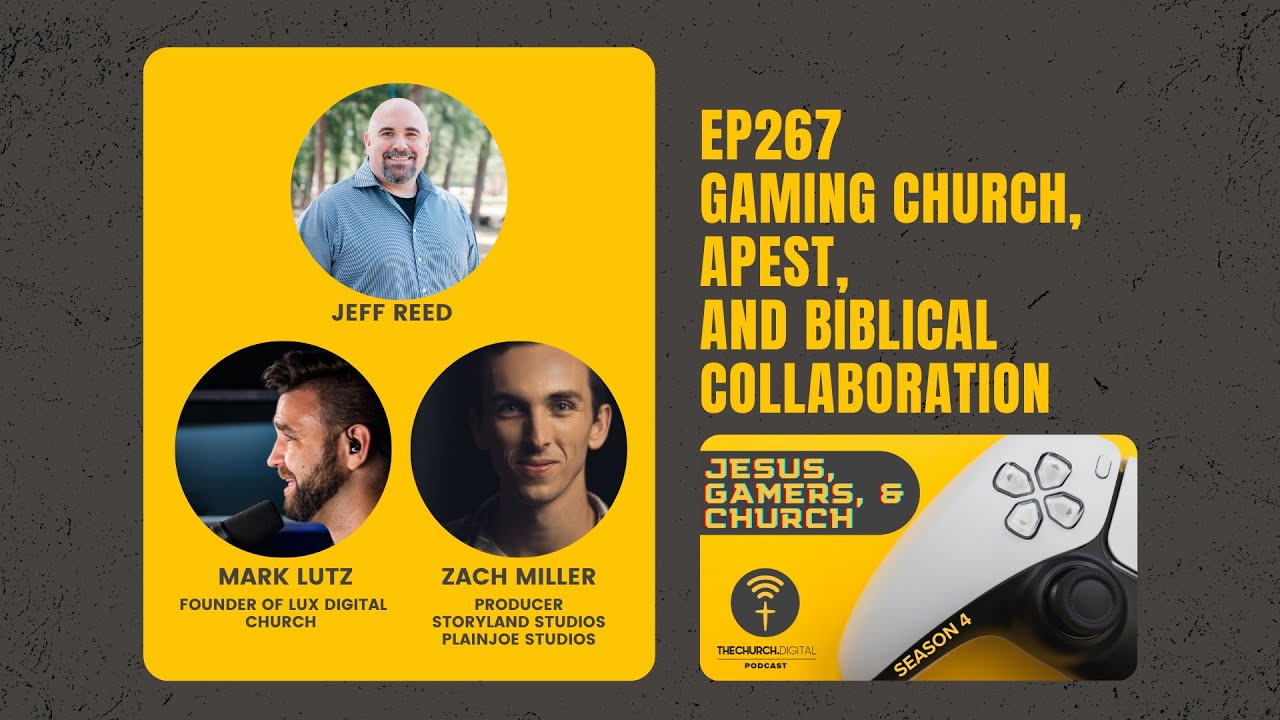
All right, hey, welcome to the Church Digital Podcast. We are streaming live on Twitch, so somewhere out in the interwebs, people are getting Twitch notifications right now to come watch us live. It's Thursday, 3 P.M. Eastern. We've been doing a season here, season four, Jesus Gamers in Church, doing a deep dive, doing an introspective, doing a 360-degree view perspective on what gaming church is. Some of the good, some of the bad, some of the challenges, some of the opportunities. And we're starting to get to the end of the season here. We've got maybe one more episode coming up, but we're definitely excited about what we've been learning in context here, centered around gaming church, really the fastest growing category of digital churches today.
Gaming churches. We've talked with Mark—don't call me Mark—Lutz, the Lux as he's been doing, Lux Digital Church. I did pronounce the church name right, at least. Lux Digital Church. And we talked nerd culture with Bubba from Love Thy Nerd. We talked digital missionaries with Jade and Aki. We talked, oh, so much. We talked to women in streaming last week, and I know I probably kissed talking about women weird. I know we probably talked. I'm probably missing a couple others along the way. Don't call me Mark. I won't Digital Church Network. I promise I won't call you Mark as well. And that, but hey, you know what? Today we've got a great episode where we're bringing in some really smart people about gaming culture. Once again, I'm positioning myself as the listener here, podcast audience, and looking and seeing what's happening and what can happen, really, as we start to explore being the church in this digital space and how it matches up. And so I'm gonna ask the Lux, Mark himself—I'm just going to call him Mark Lux from now on because I won't mispronounce the last name. Mark Lux, do your magic and let's bring in the special for today. You're okay with that name, right? Mark Lux? Like, that's not offensive or insulting to you in any way?
You're welcome to just call me Mark, Jeff. You don't have to pronounce, and you're also welcome to mispronounce my last name. It actually doesn't offend me. I, you actually make a bigger deal out of mispronouncing my last name than I make a big deal. People have been mispronouncing my name my entire life. I just respond to all of them. My name got mispronounced on my wedding day, so it's not, you know, you mispronouncing my name at the beginning of a podcast is not a big deal.
Wow, so I can't believe your father-in-law screwed up your last name on the wedding day. That's horrible.
My father-in-law? No, my father-in-law did it. My pastor did.
Oh, you're—oh, that's even worse. Like, I was, I don't know if that's what I was. I was announced. I have a pleasure of introducing for the very first time, Mr. and Mrs. Mark and Jennifer Lutz, which is what was said on my wedding day, which is inaccurate, but it was fine. We, it went, it went okay. But that's not why we're here. We're here to talk to Saint Bear here. So I mean, could Mark, could you make this podcast anymore about yourself? Like, I'm wondering, like, is there anything else we can talk about?
No, yeah, I have a handful of things that I'd like to talk about that involve me and only me.
So okay, very cool. Hey, so we got Saint Bear in the room, excited to have you on, sir. And so many, and as we've been doing these shows and streaming these shows live on Twitch, Thursdays at 3 P.M., like Saint Bear's been awesome in the background, chatting it up, and I've enjoyed getting to know him really over the past couple months. He was a new meet for me late last year. And so Zach, man, why don't you, for the podcast audience, for people that may not know you, just set the stage here a little bit. Talk a little bit about who you are, what you do, the many facets of Zach.
Yeah, um, it's really fun to be here. I, um, I came from a background. I got my degree in Business Administration, and then I went into construction and worked for a general contractor for a while. And, uh, so naturally I'm here talking about the digital church environment. Um, no, it's just been really fun to be able to land in this place where I get to do what I do for a living and also help apply it and be kind of gas in the engine for all just this wide variety of like nerd culture ministries as we're calling it.
Um, professionally, I'm a producer for Plain Joe Studios, which is a studio, um, it is a storyline studio. And, um, we do design work for churches and other cause-related organizations, nonprofits. Um, and our whole big idea as a company is how do we help the church accomplish storytelling worthy of the story? We believe the church has the best story ever told. The responsibility of stewarding that well. And we're as a church, big C church, good at doing that with our words generally. Um, but our spaces that we create and the culture we set, our communication strategy, the websites we have, digital tools we use, all of that speaks and often speaks louder than the actual words we're using.
Um, the person who comes to your church for the first time is being spoken to by how intentional you are about wayfinding, how hard it is to find a seat, uh, what kind of spaces are you creating, what kind of culture are they experiencing before you've ever spoken a word to them? And so, um, I get to do that for a living with a wide variety of organizations, um, all over the country. And as a producer, get to lead projects and help set creative direction and work with teams of artisans and craftsmen and designers and architects to do all of that.
And the beauty is I'm also a card-carrying nerd, and I love my fair share of video games and tabletop games and just all things nerdy. And so, um, I've just been able to get really connected in the space and get to know everyone and have a passion for it. Most of my closest friends are also nerds, and they're either Christians who would benefit a lot from these ministries or other people who aren't Christians who will only ever be reached by ministries like this because they have no interest in, never ever going to a traditional church. Um, and so I just have been very motivated to say how can I take all the things that I get to do kind of during my day job as a producer with Plain Joe and help imagine how that plays out in digital spaces, uh, use those skill sets and project management chops to, yeah, just be gas in the engine for all these different ministries.
So yeah, that's a little bit of who I am.
A lot of the people that we've had on this show over season four, just about all with the exception of DJ and Pastor Coco from VR Church and MMO Church, all of them were part of the Megazord Summit that happened back in October. We gathered a bunch of people together, and Zach has, it was mostly like the brainchild and the vision in the heart behind that, right? He and I worked on that a lot. That was an event that was primarily ninety percent of it was run. It was all funded by Lux or Lux Partners, but it was Zach and I that were meeting together literally every week, sometimes multiple times a week, leading up to it, making the invites, having the meetings. And then Zach in the background who did all of the project management on that. And so when he says he wants to be fueling the engine, that isn't just words. That is, I mean, that is very practically. He has been fuel in the engine of what we've seen birthed because of Megazord, right? We see on the other side of the Megazord the nerd culture minister collective network that has been forming, and people are getting into groups and connecting in those relationships built. We've seen the tremendous, we've seen more unity in this space now than I think arguably has ever been in the space. I haven't been in the space the seven or eight years that it's been here, but I think most of the people who have been would say that there's more unity right now than there has ever been. And then with that also what we're doing here at the Church Digital, um, a lot of the people who are on it, we've had those connections too, and invited them onto the show because of what happened back in October with Megazord.
And you know, Zach had a little bit of, a lot of the heart behind that. So you just want to tell us briefly, Zach, like, why Megazord? Where did that come from? Yeah, um, and follow that trail a little bit to help people understand.
Yeah, absolutely. Um, I remember, man, it's at least a year ago now, which is crazy. We, um, I was thinking about just seeing all these different ministries. There's Love Thy Nerd. There's all these different streamers. Um, there's digital churches, and there's people wanting to serve in the background. People who aren't going to be the person primarily on camera. They're not someone who really wants to be like a full-time streamer. Um, but they just love this space, want to serve it well. And so I'm seeing all these people, and I'm thinking to myself, man, wouldn't it be great if we could get them all in a room to be collaborative? Because, hey, man, it must be just be so lonely. All of these are people that have this entrepreneurial spirit. They start going, doing this ministry, head down, just running as fast as they can. And it's so hard for them to be able to make time to get to know one another.
So like, when you work in a traditional office space, you have all your coworkers, and you walk by and you chat with them, and you can kind of commiserate about things that are difficult or share lessons learned and tips and tricks. And you don't have that when you're working full-time at home for yourself, doing this mission field that you started, you know? And so there's people that have been doing it for seven, eight years now that barely know any of the other people in the same space. And so we just said, man, what if we could get them all together around the same table, build relationship so they can support one another, love on each other? And, uh, I, I think we talked about this before. I like wrote up this whole tweet, which, you know, to all three of my followers that I had on Twitter, and I posted it with this idea. And lo and behold, those three people, at one of them being my wife, was, they were not the audience that needed to hear it. Not the thought on paper. And it wasn't long after that that I met you, Mark, and I, I mentioned the same thing to you. I just, man, this has been on my heart. I wonder if this is possible. And, uh, it wasn't long after that that we were able to get funding and actually make it happen.
But really the goal behind it was, can we get these people together? And also as part of that, um, help them, help us all have a better understanding of how we fit together? We don't all need to be. That was the reason we called it Megazord, right? The other working title was how to be a body instead of a pile of dismembered limbs. And that was like the whole idea. We're pulling straight from scripture and just using nerdy language for it, of, you know, putting the Zords together into one large Megazord, right? And to say you don't have to all be the same thing, right? We don't all have to be J. We don't all have to be Aki. In fact, the beauty is that we're not. So how do we get better clarity on what each of us are?
If you're looking at someone else and trying to say like I feel like I'm different but how do I be them, um, we're just gonna have frustration. We're gonna have frustration as our communities look at us and say you're not doing the same thing as him, so you're doing it wrong and he's doing it right. Um, and just to help have that clarity, um, what does it look like to have the different roles? How do we fit together? How do we operate as a body that's, you know, where we're synergizing and complimenting one another and supporting one another and even helping people see like the role that I could play? Where I'm saying I'm not going to be the streamer, but I do have project management shop. So that's that's one of the roles that we can play as part of this Megazord. Um, so other people can start to see how they can plug in and be part of that part of that body and part of the mission without having to necessarily be the totally, you know, top tier excellent Esports competitor or the super high energy streamer. You know, those are important roles, but there's other roles to play. And how do we all fit together? So that was really the heart behind it. And I think, I think it went really well. I think that was a success in that respect.
Yeah, absolutely. Which I think, Jeff, I know that you have, uh, you're steering the ship, but there was some, I think that ties in fairly well to what you wanted to kind of touch on and get into in this episode. Am I correct?
Yeah, sure. Thanks for the transition, Mark. I appreciate that. Um, where let me ask this: where do you think the, um, where's the collaborative come from? Like individually, like these, the these people you're mentioning, they many of them were never in the same room or in the same physical space before, uh, before Megazord when we got together back then, um, or very minimal. And so relationships are digital, uh, they're stretched. Um, where, but you're you're right. At least, you know, even in the past seven years ago, there weren't that many people. There weren't enough people to really almost have collaboration because it was so so new in this gaming structure. Where do you guys think the collaboration comes from?
Um, I think at a minimum there's a lot of opportunity in just these networks that we're setting up, having networks, cohorts, whatever you want to call it. If I'm a streamer or if I'm an organization leader, if I'm a girl gamer, whatever that looks like, having a group of people that are on mission doing similar work as me. Um, because if you, you know, if you're any one of those things, finding someone that happens to like live in your neighborhood or go to your church who's doing that same thing is really unlikely. If you're a builder, you might find other contractors that you can talk to and talk shop with. There's very few, you know, the odds that you're going to find someone else that's doing your culture ministry that you can talk shop with are are pretty few. So just having those people where you can be connecting on a regular basis, sharing lessons learned, and, um, you know, this works well for me. Why are you doing it that way? Does that work better for you? Like technical stuff. What programs are you using? Practical stuff like, hey, we had this guy drop in the other day and he was just being really toxic. How you handle that? Um, we had, you know, I I'm not seeing the numbers I wish I was. How do you stay motivated? And you know, just those kinds of things that people normally get when they work in in an industry, being able to have that cross-pollination, I think is really really valuable. And then there's more tangible things where it's, hey, we're doing this fundraiser. Let's all partner on that. Um, hey, let's do a stream where we do this event together, uh, so that our communities come together and get to know each other. Let's do something in real life. We, you guys have five people in this city. We've got five people. Let's get together and set up some kind of local meetup with our combined communities. I think there's potential for all of that once you have relationships in place.
I would agree with that. I think that where does collaboration come into place, I mean, there's some obvious collaborating things, uh, built it baked into Twitch as a platform, things like raiding and hosting and all of those sorts of things. There's things like what Aki from Aki and Fam does, which is Aki and Friends, and he invites people to come on and just be part and they have a conversation. Um, he did one where it was a Gamer Dads for a while where like if you were a dad and you were a gamer, they got on and had a conversation around raising your kids well, uh, who are you're also raising your kids to be gamers. I think that there's obvious collaboration there. When I think about this, I oftentimes think about what does it look like for pastors in a town, in a small town, to collaborate. Um, and it usually isn't, hey, uh, we're doing a potluck so all of you bring your people to our potluck. But where the collaboration becomes really powerful is in seeking unity together. And I think for that, that becomes how do we actually speak of one another, um, and and how do we respond specifically when people come to us who speak poorly of other people in the space? And how do we get to the point where we have relationships where when given the opportunity, we always speak well of one another? And I was inspired by this just locally because my senior pastor helped to lead a ministerium, and it's been around, you know, he's one of the longest standing members of that ministerium of like thirty years now. And one of the things that Chris said is when people come to my church and they say I'm mad at Summit Presbyterian Church and I don't like Tom, I say, oh, I know Tom and he's a friend of mine. And it lets them know that this isn't a place that you can just come and whine and complain and moan about the other pastor up the street. We speak well of one another here.
Anything Megazord, and on top of that, collaboration in general has really been about that, right? For us, we had Amanda on last week from God Squad Church. They're one of the other digital churches in our environment. You can't get me to speak poorly about God Squad Church because I'm friends with Daylight and with Amanda and with Baz and with, uh, probably the least with Baz, but and with, uh, Susie, right? Those are people who I speak well of. You can't get me to speak poorly of Aki. Why? Because Aki's the adopter streamer that I have. You can't get me to speak poorly of Jade because Jade's like my brother. And so because of that, when people come to our community and want to maybe moan or complain or like, well, I don't really like that streamer. I don't really like what they're doing here. I don't really agree with him theologically. It's like, well, you're not going to find any grounds for that complaint here. There's no one's commiserating with you here. So go find a different place to complain. And I think that, uh, that is really where some of this, um, like working together is at its sweet spot. That there's just this spirit of unity for the entire community, the hundreds of people that are connected to the various communities across the board. That every time one of our names are seen in a stream, that streamers like, hey, Pastor Mark, hey, give you guys, we love him. Or when Aki comes in, Aki, it's so good to have you here. When Saint Bear comes to say Bear's here today, right? Like there's this camaraderie amongst the group. And it's like, wow, all of these people know each other. And more importantly, they don't compete with one another. They actually like one another. And I think that that is a really important element of what collaboration looks like in this space specifically.
We, uh, we talked about this phrase of, um, not throwing each other's dirty laundry out in the digital street and saying if we have an issue or a beef with someone, the space is young and early enough and it's emerging. We have the opportunity to set a cultural precedent now by getting all the people who are kind of on the front lines on the same page so we can set that culture precedent of if I've got an issue with you, I know you, I've met you, I'm just going to call you and talk to you about it. And we're not gonna, we're not just gonna go on Twitter and throw your dirty laundry in the digital street. And I think I agree. I think that was a big part of what we wanted to accomplish. And I think has, we've seen the fruit of that. And it helps to lead all the communities then to a greater sense of unity by setting that precedent.
Well, there's a lot more unity centered around the ideology of Megazord. The what is that? That is Power Rangers, right? Yes, I want to make sure I get myself correct here, right? So Megazord, the Power Rangers connecting together to create the giant robot with the sword? No, the sword is, uh, Voltron, which is the Lions. Anyway, I'm getting, I'm getting confused my own analogy. Um, however, I did look at dismemberedbodyparts.com. Is available. So if you did want to to shift over to more of of that ideology, I, I for one would love to help you launch this member admin member bodyparts.com or whatever that was on GoDaddy's. That is gross. And the dismembered body parts, I did not think I was going there with this conversation today, but thank you all for taking me there, uh, so eloquently.
Hey, the image works. So here, here's what, oh believe me, it works. Thank you, thank you for that. Um, yeah, like every, every Friday the 13th movie ever is flashing back in my head. Yeah, thank you. So so good. Um, here's what I wanted to dig into, and this may be a little complex, um, an idea for us to unpack, but I think we can do it. Um, so you're talking about different parts of the body with different functions. Um, you know, and how you, you've got the streamers, you've got the digital missionaries, you've got the churches, you've got the mods. We've talked about just the different facets of of roles that that operate within, um, this this gaming environment. Well, uh, it's interesting. There's there's an idea called APEST, uh, that is, uh, centered in church planting where it talks about each person has has a different characteristic. And whether you're planting a church or doing ministry or whatever it looks like, the idea is to get all of these types of people together so that you don't have just a bunch of arms or a bunch of eyeballs or a bunch of hands, um, doing something because you need all the parts of the body working together, collaborating, synergizing. I know we had some conversations about APEST earlier, and and, um, some of the Megazord stuff, and it really challenged me. It kind of opened my eyes to what what could be in gaming. I didn't realize to be honest, I didn't realize there were so many, um, characteristics, roles. I didn't realize there were so many roles, uh, within within the gaming church. And so within this past several months, that's been the eye-opening for me is is understanding, oh, you do need really that type of person to fill that specific role in this. And and and the the mods are are not, you know, one thing that I learned last week talking with the ladies is how important the mods are, uh, in in some of those situations. And so I would love for us to to unpack, uh, maybe some of the APEST ideology, uh, maybe see how that maps into gaming church, maybe even how that maps in the digital church overall and start to get a picture of that. Now, um, I do want to give the floor to Mark. Um, don't say my last name, uh, Lyft, because Mark is is is inside. He's he's got a little, he's got a little anger inside him right now. There's a chip on his shoulder. And then the chip is he's he's the four guy. He's not the five guy. So he's really upset set that I'm using APEST even though Alan Hirsch is is right and Mark is wrong. But that's okay. So Mark, would would you like to just clarify your your fourfold view for the audience here?
Sure. I, I it is is really not a chip on my shoulder, but, uh, yeah. Um, uh, so I mean, I I went ahead and posted the scripture in in our chat as well. So Christ gave himself, uh, great gave...
himself so Christ himself gave the apostles the prophets evangelists the pastors and the teachers. Um, and so the five-fold ministry kind of comes from that. There are people who are apostles, the gift of church planting, starting new things, um, entrepreneurship. Um, prophets. Uh, I've always defined that as the ability or the giftedness to call God's people back to righteousness. Um, uh, the evangelists, people who bring new people in, and then the pastors and the teachers. And in my uh theological upbringing, pastor teacher in Greek is not two terms. It is a singular term that we split in the English translation of the Bible. So pastor teacher is a singular role, not two separate roles. So I'm a four-fold guy, not a five-fold guy. But uh, the point is that all five of these roles are very important um inside any faith community, and it is exceptionally important inside of uh, inside of this community as well.
And I think what is really interesting is we've actually seen all four slash five of these things um play out uh in pretty profound ways because I think the main point is that you want to gather these things together in a church plant. Um, but I've seen the church led by each of these, right? There's certainly churches that are led and started by apostles, uh, people with the giftings of prophet on their life. That's the one that I lean most heavily into personally. If there's one that I think God has placed in my life, it's the role of prophet. Um, and not when I say that to mean predicting the future, but in terms of calling God's people back to righteousness, um, to evangelize, to you know, people who would just really, you know, missionary mission driven. Um, and then pastors and teachers, which, you know, pastors are shepherds, which I think is what Apex translates it to, right? Shepherd. Um, really great at pastoral care and just coming alongside people. And teachers, really great at just communicating biblical truth in digestible ways. And uh, we see these things in. Actually, the beautiful thing is we've actually seen these things on the show. I think that is one of the coolest things is we've seen these on the show because when I look, the shepherd role is Aki and his family through and through, right? This desire to create a place that if you don't have a safe home, you have a safe home here with us. I've told Aki and his wife uh, Natalie, several times now, if like, they are more equipped for pastoral care inside of a church than most pastoral care pastors. Like, they're just so good at it, of caring for people deeply and authentically um in really powerful ways. And then of course we had a conversation with Jade who unapologetically has said his goal is to have fifty percent of his stream to be non-believers. Why? Because he has this deep pulling as an evangelist, right? Um, and you can kind of see that in the fact that Jade's number one goal isn't necessarily putting all the building blocks in place, but it's having those deep relationships. And then we've had Bubba on, and certainly the gifting of apostles on Bubba's life as he has been a builder, right? An entrepreneur, a serial starter in many ways in which he sees things out ahead of him, and he's putting all of those blocks in place. And you can see that in what has emerged with Love Thy Nerd and now the Nerd Culture Ministry Summit. And so we've seen these giftings actually play out pretty powerfully um, I think through just this podcast and maybe not all five, but certainly at least most of them. Um, and they are really at work in the space.
So, but Bubba is your apostle in this model with the builder mentality. Like, what's your, where would you put Bubba in that? I want to be really careful that I don't stomp on Alan Hirsch's uh, I don't know, I don't know how strict APEST is, right? Or how easily it is for people to flex from one to the next, right? I will quote, I literally, I all this, Alan Hirsch uh, wrote the book The Forgotten Ways back in the mid 2000s. I actually have the page open on my computer there. We go. Perfect. Um, apostle. This is Alan Hirsch, the man who brought APEST ministry five-fold. Really, he brought it back. This was something that was around in the seventies, eighties, and nineties. Like, it just went away. Two thousands was the rejuvenation of this concept. Apostles extend the gospel as the sent ones. They ensure that the faith is transmitted from one context to another and from one generation to the next. They are always thinking about the future, bridging barriers and establishing the church in new contexts, developing leaders, networking trans-locally. Yes, if you're focused solely on initiating new ideas of rapid expansion, you can leave people in organizations wounded. The shepherding and teaching functions are needed to ensure people are cared for rather than simply used. And like at the end, so there's pros and there's cons. There's good sides to being an apostle and bad sides to being an apostle. And let's not, when I'm talking Bubba, I'm not saying he's using or abusing people. But like, does Bubba fit that model of the apostle? You know, Mark, I know you fit that model. I would feel comfortable putting you in that space. Um, prophets. Uh, no, God's will. They are particularly attuned to God and his truth for today. They bring correction and challenge and challenge the dominant assumptions we inherit from the culture. They insist that the community obey what God has commanded. They question the status quo. Without the other types of leaders in place, prophets can become belligerent activists or paradoxically disengage from the imperfections of reality and become otherworldly. I don't know. I can see I can see a little bit of Mark in that too.
Yeah, well, where do you see yourself, man? Let's make it about you, Mark. That's why I'm saying, like, I don't, you know, depending on what your view on this is, people can flex from one to the next, right? Um, and there's certainly people who exhibit multiple giftedness, even in the people that have been in the show so far. Um, whereas, oh, I would say that people have primary voices when it comes to APEST and maybe secondary voices when it comes to APEST. And if I had a primary voice, my primary voice is that of prophet. My secondary voice is that of apostle, at least in this particular season of life. But do you feel like those uh categorically uh would you agree with some of that stuff because you know a lot of these people very closely now as you've built relationships intentionally with so many of them over the last year?
Yeah, yeah, I think um, I think the space for APEST, when we talk about nerd culture ministry, the whole space in some ways feels like it fits that description of the apostolic. It's contextualizing the gospel to a specific culture. It's doing something that's kind of new and different. And within that, then you have within this like apostolic setting, kind of you still have all those other roles, right? So you still have the person who's a prophet in that space, making sure that just because we're doing a new thing, we're not getting too, you know, so off the rails that we let that new context completely remove us from what we're really here for, and make sure that we're still staying on target and staying on goal with the gospel. Um, we have the people who within that space are called to be teachers and shepherds and evangelists. Um, so absolutely, that that like brief description you just walked through with Jake tending toward that evangelistic side, Hockey being more of a shepherd, all those I think make sense. And it was funny, I am not, I historically haven't spent a lot of time being familiar with APEST, so I just wanted to kind of get familiarized with it and was doing some research as I flew home yesterday. And I was reading an article about it where it talked about how for them a big part of APEST is getting rid of this concept of like pastor versus laypeople. And it had this phrase in there where it said within the Christian community, there are few words more disabling than layperson or laity. But this whole point being like everyone has a role to play. And yes, there's the shepherd or there's the teacher and like the things that are kind of more obviously pastoral roles, but everyone has a role to play. And that's part of what I think is so cool about the space is to see how people, it's not that guy up there is doing the work and I can support it from back here as a lay person, but all of us have a part to play as a part of this body, and they're all important and they all matter. Um, which I think is really beautiful.
I can remember having early conversations with Jay. This is going back all the way to maybe 2018, 2019. This is probably the first podcast I did with Jake whenever it was. And um, and he told me, he's like, yeah, I will never be called a pastor uh, because he felt if he took the moniker, the label of pastor, the expectation would be from the people that were following him that he would be the one doing the work. The expectation is that the pastor is doing the work and the audience is consuming. And so for him, and that's just his spin, you know, Jade's spin was don't call me pastor. I'm just one of you people. Let's do this ministry together. And I always, I always respected that. I don't, I don't know that I agree with it um, but I certainly respected his view of it, you know?
Leonard Tweed, I also did a podcast with him maybe late last year, and I remember I was talking about, I forget the term that set him off, but it was something in the priesthood of all believers like camp. Oh no, I know what it was. It was bi-vocational. It was like, it was a uh, so I was talking about a bi-vocational pastor, somebody that's doing ministry that has a job and then was doing ministry outside of that. And he was, and Leonard Tweed was like, yeah, that's that shouldn't be a thing, Jeff. And I thought he was like trying to talk about how, you know, everybody needed to go to seminary in that model. He's like, no, like, you don't need to call out specialty people that are bi-vocational. He says we all have the responsibility to be that. We all are carrying that mantle of weight of ministry. And so it like, he flipped it where we all should be doing that, not just pastors that are bi-vocational. And so I love seeing and I love seeing this roll out in uh, in gaming.
Let me ask, because you know, apostles, prophets, you know, I can definitely see that in Mark. My gut is we've really drilled into Bubba. We probably would see something uh in the apostle prophet's face. Uh, evangelist, shepherds, we talked some about that. Uh, teachers. So he, let me let me read the definition of teachers here uh, according to Alan Hirsch from The Forgotten Ways, 2000 book that was written. Uh, teachers understand and explain, communicators of God's truth and wisdom. They help others remain biblically grounded to better discern God's will, guiding others towards wisdom, helping the community remain faithful to Christ's word and constructing a transferable doctrine. Without the input of other functions, teachers can fall into dogmatism or dry intellectualism. They may fail to see the personal or missional aspects of the church's ministry. Who's a good example? Or what does a teacher look like in a gaming context? I'm curious here. Uh, you know, I think of two people. One that we have not had on the show or was on the show a while ago, Susie has a way of being able in the middle of a raid um, to preach a sermon off the top of his head and take complex spiritual ideas and make them simple. Um, and uh, he hasn't been in this season, but I've watched him do that in a way that was like compelling and life-giving to me as after a decade in ministry, right? After a decade of listening to
Sermons and writing sermons and studying stuff, there's not a lot of people that I sit and listen to and I can like, they get me up out of my seat instead of make me sit there and critique, right? And so when Matt has been able to do that, it has been like, yeah, like this guy can game, read chat, and preach a sermon off the top of his head. Um, there's some giftedness in teaching there I think that he also flexes really well into evangelist. To be fair, um, I would say the other person that I could think of in my head, uh, Zach, someone else who has not yet been on the show and we should have on at some point, which is Dustin. Um, Pastor Dustin, uh, literally does like his Bible studies. What's really cool about Dustin is that there are actually a lot of people who will jump on here and they will do teaching on Twitch. Plenty of people that do their weekly sermon prep live with people, um, or they do Bible in one year, which is what Flat Cap does, and he was on the show earlier in the season. Um, but then you have guys like Dustin who have the ability to have unbelievably great video and audio quality. I mean, it is his ideas and the way that he has a setup is just staggering. I keep saying like everyone in the space, a Christian space, needs to learn from him in many ways. Um, and then he also does a lot of his sermon prep and just Bible study on stream, and it's excellent. Like he does a really, really great job at it. And then he'll also play games. And so he has the ability to flex into multiple of these things where he creates a space for fellowship and people really do come to flock just to learn from him. And I think that is one of like the major draws for his live stream is people show up in his live stream just to learn from him. Um, and that isn't the case with my live stream. So I always really appreciate that. And do, am I, who am I missing? Do you agree with that, uh, Zach?
Yeah, Dustin is the one that immediately came to mind for me. Um, I just popped into his stream the other day and he was going through, uh, commentary. But it was like, there's like the, hey, I gotta study Bible, it's got the little notes in the bottom, and then there's like the commentaries that you know pastors use that have like twenty pages on one verse, kind of thing. It's like a full novel just on the book of Romans. And so he's going through, I think it was the book of Romans. I might be getting that wrong. Um, and uh, he was, he spent the full stream, it was multiple hours, going through one verse and just really digesting, getting into the meat of it, right? And so like, that's different and that's good. That's kind of the point right there. There's people like Jate who want to do it very conversationally and make it very, um, accessible to someone who's never read the Bible before. Um, I feel like more of the like pastoral approach is like what you see in like a church setting where it's halfway. There's information, but a lot of it is meant to inspire and encourage. What he's doing is like, hey, let's do a study together. This is going to be like, this is me. We're gonna dig in. It's gonna be a lot to digest. Let's really wrestle through this. And there's not a lot of people doing that. And if you're a new believer or someone who's not a Christian, that might be a harder setting for you to get plugged into. Though I, I know he does have people in his streams that that love that who aren't Christian but want to hear and get into the meat of things. But yeah, being able to really get into meat of things that way as a teacher, he does pretty uniquely. I think there's a few others, but I think he's probably got the most like, um, tenure, I guess, uh, and like he's doing it in the most solid way. Um, to your point about like just really having a well-established setup in his space and a community that gets it, and he's been doing it for a long time on a very consistent basis. So yeah, I would agree with that.
Dustin, what's his, what's his handle on Twitter? Where do we find, excuse me, on Twitch? Where do we find them? Pastor Dustin, D-O-O-S-T-Y-N. Oh, I've seen him. That's that's interesting. Yeah, I'll have to check him out. Very, very cool. Uh, and so like, but all those, it's interesting comparing Jate as a teacher, conversational, Dustin, which you're describing, you know, a very different, remember, content. She even for the audience, like contextualization is so important. The people that Jate are going to reach with Jate's model of conversational, relational, is completely different than the people that that Pastor Dustin is going to reach, uh, with his, um, with his approach. And so it's not that one's bad or better than the other or one's wrong, one's right. It's they're both serving their purpose for the kingdom to connect with those different types of audiences. So I, I love that. Um, what is the, is there one of these, a pest, is there one of these that's more difficult in gaming environments like Discord, relationally connecting, or Twitch? Like, is there one that's just more challenging than the other? So between Apostle, Prophet, Evangelist, Pastor, Teacher, um, yeah, I'm just curious. I mean, I, I think the space lends itself, I, I agree with Zach. He said like the entire place feels Apostolic, right? Because it is so new and so future thinking. Like there is nobody in this space that got in here, um, because they, there are some of us who've been inspired by others, but there's nobody who's getting in here because they're a late adopter, right? Like there's every one of us are either like really early adopters or like first people. Um, and so because of that, it feels very Apostolic, period. Um, I would say that it's really interesting. I think that if it really lends itself heavily to evangelists too, because most of us have just a heart and a love for people in this community and we want to see them come to Jesus. And it is such an unreached people group that you really can't get away from that. Like there's not a lot of people who are like, I just really want to care for Christians, um, and so they decide to start a Twitch stream. Why? Because we all know the reality is that you're going to get lots of people who aren't Christians coming into your Twitch stream very likely. And so it feels very evangelistic in that way as well. I think maybe the voice of the Prophet is one of the harder ones to find a place in this in the space, although your definition of prophet, not so much, because you really were talking about like challenging the status quo. I, I don't think that you can get into this space without having at least a little bit of fire in your belly and wanting to challenge the status quo, right? You kind of have to be, you have to be a little nutty, to be honest with you, to be actively in this space as a Christian and trying to influence people towards Jesus. Like it's just openly hostile towards Christians. So, um, I'd love to know your thoughts on it, Zach.
I feel like all of them have a very clear place once you get to know the environment. I think, um, the things we probably have the most of and that feel the most obvious are evangelists. Um, I think we have people that are trying to, that are doing the Apostolic element. I think the prophet element feels very important because whenever you're going and contextualizing to a new space, um, having someone who's challenging those people to stay on target and to not have any mission drift in that space, to stay true to the gospel, I just think it can become really easy, especially when you're doing a mission, um, that is also something you love to do, right? Because people are doing this because they like gaming. If you didn't like gaming, I, there are some people that get into the space purely missionally and don't like gaming, and they really struggle because people see right through that and they can tell that you're disingenuous about the space you're in. Um, and so I think within that, it's really important to have people who can help everyone keep, you know, avoid mission drift, stay on target, make sure that we're holding true to the gospel, um, not sacrificing truth for the sake of, uh, reaching a new context more effectively or trying to evangelize better, um, not watering down. And so I see that role as being really important and probably something that we could even use more of. Um, just being able to kind of keep, be that checking balance. And teacher, I think is probably like, probably the part that is the piece of the equation we have yet to really nail down is the effective discipleship part. Like you've gotten someone who says I want to be a Christian, help me walk through that. I think Jake does it well. I think everyone is figuring it out, but really having good tools in place to then really teach them and start offering them meat to chew on, I think is an area that there's still a lot of room for growth, um, and for people that can do it better, better tools to do it with. Um, yeah, my, you know what, my hope is and, and uh, it's interesting. I'm going to tie this in. My hope is that, you know, vendors and resources like Plain Joe and and some others that that are out there start developing, you know, tools and systems to better allow for, uh, Jake and the crew like that to develop, you know, there's the idea of, which is one of the reasons why I championed the idea of digital discipleship so much right now, because that's that's the missing piece to really blow open the doors on digital church, on gaming church, on virtual reality church, uh, to, to once we can really start to have some tools and resources to help, uh, create a more stable disciple in in digital space. Um, this has been a great conversation. Like, you know, I've, I've loved hanging out with Saint Bayer. I've loved hanging out with Mark the Lift, and uh, definitely, uh, excited about, um, you know, what's coming up here, even if we're looking ahead to what's what's in store for, uh, for the gaming church as we're landing the plane here. Um, uh, Mark, any closing thoughts on your side?
No, I don't think so. I think this has been a really great look at how, um, I think it's just been a really great look at how like the very same things that we look at inside a physical church and in church planting are vibrant, alive, and well inside of this space as well. And I think that for me, that's just encouraging. And hopefully it's encouraging to you if you're listening in and your physical church pastor and you're trying to figure out what are the differences between what we're talking about here digitally and what you're doing. You'll begin to notice that God doesn't use different skill sets because the platform changed. Uh, he he continues to give the church the same tools, and we continue to use those tools in new ways. Um, and it's just so cool to see the two-thousand-year-old, you know, giftedness that Christ has given the church over and over again continue to play out to reach new people. And I love that.
Would you say, Mark, just real quick, quick answer? Um, would you feel that you have a pest or fourfold represented within your Lux leadership right now?
Oh yeah, absolutely, yep. Uh, like inside of, you know, you're intentionally, yeah, inside our church, yeah, we identify that stuff. We do our best to identify that stuff pretty early on. Looking at the larger scale picture, Jeff, I think that it's easier to pick those things out because people's giftedness is just wildly on display, um, in in some cases, but absolutely you see that come out. And as we're doing leadership development inside of our own church with our own dream team right now, we're actually seeing that pop off even more.
Love it. Um, hey, uh, St. Bayer, we're wrapping up here. Any closing thoughts on your side?
Yeah, I just, I would, I would agree with what Mark was saying. I think it's really encouraging. It's easy to look at this space and be like, why, you know, it's new. Why do we have to reinvent what the church had been doing for two thousand years? Um, why can't we just let a good thing be?
A good thing, and to Mark's point, I would argue we're doing the same thing that's been being done for 2000 years. Yeah, um, the church has always been about taking the gospel and offering it to new contexts and doing it in ways that hold true, taking the same skills and um and giftings. Um, and so we're just trying to do what the church has been doing for the past 2000 years um with this nerd culture context in mind. And so that to me is really helpful. It's really grounding, and it's good to be rooted in that. And I think it's helpful to see some of the tangible ways that's true. Um, and I think it's really beautiful for people like me who aren't, feel, don't feel called to be pastors or uh to be generally the person in front of the camera, to help people see how, you know, they don't have to think of themselves as like quote unquote just a lay person. They have an important role to play. Um, and it can, they can be kind of out of the box and what that looks like as a behind the scenes role. Sometimes, Saint Bear, what are you? What do you consider yourself? We didn't ask. Apostle, prophet, evangelism? Oh, I don't know. I uh, again, I learned what APEST was fairly recently. If I had to guess, uh, I'd be curious if Mark has a take on this, but if I had to guess, the closest would be a shepherd. When I think of like a project manager, uh, which is kind of the heart of who I am in a lot of my life, I feel like uh that's someone who kind of shepherds a community of people and shepherds a story. So interesting. I agree. Caregiver of the community. They focus on the protection and spiritual maturity of God's flock, cultivating a loving and spiritual mature network of relationship making. And the relationships making and developing disciples. So interesting. I I could see that. Awesome. I'll take it. Well, tell you what, we're gonna land. Yeah, you take it. This is great. Saint Bear, the shepherd. Um, Barron, shepherd are two separate images into itself. So maybe we can dig back into that one later, but that's a conversation for a different day. So hey, guys, we're gonna land the plane. Uh, short conversation today, but at the heart, really wanted to explore the idea of maybe there's nothing new under the sun. You know what we're, what we're doing in these gaming communities, we were really, you know, to quote DJ Soto, we're not trying to reinvent the church. We're trying to reimagine what it can be in biblical context. And so we're not creating something new. Um, we're reimagining it and imagining what it can look like in these gaming contexts. And so hey, this has been a great conversation. I want to thank Saint Bear. I want to thank Mark for jumping on the podcast. I want to thank my wife for delivering Smoothie King literally right here to my desk as we're wrapping up this podcast here. So you've been listening to the Church Digital Podcast. We do this Thursdays uh 3 P.M. Eastern. And so hey, we're, I think we're wrapping up the season Jesus Gamers in Church next week. Uh, so come celebrate what's happening. Come check out the closure uh and some things that that we'll be talking about next week here with Jesus Gamers in Church, Thursdays 3 P.M. on Twitch. And of course, you can find us at the Church Digital Podcast, the church.digital slash podcast to subscribe to that podcast moving forward. Thanks, y'all. Thanks for being here, and uh, you all have a good day.