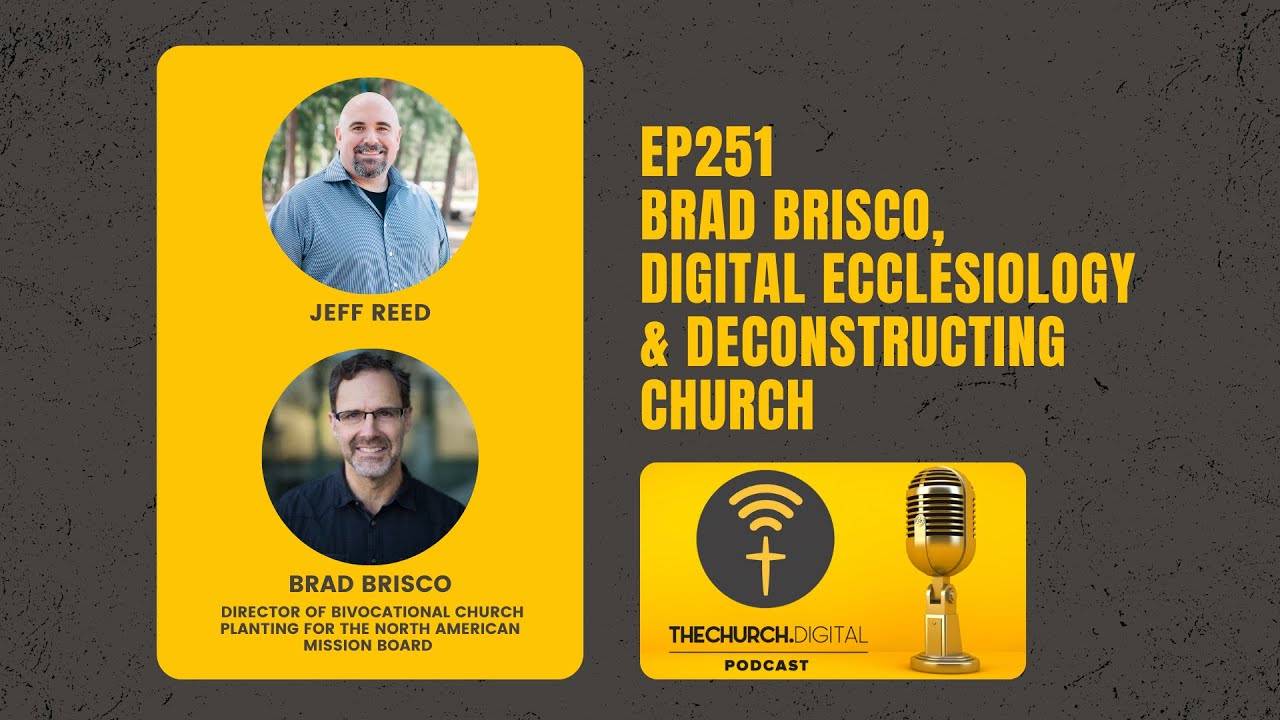
Can we deconstruct the church and not God? Can we challenge the bride of Christ in America without questioning our faith? This is a quandary I live in. This is just one of the questions we dug into in the podcast. As we explore digital ministry and digital church, we are…
Sometimes people just freak out when they hear deconstruction and they think that absolutely you're deconstructing your faith and that's not the case. I think in maybe not the vast majority of conversations but I'd say at least half the conversations I have with people that are going through some sort of deconstruction they're deconstructing the form and function of the church. They're not deconstructing their faith.
Welcome to the Church Digital podcast. Through this podcast we'll talk about the technological innovations within the church, but more than tech itself, we'll address deeper questions. Is disciple making possible digitally? How should we approach the digital mission field? Can a biblically grounded church operate in digital space? And where does the metaverse fit into all this? Whether you're a big or small church, an established church or a startup church plant, the Church Digital's goal is to help churches like yours learn to be a multiplying church digitally and physically. Our heart is that churches like yours will discover a newfound focus on disciple making that will revolutionize your church.
And now here's your host, Jeff Reed.
Hey everybody, welcome to the Church Digital podcast. Jeff Reed here, founder of the Church Digital, co-founder Digital Church Network. And I have been wanting to have this conversation, do this podcast for maybe close to a year. I met this guest close to a year ago. He probably doesn't even remember meeting me, but it was a great time. We were hanging out at Exponential Ventures. I want to say that was probably the Houston or San Antonio one, and I had the honor of being on a panel or something and sitting next to Brad Briscoe for a couple days. And I just was like, man, I really like the way that this guy talks and thinks. I really want to talk to him and dig more. And just the event was so hectic and I didn't get a chance to follow up with him. And then I followed him on Twitter. And by the way, if you're looking for like the on—and I told Brad this just a fair warning—it's like Brad, you're like one of my favorite Twitter follows. Like I would put you in the top pot, maybe top three, towards that, just because there's so much wisdom. You know, these pearls that get dropped talking about church in this new season and bifocational and a lot of this we're gonna get into the podcast. And every time I see someone some of these come up, like I make a mental note: I gotta follow up, I gotta DM Brad, I gotta get back with Brad. And you know, it never actually happened till now. And so we're finally actually having the conversation.
So Brad Briscoe, director of bifocational church planting for North American Mission Board, thanks for jumping on the podcast.
Well, Jeff, thanks for being consistent and getting a connection. And actually it was in Austin. I know you went to a whole bunch of those meetings, but I think the one that we were at together was in Austin.
You are right. It was at—it was very cool. Yeah, that was totally my fault. That was what church were we at? That's a conversation for another day. I don't remember. But yeah, that was a good time. So yeah, and I'm looking forward to this totally and completely. Thank you so much for jumping on here, Brad.
Now right off the bat, I want to totally get into bifocational and I want to get into deconstructing church because that's been a lot of some of our conversations on Twitter. But I just want to call something out here because this is interesting. People who are active in digital ministry, digital church planting, know that North American Mission Board, Southern Baptist Convention, they're not always supportive of the digital ministry stuff. You know, I could probably tell some stories that would actually shed not good light on them not being too excited about the idea of digital ministry and in some of this really just trying to get back to the physical building. Are you just thinking so far out of the box with your bifocational stuff that that supplements or goes beyond like what's your feedback or thoughts? Or what have you been reading even as you've been looking at the scenario? What is digital ministry, digital discipleship? What is that doing to churches in digital space? What does that mean to you?
Well, I think I say all the time we are all living in a rapidly increasing missionary context. So we absolutely have to think outside the box. And I think sometimes if we've had some quote unquote success in the way we've planted churches historically, it's just we're not forced to think outside the box. And I think sometimes that could be the case with the Southern Baptist Convention. We've planted churches for a long time. We've been very successful at it. But I do think the context is radically, radically different than it used to be, both inside the church and outside the church. So we have to think completely different. And I just think though there are some networks and some denominations that haven't been forced to do that yet. And I think the digital space is one of those that, you know, we said before we got on air that I'm not surprised that you haven't found a lot of reception within kind of the SBC culture. But it's unfortunate because it's here. You know, it's just like with bifocational. I say all the time that bifocational church planting, I'm convinced, is the single missiological and financial strategy for planting a church. But we haven't, in most networks or denominations, we haven't been forced to go there yet. But I would argue we're there. It's not just the future of church planting. It's the present. So I just think sometimes, you know, creativity and innovation—until we're forced to go there, we don't go there often, unfortunately.
Yeah, that's interesting. You know, some of us, the larger an organization gets, the more unwieldy it is and exploring different things and shaking the boat. And so that's interesting. I've known, you know, like I've worked with SBC churches and so it's not always, you know, everyone has that idea. But definitely options to explore why.
Well, hey, let's do this. Let's just go ahead and dig in because I'm really excited about this first question. So like, it was funny. I was sitting at Thanksgiving. I'll set it up this way. I had just published the book—I'll even hold it up for the YouTube audience—VR in the Vestibules of the Church, had just had this published through Leadership Network. And so I'm sitting at Thanksgiving table with my in-laws telling them about this, this book. And so some of them are kind of looking at me side-eye, kind of like not really sure about this whole virtual reality thing. And I said, you know what, I said to be honest, like the spirituality, like the Jesus stuff, like I'm not deconstructing Christ. I'm deconstructing the church. I'm deconstructing what that opportunity looks like. Thinking, oh, this is the solid answer. This is perfect. This is going to appease everyone. It didn't. It actually started a hailstorm. Hellfire and brimstone falling from the sky. The earth split open. And actually like there was a war at the idea of deconstructing church.
Now I know from following you on Twitter like there, the idea of deconstructing church, isn't—I would say I don't look, maybe I'm reading into you, but I don't think you think that's a bad thing. Talk to me a little bit here. I would love your take. Deconstructing church, deconstructing Christ, deconstructing God. Like what are the perils? What's too far? What are the opportunities that we have as you're doing bifocational ministry and beyond? Like what is this idea of deconstructing Christ via or church via deconstructing Christ?
Well, that's a lot there. I mean, you know that already, Jeff. But I think it's important to recognize, you know, we hear the language of deconstruction or deconstructing thrown around all the time and people always see it as a bad thing. And I don't necessarily see it as a bad thing, especially if it's deconstructing the practices, the form and function of church rather than deconstructing faith. Because there's a lot of issues as it relates to deconstructing a person's faith that if they're not reconstructing, that can be a very problematic thing.
But I'll admit, even where I am and the way I understand bifocational church planting, it all started, you know, a decade ago, probably more like fifteen years ago, with me in a sense deconstructing my understanding of the practices of church. It was so I would say it was almost like a missiological deconstruction that I started to recognize that way we were so Sunday-centric and the way we were so focused on Sunday morning worship services. That I needed to kind of deconstruct that and understand so that's influenced the way I think about church planting. You know, there's a little phrase I use all the time. I'll say we need to help church planters think less like a pastor starting a Sunday morning worship service and more like a missionary engaging a context. So we have to start with missionary behaviors and activities and get to the Sunday morning worship service. So for me there was deconstructing that had to take place there. I had to see that the Sunday gathering isn't church. You know, it's not a building where certain things happen.
So I think it's helpful because sometimes people just freak out when they hear deconstruction and they think that absolutely you're deconstructing your faith and that's not the case. I think in maybe not the vast majority of conversations but I'd say at least half the conversations I have with people that are going through some sort of deconstruction, they're deconstructing the form and function of the church. They're not deconstructing their faith. And in some cases they're actually walking closer—this is going to sound crazy—but they're actually walking closer to Jesus as they're deconstructing some of the activities of church. So it's actually a personal journey for them. And where it's a serious thing, it's not just some crazy craze, but they're actually on an honest journey of growth as they're recognizing, you know what, what's at the core of their faith and how much of that is church-centric and how much is actually Jesus-centric. So I think if that's the kind of deconstruction we're talking about, I think it's actually a very healthy thing.
Yeah, so if we're deconstructing the activities, you know, reimagining what that is, you know, when I talk about digital church we talk about how we're reimagining what the Bible calls the church to be. We're remapping Acts 2:36 to 47, Acts 8, Acts 16. We're remapping that on digital functions. Like how do these platforms operate? What are how can we do this? What does this look like? But if we're holding true to the biblical context then you know what I'm hearing from you is reimagining, reinterpreting—some say reinterpreting maybe the bad word—reimagining what it could be but grounded with that biblical ecclesiology. Like that's the right step for us to reimagine this stuff.
Yeah, and you know something, and it's funny you mentioned Twitter. It just reminded me the last couple of days, a couple of things I've just been sharing on Twitter in light of some things that I've been reading and rereading is I think one of the issues we have in North American culture, church context or church culture, one of the greatest problems is reductionism. And you know, and I tweeted and said we like to make great things small.
I think there's lots of different areas of church that we've reduced it down to like the bare minimum and I think it's really this is something I tweeted just this morning. I think we have to be reminded that both the historic and global church is and was amazingly diverse and vast and beautiful.
So when we do that, when we start to recognize just the diversity of church around the world and throughout history, we ought to just kind of lighten up a little bit in a way we personally define church. And I think just as you've been talking about with the digital space, it ought to create that space. I mean, it ought to create at least in our minds or crack open our imagination to say, well, wait a minute, maybe church is more than the hour we spend on Sunday morning in this building. And of course we know that it's way more than that, but I just think one practical step is just to be reminded of just the diversity around the world and throughout history.
Well, as we're looking at reimagining, as we're looking at deconstructing the church, you know, your interpretation and one of the things that you've worked with is this idea of bivocational and co-vocational ministry. Now it's interesting. I've had conversations with people and there's been some confusion and even I've heard so many different ideas about what bivocational is and what co-vocational is and the differences between those. So you know, I would love your take on that. Like, what's the difference between bivocational and co-vocational ministry?
Yeah, so let me back up just a little bit to lay give a little bit of a kind of foundation for the way that I like to define those two words. A little bit of a nuance for me is that when I first moved into the role of North American commission board several years ago as director of bivocational church planning, I knew one of the things I wanted to do, at least within our context or within our network, is I wanted to help try to change what I would call the biased narrative that we have around bivocationalism.
And what I mean by biased narratives is if you ask people what comes to mind when you hear the word bivocational, or if you ask them what do you think comes to mind of people in the church when they hear the word bivocational, it's almost always negative. If it's like part-time, you know, they can't give their full attention, they split their time between this and that. I mean, it's just always negative. And I don't think that's good. I don't think it's helpful. I don't think it's biblical.
So I felt like one of the things, one of the ways we could begin to change that narrative is that we needed to first off talk about the amazing benefits of being bivocational. The missiological benefits, I think there are some amazing financial benefits of being bivocational, but the third thing is I felt like we needed to expand the language. So not necessarily change the language, but we needed to bring in some additional language to kind of crack open our imagination. So we started playing around with different words and a few years ago we landed on this word co-vocational.
So here's the reason why I think this is helpful and necessary. First off, go back to the word bivocational. I'll often say, have you ever heard the word bifurcate? So to bifurcate means to take one thing and divide it into two parts. And I think that's what we do, unfortunately, when we hear the word bivocational. We compartmentalize or we bifurcate mission over here with work, or ministry and work. So often I hear church leaders at our bivocational say, well, I do my job over here so I can do mission and ministry over here. And I don't think that's helpful. That's dualism. That's a sacred-secular divide there that says some work is more important than other works or some work is more sacred than other work.
So to overcome that, like I said, we started playing around with this word co-vocational. And think of that word for a minute. Think of co-vocational. So co comes from the Latin prefix com, c-o-m, which means to have in common. So think of words like co-labor, co-pilot, co-author. We're trying to align two things together.
So I still use both bivocational and co-vocational, but to get to your question, here's a little nuance for me. A bivocational pastor, or really most of the time I'm talking to church planters, so a bivocational church planter is someone who has a part-time job in the marketplace that they see as temporary. So their hope is that the church will grow to the point where they can leave their part-time job and focus full-time on the church plant.
Well, a co-vocational church planter, and this is where we're really expanding the language here, is a co-vocational church planter as someone that has a primary call in the marketplace that they never intend to leave. So in other words, they know that God has called them to be an architect or an engineer or a school teacher or a mechanic. And at the same time, they feel like God's called them to start something. So they have this full-time calling in the marketplace, but they feel like God's calling them to start something. And in the past, they felt like they had to choose. It's like, well, I've got to choose either this calling in the marketplace or being a pastor or a church planter. And I want to say to them, no, you don't have to choose. Let's figure out though how can you start something while you have a full-time gig in the marketplace?
And man, there are so many beautiful implications to this. I think generally with today's generation, you know, it's just normal to have more than one like side hustle or you know, so it's not unusual or out of place for someone to think that, oh yeah, I have two jobs or I have three jobs.
So then here's the last thing I'll say, and then however wherever you want to go with this, Jeff, is I hope that as we talk about the benefits of being bivocational, we'll actually have more and more bivocational church planters in a sense become co-vocational. And what I mean by that is even when the church grows large enough that they could leave their part-time job and focus full-time on the church, they stay because they just realize there's just too many missiological benefits and there's too many financial benefits for them to stay in the marketplace.
And again, I just think this is so important today more than ever before because we are living in an increasing missionary context and more and more people are less and less interested in the programs and activities of the church. So we have to go where people are. And I think one of the best places to go is in the marketplace.
So I hope that's helpful, just a little nuance between bivocational and co-vocational. Like I said, I still think, you know, one's not better than the other, but I just think we have tens of thousands of people sitting in our churches throughout North America that didn't know it was an option. They felt like if God called them in the marketplace, they couldn't start something. And I want to say, no, you can. You can do both. But we have to think about it differently.
You know, I spent years in the early 2000s, early mid-2000s, angry at God because I was not employed at a church. Like, for me, in coming out of college, my twenties, you know, I felt like God was leading me to do ministry, and in my mind I had reconciled that to mean that I was working on a church staff. And it's interesting to me, you know, I've had Ray, Ray, uh, Ray D'Armus, he used to be the co-host of this podcast with me here. He was a digital pastor, stepped out of ministry, actually went back to school to work on a medical technician's degree, a medical assistant. I don't know what the actual title was, but like, he's engaging completely in the secular workplace. And he tells me things. He's like, Jeff, I talked to ten times more lost people daily than I would really connect with while working at a church monthly, right? Like, the exposure to actual ministry.
An assistant, she used to work for me when I was working at a church in Austin, and she told me she quit her job after about four months. She's like, this is not what I thought working for a church would actually be. I was like, what'd you think? And she was describing, you know, all the ministry and living missionally and engaging and having conversations and witnessing. And I was like, unfortunately, as the assistant to the creative department, that's not the life that you're going to live nine to five. But if that's what you really want, you need to go do that and not work here anymore. And she quit her job to go do that.
And so it's interesting to me how now, you know, there's a re-emergence of this bivocational, of this co-vocational doing ministry with the job, engaging. You know, even to your point, I don't, I, my church can afford to pay me, but there's a ministry opportunity working in this job outside the church. I should go there and instead of taking it easy, taking that church check. Um, like, do you see this active? And you know, and I know you work mostly with planters. Do people outside the established church, the planting church, like physical churches, established churches, generational churches, like do they think this way? Or is there a struggle for them to maybe recognize some of this opportunity?
Yeah, so again, that's an enormous question with lots of different facets to it. First off, I would say we need to recognize or just be reminded of that this isn't anything new for most the church around the world. And in almost every diverse culture or ethnic diverse culture, it's always been bivocational or co-vocational. I mean, you know, with the African-American community, Hispanic community, so many different communities, it's all, you know, they've always started churches and pastored churches as bivocational, co-vocational, or jokingly sometimes they'll say try-vocational leaders.
Primarily, this resurgence of this co-vocational language, the reality is it's primarily within suburban American, I would say church growth movement influenced churches where we felt like the pastor had to be fully funded, had to be professionalized. We really professionalized ministries. So there's that whole thing. We have to recognize that around the world it's almost always been bivocational, and we need to learn from them.
But then to go back to your original question about the existing church, what I've seen in the midst of COVID is there's a huge number of leaders that were forced to be bivocational. And they kind of went into a, you know, hollering, screaming and hollering that they didn't want to do it. It was out of necessity, not out of choice. But some of them have recognized once they went into being bivocational, they started to recognize the benefits.
I mean, I had the privilege to interview dozens and dozens and dozens of bivocational, co-vocational leaders, and I have these kind of the same eight questions I like to ask. And the very first question I always ask is, share with me two benefits that you've discovered of being bivocational or co-vocational. And this is no exaggeration, every single time, bar none, every single time, the very first benefit was always this missiological benefit of, you know, having access to a mission field they wouldn't have otherwise.
Now people use different language, but it's just what you said, Jeff. They just said, man, I've got so many relational connections that I never would have had before. These people would never come to our programs and activities of the church, but I'm getting to know them because I'm in the marketplace.
Of my job in the marketplace, you know, and I hope as we begin to like change this biased narrative, as more and more leaders have to become bivocational, they won't see it as a demotion, they won't see it as a downgrade, but they'll see the benefits of it. But then the other thing that I would say is I encourage leaders in existing churches all the time to go out and get a part-time job. And I'll say, look, I don't care if you don't need to, if you need the money or not, just one, at least one day a week, find some part-time thing you can do in the marketplace because it'll open up your eyes to the things that people really go through Monday through Friday. It'll give you great street cred or respectability inside the church because people in the church will know you'll begin to understand what they're going through. But it'll also give you great respectability or street cred outside the church. So when you start to meet people that have no church connection, instead of leading with, "Oh, I'm a pastor or I'm a church planter," you initially, at least, you can lead with what you do in the marketplace. So I think that's another missiological benefit.
So yeah, I do think, um, as this whole conversation, especially as I said earlier, kind of this American church growth mentality influence type of church, as this conversation about bivocational is becoming more commonplace, I do see leaders in existing churches begin to recognize the benefits, the missiological benefits, the financial benefits, and other benefits. I mean, they don't have to be dependent on the giving from the church. So I've even heard some leaders say it's actually giving them freedom in their voice, especially if it's a prophetic voice, to say they don't have to worry about, you know, like if they make somebody mad that's the big giver or there's just lots of little benefits there. I think that, um, it's just again, it's just a great, great way, I think, to think about leading the church in a missionary context.
Are you seeing, uh, like a person, especially on the planting side, have you seen an increase of this? You know, the economy's been rough. People are walking out of the church ministry in digital space. I've seen a lot of people leave established churches to start to plant their own digital churches and take a bivocational approach because digitally, the monies, the digital churches typically don't have the funding vehicles that some of the established are. And so like I see 75, 85 percent of the churches we're planting in digital space are bivocational or not even really funded well from like parent organizations and denominations. Have you seen a trend in recent months towards more bivocational planting?
Well, um, yeah, I don't have stats for this in the last couple of years, but at least anecdotally, absolutely. I mean, I have more and more conversations than ever before with uh church leaders and church planters that they are, they're almost all bivocational. And some cases, like you said, digital space, sometimes it's just that they're doing more of a neighborhood, uh, kind of smaller expression of church, microchurch, missional community, whatever language. But the other thing that I'll say, and I think this is helpful, as I'll say, when you think of bivocational, don't think model, but think strategy. That, and I know I've said this several times already, but I think it is a missiological and financial strategy. It's not a model. And what I mean by that is a lot of times when people hear bivocational planting or co-vocational planting, they think of house church or microchurch. And yes, it can be that, but it doesn't have to be that. I know churches that are very large, I mean hundreds of people, and all the staff are bivocational. It's because the very first church planter is bivocational or co-vocational. And as the church grew, where he couldn't have left his part-time job and focused full-time in the church, he didn't. Or they didn't. Instead, they hired other bivocational leaders. So like all eight or ten or twelve staff are all bivocational.
So but yes, I think it's without a doubt there's more and more. Part of it's COVID, part of it's the economy, and part of it's just people are wanting to have more incarnational, smaller expressions like, you know, planted in their neighborhood. Rather, there was a time where, again, kind of the church growth mentality, it was about, you know, starting a launch large regional type of church. And I just think there's a movement towards smaller expressions.
I've, uh, you know, I've seen you on Twitter talk about, you know, I think I think you've used the phrase "deprofessionalize ministry." You know, I know we had Leonard Sweet on here maybe a month ago, and I asked him a question on bivocational, and he reacted, um, I don't want to say it was aggressively, but he reacted with more energy towards that question than any other question. I talked about, you know, really towards Jeff. We shouldn't use the language "bivocational." When he said, I was like, "Wait, you're against bivocational?" He's like, "No, no, no, we're all bivocal. Like, everyone is bivocal. There shouldn't even be," he used, it was so interesting. He said, um, "It's going to become increasingly difficult for pastors to make money off of the church." Um, and that opened up, you know, just a series of questions we weren't able to get into. But what a profound thought, kind of moving forward, which really speaks to this idea of deprofessionalized, maybe you want to speak to that a little bit. Some of the challenges we will be facing, some of the opportunities to move away from that mindset towards a bivocational approach.
Well, we mentioned earlier I use the phrase "sacred-secular divide," that I think we need to diminish or blow up the sacred-secular divide as relates to vocation. But the second thing that we need to blow up is the clergy-laity divide. So yes, I think that the chasm that we've created throughout church history, especially, you know, Constantine and Constantinian model of church, that we created this huge chasm between the clergy and the laity. And it's funny, laity, the Greek word actually means "people of God." So I think we do, we need to diminish that. So sometimes when I say "deprofessionalize," that's all I mean is that we need to diminish that divide between clergy and laity.
And it's funny that reminds me of a kind of a famous saying, if I can remember it right. Uh, Lesslie Newbigin, he was accused of trying to eliminate the clergy. And there's this great quote he says, "Oh no, I'm not trying to eliminate the clergy. I'm trying to eliminate the laity." So I just think, I think that's beautiful. Yeah, like it's like, and I think maybe that's what Lynn Sweet was trying to get at is that, no, when we talk about diminishing the chasm between clergy and laity, let's raise up the laity. I mean, like, when if we really believe in the priesthood of all believers, then we want to equip and activate and empower all the people of God. And it's a phrase I say all the time too. I'll say, like, if I'm writing it, I'll say "all" and I'll put, you know, the word "all," A-L-L, and all caps, and say we need to activate ALL the people of God, not just with paid professionals, but everybody.
Um, and I think it's great. I think this comes from underground church. I think you've interviewed Ryan Sanders before. But in his book "Underground Church," I remember he's got a sentence there that I love. He says, "No strategy will ever reach every kind of people except the strategy that mobilizes every kind of people." So it's again, it speaks to the priesthood of all believers, that we have to activate all the people of God if we're really going to engage in God's mission.
Okay, so so help me with this. Let me pull the thread. Um, you know, the church that I, the church that I most recently worked for, um, when I resigned in 2018, the senior pastor literally had three different doctorates and would, um, would spend, uh, I don't know, 30, 35 hours a week crafting his one-hour sermon. Um, and so very well educated, very well resourced of time. And now we're describing not exposure towards that mentality, but more of a bivocational where I've got another job nine to five. So I'm not crafting this eloquent message. I don't have massive seminary degrees. Or maybe, maybe I do. Like, how do we even educate a bivocational, a co-vocational movement? Is do we hold them to the same standards? What does this look like?
Yeah, that's a great question too. Well, there's a couple things. First off, I think we need to have this conversation very early on within the church. So absolutely, we need to be having this conversation in the collegiate ministries. But I would say we need to even be having this in the conversation like youth ministries of the church is helping, helping young people understand that if they feel like God's called them to be an engineer, they should go be the best engineer they possibly can for the glory of God. And at the same time, help them think about starting something. So we need to help them know early on they don't have to decide between mission and work or vocation. That there ought to be an alignment there. So I think that's a huge thing.
Secondly is ultimately this whole co-vocational discussion or conversation is going to change the way we think about theological education. So I think first off, well, there's two parts of that. I think the content of our theological education and the delivery of the theological education is going to change. What I mean by the especially the delivery is I think ultimately, and I know this is a big thing, you know, this isn't going to happen overnight, but I think everyone would agree that the best place for theological education to take place is in the local church. And I think that's a movement that's going to take a long time, but we need to move towards that where theological education is taking place in the church so we can be raising up more and more leaders to start things. I mean, it's just crazy. And I have two seminary degrees, so I'm not anti-theological education, that's for sure. But it just doesn't make any sense to uproot somebody from the place where they live and go somewhere else for three or four or five years to earn a degree that today there's no way they're going to go get a job in a church to pay for the debt, you know, I mean, not. It just doesn't make sense.
All of that. So I think, um, the delivery of our theological education is going to change. And I am grateful right now that all the seminaries across the country have, you know, a hundred percent online degree. So I think that's really helpful. But I think even the content is that, you know, I think it's unfortunate there's very few seminaries that teach a theology of work. Uh, there's very few seminaries or colleges or universities that help, uh, someone that wants to be engaged in mission and ministry think about a trade or, you know, some other skill that they could access. Um, because I think right now we're kind of in an in-between time where there are lots of leaders in a church, you know, they'll say, "Hey, I'm open to being bivocational, but I have no other skill. Like, there's nowhere for me to go." And that's got to change. So I think we're kind of in this in-between time that if we have this conversation earlier on, as I mentioned, then we're going to have more and more leaders that have a calling in the marketplace and they can start something.
So, um, man, there's just a huge, I mean, theological education there is an enormous conversation around all of this. And then I think the other thing too, Jeff, go back to your comment about you...
Know someone spending 30 or 40 hours a week, you know, on an hour message. I think anyone that's involved in church planting understands you need to plant with a team. But if you're bivocational or co-vocational, there is absolutely no other option. I mean, you have to do this with a team.
And I'm a big proponent of APEST—Ephesians 4—and I know you're familiar with Apostle, Prophet, Evangelist, Shepherd, Teacher. I think that's a really helpful way to think about a church planting team is to create a team around gifting. It's not just ministry categories, but around giftings. And if we do that, then we can plant churches bivocational or co-vocationally much easier because then we don't have to do it all. We just focus on the lane where we're gifted. If that makes sense.
Totally and completely. It's funny, just yesterday I was talking to a digital church planter in Nigeria. He's starting out, and you know, challenged him to build that team around him. And it was funny—he literally said, "Jeff, I'm confused. Am I supposed to start by evangelizing and recruiting my team off of people that are coming to Christ, or am I supposed to go to my friends and recruit from my friends and then challenge them to step into ministry?"
And you know, basically I said to him, "Well, if you can't convince your friends to follow you into ministry, then I don't think you're going to be able to convince strangers to follow you into ministry." And he's like, "Oh, that's good."
But APEST is such a great model toward that. And so, you know, love digging into that and even trying to figure out, you know, some of the stuff with Digital Church Network—we're trying to figure out what APEST looks like even in virtual reality, what APEST looks like in digital, what APEST looks like. I had a conversation with Mark Lutz with some stuff we're doing with the podcast, but what does APEST look like in the gaming community? Well, you're going to do APEST in gaming? Yeah, let's figure it out. Mark's fourfold, more fivefold—we'll fight about it at some point and come to a conclusion, I'm sure.
So let me ask—um, where do I want to go? So many options. So we're talking a lot about education, and I think that's good. It's interesting. I've been—I think that's good. That's a weird kind of statement.
Yeah, I think education is a good thing. I think that's hopefully nobody like pulls that out as a sound bite. Um, here's the deal: like, I'll talk about priesthood of all believers, and I'll have churches reply to me, "Hey, Jeff, I don't know why you're making such a big deal about priesthood of all believers. We've been doing this for decades." And then I'll talk to churches about priesthood of all believers, and I'll get, "It's got to be done by a certain person in a certain way in a certain process." You know, and I'm not going to call attention that some of those more aggressive against priesthood happen to be Southern Baptist churches. Set that aside—we can nuance that later. But maybe for you, for me, um, what's the biblical grounding in priesthood of all believers? You know, you've got APEST as a thing, and you've got the tribes. We can get into it. I'm not looking for like the full thesis here, but if I'm trying to help a church or leader or a pastor understand the opportunities of priesthood, what's the biblical foundation that I should be building on?
Well, yeah, that's a great question. Well, I do think—and we've already talked about this, so we don't need to go there—I do think APEST is a big piece there because those five gifts in Ephesians 4 are giftings. Unfortunately, historically we've interpreted them as offices or roles, and we've interpreted that text as a leadership text—like, those are gifts given to a leader so they can equip the work, the saints for the work of ministry. And it's not a leadership text. It's a body text. So I think that's a really good place to start: to say those gifts are given to the body, so we, the saints of the body, the body of Jesus, so we can equip the saints for the work of ministry. So I think that's a huge piece.
I think also, I mean, if someone really wanted to go down like the rabbit hole of the whole priesthood of the Old Testament, you know, First Peter chapter two, when Peter says we're a chosen generation, royal priesthood, holy nation, special people—you know, that's us. So there was a movement in the New Testament, I would argue, from priests to saints. And then I think also, anyone that's really interested in digging into this is to go back to Luther's writing, the Protestant Reformation. And you know, I mean, for Luther, the Protestant Reformation was really about justification by faith, of course. And the priesthood of all believers is that all of us had access to the Father. But and because now Jesus is the high priest, right? But Luther also made a real distinction. The implication of we all have access to the Father is that now we are all priests or saints. And there was no distinction between religious and secular except for the sake of office or work. It was a little phrase that Luther used all the time. So he'd say that really we're, in a sense, we're all priests or bishops or popes. He said so.
I think, yeah, so I think APEST—understanding that those are gifts, not roles and offices—I think constantly thinking about how can we diminish this clergy-laity divide. I think how can you be thinking about, you know, the move from priests to saints. And I think moving to just the activation of everybody. And I don't know, and I think, Jeff, I haven't really processed this, but I do think when we make church about the Sunday morning worship service—and I'm not anti-gathering. I mean, we are a gathered worshiping community, so I'm not anti-gathering. But when throughout the church—well, I would say throughout kind of this Constantinian understanding of church and then you add to that church growth movement mentality from 50 years ago—we made church about the Sunday morning worship service. Well, when we did, we very much professionalized the activities around that Sunday gathering, which was primarily preaching and then worship leading, like any other programs or activities around the Sunday gathering. And we minimized everything that took place outside that Sunday gathering.
So I think when we think about activating all the people of God or the saints of God to engage in mission, we're talking about mission outside the walls of the church. I mean, we're talking about mission in the marketplace and in our neighborhoods and in social spaces. So I think that's where, um, as a church in North America again in an increasing missionary context, we just have to do a better job. We have to activate all the people of God to engage in God's mission outside the walls of the church. And that absolutely would include digital space. Um, and you don't have to have a four-year seminary degree or eight years of seminary degree to do that. Um, that wasn't the case in the early church, and it absolutely isn't the case in the predominant church around the global world. I mean, it's just churches are not led by professional clergy um around the world primarily.
Well, let me ask, because you know, as we're wrapping up here, um, there's you know, you've got a lot of people, or at least I have a lot of people that are now having to think bivocational when they've never thought that way. You know, even I, as I've started Digital Church Network, which I consider a bivocational ministry—like, no, we're not. I'm not making a living off it. And so, you know, having to recruit leaders and guys, we're not having a ton of money coming in, and I'm not going to charge a bunch of money for people that are living bivocational lives. Like, we need to figure out how to do this without money being the activity for it. And so at least in my own life, I have a bunch of people that are living five—occasionally that are that aren't used to it. What are some resources? What are some knowledge, books, blogs, podcasts, people, you know, like you, that that are helping kind of cast vision, direction toward understanding the bivocational model more? Do you have any examples or people we can connect with?
Yeah, so give you a couple examples or a couple ideas. One, and it's easy for me to promote this because it's free, but I wrote a book a couple years ago called "Co-Vocational Church Planting," and it's actually a free digital download now. You can buy a hard copy on Amazon, but if you just Google "co-vocational church planting," it'll take you to a website where you can download it in both English and Spanish for free. Also, there is, um, oh, and then another—I tell you a book that just came out a couple months ago, and I just think he's done an absolutely fantastic job with it. It's called "The Future is Bivocational," and it's by Andrew Hamilton. And I just think Andrew, man, he just done a fantastic job with the book. So that would be another thing I would recommend.
Also, um, there is a ministry that was created just a few months ago. I'm gonna find it here for you real quick. Eric Hoke—H-O-K-E—he started a fantastic ministry called "I Help Pastors Get Jobs." So again, I think if you just Googled "I help pastors get jobs," Eric has done an incredible job of putting together just a whole slew of services and resources to help pastors move into that bivocational and co-vocational space. Super helpful. Um, interesting. Yeah, and then, uh, Golas, um, and if I could find—there's also maybe Chris Golas has a website, and I would follow. Oh, his website is tentmakingpastors.com. Very similar to some of the stuff that Eric is doing, although they're doing different things that Eric is doing. Also provides some great resources to help pastors.
Um, because like you said, Eric, I mean, the difficult thing here—we already alluded to this a little bit—um, is I think this is going to change over time because we're going to have a younger generation that they don't see it as odd as having a side hustle or, you know, a side gig. But uh, we have leaders now, more of the really Boomers and maybe even some builders, that uh, you know, just had one job their whole life. And you know, they went to Bible college, they went to seminary, they've been in a church this whole time. And now when they think about being bivocational, it's very difficult because they just have a hard time thinking about, "I don't have any other skills." But I do think there's some helpful things there.
One conversation I'll lead people into sometimes is I'll say, "Think about time, money, and relational capital." Well, here's what I mean by that: when you think about a job, especially as a church planter, but when you think about a job, think about those three different arenas. Like, is this job—can you work this job in a short period of time? Like, could you do this job in two days or three days so it can free you up for more time to focus on the church? Or could you do this job and make a lot of money in a shorter period of time? Or does this job give you like great relational capital?
So kind of like jokingly, I'll say, if you're working in an office and let's say you're working in a cubicle all by yourself from nine to five, that's probably not a very good job to have if you're a church planter. If you're working, you know, nine to five Monday through Friday, it's just you. But if you can do that job in three days to where you're off Thursday and Friday, maybe it's not bad. Or let's say...
Say if you're working in a service industry and you're not making a lot of money but you're meeting 300 people a day, that might be a really good job to have as a, you know, as a church planter. So I just think when you think about jobs, rarely are we going to find one where you make a lot of money in a short period of time and you meet lots of people. But you know, kind of balance those three things. But and then also, like I said, if you look at one of those other ministries, both from Eric or from Chris, they've got just some great blog posts and resources that can help help leaders in existing churches move more into that vivo space.
Very cool. We'll put a bunch of, we'll put all those links in the show notes and we'll find them in the background. But it's taking meticulous notes in the background during it. But uh, hey Brad, thanks for jumping on the podcast. Love having this conversation.
Thank you, Jeff. Yeah, we will. We'll put uh, even Brad, follow him on Twitter and and other uh information on on the show notes as well. So but as we're landing the plane here, Brad, any closing thoughts?
Um, no. I would just say if if you are a bivocational leader, the existing church, church planter, don't hesitate to tell your story. Um, because people need to hear it. They need to hear how are you making this work as a bivocational leader? And then I would say if you're not a bivocational leader but you know someone that is, please tell their story and tell their story to be an encouragement to them. But also tell their story in the hopes that it would crack open the imagination of other people. Because I tell you, there are again thousands of people sitting in our pews and they don't know that they could be a school teacher and a church planter at the same time. They just think it's got to be one or the other, and I'm just convinced it doesn't have to be.
Very cool. So uh, listen, I'm excited about the idea of bivocational ministry and the opportunities that are there. And uh, so much of what I think the future is going to look like for the church is grounded in this idea of the priesthood of all believers. And so if you're if you're a church plant, you're definitely exploring that space. If you're a physical church, um, you need to be exploring that space. So much of future ministry uh is going to be much more possible when we release them, we mobilize them. Even going back to the uh Tampa Underground quote from Brian, Brian Sanders, that you can't, it's more about about releasing those people to to reach the different contexts that are out there. And so that was so good. But hey, we're gonna land the plane. So so Brad, thanks for jumping on this podcast. For Brad, this is Jeff with the Church Digital and Digital Church Network. Thanks for jumping on on the pod here. We'll see you next time on the show. You all have a good day.